
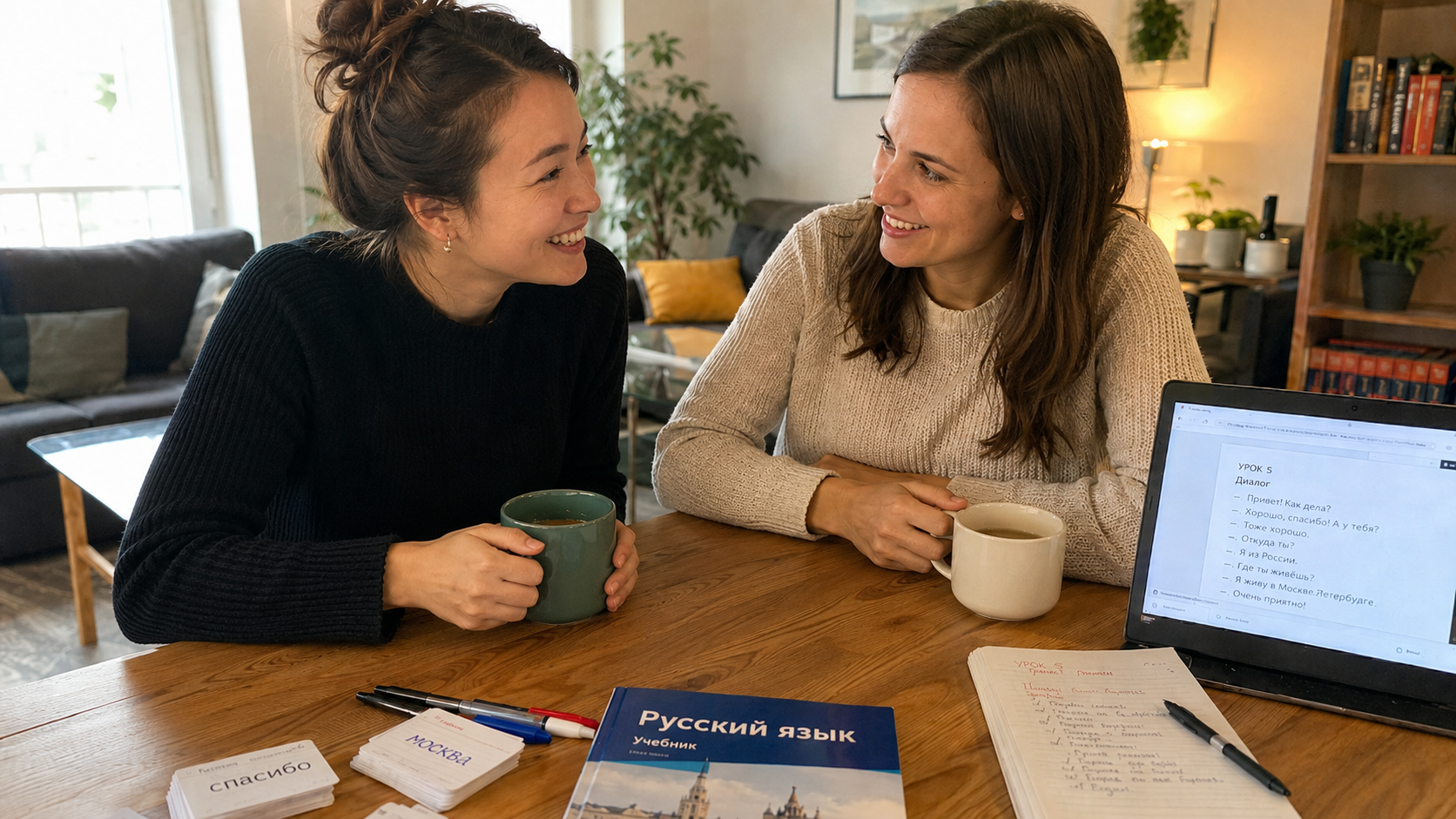
If you have ever opened a Russian textbook, looked at a sentence full of unfamiliar Cyrillic letters, long words, mysterious endings, and sounds that do not seem to exist in English, and immediately wondered whether learning Russian is something only diplomats, linguists, heritage speakers, or unusually gifted people can realistically do, you are asking one of the most common and understandable questions adult learners have: is Russian hard to learn?
The honest answer is yes—but not in the way many people imagine.
Russian is not hard because it is random. It is not hard because it has no logic. It is not hard because adults cannot learn it. Russian is hard because it is different. It asks English speakers to pay attention to things English often ignores: word endings, grammatical case, verb aspect, word stress, motion, formality, and sentence structure. It uses a different alphabet. Its vocabulary is less familiar than Spanish, French, or Italian. Its grammar gives words more flexibility, but that flexibility comes from endings that learners have to understand and practice.
So yes, Russian is challenging.
But it is also systematic, beautiful, expressive, and absolutely learnable.
The problem is that many beginners approach Russian with either too much fear or too much fantasy. One person says, “Russian is impossible.” Another says, “You can become fluent in three months.” Neither is helpful. Russian is not impossible, but it is not instant. It requires time, repetition, structure, listening, speaking, and patience. The good news is that the difficulty can be broken down. Once you understand what makes Russian hard, what is actually easier than expected, and how long each stage usually takes, the language becomes much less intimidating.
For adult learners, this matters. Adults are often busy. They have jobs, families, businesses, responsibilities, and limited time. They do not want vague encouragement. They want the truth. How many hours does Russian take? When can you start speaking? Is the alphabet the hardest part? How long before Russian feels conversational? Can you learn Russian with one class per week? Is it worth starting if you are not young anymore?
This article gives the honest answer.
Russian is hard enough to deserve respect, but not so hard that you should avoid it. With the right expectations and a good learning plan, you can make real progress. You can learn to read Cyrillic. You can introduce yourself. You can understand basic conversations. You can travel with Russian. You can reach conversational Russian. And if you stay with it long enough, you can access Russian literature, film, history, humor, and culture in a completely different way.
Let’s look at what really makes Russian difficult—and why it is still worth learning.
Is Russian Hard to Learn for English Speakers?
Yes, Russian is generally considered difficult for English speakers. It is harder than many Western European languages because it belongs to a different language family, uses a different alphabet, and has a grammar system that does not work like English.
For English speakers, languages like Spanish, French, Italian, Dutch, and Portuguese feel more familiar. They use the Latin alphabet. They share many words with English. They have sentence patterns that are easier to recognize. Even when their grammar is challenging, the learner usually has more familiar material to hold onto.
Russian gives you fewer of those comforts.
The alphabet looks unfamiliar at first. Many common words do not resemble English words. Nouns and adjectives change endings. Verbs behave differently. Word order is more flexible. Stress can move. Pronunciation requires attention. And Russian grammar demands a level of precision that English speakers may not be used to.
But difficulty does not mean impossibility.
Russian is a highly structured language. Once you begin to understand the structure, many things start to make sense. Cases are difficult, but they are not random. Verb aspect is subtle, but it follows patterns. Cyrillic looks intimidating, but it is learnable. Russian pronunciation is different, but not unmanageable. The language becomes easier when you stop expecting it to behave like English.
That is the real turning point for learners: Russian feels hardest when you try to force English logic onto it. It becomes much more manageable when you accept Russian on its own terms.
Why Russian Has Such a Difficult Reputation
Russian has a difficult reputation for several reasons.
First, the Cyrillic alphabet creates an immediate visual barrier. Before you understand a single word, the page itself looks foreign. This can make Russian feel harder than it really is. Many beginners assume that if the alphabet looks difficult, everything else must be impossible.
Second, Russian grammar is visible. In English, much of the grammar is hidden in word order and helper words. In Russian, grammar appears directly on the words themselves. Endings change constantly. A noun may look different depending on whether it is the subject, object, possession, location, direction, or instrument of an action.
Third, Russian has six cases. This is one of the biggest challenges for English speakers. Cases affect nouns, adjectives, pronouns, and numbers. They are central to the language, not a decorative extra.
Fourth, Russian verbs have aspect. This means many verbs come in pairs, usually one imperfective and one perfective. Learners must understand not only what action is happening, but whether the action is ongoing, repeated, completed, attempted, or viewed as a whole.
Fifth, Russian has verbs of motion, which are famously difficult. English uses “go” in many situations. Russian has different verbs depending on whether someone is going by foot, by transport, in one direction, regularly, there and back, carrying something, bringing something, and so on.
Finally, Russian listening comprehension can be challenging. Native speech is fast. Word stress is not always predictable. Unstressed vowels reduce. Sounds blend. Even when learners know a word on paper, they may not recognize it immediately in speech.
All of this is real. But none of it means Russian cannot be learned. It means Russian needs a structured approach.
How Hard Is Russian Compared to Spanish, French, or Italian?
For most English speakers, Russian is harder than Spanish, French, or Italian.
Spanish, French, and Italian share thousands of cognates with English. Words like information, important, family, music, university, problem, restaurant, culture, and language often have recognizable relatives. Even when pronunciation changes, the words feel familiar.
Russian has some international vocabulary too, especially in areas like science, technology, politics, and culture. But everyday Russian vocabulary is much less transparent. Words like дом, вода, хорошо, сегодня, говорить, понимать, and человек do not immediately help an English speaker.
The grammar is also more different. Spanish and French have verb conjugations and gender, but they do not have Russian-style case endings. Italian has beautiful but manageable pronunciation. Spanish spelling is highly regular. French pronunciation is difficult, but the alphabet is familiar.
Russian asks the learner to build more from scratch.
That is why Russian often takes longer. It is not because Russian learners are less capable. It is because the distance between English and Russian is greater.
Still, Russian has some advantages. It has no articles like “a” or “the.” It has no equivalent of “the table” versus “a table.” It does not require the same kind of article memorization that frustrates learners of French, Spanish, German, or Italian. Russian pronunciation is often more phonetic than English once you learn the system. And Russian word order, while complex, can be flexible because endings carry meaning.
So Russian is harder overall, but not every part of Russian is harder.
How Many Hours Does It Take to Learn Russian?
A common estimate is that Russian takes around 1,100 classroom hours for English speakers to reach a professional working level. That does not mean you need 1,100 hours before you can speak. It means that high-level Russian takes sustained study.
A more practical breakdown looks like this:
LevelApproximate HoursWhat You Can DoA1100–150 hoursRead Cyrillic, introduce yourself, use basic phrasesA2300–400 cumulative hoursHandle simple everyday situationsB1400–600 cumulative hoursHave conversations on familiar topicsB2800–1,200 cumulative hoursUse Russian independently in many real situationsC11,000–1,200+ hoursUse Russian flexibly for complex topics
These numbers are approximate. Some learners move faster because they study daily, already know another Slavic language, have strong grammar skills, or get lots of speaking practice. Others move slower because they study irregularly or rely only on apps.
The important point is this: Russian progress is measurable. You do not have to wait years before seeing results. You can begin reading and speaking simple Russian in the first weeks. You can hold basic conversations after a few months of consistent work. You can become conversational in one to two years with serious study.
Russian Learning Timeline: What to Expect
After 1 Month
After one month, a motivated beginner can usually recognize and read Cyrillic, greet people, introduce themselves, say where they are from, count, and understand some basic classroom phrases.
You will not feel fluent. You may still read slowly. You may confuse letters. You may forget words. But Russian will no longer look completely mysterious.
After 3 Months
After three months of steady study, you may be able to form simple sentences, talk about yourself, ask basic questions, order something simple, understand slow beginner dialogues, and recognize common grammar patterns.
You may know some present-tense verbs, basic noun gender, personal pronouns, and simple case forms. You will still make many mistakes, but you will have a foundation.
After 6 Months
After six months, many learners reach late A1 or A2, depending on study intensity. You can handle more everyday topics: family, work, hobbies, food, travel, likes and dislikes, daily routines, and simple past events.
This is where Russian begins to feel more real. You are no longer only memorizing phrases. You are starting to build sentences.
After 1 Year
After one year of consistent study, a serious learner may be around A2 or approaching B1. You may be able to hold simple conversations, understand slow Russian on familiar topics, read short texts, and describe experiences.
You will still struggle with cases, aspect, and listening speed, but you will be able to communicate.
After 2 Years
After two years, many consistent learners can reach B1. This is the stage where Russian begins to feel conversational. You can talk about familiar topics, ask questions, tell stories, express opinions, and manage common travel or social situations.
You may still make grammatical mistakes, but communication becomes possible.
After 3+ Years
After three or more years, learners who continue seriously may reach B2 or beyond. At this level, you can engage with more authentic Russian: films, podcasts, news, literature, and longer conversations.
Advanced Russian takes time, but the rewards are enormous.
The Cyrillic Alphabet: Scary at First, But Not the Hardest Part
The Cyrillic alphabet is usually the first thing that frightens beginners. It looks like a wall. But in reality, Cyrillic is one of the most manageable parts of Russian.
Russian has 33 letters. Some are easy because they look and sound like English letters: А, К, М, О, Т. Some look familiar but sound different: В sounds like “v,” Н sounds like “n,” Р sounds like “r,” С sounds like “s,” and У sounds like “oo.” Others are completely new, such as Ж, Ц, Ч, Ш, Щ, Ы, Э, Ю, and Я.
At first, this feels strange. But with practice, most learners can learn the alphabet in a few weeks. Reading quickly takes longer, but basic decoding comes early.
The alphabet is not the real monster. It is the front gate. Once you pass through it, the real work begins: pronunciation, grammar, vocabulary, listening, and speaking.
Russian Pronunciation: What Makes It Difficult?
Russian pronunciation is not impossible, but it requires attention.
Some sounds are unfamiliar to English speakers. The sound ы is often difficult. Soft consonants can be challenging because English does not use softness in the same systematic way. The rolled р may take practice. Consonant clusters can feel heavy.
But the biggest pronunciation challenge is often stress. Russian word stress is not always predictable, and stress affects vowel pronunciation. An unstressed о often sounds more like а. This means that a word may not sound exactly the way a beginner expects from its spelling.
Listening is also difficult because native Russian can be fast and compressed. Words blend together. Endings may be hard to hear. Beginners often know a word in writing but fail to recognize it in speech.
The solution is early listening practice. Do not wait until you “know enough grammar” to listen. Start with slow, clear audio from the beginning. Repeat phrases aloud. Work with a teacher who can correct pronunciation before bad habits settle in.
Russian Grammar: The Real Challenge
Russian grammar is where many learners feel the real difficulty.
English relies heavily on word order. Russian relies more heavily on word endings. This means that Russian words change depending on their grammatical role.
For example, the word for “student” may appear in different forms depending on whether the student is doing something, someone sees the student, something belongs to the student, someone gives something to the student, someone is speaking with the student, or someone is talking about the student.
This is difficult for English speakers because English nouns barely change. Russian nouns change constantly.
Russian grammar includes:
Six cases
Three genders
Singular and plural forms
Noun endings
Adjective agreement
Pronoun changes
Verb conjugation
Past and future tense
Imperfective and perfective aspect
Verbs of motion
Flexible word order
Prepositions that require certain cases
This sounds like a lot because it is a lot. But you do not learn it all at once. A good Russian course introduces grammar gradually and repeatedly. You meet a pattern, practice it, forget it, meet it again, use it in speech, see it in reading, and slowly internalize it.
Russian grammar is not conquered in one dramatic moment. It is absorbed through repeated contact.
Russian Cases: Why They Matter
Cases are one of the defining features of Russian.
A case shows the role of a word in a sentence. Is the noun the subject? The object? The owner? The location? The destination? The instrument? Russian often answers these questions through endings.
The six main Russian cases are:
Nominative
Accusative
Genitive
Dative
Instrumental
Prepositional
For example, instead of relying only on word order, Russian changes the form of nouns and adjectives. This allows the sentence to be more flexible.
For beginners, cases are confusing because they require a new habit of thought. You cannot simply learn a noun once and use it unchanged forever. You must learn how it behaves.
The good news is that cases become easier with patterns. You do not need to memorize every possible form before speaking. You start with common phrases:
Я живу в Москве.
I live in Moscow.
У меня есть книга.
I have a book.
Я говорю с другом.
I am speaking with a friend.
Мне нравится русский язык.
I like the Russian language.
Over time, these patterns become familiar.
Verb Aspect and Motion Verbs: The Intermediate Challenge
If cases are the big beginner challenge, verb aspect and motion verbs are the big intermediate challenge.
Russian verbs often come in pairs. One verb describes an action as ongoing, repeated, habitual, or incomplete. The other describes the action as completed or viewed as a whole. This is called aspect.
For example, the difference between “I read,” “I was reading,” “I have read,” “I will read,” and “I finished reading” may involve different Russian verb choices. English expresses these distinctions with tense and helper verbs. Russian often expresses them through aspect.
Motion verbs are another challenge. Russian distinguishes between different kinds of movement. Going by foot is different from going by vehicle. Going once in one direction is different from going regularly. Carrying something, bringing something, entering, leaving, approaching, and crossing all involve specific verb patterns.
This can feel overwhelming. But learners do not need to master aspect and motion verbs immediately. These topics develop gradually. A beginner needs basic exposure. An intermediate learner needs practice. An advanced learner refines nuance.
What Parts of Russian Are Easier Than People Think?
Russian is hard, but some parts are easier than beginners expect.
First, Cyrillic is learnable. It looks intimidating, but it does not take years to learn.
Second, Russian has no articles. You do not need to decide between “a,” “an,” and “the.” This is a relief for many learners.
Third, Russian pronunciation is not as unpredictable as English. Once you learn the sound system and stress patterns, spelling often gives useful clues.
Fourth, Russian grammar is systematic. It has many forms, but they follow patterns.
Fifth, Russian word order can be flexible. This does not mean word order is random, but it does mean that Russian can express emphasis in interesting ways.
Sixth, many Russian words are international. Words related to technology, culture, science, politics, and modern life may be recognizable.
Finally, Russian is rewarding early. Even learning a few phrases can feel exciting because the language opens a new cultural world.
Can Adults Learn Russian Successfully?
Yes. Adults can absolutely learn Russian.
The idea that adults cannot learn languages well is one of the most discouraging myths in language learning. Adults may not learn exactly like children, but they have important advantages.
Adults understand goals. They know why they are learning. They can appreciate grammar explanations. They can compare languages. They can choose meaningful materials. They can commit intentionally. They can use discipline and life experience.
In fact, Russian grammar often benefits from adult understanding. A child may absorb patterns naturally over many years, but an adult can understand the logic of cases, aspect, and sentence structure when it is explained clearly.
The main challenge for adults is not age. It is consistency. A busy adult studying once every few weeks will struggle. But an adult who studies regularly, attends class, reviews, listens, and practices speaking can make excellent progress.
You are not too old to learn Russian. You need the right structure.
What Makes Russian Worth the Effort?
Russian is worth learning because it opens a vast cultural and intellectual world.
Russian literature alone is a powerful reason: Tolstoy, Dostoevsky, Chekhov, Pushkin, Gogol, Bulgakov, Akhmatova, Tsvetaeva, Nabokov, and many others. Even if you read them in translation, knowing Russian changes your understanding of their rhythm, humor, emotion, and worldview.
Russian also opens doors to film, music, history, politics, philosophy, theater, art, and everyday conversation with Russian speakers around the world.
But the value is not only cultural. Learning Russian changes how you think. It trains patience, attention, memory, and flexibility. It teaches you that language can organize reality differently. It gives you access to expressions, ideas, and emotional tones that English does not capture in the same way.
For adult learners, Russian can also be personally meaningful. It may connect to family heritage, travel dreams, intellectual curiosity, career interests, or simply the pleasure of doing something difficult and beautiful.
Common Myths About Learning Russian
Myth 1: Russian is impossible
Russian is difficult, but it is not impossible. Many adults learn it successfully. The key is steady progress, not perfection.
Myth 2: You must master grammar before speaking
You need grammar, but you do not need perfect grammar before speaking. Speaking helps grammar become real. If you wait until you are ready, you may never start.
Myth 3: Cyrillic is the hardest part
Cyrillic is usually not the hardest part. It is unfamiliar, but it is learned relatively quickly. Cases, listening, aspect, and motion verbs are more demanding long-term challenges.
Myth 4: You need to live in Russia to learn Russian
Immersion helps, but it is not required. Online classes, tutors, textbooks, media, graded readers, and conversation practice can take you very far.
Myth 5: You can become fluent in three months
You can make real progress in three months, but fluency takes longer. Be suspicious of promises that make Russian sound effortless.
Myth 6: Adults cannot learn Russian well
Adults can learn Russian very well. They simply need consistency, guidance, and realistic expectations.
Practical Tips for Learning Russian Faster
Learn Cyrillic early. Do not rely on transliteration for too long. The sooner you read Russian letters, the sooner the language starts feeling real.
Practice pronunciation from the beginning. Russian sounds, stress, and rhythm matter. Listen and repeat often.
Study a little every day. Russian responds well to frequency. Twenty minutes daily is better than three hours once every two weeks.
Learn grammar through examples. Charts are useful, but examples are what you remember.
Start speaking early. Use simple phrases. Make mistakes. Repeat. Speaking is not the reward for learning Russian; it is part of the learning process.
Use spaced repetition for vocabulary. Russian vocabulary may not look familiar, so review matters.
Listen to slow Russian audio. Train your ear before expecting to understand native-speed speech.
Read graded materials. Do not jump straight into Dostoevsky unless you enjoy suffering.
Take structured classes. Russian is easier when someone guides you through the system.
Be patient with plateaus. They are normal. Plateaus often mean your brain is consolidating.
Best Study Routine for Busy Adult Beginners
A realistic weekly routine might look like this:
One live Russian class per week gives structure, explanation, speaking practice, and accountability.
Two short vocabulary sessions during the week help keep new words alive.
One listening session trains your ear.
One homework or grammar review session reinforces class material.
One short speaking or self-talk session helps you produce language actively.
This does not require hours every day. Even three to five hours per week can create steady progress if you are consistent.
A simple weekly rhythm might be:
90 minutes: class
30 minutes: vocabulary review
30 minutes: listening practice
45 minutes: homework
20 minutes: speaking practice
20 minutes: reading or review
That is manageable for many adults, and it is far better than studying intensely for one week and then disappearing for a month.
How to Stay Motivated When Russian Feels Hard
Russian will feel hard sometimes. That does not mean you are failing. It means you are learning a language that asks your brain to work differently.
Motivation comes from noticing small wins.
The first time you read a word in Cyrillic, that is progress. The first time you understand a phrase in a song, that is progress. The first time you answer a question without translating every word, that is progress. The first time a case ending makes sense, that is progress.
Do not measure your Russian only by what you cannot do yet. Measure it by what used to be impossible and is now familiar.
Also, keep your reasons close. Are you learning Russian for travel? Literature? Family? Culture? Intellectual challenge? Conversation? Write that reason down. Return to it when grammar feels heavy.
Russian is a long journey, but it is not a joyless one. The joy is in the discoveries along the way.
Final Answer: Is Russian Hard to Learn?
Yes, Russian is hard to learn for English speakers.
But it is not impossibly hard. It is not randomly hard. It is not hard because you are too old, too busy, or not talented enough. It is hard because it is different from English in deep and interesting ways.
The alphabet is different. The grammar is richer. The vocabulary is less familiar. The pronunciation requires attention. Cases and aspect take time. Motion verbs can be frustrating. Listening comprehension develops slowly.
But every one of these challenges can be learned.
Russian rewards learners who are consistent, curious, patient, and willing to practice imperfectly. You do not need to master everything at once. You need to begin, continue, review, speak, listen, and let the language become familiar over time.
Russian is hard.
But it is worth it.
FAQs About Learning Russian
Is Russian hard to learn for English speakers?
Yes, Russian is generally hard for English speakers because it uses Cyrillic, has six cases, uses verb aspect, and has vocabulary that is less familiar than Romance languages. However, it is systematic and learnable with structure and practice.
How long does it take to learn Russian?
Basic Russian may take a few months. Conversational Russian often takes one to two years of steady study. Advanced Russian usually takes several years.
How many hours does it take to become fluent in Russian?
A high professional level may require around 1,100 classroom hours or more. However, learners can speak and understand basic Russian much earlier.
Is Russian harder than Spanish or French?
For most English speakers, yes. Spanish and French use the Latin alphabet and share more vocabulary with English. Russian has a different alphabet, more complex noun endings, and less familiar vocabulary.
Is the Russian alphabet hard to learn?
The Cyrillic alphabet looks intimidating, but it is usually one of the easier parts of Russian. Many learners can begin reading simple Russian within a few weeks.
What is the hardest part of Russian grammar?
For many learners, the hardest parts are cases, verb aspect, and verbs of motion. These take time and repeated practice.
Can adults learn Russian successfully?
Yes. Adults can learn Russian very successfully. Adult learners often have strong motivation, discipline, and the ability to understand grammar explanations.
Can I learn Russian without living in Russia?
Yes. You can learn Russian through classes, online lessons, textbooks, media, conversation practice, and consistent self-study.
Can I learn Russian with one class per week?
Yes, but one class per week works best when combined with homework and review. Russian needs regular contact between classes.
When will I be able to have conversations in Russian?
Many learners begin having simple conversations after a few months. More comfortable conversational Russian often develops around B1, which may take one to two years depending on study intensity.
Is Russian pronunciation difficult?
Russian pronunciation has challenges, including word stress, vowel reduction, soft consonants, and unfamiliar sounds. But with listening practice and correction, it becomes manageable.
What is the best way to start learning Russian?
Start with Cyrillic, basic pronunciation, greetings, essential phrases, and simple sentence patterns. A structured beginner class is one of the best ways to avoid confusion and build confidence.
Learn Russian with Polyglottist Language Academy
At Polyglottist Language Academy, we offer Russian language classes for adult learners who want structure, clarity, and real progress.
Our Russian classes are designed to help students build a strong foundation step by step. You will learn the Cyrillic alphabet, pronunciation, essential vocabulary, grammar patterns, speaking skills, listening comprehension, and cultural context in a supportive environment. Instead of trying to figure out cases, verb aspect, and pronunciation on your own, you can learn with guidance from an experienced instructor and practice with other adult learners.
Whether you are a complete beginner or continuing after previous study, Russian becomes much less intimidating when you have a clear path. If you are ready to begin learning Russian—or return to it with more structure—we invite you to explore our Russian classes at Polyglottist Language Academy and sign up for the level that fits you best.
Russian may be hard, but with the right teacher, the right method, and steady practice, it becomes one of the most rewarding languages you can learn.