
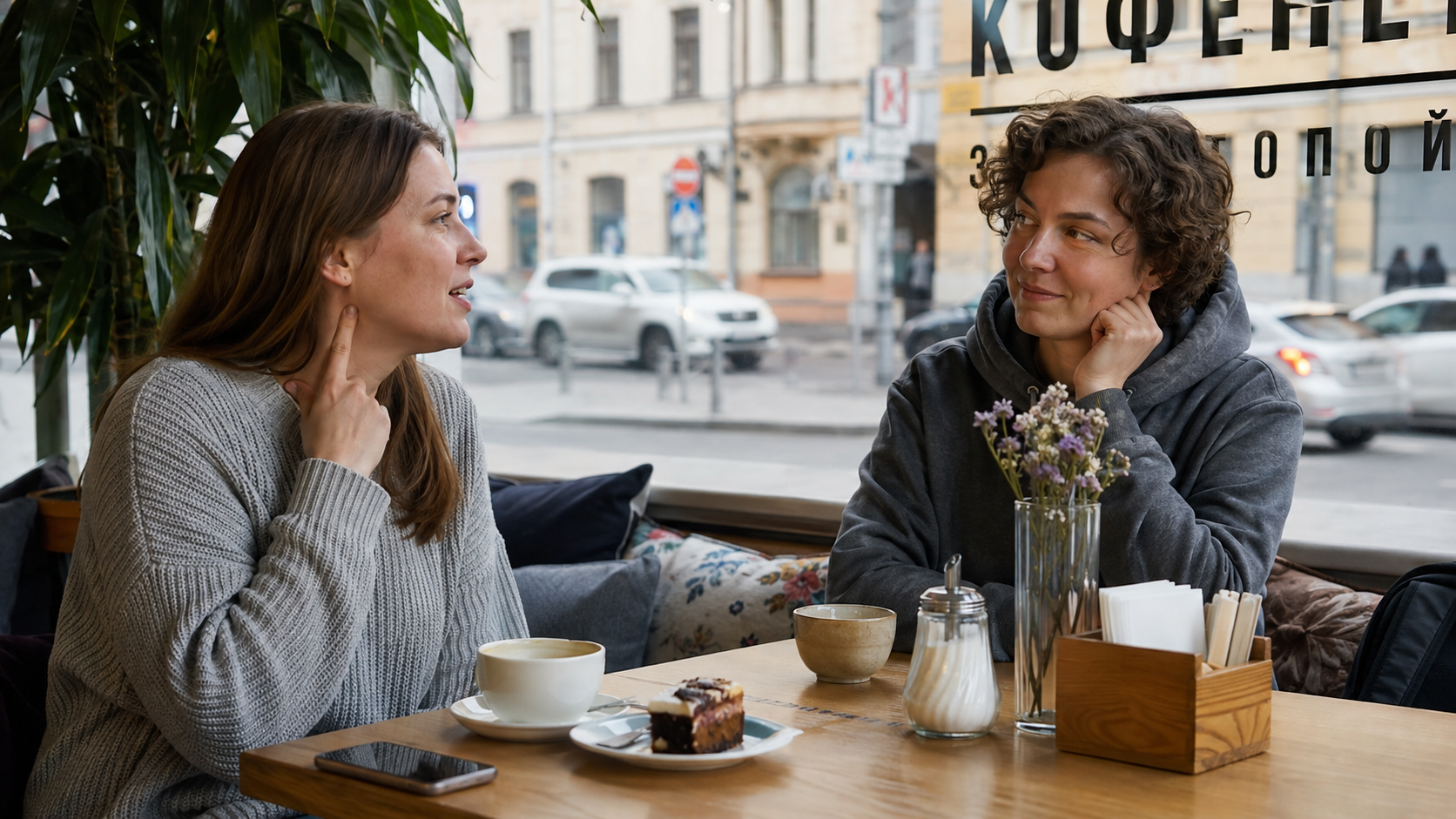
You can understand every word in a Russian conversation and still miss what just happened. Someone lowers their head slightly and taps the side of their neck with a finger. Nobody says anything about alcohol, dinner, or going out, yet everyone else seems to understand immediately.
That is one of the more distinctive examples of Russian body language, but it is hardly the only one. Much of nonverbal communication in Russia will look perfectly familiar to someone from the United States or Western Europe. Russians shrug when they do not know something, wave away topics they no longer want to discuss, raise their eyebrows in disbelief, and use their hands while talking. The differences tend to appear in smaller details: a gesture that carries a cultural meaning you would never guess, a greeting that stops at the doorway, or a neutral expression that an American might mistakenly read as unfriendly.
It is also worth being skeptical of lists of “uniquely Russian gestures.” Many hand movements are shared across Europe, some are associated more with older generations than younger ones, and others have been exaggerated online until they seem far more common than they really are. What matters is not memorizing a catalog of exotic signals. It is learning which details can actually change the way you understand an interaction.
A Tap on the Neck Can Replace a Sentence
One of the most recognizable examples is the gesture associated with drinking. A person taps or flicks the side of the neck, usually with the index finger. Depending on the situation, it can suggest “Let’s have a drink,” “He’s been drinking,” “He’s drunk,” or simply make an indirect reference to alcohol.
The gesture is informal and often humorous. You are much more likely to see it among friends than in a formal setting, and even people who rarely use it themselves are likely to recognize what it means.
Its origins are less certain than its modern meaning. A popular story traces the gesture to the reign of Peter the Great and a craftsman who supposedly received a mark on his neck entitling him to free drinks. Other explanations connect it with nineteenth-century slang and expressions related to drinking. The historical details are difficult to verify, although the gesture itself is well established in Russian culture.
What makes it especially interesting is that it works almost like vocabulary. Someone can communicate an idea connected with выпить (vypit', “to have a drink”) without saying the word at all.
You do not need to start tapping your own neck when you speak Russian. Recognizing the gesture when someone else uses it is considerably more useful.
Фига: A Gesture That Says “You're Getting Nothing”
Another gesture worth knowing is фига (figa), also called кукиш (kukish), дуля (dulya), or шиш (shish).
The hand forms a fist with the thumb pushed between the index and middle fingers. To someone unfamiliar with it, the shape may not look particularly expressive. In Russian culture, however, it traditionally communicates an emphatic refusal: something along the lines of “No way,” “You’re getting nothing,” or, depending on the tone, a considerably less polite version of the same message.
The fig sign is not exclusively Russian. Variations of it have existed in other European and Mediterranean cultures for centuries. What is particularly useful for Russian students is that the gesture also survives in colloquial language. Someone can say фиг тебе! without making the hand sign, and the verbal expression carries much of the same attitude.
Context matters. Among friends, фига can be theatrical or joking. In an angry exchange, it can be deliberately insulting. It is one of those gestures that is useful to recognize long before there is any reason to use it yourself.
The same principle applies to many pieces of slang. Knowing the dictionary meaning is only the beginning; tone, expression, and the relationship between the speakers determine whether something sounds funny, dismissive, affectionate, or hostile.
Why a Russian Host May Refuse Your Handshake at the Door
Some of the most memorable differences involve no unusual hand signal at all.
Suppose you arrive at someone’s apartment. The host opens the door, and while you are still standing in the hallway, you extend your hand. Instead of shaking it, the person waits or motions for you to step inside.
If you do not know the custom, the hesitation can look surprisingly personal.
There is a long-standing Russian superstition against shaking hands, hugging, kissing, or otherwise greeting someone across the threshold. Traditionally, the threshold marked a symbolic boundary, and exchanging greetings across it was associated with bad luck or future conflict. The practical result is simple: you step fully inside first and greet the person afterward.
Not every Russian takes the superstition literally, of course. Someone may follow the rule simply because it is what they were taught at home. Cultural habits often survive in exactly this form. People do not stop to analyze their historical origins every time they perform them.
The threshold rule is particularly easy for foreigners to misread because the physical behavior can look like reluctance. The visitor reaches forward, the host does not respond, and for a second it may seem that the welcome is less warm than expected. In reality, the host may be trying to observe a rule of hospitality.
The Serious Face That Is Not Necessarily Serious
Hand gestures attract attention because they are easy to describe, but facial expressions probably create more everyday misunderstandings.
Foreign visitors often notice that Russians are less likely than Americans to exchange casual smiles with strangers. From this observation came the familiar cliché that “Russians don’t smile,” which is both obviously false and not very useful.
The real difference is more subtle. A smile does not perform exactly the same social function in every culture.
In the United States, a brief smile can be almost automatic. People smile at cashiers, hotel employees, strangers in elevators, people passing in a hallway, or someone whose eyes they accidentally meet. It may not signal happiness at all. It can simply mean, “I’m friendly,” “I acknowledge you,” or “Everything is fine.”
Traditional Russian norms have placed less emphasis on this kind of routine social smiling. A smile is more closely associated with an actual reason to smile: amusement, affection, pleasure, familiarity, or genuine friendliness.
That difference can produce remarkably inaccurate first impressions.
A cashier with a neutral face may simply be doing her job. Someone listening carefully may frown slightly because he is concentrating. A passenger on the metro can look serious without being angry, sad, or hostile to anyone around him.
There is even a well-known saying:
Улыбка без причины — признак дурачины.
Literally, it means roughly, “A smile without a reason is a sign of foolishness.”
It would be a mistake to treat that saying as a description of every Russian interaction. Younger Russians, international workplaces, travel, social media, and changing customer-service conventions have all affected expectations. Still, it captures an older cultural assumption that a smile should correspond to something real rather than function automatically as a marker of politeness.
This helps explain why Russians abroad sometimes perceive American smiling as exaggerated or insincere, while Americans in Russia can interpret perfectly neutral expressions as cold.
Neither interpretation is necessarily correct. The social signal is simply being read through the wrong cultural system.
Public Seriousness and Private Warmth Are Not Contradictions
The picture changes considerably once people know one another.
Among friends and relatives, Russian conversation can be animated, affectionate, noisy, humorous, and physically expressive. People may hug when greeting, touch an arm or shoulder during conversation, laugh loudly, interrupt one another, or show far more emotion than someone observing strangers in a public place might expect.
This is why descriptions of Russians as naturally “cold” do not hold up very well. Much depends on the relationship between the people involved.
With strangers, reserve may be perfectly normal. With close friends, the expectations can be completely different.
Greetings vary as well. A handshake may be appropriate in one situation, while a hug or cheek kiss feels natural in another. Family, generation, region, gender, and individual personality all matter. Trying to memorize a rigid rule about exactly how Russians greet one another is less useful than noticing what the other person does and following their lead.
The same applies to eye contact and physical distance. There are broad cultural tendencies, but statements such as “Russians always stand closer than Americans” turn complicated social behavior into a stereotype. Relationships and circumstances usually explain more than nationality alone.
Crossing Yourself and Other Gestures With Older Roots
Another movement foreigners may notice is the Orthodox sign of the cross.
In the Russian Orthodox tradition, the thumb, index finger, and middle finger are typically brought together, and the hand moves from the forehead down to the torso and then from the right shoulder to the left shoulder. That right-to-left movement differs from the pattern familiar to many Western Christians.
Someone may cross themselves in church, during prayer, when passing a church or sacred site, or at an emotionally charged moment. How often this happens depends enormously on the person. Russia includes observant Orthodox Christians, nominally Orthodox people, members of other religions, and people who are not religious at all.
It is therefore better understood as a religious and cultural gesture than as something “Russians do.”
Superstition produces another interesting example. After mentioning something fortunate, a Russian speaker may say:
Тьфу-тьфу-тьфу!
The sounds imitate spitting, traditionally over the left shoulder, and are meant to avoid tempting fate. The closest English equivalent is probably “knock on wood.”
Someone might say that a child has not been sick all winter and immediately add тьфу-тьфу-тьфу, sometimes making a small movement toward the shoulder. The person may be completely modern and rational in every other respect. That does not prevent the old ritual from appearing almost automatically.
This is one of those details that can be genuinely confusing to a Russian student because тьфу looks more like a sound effect than a word. Yet in real conversation, everyone understands exactly why it has been said.
Sometimes a Shrug Really Is Just a Shrug
Once people begin looking for cultural differences, there is a temptation to discover them everywhere.
A Russian may wave a hand dismissively while saying:
Да ладно.
Da ladno.
Depending on intonation, the phrase can mean “Come on,” “Forget it,” “It’s fine,” “Don’t worry about it,” “Oh, please,” or several other things.
Someone may shrug with open palms while saying не знаю (ne znayu, “I don’t know”). A person describing something as mediocre may rock a flat hand from side to side in a way that will look familiar to people from many countries.
These movements are part of Russian communication, but they are not necessarily uniquely Russian.
That distinction matters because online articles sometimes present ordinary European or international gestures as if visitors have entered an entirely new nonverbal universe. Nose tapping associated with secrecy, for example, is better documented in British and other European contexts than as a particularly Russian sign. The outward flick from beneath the chin is also associated with several cultures and should not automatically be labeled Russian.
Global media has made these boundaries even less clear. Younger Russians use emojis, memes, internet gestures, and body language influenced by the same international culture as their peers elsewhere.
A useful question is therefore not simply, “What does this gesture mean in Russia?” It is also, “Is this actually Russian, or is it something Russians happen to use too?”
Words, Tone, and Movement Usually Work Together
One reason gestures matter to Russian students is that they rarely operate in isolation.
Take Да ладно again. In a textbook, you can learn several possible translations. In real conversation, the expression might be accompanied by a smile, a raised eyebrow, a dismissive hand movement, an incredulous stare, or a shrug. The words remain the same while the meaning shifts.
A smiling Да ладно! might mean, “Oh, come on, really?”
A weary one with a hand wave can mean, “Forget it.”
A sharp one may express irritation.
The difficulty is not Russian vocabulary. It is understanding what the speaker is doing with that vocabulary.
This becomes increasingly noticeable as students move beyond beginner material. At first, most of the effort goes into cases, verbs, pronunciation, and remembering the right word quickly enough to finish a sentence. Later, comprehension depends more and more on intonation, humor, implied meaning, expressions, and the small nonverbal signals that native speakers barely notice themselves.
That is also why trying to imitate gestures deliberately is rarely the best goal. Using a culturally specific gesture in the wrong situation can look more unnatural than simply not using it.
Recognition comes first.
If someone taps the neck, you understand the reference. If you see фига, you know that the person is refusing something emphatically. If a host waits until you step across the threshold, you do not interpret the hesitation as rejection. If someone looks serious while talking to you, you do not immediately assume you have offended them.
Those small corrections in interpretation are much more valuable than trying to perform Russian body language on command.
Learning these details also becomes easier when Russian is practiced with real people rather than encountered only as vocabulary and grammar exercises. In Polyglottist Language Academy's Russian classes, students can work on spoken Russian in context, where tone, expression, and cultural conventions naturally become part of understanding the language.
Knowing Russian body language does not mean memorizing twenty hand signs and trying to look like a native speaker. Much of it is simply learning not to make automatic assumptions. A smile does not always perform the same social job. A delayed handshake may be hospitality rather than hesitation. A tap on the neck can communicate something that was never said aloud.
Sometimes you understand every Russian word in the conversation and still miss part of what was said. The missing vocabulary was never verbal in the first place.