
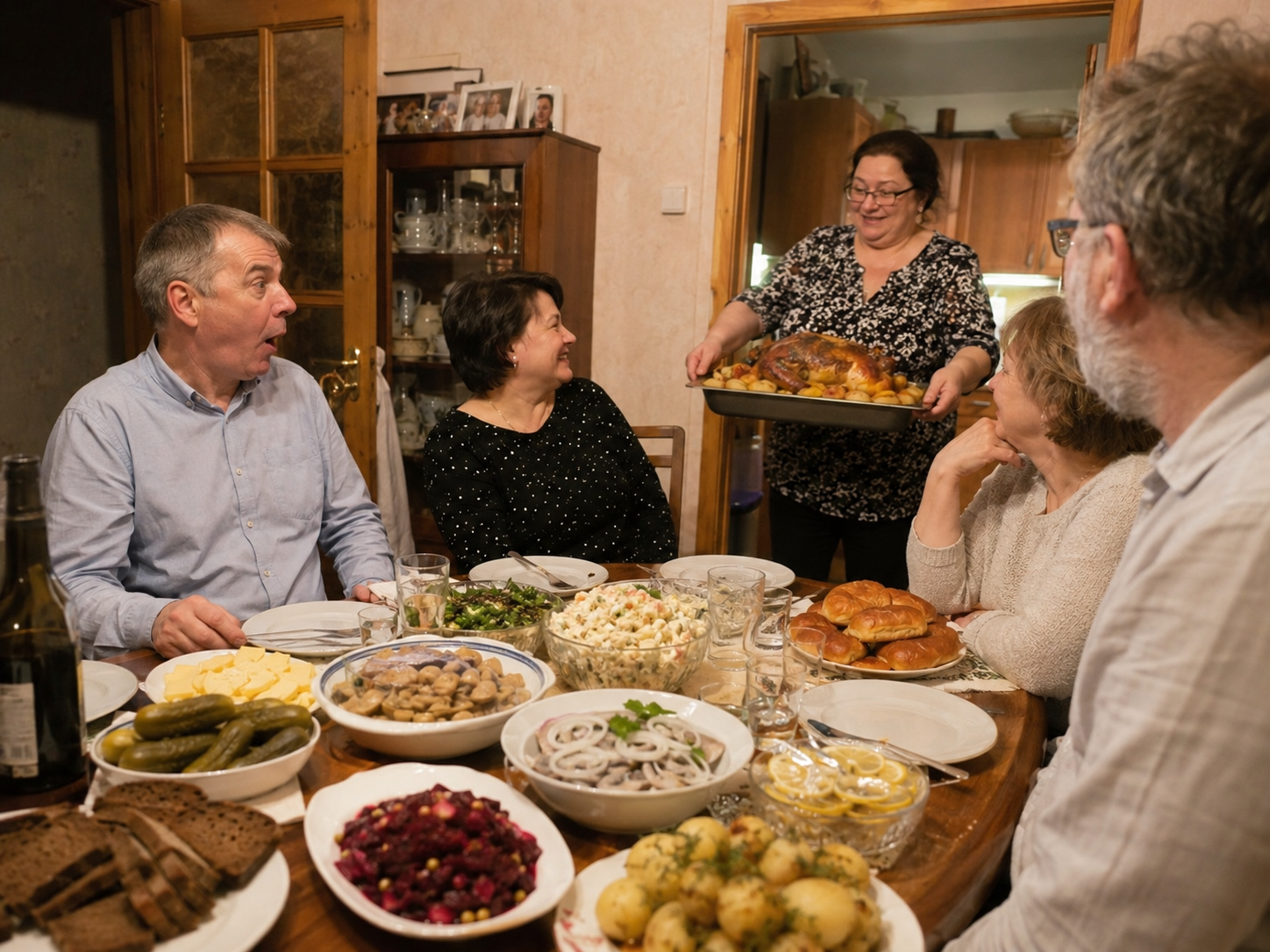
You arrive at seven o’clock expecting dinner.
The table is already covered. There are sliced cucumbers and tomatoes, glossy pickled mushrooms, dark rye bread, herring, cheese, cold meats, boiled eggs, two salads, and a plate of small pastries. Someone opens a jar of homemade pickles. Glasses are filled. The host urges you to sit down and says:
Угощайтесь!
Help yourself!
Naturally, you assume the meal has begun.
Then, after you have eaten far more than intended, a hot dish appears from the kitchen.
This is one of the first lessons of the Russian zakuski table: what looks like dinner may only be the beginning.
Zakuski are often translated as “appetizers,” “hors d’oeuvres,” or “snacks,” but none of those words quite captures their role. They are food, certainly, but they are also a way of arranging an evening. They create time for late arrivals, conversation, introductions, toasts, stories, and the slow transition from being people in the same room to being people gathered around one table.
The most interesting thing about zakuski is therefore not what is served. It is what the food allows to happen.
A Table Designed for Conversation
In many American restaurants, an appetizer has a clear position in the sequence of a meal. It arrives before the entrée, serves its purpose, and disappears.
Zakuski do not always behave so obediently.
They may precede a formal meal, remain on the table throughout dinner, accompany drinks, or become an informal meal by themselves. Guests return to the same dishes repeatedly: one more mushroom, another slice of bread, a little more salad, half a pickle after a toast.
This gives the table a particular rhythm. Nobody must concentrate on a single plated course. People can eat a little, stop, talk, listen, and begin again. The food does not constantly interrupt the conversation; it supports it.
That is why it can be useful to think of zakuski not simply as a food category but as a form of social pacing.
A table covered with small dishes removes urgency. The host does not have to serve everyone at precisely the same moment. A guest who arrives late can sit down without disrupting the entire meal. Someone who is shy has something to comment on. Someone who does not know the other guests can ask who made the mushrooms or what is inside a pastry.
The food creates small openings through which conversation can begin.
Food scholar Darra Goldstein has described Russian culinary history as a story shaped by both hardship and hospitality. Her work emphasizes how food can reveal social structures and a strong desire for conviviality—the pleasure of eating together despite difficult material circumstances. The zakuski table brings those two forces into unusually clear view: generosity is expressed not through one enormous centerpiece but through variety, replenishment, and the feeling that there is always something else to offer.
What Does Zakuski Actually Mean?
Закуски is the plural of закуска.
закуска — one appetizer or snack
закуски — appetizers, snacks, or a spread of small dishes
закусить — to have a bite or eat something, often after a drink
The word belongs to the same family as кусать, “to bite.” Merriam-Webster traces zakuska to the Russian verb закусить, associated with having a snack or taking a bite.
For beginners, the stress is worth noticing:
заку́ска — za-KOOS-ka
заку́ски — za-KOOS-kee
English speakers sometimes use zakuski to mean a specific set of traditional Russian dishes. In Russian, the word is broader. A restaurant menu may have a section called холодные закуски, “cold appetizers,” and another called горячие закуски, “hot appetizers.” A person can also say Я хочу закусить—“I want to have a bite.”
Context matters. A single sandwich eaten quickly can be a snack. A festive table covered with fish, salads, pickles, bread, and small dishes is also zakuski, but culturally it is something much larger.
This is a useful reminder for language learners: dictionaries give meanings, but situations give words their full shape.
From the Aristocratic Side Table to the Apartment Kitchen
The history of zakuski is not a single, tidy origin story.
Food historians connect the tradition with several influences, including northern European drinking tables, European banquet customs, and the varied foodways of the Russian Empire. By the eighteenth and nineteenth centuries, wealthy households could present elaborate assortments of fish, caviar, meats, pies, aspics, pickles, and other delicacies, sometimes on a separate table or even in a room through which guests passed before the main dinner. The food could refresh travelers whose arrival times were uncertain and display the host’s status and generosity.
In an aristocratic household, abundance might mean rare fish, expensive caviar, elaborate aspic, imported wine, and silver serving dishes. But the underlying idea eventually traveled far beyond aristocratic dining rooms.
During the Soviet period, the festive spread developed under very different conditions. Living spaces were often smaller, ingredients could be difficult to obtain, and families learned to create celebration through planning, preserving, saving, exchanging, and improvising. Research on Soviet food practices has shown how recipes circulated informally and how hospitality could become part of a complex network of sharing and mutual support.
The separate zakuski room disappeared, but the principle survived on the apartment table.
A jar saved for months could be opened for New Year’s Eve. A scarce ingredient might be acquired through a friend. Familiar potatoes, carrots, beets, eggs, canned fish, and mayonnaise could be transformed into carefully layered salads. What mattered was not only expense. It was evidence of preparation.
The host had thought ahead.
The table said: this evening is important, and so are the people sitting around it.
What Belongs on a Zakuski Table?
There is no official checklist.
A zakuski spread can be luxurious or modest, traditional or contemporary, homemade or assembled partly from store-bought food. It can contain three dishes or twenty. It can be served at a wedding, birthday, holiday dinner, informal visit, or quiet evening with friends.
Still, many classic tables are built around a recognizable balance of flavors and textures.
Something salty
Salted or smoked fish is a natural presence: herring, salmon, sprats, mackerel, or other preserved fish, depending on region, availability, and family preference.
Herring may be served simply with onion, potatoes, and oil. Sprats can appear on small pieces of bread. Smoked fish might be accompanied by lemon, herbs, or sliced cucumber.
Something sour or pickled
Pickled cucumbers are perhaps the most instantly recognizable example, but they are only the beginning.
A table might include:
Pickled mushrooms
Sauerkraut
Marinated tomatoes
Pickled garlic
Beets
Cabbage salads
Preserved peppers
Salted or lightly fermented vegetables
These sharp flavors cut through richer foods and invite repeated small bites.
Something creamy or substantial
Festive salads often provide the heavier center of the spread.
Olivier salad, commonly contains potatoes, carrots, peas, pickles, eggs, mayonnaise, and meat or chicken, although recipes differ from family to family.
Vinaigrette salad, usually combines beets, potatoes, carrots, pickles, and sometimes sauerkraut or beans.
“Herring under a fur coat,” layers salted herring beneath potatoes, carrots, beets, and mayonnaise. The familiar Soviet version became especially associated with holiday tables across Russia and much of the former Soviet world.
These salads are not delicate restaurant starters. They are filling, colorful, and designed to be prepared in advance—an important advantage when a host is feeding many people.
Something to put on bread
Dark rye bread, white bread, butter, cheese, cold meats, pâté, fish, and spreads allow guests to build their own small combinations.
Caviar may appear on buttered bread, blini, or small canapés, but caviar is not required for a table to qualify as zakuski. The international image of Russian food often overemphasizes luxury ingredients. A plate of well-seasoned potatoes and homemade pickles may be far more emotionally meaningful to a family than an expensive jar of roe.
Something warm
Although people often picture zakuski as cold dishes, hot appetizers also have a place.
These may include:
Small pirozhki filled with cabbage, mushrooms, potato, or meat
Blini with savory toppings
Baked mushrooms
Small meat dishes
Hot sandwiches
Pastries or filled pies
The border between an appetizer and a meal can become pleasantly unclear.
A Russian Table, but Not a Culinary Border Wall
Food rarely respects political boundaries.
Many dishes seen on Russian tables also belong to, originated in, or were shaped by Ukrainian, Belarusian, Jewish, Georgian, Armenian, Azerbaijani, Central Asian, Baltic, Scandinavian, French, German, and other culinary traditions.
That does not make them less meaningful in Russian homes. It does mean that describing every dish eaten in Russian as exclusively “Russian” can flatten a much more complicated history.
This is particularly important when discussing food from the Russian Empire and the Soviet Union, both of which encompassed many peoples and cuisines. A recent academic study of food knowledge in the post-Soviet world found that even advanced AI systems frequently misattribute dishes based on the language used in a question rather than their actual cultural origins. In other words, a recipe described in Russian is not automatically Russian in origin.
For travelers and learners, curiosity is more useful than ownership claims.
Ask where a dish comes from. Ask who taught the host to make it. Ask whether their family uses apples, onions, beans, dill, or a particular kind of pickle. Often the personal history of the recipe is more revealing than the national label.
The Pickle Is Doing More Work Than You Think
A pickle on a zakuski table is not decorative.
Its acidity wakes up the palate after rich salad, oily fish, or cold meat. Its crunch changes the texture of the meal. Its saltiness makes it a natural partner for bread, potatoes, and drinks.
But homemade pickles also carry a less visible meaning.
They connect the table to a season that is no longer present. Cucumbers gathered in summer appear in winter jars. Mushrooms collected in autumn return at New Year. Cabbage preserved months earlier waits until guests arrive.
A jar can therefore contain time as well as food.
Older methods of preserving were practical responses to climate, seasonality, and storage. Today, people may buy excellent pickles in a supermarket, but homemade preserves still have emotional force. They suggest knowledge passed through families: how much salt to use, which leaves to add, how long to wait, and how to recognize when something tastes right.
At Polyglottist, adult learners often discover that food vocabulary quickly turns into family vocabulary. A discussion of salted cucumbers, leads to memories of a grandmother’s kitchen, a dacha garden, a holiday table, or a recipe nobody ever wrote down.
Must Zakuski Be Served with Vodka?
No.
Vodka has a strong historical association with zakuski, and the verb закусить can refer specifically to eating something after a strong alcoholic drink. Salty, sour, and fatty foods pair naturally with spirits, and formal or celebratory meals may include a sequence of toasts followed by bites of food.
But zakuski are not dependent on alcohol.
They can accompany wine, beer, mineral water, juice, tea, or nothing at all. Children eat them. People who do not drink eat them. Families may serve essentially the same assortment at lunch, dinner, or a celebration where alcohol is absent.
Reducing zakuski to “vodka snacks” misses the social structure of the table.
The essential pairing is not food and alcohol. It is food and company.
Toasting Without Turning the Evening into a Performance
Visitors sometimes become anxious about Russian toasts. They imagine they will be required to deliver a profound speech in flawless Russian before drinking an entire glass of vodka.
Most gatherings are less theatrical.
The formality depends on the occasion, the generation, and the people present. At a wedding or major celebration, toasts may be longer and more ceremonial. At an ordinary dinner, someone may simply raise a glass and say:
За встречу!
To our meeting!
За дружбу!
To friendship!
За хозяев!
To the hosts!
A guest who does not drink alcohol can raise another beverage. A person can also politely refuse a drink:
Нет, спасибо. Я не пью.
No, thank you. I don’t drink.
The more useful rule is to pay attention to the room. Do not begin drinking before a toast if everyone else is waiting. Do not assume every toast requires you to empty your glass. Follow the hosts’ pace rather than trying to act out a scene from a film.
Cultural confidence rarely comes from performing the most stereotypical version of a custom. It comes from noticing how the people actually present are behaving.
The Host’s Language: “Try This. And This. And This.”
Russian hospitality is often expressed through verbs.
A host may not make a long speech about how delighted they are to see you. Instead, they move a plate closer and say:
Попробуйте.
Try it.
Then:
Возьмите ещё.
Have some more.
And, after you insist that you are full:
Ну, ещё чуть-чуть.
Come on, just a little more.
The exchange can sound like negotiation because, in a sense, it is. The host wants to demonstrate abundance and care. The guest wants to accept enough to show appreciation without eating beyond all physical reason.
How to Be a Good Guest at a Zakuski Table
There is no need to memorize an elaborate etiquette code. A few habits will carry you comfortably through most gatherings.
Do not fill your plate immediately
The visible spread may not be the complete meal. Begin with modest portions and leave room for dishes that have not appeared yet.
Try something homemade
When a host proudly identifies homemade mushrooms, pickles, pastry, or salad, tasting it is a meaningful compliment. You do not need to take a large serving.
Compliment something specifically
Instead of only saying “Everything is delicious,” mention a dish:
Салат очень вкусный.
The salad is very tasty.
Грибы замечательные.
The mushrooms are wonderful.
Specific praise sounds more sincere and often begins a story about the recipe.
Allow the host to offer twice
In some families, a first refusal may be interpreted as politeness rather than a final answer. You can accept the second offer or decline warmly and clearly.
Pass dishes rather than reaching across the table
Say:
Передайте, пожалуйста…
Please pass…
Do not assume alcohol is compulsory
A polite refusal is enough. You can participate in a toast with water or another drink.
Bring something small when invited to a home
Flowers, sweets, wine, fruit, or another modest gift may be appropriate, depending on the relationship. The gesture matters more than the price.
Most importantly, do not treat the table as a cultural examination. You are a guest, not an anthropologist collecting evidence. Eat, listen, ask natural questions, and enjoy the company.
Creating a Zakuski Evening at Home
You do not need caviar, crystal glasses, or three days of cooking to create the spirit of a zakuski table.
The goal is not to reproduce an imaginary imperial banquet. It is to offer variety and make it easy for people to linger.
A simple table for six might include:
Dark rye bread and butter
Pickled cucumbers
Marinated mushrooms
Sliced cheese
Smoked fish or herring with onions
A bowl of vinaigrette or Olivier salad
Boiled potatoes with dill
Small pirozhki or another savory pastry
For a vegetarian table, combine:
Pickles and sauerkraut
Marinated mushrooms
Beet salad
Eggplant spread
Cheese
Deviled eggs
Potatoes with herbs
Mushroom or cabbage pirozhki
Bread and butter
Arrange everything before the guests sit down. Use serving dishes that can remain on the table. Provide small plates so people can return for modest portions.
Most of all, do not rush to clear the food.
The lingering is part of the point.
Why Zakuski Matter to Language Learners
Food is sometimes treated as the “easy” side of culture, something decorative added after the serious work of grammar.
You hear aspect in verbs of eating, cutting, preparing, and finishing. You hear affectionate pressure, polite refusal, family jokes, and stories that would never appear in a textbook dialogue about ordering lunch.
At Polyglottist Language Academy, we encourage adult students to notice these ordinary cultural moments. Online Russian classes can teach you how cases work, but they can also help you understand why a host keeps offering food or how to decline without sounding cold. Language becomes more vivid when it belongs to a room, a relationship, and a reason to speak.
Explore Russian Classes at Polyglottist Language Academy
The Table Is Still Changing
There is no single modern zakuski table.
Some families preserve a familiar holiday spread almost unchanged. Others replace mayonnaise-heavy salads with lighter dishes. Contemporary restaurants present small, carefully styled interpretations of herring, pickles, caviar, rye bread, and preserved vegetables. Younger hosts may combine traditional food with hummus, olives, sushi, local cheeses, or anything else they enjoy.
Russian-speaking communities abroad adapt the table to available ingredients. A Bay Area gathering might include California produce alongside herring and rye bread. A family recipe may change because the familiar brand of mayonnaise is unavailable or because someone has become vegetarian.
Traditions remain alive by changing.
The defining feature of zakuski has never been perfect culinary purity. It is the decision to place several dishes between people and allow the evening to unfold around them.
Related Polyglottist Articles
Russian Blini: History, Recipes, And Why They're More Than Just Pancakes
Russian Wedding Traditions: What Happens At A Traditional Russian Wedding
Russian Black Bread: What It Is And Why Russians Are So Proud Of It
Frequently Asked Questions About Zakuski
Are zakuski the same as appetizers?
The closest English translation is “appetizers,” but zakuski may play a larger role than a conventional starter. They can remain on the table throughout a meal, accompany drinks and conversation, or constitute an informal meal on their own.
Are zakuski always cold?
No. Cold zakuski are especially common because they can be prepared in advance and left on the table. Hot zakuski may include pastries, mushrooms, blini, small meat dishes, and other warm foods.
Do zakuski have to be served with vodka?
No. They may accompany vodka, but they can also be served with wine, beer, tea, juice, mineral water, or no special drink. Their broader purpose is hospitality and shared eating.
What is the difference between zakuska and zakuski?
Zakuska is singular and refers to one appetizer or snack. Zakuski is plural and may refer to several appetizers or an entire spread.
Can zakuski be vegetarian?
Absolutely. Pickled vegetables, marinated mushrooms, beet salad, vinaigrette, cheese, eggs, potatoes, eggplant spread, cabbage pastries, bread, and vegetable preserves can create a generous vegetarian table.
Are zakuski served only on holidays?
No. Elaborate spreads are associated with celebrations, but simpler zakuski can appear at ordinary dinners, visits, or casual gatherings. A few pickles, bread, cheese, fish, or salad may be enough.
What should I bring when invited to a Russian home?
A modest host gift such as flowers, sweets, wine, fruit, or another small item is often appropriate. Consider the host’s preferences, and do not bring alcohol when you are unsure whether the household drinks.
That is the quiet intelligence of zakuski. A few small dishes create reasons to pause, offer, accept, ask, remember, and stay a little longer. Something as simple as a pickle, a slice of dark bread, or a shared bowl of salad can open a door into language, culture, and a different way of paying attention—to food, to time, and to one another.