
Why Do Japanese People Remove Shoes Inside? The Cultural Logic Explained
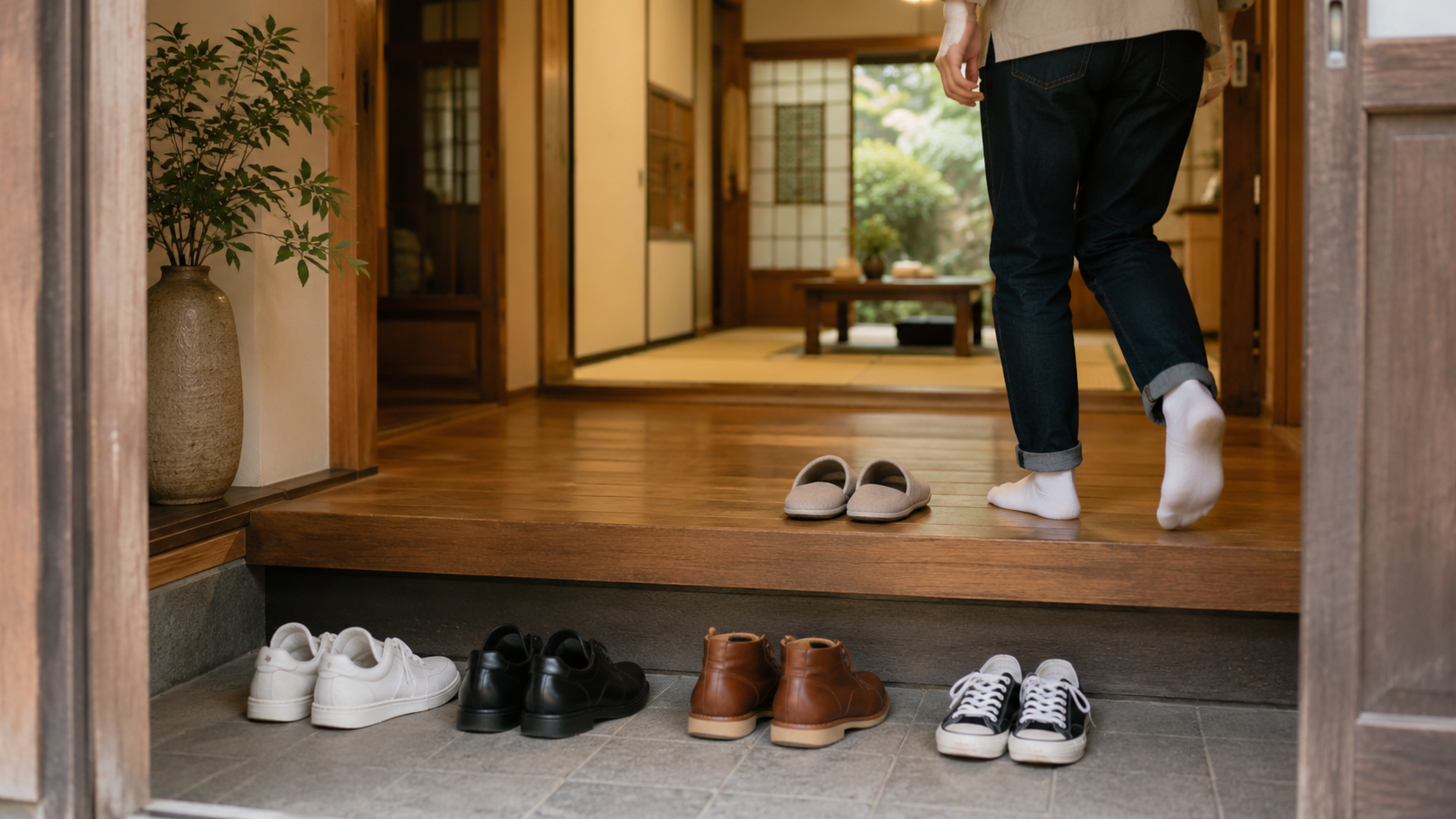
You have stepped through the front door of a Japanese home. Your host has already gone inside, but you are still standing in the entrance, looking down.
There is a tiled floor beneath your shoes. A polished wooden floor begins several inches higher. A pair of slippers waits on the raised side. Your host’s shoes have been placed neatly near the door, pointing outward.
Should you take off your shoes before stepping up? Should you put on the slippers? Should you turn your shoes around? And how are you supposed to do all of this without putting a socked foot back onto the entrance floor?
For a first-time visitor, this can feel like a surprisingly complicated moment.
For someone accustomed to Japanese homes, it is an ordinary piece of entrance choreography. Shoes remain in the lower area. Clean feet move into the raised interior. Outdoor space ends, indoor space begins, and everyone understands the boundary.
Removing shoes in Japan is often described as a cleanliness rule. That is certainly part of the explanation—but only part of it. The custom also reflects the architecture of Japanese homes, the historical importance of floor-level living, respect for shared spaces, and a deeply established distinction between the world outside and the protected interior.
The most interesting question, then, is not simply, “Why do Japanese people take off their shoes?”
It is: What changes when someone crosses the threshold?
The genkan is not quite outside—and not yet inside
The key to understanding Japanese shoe etiquette is the genkan.
A genkan is the entrance area found in Japanese houses, apartments, and many traditional or semi-public buildings. It is usually positioned just inside the front door, but its floor is lower than the main interior. It may be made of tile, stone, concrete, or another durable material associated with outdoor footwear.
The raised wooden floor beyond it marks the beginning of the clean living space.
This difference in height is practical, but it also communicates instructions without anyone having to explain them:
Shoes belong on the lower level.
Socks, bare feet, or indoor slippers belong on the raised level.
The two surfaces should not be mixed.
The genkan therefore functions as more than a foyer. It is a transition zone in which a visitor changes not only footwear, but also their relationship to the space they are entering. Research on the custom describes it as the architectural point where the potentially dirty public world is separated from the protected interior.
In many Western homes, an entrance hallway is simply the first part of the interior. In a Japanese home, the genkan is more ambiguous. You are already inside the building, but you have not yet fully entered the home.
That subtle distinction explains why stepping onto the raised floor in outdoor shoes is such a noticeable mistake. You have crossed the boundary without completing the ritual that makes the crossing appropriate.
A small ritual of inside and outside
Japanese is rich in words that describe social and spatial relationships. Two often discussed terms are uchi, meaning “inside,” “home,” or one’s own group, and soto, meaning “outside” or the world beyond that group.
These concepts should not be treated as a magical explanation for every Japanese custom. Most people are not consciously thinking, “I am now passing from soto into uchi,” each time they take off their shoes.
Still, the distinction offers a useful lens.
The outside world is public, unpredictable, and shared with strangers. Shoes travel through streets, stations, public toilets, shops, elevators, parks, and rainy sidewalks. The interior of a home is private and controlled. It is where people relax, eat, sit on the floor, and sleep.
Removing shoes gives that boundary a physical form.
You take off what has carried you through the public world before entering the intimate one.
Adult language students often encounter this broader pattern in Japanese. The language itself changes depending on relationships, levels of formality, and whether someone belongs to an inner or outer group. Shoe removal is not a grammatical rule, of course, but it reflects a similar cultural attentiveness to context: Where am I? Whose space is this? What behavior belongs here?
When the floor is furniture
To understand why shoes feel particularly out of place in a traditional Japanese interior, it helps to stop thinking of the floor as merely something people walk across.
Historically, the floor was also where much of daily life happened.
People sat on tatami mats around low tables. Meals were served close to floor level. Children played on the floor. Futons were unfolded directly onto tatami at night and stored away during the day. Tea ceremonies, formal greetings, and family conversations all took place close to the ground.
In other words, the floor functioned partly as a chair, dining area, play space, and bed.
This makes outdoor shoes seem less like footwear worn across a hallway and more like shoes placed on someone’s sofa or bedding.
Why tatami matters
Traditional tatami mats are made with a woven rush surface over a supporting core. They have a distinctive texture and scent, and they are more delicate than stone or tile flooring.
Mud, grit, moisture, and hard soles can stain or damage them. Tatami is also difficult to clean aggressively. It cannot simply be scrubbed in the same way as an entrance floor.
Even today, the presence of tatami changes the footwear rules. A visitor may wear slippers in a wooden corridor, then remove them before entering a tatami room. Socks or bare feet are generally appropriate on tatami; outdoor shoes and ordinary house slippers are not.
Traditional architecture therefore helped turn shoe removal into a durable social custom. Raised floors, tatami rooms, low furniture, and futon sleeping made a clean interior floor essential rather than merely desirable.
The custom is older than the slippers
It is tempting to imagine Japanese house slippers as part of an unchanged ancient tradition. In fact, the two parts of the custom have different histories.
Removing outdoor footwear has deep historical roots. Sources describe elevated-floor dwellings in early Japan and picture scrolls from the Heian period, from 794 to 1185, showing aristocrats removing footwear before entering residences.
The word genkan itself is connected historically to Zen temple architecture. It later became associated with formal entrances in elite and warrior residences before developing into the familiar entrance area found in ordinary homes.
No single date can be identified as the moment Japan “invented” indoor shoe removal. The custom developed gradually through a combination of raised architecture, floor-level living, climate, footwear, and ideas about clean and protected spaces.
Slippers came much later.
Western-style shoes became increasingly common in modern Japan, and indoor slippers spread widely during the twentieth century, particularly after the 1950s. They provided a convenient way to keep outdoor shoes separate while making wooden or Western-style indoor floors more comfortable.
So the underlying rule is old, but one of its most recognizable accessories is relatively modern.
Rain, mud, and the practical logic of clean floors
Japan’s climate also matters.
Many regions experience heavy rain, humid summers, and a distinct rainy season. Historically, unpaved roads and paths could become muddy, while traditional footwear such as geta, or raised wooden clogs, helped keep feet above wet ground.
Whether a person wore geta, straw sandals, or later Western shoes, bringing outdoor dirt and moisture onto tatami or wooden floors would have been inconvenient and damaging.
The practical benefits remain obvious today. Removing shoes helps reduce:
Mud and rainwater
Dust and street debris
Wear on wood and tatami
Cleaning in compact living spaces
Outdoor contamination on surfaces where people sit or children play
Modern Japanese apartments may have laminate flooring, Western beds, dining chairs, and no tatami room at all. Yet most still preserve some version of the genkan. It may be very small, and the height difference may be subtle, but the distinction between the footwear zone and the living area remains.
The custom survives partly because it continues to work.
Cleanliness is not exactly the same as purity
Discussions of Japanese shoe removal sometimes move quickly from hygiene to religion. Shinto places importance on purification and on avoiding kegare, a form of pollution or impurity. Buddhist and Shinto spaces also have long traditions of marking sacred interiors and requiring visitors to remove footwear in certain buildings.
These traditions likely reinforced a broader cultural preference for separating clean, special, or protected spaces from the dirt of ordinary travel.
But it would be misleading to say that Japanese people remove their shoes at home because they are consciously performing a religious act.
Most people do it because it is normal, practical, comfortable, and expected. Religion is part of the historical background—not necessarily the everyday motivation.
The distinction is important. Customs rarely survive for centuries because of a single idea. In this case, religious attitudes about purity worked alongside architecture, climate, materials, household habits, and social etiquette.
The entrance choreography: how to remove your shoes correctly
Knowing that shoes must come off is only the beginning. The movement itself matters.
Imagine that you are standing in the genkan:
Enter the lower area while still wearing your shoes.
Stop before the raised interior floor.
Remove your shoes while keeping your feet on the lower surface.
Step directly onto the raised floor in socks or bare feet.
Avoid placing your socked foot back onto the lower genkan floor.
Turn your shoes neatly so they point toward the door.
Put on the indoor slippers if your host has provided them.
The most common mistake is removing one shoe, placing that socked foot on the genkan floor, and then removing the other. From the visitor’s perspective, this may seem harmless. From the logic of the space, however, the sock has now touched the same surface as outdoor shoes and is about to carry that dirt inside.
You do not need to perform the movement with theatrical precision. Simply pause, observe what others are doing, and try to keep the lower and raised areas separate.
Turning the shoes toward the door is a gesture of neatness and consideration. It prepares them for departure and prevents the entrance from becoming disorganized. In some homes, the host may turn a guest’s shoes after the guest steps inside.
Slippers have territories of their own
Once you have successfully removed your shoes, you may discover that the footwear rules are not over.
Japan has several categories of indoor footwear, and each belongs to a particular kind of space.
House slippers
Ordinary indoor slippers, called surippa, may be provided in homes, clinics, traditional inns, schools, and some restaurants. They are normally worn on wood, vinyl, or other hard indoor floors.
Not every household uses them. Some families prefer socks or bare feet, so follow the host’s example.
Tatami means slippers off
Slippers should normally be removed before walking onto tatami. The mats are treated as a distinct surface, and slipper soles may damage or dirty them.
A traveler at a ryokan might therefore follow this sequence:
Outdoor shoes off → corridor slippers on → corridor slippers off → tatami room entered in socks.
Toilet slippers
Toilet slippers are kept specifically inside the toilet area. They create another boundary between the bathroom floor and the rest of the home.
The famous mistake is forgetting to remove them.
A guest walks into the toilet wearing house slippers, changes into the toilet slippers, uses the facilities, and then absentmindedly walks back into the living room still wearing them. This is embarrassing because the footwear associated with the toilet has crossed into the clean household space.
If you remember only one advanced slipper rule, remember this one: toilet slippers stay in the toilet.
Indoor school shoes
Japanese students commonly change from outdoor shoes into uwabaki, lightweight indoor shoes worn inside school buildings. Shoe lockers near the entrance make the transition part of the daily school routine.
The categories may initially seem complicated, but they all follow the same principle: different spaces require different levels of separation.
Where should you expect to remove your shoes?
Private homes are the clearest example, but travelers may encounter shoe-free interiors in many other places.
You may need to remove your shoes in:
A ryokan or traditional inn
A tatami room in a hotel or restaurant
A traditional restaurant with floor seating
A tea ceremony room
Certain temple buildings
Some medical or dental clinics
Schools and kindergartens
Martial arts dojos
Historic houses and museums
Some community centers and small businesses
Changing areas at baths and hot-spring facilities
Most modern public interiors do not require shoe removal. You normally keep your shoes on in train stations, department stores, supermarkets, convenience stores, modern cafés, office towers, and Western-style hotel lobbies.
Look for visual clues rather than assuming that all Japanese interiors follow the same rule. Shoe shelves, lockers, waiting slippers, a raised floor, visible tatami, or a cluster of shoes near the entrance usually provide the answer.
You may also see signs such as:
靴を脱いでください
Kutsu o nuide kudasai.
Please remove your shoes.
Or:
土足厳禁
Dosoku genkin.
Outdoor shoes strictly prohibited.
Useful Japanese for the moment at the door
A few simple words can make the entrance experience much easier.
玄関 — genkan
The entrance area where outdoor shoes are removed.
玄関で靴を脱ぎます。
Genkan de kutsu o nugimasu.
I take off my shoes in the entrance.
靴 — kutsu
Shoes.
靴はここに置きますか。
Kutsu wa koko ni okimasu ka.
Should I put my shoes here?
靴を脱ぐ — kutsu o nugu
To remove one’s shoes.
ここで靴を脱ぎますか。
Koko de kutsu o nugimasu ka.
Do I take off my shoes here?
スリッパ — surippa
Slippers.
スリッパを使ってもいいですか。
Surippa o tsukatte mo ii desu ka.
May I use the slippers?
上履き — uwabaki
Indoor shoes, especially the type worn in schools.
畳 — tatami
Traditional Japanese mat flooring.
畳の上ではスリッパを脱ぎます。
Tatami no ue de wa surippa o nugimasu.
You remove slippers on tatami.
土足 — dosoku
Wearing outdoor shoes indoors, or literally entering with “soiled feet.”
The phrase 土足禁止, dosoku kinshi, means that outdoor shoes are prohibited.
These expressions are useful because they connect vocabulary to a physical action. Language becomes easier to remember when it is attached to a place, a gesture, and a real social situation. The suggested questions for asking about shoes and slippers are natural polite expressions for an unfamiliar entrance.
Is removing shoes uniquely Japanese?
No. Shoe removal is common in Korea, parts of China and Southeast Asia, Scandinavia, Eastern Europe, Canada, Hawaii, and many individual households throughout the United States.
Weather, floor seating, religious practice, household preference, and cleanliness all contribute to similar customs around the world.
What is particularly distinctive in Japan is the way several features work together:
A built-in genkan marking the transition
Raised interior flooring
Tatami and floor-level living
Specific categories of slippers and indoor shoes
Detailed etiquette for moving between surfaces
A strong expectation that visitors recognize the boundary
Japan did not invent the desire for clean floors. It developed an especially visible architectural and social system for maintaining them.
What this custom teaches language learners
Cultural understanding often grows through details that initially seem too small to matter.
Students may begin by learning that kutsu means “shoes” and nugu means “to remove.” But the useful lesson is not only how to form the sentence kutsu o nugimasu. It is understanding when the sentence becomes relevant, why the action matters, and what the surrounding space communicates.
This is one reason cultural context belongs in language study.
At Polyglottist Language Academy, we encourage students to notice the everyday systems surrounding vocabulary: how people enter a room, offer something to a guest, soften a question, respond to hierarchy, or show consideration without stating it directly.
Studying Japanese helps learners understand not only grammar and words, but also details such as home etiquette, spatial boundaries, dining customs, gift-giving, and everyday expressions.
Readers interested in exploring the language more deeply can learn about our Japanese classes.
Common questions about shoe removal in Japan
Do Japanese people remove their shoes in every building?
No. Shoes remain on in most modern shops, train stations, offices, cafés, department stores, and public buildings. Removal is expected mainly in homes and in spaces with a clearly marked shoe-free interior.
Should visitors be barefoot in a Japanese home?
Clean socks are usually the safest choice. Some homes are comfortable with bare feet, while others may prefer socks or offer slippers. Follow the host’s example.
Should I wear slippers on tatami?
Usually not. Remove ordinary indoor slippers before stepping onto tatami and walk on the mats in socks or bare feet.
What happens if I forget and step inside wearing shoes?
Apologize, step back, and remove them. Most hosts understand that foreign visitors may be unfamiliar with the custom. A simple sumimasen, meaning “excuse me” or “I’m sorry,” is appropriate.
Why are toilet slippers separate?
They keep the toilet floor symbolically and practically separated from the rest of the home. Remember to leave them inside the toilet area.
Do Japanese people remove shoes in modern apartments?
Yes, in most cases. Even very contemporary apartments normally include a small genkan or a clearly defined entrance surface where outdoor shoes are left.
Is it rude to ask whether I should remove my shoes?
Not at all. Asking politely is better than guessing. You can say:
ここで靴を脱ぎますか。
Koko de kutsu o nugimasu ka?
Do I take off my shoes here?
Related reading
8 Japanese Customs That Will Save You From Embarrassment As A Tourist
What Is Anime? A Complete Beginner's Guide To Japanese Animation