
8 Japanese Customs That Will Save You from Embarrassment as a Tourist
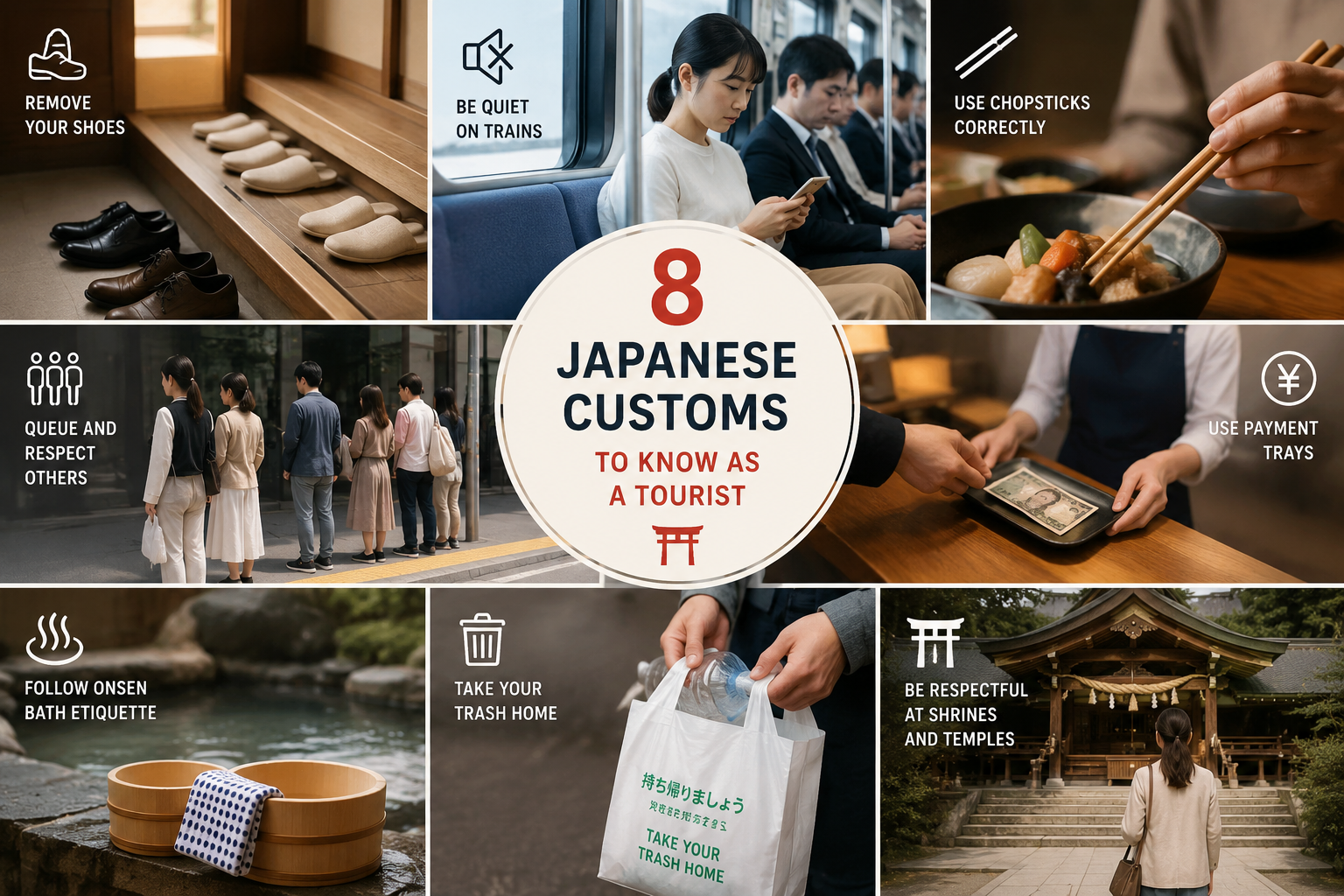
The train doors open at Shinjuku Station, and you step forward with your suitcase—only to realize that everyone else is standing to the side.
Passengers stream out first. Nobody pushes. Nobody loudly announces that they are in a hurry. The people waiting simply allow the carriage to empty, then board in the order marked by neat lines on the platform.
You move aside, slightly embarrassed, and join the queue.
Nothing dramatic has happened. Nobody is offended. But in that small moment, you have discovered something important about traveling in Japan: many customs are not complicated rituals. They are quiet systems that help millions of people share space without creating unnecessary friction.
Japanese etiquette is sometimes presented to tourists as a frightening list of rules. Do not do this. Never do that. Bow at precisely the right angle. Hold everything with two hands. Make one mistake, and an entire restaurant will fall silent.
Real life is much more forgiving.
Japanese people generally understand that international visitors do not know every local convention. An imperfect bow, hesitant chopstick technique, or confused moment at a shoe rack is unlikely to ruin anyone’s day. What matters more is whether you notice what is happening around you, respect posted instructions, and correct yourself when necessary.
The customs below are worth knowing because they help you avoid mistakes that are genuinely awkward, disruptive, or uncomfortable for others. More importantly, they reveal something about how everyday life in Japan works.
1. The Floor Is Telling You Whether Your Shoes Belong There
Imagine arriving at a traditional inn in Kyoto after a long day of walking. You enter through the front door and see a lower tiled area, a raised wooden floor, several pairs of neatly arranged shoes, and a row of slippers.
This is not merely an attractive entrance. It is a set of instructions.
The lower entrance area is called the genkan. It marks the boundary between the outside world and the clean interior. In private homes, traditional accommodations, some restaurants, temples, clinics, and certain fitting rooms, outdoor shoes remain at this boundary.
The easiest rule to remember is visual:
When the floor rises, your outdoor shoes usually do not rise with it.
Look for shoe shelves, slippers, signs, or other people’s footwear. If everyone else has removed their shoes, do the same.
At a ryokan or private home, you will often be given indoor slippers. However, those slippers should generally not be worn on tatami mats. Tatami traditionally serves as a surface for sitting, dining, and sleeping, so people usually step onto it in socks or bare feet.
Then there are toilet slippers.
Many homes, inns, and traditional establishments keep a separate pair of slippers inside the bathroom. You put them on when entering and leave them there when you exit.
Forgetting to change back is one of those classic embarrassments that can happen to visitors and Japanese people alike. You walk proudly into the dining room, only to notice that everyone is looking at the word “TOILET” printed across your feet.
It is embarrassing, but not catastrophic. Turn around, change your slippers, and laugh at yourself.
A useful question is:
靴を脱ぎますか?
Kutsu o nugimasu ka?
“Should I take off my shoes?”
You do not need to ask every time. Usually, the environment makes the answer obvious. But the phrase is helpful when the entrance is confusing or the building combines Western-style and traditional rooms.
Modern hotels, cafés, department stores, and chain restaurants normally allow shoes throughout. The custom is not “always remove your shoes in Japan.” It is “notice when you are crossing into a shoes-off space.”
That habit—looking before stepping—is more valuable than memorizing a long list of building types.
2. On Trains, Your Silence Becomes Part of the System
Visitors often notice how quiet Japanese commuter trains can be, even when every seat is occupied.
People read, sleep, look at their phones, or speak softly to companions. Phones are usually placed on silent mode, often called manner mode, and voice calls are avoided inside the carriage.
This does not mean that conversation is forbidden. You do not have to sit in total silence. But a loud phone call, animated group conversation, or video playing without headphones will stand out immediately.
The expectation is especially noticeable in Tokyo and other major cities, where enormous numbers of passengers depend on public transportation every day. A quiet carriage gives everyone a little psychological space, even when physical space is limited.
The choreography begins before you board.
Platforms usually have markings showing where lines should form. Stand in the queue, allow passengers to exit first, and then board in order. Do not plant yourself directly in front of the opening doors with your luggage.
Once inside, avoid blocking the doorway. Place smaller bags on your lap or use an overhead rack when appropriate. During busy periods, carrying a backpack in front of your body can prevent it from bumping other passengers.
Priority seats are intended for elderly passengers, pregnant passengers, people with disabilities, and others who may need them. Sitting there when the carriage is empty is not automatically scandalous, but remain alert and offer the seat promptly when someone needs it.
Eating also depends on the type of train.
On local commuter trains and city buses, people generally do not eat full meals. On the Shinkansen and many long-distance trains, however, eating an ekiben—a boxed meal purchased at a station—is completely normal and often part of the pleasure of the journey.
So the real distinction is not “never eat on a Japanese train.” It is the difference between a local shared commuting space and a long-distance travel environment designed for greater comfort.
When you need to move through a crowded carriage to reach the door, say:
すみません、降ります。
Sumimasen, orimasu.
“Excuse me, I’m getting off.”
A polite sumimasen often accomplishes more than physically squeezing through in silence.
3. A Queue May Be Marked on the Floor Rather Than Announced
In Japan, a line is not always obvious to a visitor.
At a station platform, the queue may be indicated by painted rectangles. At a bus stop, passengers may be standing in a narrow formation that looks casual but is actually ordered. Outside a ramen restaurant, people may wait along the wall so that they do not block the pavement.
The safest strategy is to pause before joining.
Look at the floor. Look at the direction people are facing. Notice whether someone who appears to be standing alone is actually the last person in a line.
You can ask:
すみません、並んでいますか?
Sumimasen, narande imasu ka?
“Excuse me, is this the line?”
Cutting in front of others can cause real irritation, particularly when people have been waiting for a popular restaurant, train, or attraction. Most people will not confront you aggressively, but that does not mean the mistake has gone unnoticed.
Escalators require similar observation.
Traditionally, passengers in Tokyo and much of eastern Japan stand on the left and leave the right side open. In Osaka and parts of the Kansai region, the opposite pattern has been common: stand on the right and pass on the left.
However, this is changing.
Some stations now encourage everyone to stand rather than walk on escalators, partly for safety and accessibility. A rigid “Tokyo left, Osaka right” rule is therefore less useful than it once was.
Follow the signs in front of you. If signs ask passengers not to walk, do not worry about preserving a passing lane. If everyone is clearly standing on one side, follow their pattern and keep your luggage close.
This is an excellent example of why cultural awareness is not the same as memorizing trivia. The person who remembers an old regional rule but ignores a current safety sign is not being more culturally sensitive than the person who simply pays attention.
4. Street Food Is Not Forbidden—but Carrying Your Rubbish Is Your Responsibility
One of the most exaggerated claims about Japan is that eating while walking is always rude.
There is some truth behind the idea. People often prefer to stop near the place where they bought food rather than walk through a crowded street while eating something messy. On ordinary pavements and local public transportation, eating can appear careless or inconvenient to others.
But context matters.
At festivals, food markets, tourist streets, and designated eating areas, outdoor eating is expected. An ice cream, small snack, or festival food is not automatically a cultural violation. Many vendors simply prefer customers to finish nearby, where rubbish can be collected and the surrounding streets stay clean.
The more practical challenge is the shortage of public rubbish bins.
Visitors may buy a drink, finish it, and then carry the empty bottle for the next hour. This surprises people accustomed to seeing bins on every street corner.
A small bag for wrappers and other rubbish is genuinely useful when traveling in Japan. Keep your waste until you find an appropriate disposal point at a station, hotel, convenience store, or designated collection area.
Bins may be divided into categories for bottles, cans, plastics, or combustible rubbish. Follow the pictures when the Japanese labels are difficult to read.
To ask for a bin, say:
ゴミ箱はどこですか?
Gomibako wa doko desu ka?
“Where is a rubbish bin?”
Littering is more serious than eating a snack while walking. The underlying value is not perfect table manners. It is responsibility for the condition of shared space.
Smoking follows a similar principle. Walking while smoking is prohibited in many urban areas, and some districts impose fines. Use designated smoking areas rather than assuming that an outdoor street is automatically acceptable.
When unsure whether you can eat where you are standing, ask:
ここで食べてもいいですか?
Koko de tabete mo ii desu ka?
“Is it all right to eat here?”
That question is more useful than trying to apply one absolute rule to every station, market, shrine approach, and shopping street in Japan.
5. Put the Money on the Tray—and Keep the Tip
At a small shop, café, hotel, or restaurant, you may see a shallow tray beside the register. Place your cash or card on it rather than automatically handing it directly to the employee.
The staff member will usually return your change, card, and receipt using the same tray.
This is not a deeply sacred ritual. If you absentmindedly hand over your card, nobody will be shocked. Some employees will accept it directly. But using the tray matches the rhythm of the transaction and prevents the awkward moment when both people reach in different directions.
Payment trays also reflect a broader preference for creating a clear, polite boundary between customer and employee.
Tipping creates more confusion.
In most restaurants, taxis, cafés, and hotels in Japan, tipping is neither required nor expected. Excellent service is treated as part of the professional standard rather than an extra service purchased through gratuity.
A visitor may leave money on a table intending to be generous, only to have a staff member hurry outside to return what they believe was forgotten cash.
The polite response to good service is usually verbal appreciation:
ありがとうございます。
Arigatō gozaimasu.
“Thank you very much.”
You can also support a business with a positive review or a return visit.
In some high-end or specialized contexts, a carefully presented gift or gratuity may be appropriate, but that is not something the average tourist needs to navigate. For ordinary travel, do not tip unless a specific service explicitly indicates otherwise.
Another small surprise is that some restaurants prefer one payment per table. Splitting the bill may be possible, particularly in modern or tourist-oriented establishments, but it should not be assumed.
You can ask:
割り勘できますか?
Warikan dekimasu ka?
“Can we split the bill?”
Be prepared for the answer to be no, especially at busy or smaller businesses.
6. Chopstick Etiquette Is Simpler Than the Internet Makes It Sound
Visitors are often warned about chopsticks as though every movement carries profound symbolic meaning.
Most of the time, Japanese dining is not that fragile.
Holding chopsticks imperfectly is not a moral failure. Dropping a piece of food is not a diplomatic incident. If you are struggling, asking for a fork is better than spending the entire meal in panic.
A few taboos are worth remembering because they are connected to funeral practices.
Do not leave chopsticks standing upright in a bowl of rice. This resembles rice offerings made for the dead.
Do not pass food directly from your chopsticks to another person’s chopsticks. During Japanese funeral rites, cremated bones may be passed between family members using chopsticks, which gives the dining gesture an uncomfortable association.
Beyond those two major taboos, use ordinary consideration. Do not point at people with chopsticks, wave them while speaking, drum with them, or stab repeatedly at food as though they were miniature spears.
When you pause, place them on the chopstick rest if one is provided. If there is no rest, lay them neatly across the edge of a small plate rather than planting them in the rice.
For shared dishes, serving utensils may be provided. Use them when available. In casual settings, your companions may have their own preferred way of transferring food, so observe rather than insisting on one theoretical rule.
To ask for a fork, say:
フォークをお願いします。
Fōku o onegai shimasu.
“A fork, please.”
Or, with a little self-deprecating honesty:
お箸が難しいです。
Ohashi ga muzukashii desu.
“Chopsticks are difficult for me.”
Most restaurant staff would rather help you enjoy the meal than judge your technique.
And no, you are not required to slurp noodles. Slurping is accepted and common, but eating quietly is also fine. You do not need to manufacture a loud performance to prove that you understand the culture.
7. An Onsen Is a Bath, Not a Swimming Pool
Public bathing can be one of the most memorable experiences in Japan—and one of the most intimidating for a first-time visitor.
The central rule is straightforward:
You wash before entering the communal bath.
The large bath is for soaking and relaxing, not for cleaning your body.
After undressing in the changing room, go to the washing stations. Sit on the small stool, rinse yourself, wash thoroughly with soap and shampoo, and rinse away all soap before entering the bath.
In a traditional nude bathing area, do not wear a swimsuit unless the facility specifically requires bathing clothing. Keep long hair tied up so that it does not enter the water.
You may receive a small towel. Do not place it in the bath. Leave it at the side or fold it on top of your head, as many bathers do.
Phones and cameras should remain outside the bathing area. Even a harmless attempt to photograph the architecture can violate other guests’ privacy.
The atmosphere is usually calm. People may speak quietly, but the bath is not a place for splashing, swimming, or energetic play.
Tattoo policies vary greatly.
The statement “tattoos are banned in every Japanese bath” is outdated and inaccurate. Some onsen still prohibit them because tattoos have historically been associated with organized crime. Others permit small tattoos, offer covering patches, welcome tattooed visitors, or provide private baths.
Municipal sentō may have different policies from luxury resort onsens. Always check the facility’s website or ask at reception.
A useful phrase is:
タトゥーは大丈夫ですか?
Tattoo wa daijōbu desu ka?
“Are tattoos all right?”
First-time visitors can also say:
温泉は初めてです。
Onsen wa hajimete desu.
“It is my first time at an onsen.”
That sentence gives staff an opportunity to explain the process. Asking is far less embarrassing than confidently guessing.
Entering the bath without washing, ignoring a clearly stated tattoo policy, or bringing a camera into the bathing area can cause genuine discomfort. Placing your towel in the wrong spot for a moment is a minor procedural mistake that can be corrected.
The difference is intention and impact.
8. A Shrine Is Still a Sacred Place Even When It Is Famous on Instagram
Fushimi Inari’s red torii gates, Sensō-ji’s lanterns, and the historic streets of Kyoto appear in millions of photographs. Their popularity can make it easy to forget that many shrines and temples remain active religious sites.
People are not only sightseeing there. They are praying, making offerings, attending rituals, mourning, celebrating, and participating in living traditions.
At a Shinto shrine, many visitors bow lightly before passing through a torii gate and avoid walking through the exact center, which is traditionally regarded as a path for the deity. Nobody expects a foreign visitor to perform this perfectly, but moving calmly and respectfully is appropriate.
You may also see a water basin called a temizuya or chōzuya, where visitors purify their hands before approaching the main shrine.
The usual sequence is to rinse the left hand, then the right hand, rinse the mouth without touching the ladle to your lips, and finally rinse the ladle handle. However, do not become so preoccupied with performing every step flawlessly that you block the basin or turn the ritual into a photo shoot.
At both shrines and Buddhist temples, obey posted photography rules. Outdoor photography is often welcome, but certain inner halls, statues, ceremonies, and sacred objects may not be photographed.
A crossed-out camera symbol is not an invitation to take one quick picture while nobody is looking.
Ask before photographing monks, worshippers, performers, or other individuals:
写真を撮ってもいいですか?
Shashin o totte mo ii desu ka?
“May I take a photograph?”
This matters beyond religious sites as well. In heavily visited neighborhoods, particularly in Kyoto, residents have grown frustrated with visitors photographing private homes, blocking narrow streets, chasing geisha or maiko, and treating ordinary people as scenery.
The issue is not photography itself. It is whether the photograph intrudes on somebody else’s worship, work, privacy, or movement.
A beautiful picture does not require making the person beside you uncomfortable.
The Four Phrases That Repair Most Small Mistakes
Etiquette is partly behavioral, but language can soften an awkward moment before it becomes a problem.
You do not need advanced Japanese to show that you are paying attention. Four expressions can carry you through a surprising number of situations.
すみません — Sumimasen
This can mean “excuse me,” “I’m sorry,” or even a grateful “thank you for the trouble.”
Use it when passing through a crowd, getting someone’s attention, apologizing for a small mistake, or asking a question.
It is perhaps the single most useful word for a traveler in Japan.
ありがとうございます — Arigatō gozaimasu
This is the polite form of “thank you.”
Use it after receiving directions, completing a purchase, being served, or getting help. Your pronunciation does not have to be perfect for the gesture to be appreciated.
大丈夫です — Daijōbu desu
Depending on context, this can mean “I’m fine,” “It’s all right,” or “No, thank you.”
It is useful when politely declining a bag, extra item, refill, or offer of assistance.
Because the phrase can also mean that something is acceptable, pay attention to context and accompany it with a small gesture when necessary.
失礼します — Shitsurei shimasu
Literally, this means something like “I am being rude” or “Excuse my intrusion.”
It is used when entering a room, interrupting, passing in front of someone, or leaving certain formal situations. Tourists may not use it frequently, but recognizing it reveals something about Japanese politeness: the speaker acknowledges that their movement affects another person.
These expressions do not merely translate information. They manage relationships.
That is something adult learners often begin to notice when studying Japanese. A word such as sumimasen cannot be reduced to one English equivalent because its meaning changes with the social situation. Learning the vocabulary also means learning to recognize what the speaker is doing—apologizing, requesting attention, expressing gratitude, or smoothing over a small inconvenience.
What Japanese People Usually Forgive—and What Actually Bothers Them
A tourist who bows awkwardly is usually harmless.
A tourist who loudly argues with train staff because a rule is inconvenient is not.
A visitor who briefly forgets to remove slippers before stepping onto tatami can correct the mistake. A visitor who ignores multiple signs, watches other people remove their shoes, and walks in anyway appears careless.
This distinction is useful because it prevents etiquette anxiety.
Japanese people do not generally expect travelers to understand every local custom. They are much more likely to forgive:
an imperfect bow;
hesitant or grammatically incorrect Japanese;
clumsy chopstick use;
uncertainty at a shoe entrance;
a confused moment when sorting rubbish;
an incomplete shrine purification ritual.
Behavior becomes more serious when it directly disrupts other people or continues after clear guidance. Examples include shouting on public transportation, cutting lines, littering, ignoring photography restrictions, filming people without permission, entering a communal bath without washing, blocking pathways for photographs, or arguing aggressively with staff.
The goal is not perfection. It is responsiveness.
Notice. Adjust. Apologize when necessary. Continue with your day.
The Best Etiquette Strategy Is to Read the Room
Travel guides are useful, but Japanese daily life varies.
A modern Tokyo café does not function like a Kyoto tea house. A rural bus may be more conversational than a rush-hour commuter train. A municipal sentō may have a more relaxed tattoo policy than a resort onsen. A festival food stall is not the same as a quiet local train.
When you are uncertain, look for three things:
What are other people doing?
Are they removing their shoes, forming a queue, speaking softly, or waiting to eat?
What does the space communicate?
Are there floor markings, slippers, pictograms, barriers, or multilingual signs?
Who might be affected by your choice?
Would you block a doorway, interrupt a ritual, create noise, or make someone feel photographed without consent?
This approach is more flexible than carrying a mental catalogue of prohibitions.
It also connects naturally to language study. At Polyglottist Language Academy, we believe that studying Japanese is not only about verb forms, writing systems, and vocabulary lists. Students also begin to notice how communication is shaped by context: why a gentle phrase works better than a blunt refusal, why silence can communicate consideration, and why a small word like sumimasen appears in so many different situations.
Our Japanese classes online are designed for adult learners who want to understand both the language and the cultural details that give it meaning. Even basic Japanese can make travel feel less like moving through a series of transactions and more like participating in daily life.
Related Reading
Why Learn Japanese? 8 Genuinely Great Reasons Americans Are Studying It In 2026
10 Traditional Japanese Dishes Every American Should Try At Least Once
What Is Anime? A Complete Beginner's Guide To Japanese Animation
Frequently Asked Questions About Japanese Etiquette
Will Japanese people be offended if I make an etiquette mistake?
Usually not, especially when the mistake is clearly accidental. Visitors are not expected to understand every custom. Correcting yourself, following signs, and saying sumimasen are normally enough.
Do tourists need to bow in Japan?
You do not need to master formal bowing. A small nod is appropriate in many everyday interactions, and Japanese people often understand that visitors may be more accustomed to handshakes. Avoid exaggerated or theatrical bowing.
Is it rude to speak English in Japan?
No. The problem is not speaking English but assuming that every person must understand it. Begin politely, speak clearly, avoid becoming louder when someone does not understand, and use simple Japanese phrases when possible.
Can I eat while walking in Japan?
Sometimes. It is generally better to stop near the vendor or use a designated eating space, particularly with messy food. At festivals, markets, and certain tourist areas, outdoor eating is common. Avoid eating full meals on local trains and buses.
Is it rude to finish all the food on my plate in Japan?
No. Finishing your meal is generally acceptable and often appreciated. You do not need to leave food behind to be polite. Try not to order far more than you can eat.
Can tourists use public baths and onsens?
Yes, provided they follow the facility’s rules. Wash before entering the bath, keep towels and hair out of the water, leave phones outside, and check tattoo policies in advance.
Do I need to speak Japanese to travel respectfully?
No, but a few phrases make interactions easier. Sumimasen, arigatō gozaimasu, and simple questions show consideration and often encourage people to help you.
Continue Learning with Polyglottist Language Academy
At Polyglottist Language Academy, our Japanese classes help adult learners develop practical communication skills while understanding the cultural details behind the language. Whether you are preparing for a trip to Japan, exploring the culture more deeply, or beginning a long-term language goal, our small-group classes offer a supportive and engaging way to study Japanese in Berkeley or online.