
Why Learn Japanese? 8 Genuinely Great Reasons Americans Are Studying It in 2026
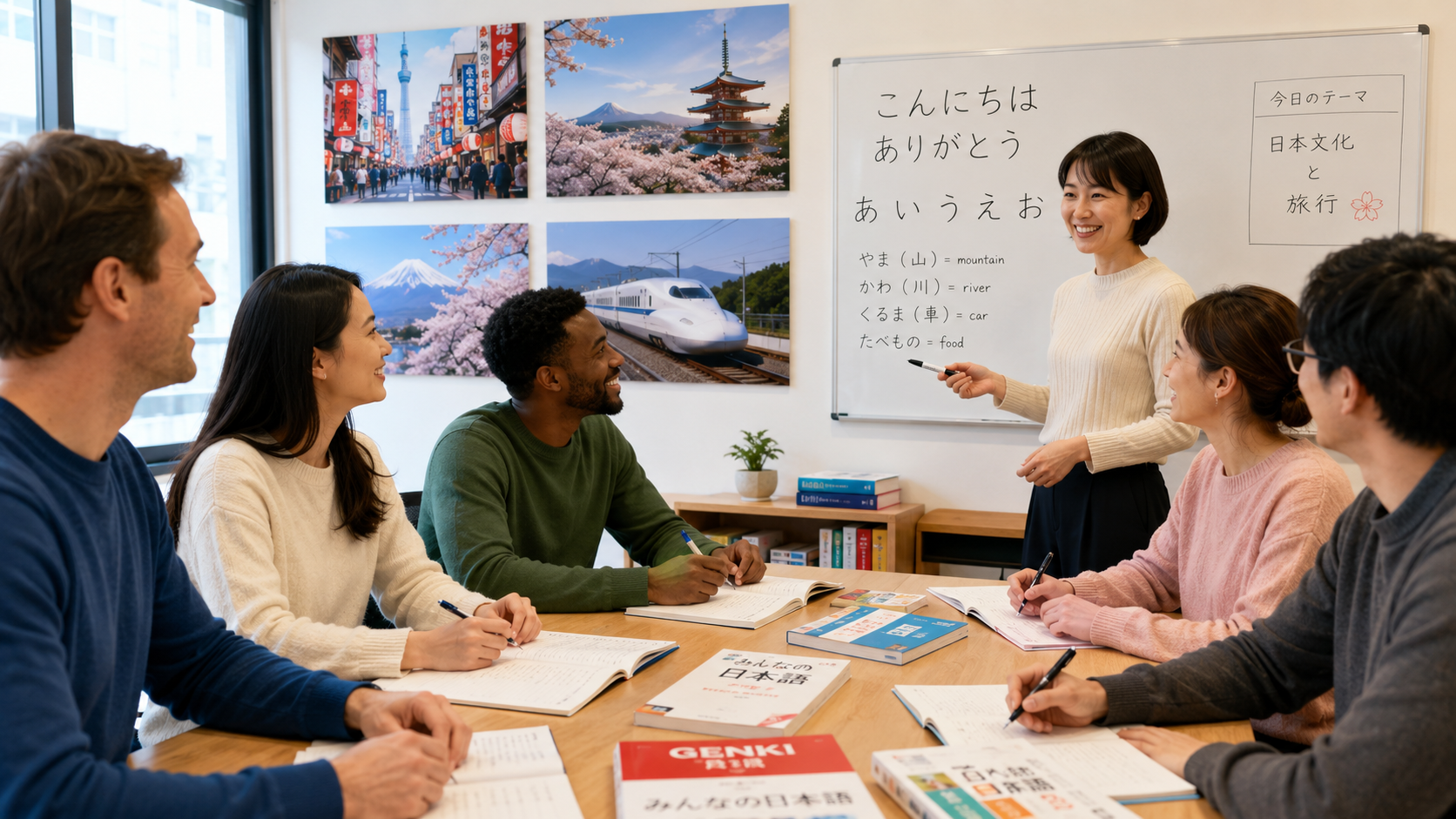
Why learn Japanese in 2026?
For some people, the answer begins with anime. For others, it begins with a dream trip to Tokyo, Kyoto, Osaka, Hokkaido, or Okinawa. For some, it starts with Japanese food, design, literature, video games, martial arts, business, technology, or a deep fascination with a culture that feels both highly modern and deeply rooted in tradition.
But for many Americans studying Japanese today, the real answer is bigger than one interest.
Japanese is not just a language people study because it is useful. It is a language people study because it opens a world.
It opens the world of Japan itself: the temples, trains, convenience stores, tea houses, bookstores, izakaya, neighborhoods, mountain villages, festivals, and everyday rituals that make Japan so unforgettable. It opens the world of Japanese culture: its aesthetics, politeness, humor, indirectness, attention to detail, and deep respect for context. It opens the world of Japanese media: anime, manga, video games, films, music, novels, dramas, and internet culture. It also opens the world of connection—with teachers, classmates, travelers, professionals, artists, fans, and Japanese speakers around the world.
In 2026, Americans are studying Japanese for more reasons than ever. Some want to travel more confidently. Some want to understand their favorite shows without relying completely on subtitles. Some want career advantages in technology, gaming, business, translation, design, education, or international relations. Some are heritage learners reconnecting with family history. Some simply want a meaningful intellectual challenge—something that gives structure, depth, and joy to their week.
Japanese has a reputation for being difficult, and yes, it is different from English. It uses three writing systems. It has particles instead of the word order English speakers expect. It has levels of politeness that require you to think carefully about relationship, tone, and social situation. It contains thousands of kanji characters. It asks you to listen differently, read differently, and sometimes even think differently.
But that is exactly why so many learners find it rewarding.
Japanese is not a language you “hack” in a weekend. It is a language you grow into. At first, you learn greetings. Then you recognize hiragana. Then you can read a menu. Then you understand a line in a song. Then you catch a joke in anime. Then you realize you can introduce yourself, ask for directions, describe your interests, or read a simple manga panel without translating every word. Each step feels small, but together, they become something powerful.
For adult learners especially, Japanese offers something rare: a long-term project that is both practical and personal. It can help you travel. It can support your career. It can connect you with culture and community. But it can also become a source of private satisfaction—a language you return to because it keeps surprising you.
So, why learn Japanese? Here are eight genuinely great reasons Americans are studying Japanese in 2026.
1. Japanese Gives You Deeper Access to One of the World’s Most Fascinating Cultures
Many people first become interested in Japan through food, travel, film, anime, design, or history. But the deeper you go, the more you realize that language is not separate from culture. Japanese is one of the clearest examples of this.
The language reflects how people relate to one another. It reflects politeness, social hierarchy, humility, indirect communication, emotional restraint, gratitude, apology, and respect. Even simple phrases often carry layers of meaning that do not translate neatly into English.
Take よろしくお願いします, for example. It is one of the most useful phrases in Japanese, but it has no single English equivalent. Depending on the situation, it can mean “nice to meet you,” “I look forward to working with you,” “please take care of this,” “thank you in advance,” or simply a polite way of acknowledging a relationship or shared responsibility. You can translate the words, but not the feeling completely.
The same is true of すみません. Beginners often learn it as “excuse me” or “sorry,” but in real life, it can also express gratitude. If someone goes out of their way to help you, すみません can carry the feeling of “I’m sorry to trouble you, and thank you.” That blend of apology and appreciation tells you something about Japanese social interaction.
Learning Japanese also gives you access to ideas such as omotenashi, often described as thoughtful hospitality; mottainai, a sense of regret over waste; wabi-sabi, an appreciation of imperfection and impermanence; and ganbaru, the idea of persevering and doing your best. These words are not just vocabulary. They are windows into cultural values.
Of course, you can enjoy Japanese culture in translation. You can watch Japanese films, eat ramen, visit museums, read translated novels, and travel with English-language guides. But learning Japanese changes the experience. You begin to notice details that were previously invisible. You understand why people choose certain phrases. You hear levels of politeness. You recognize humor, hesitation, warmth, and social distance.
Japanese culture is admired around the world for its beauty, precision, creativity, and depth. The language gives you a way to participate in that culture more respectfully and more directly.
2. Anime, Manga, Games, and Pop Culture Become Much More Rewarding
Let’s be honest: for many American learners, Japanese begins with pop culture.
Anime, manga, Japanese video games, J-pop, J-dramas, voice acting, fashion, online fandoms, and internet culture have introduced millions of people to Japanese. For some learners, a favorite anime is the first time they hear the language. For others, a video game, song, manga series, or film creates the first spark.
There is nothing shallow about that. Pop culture is one of the most powerful gateways into language learning because it gives learners emotional motivation. You are not memorizing words in isolation. You are learning because you want to understand something you already love.
When you study Japanese, anime and manga become richer. You start to hear how characters speak differently depending on personality, age, gender, social role, and emotional state. A rough character may use casual or masculine speech. A polite character may use formal endings. A child may speak differently from a teacher. A villain may use elevated or old-fashioned language. Friends may drop polite forms. Strangers may maintain distance. These differences can be hard to capture in subtitles.
Honorifics are another example. Words like -san, -kun, -chan, -sama, and sensei communicate relationship, respect, affection, hierarchy, or formality. English translations often remove them or replace them awkwardly, but in Japanese they are part of the emotional structure of a scene.
Then there is wordplay. Japanese is full of puns, sound symbolism, double meanings, and jokes based on kanji readings or homophones. Many jokes simply cannot be translated directly. A translator may create a new joke in English, but the original flavor changes.
The same is true in video games. Japan has had an enormous influence on global gaming, and Japanese appears in game dialogue, developer interviews, fan communities, art books, strategy guides, and original scripts. A learner who knows Japanese can experience these worlds in a different way.
Studying Japanese does not mean you must give up subtitles or translations. It means you slowly gain another layer of access. At first, you recognize greetings and repeated phrases. Later, you catch familiar grammar. Eventually, you hear tone, humor, politeness, and character voice more clearly.
For anime, manga, and gaming fans, Japanese turns passive enjoyment into active discovery.
3. Japan Is One of the Most Exciting Travel Destinations in the World
Japan is high on many Americans’ travel lists, and it is easy to understand why.
Few countries offer such a powerful combination of tradition and modernity. You can spend the morning walking through a quiet temple garden in Kyoto and the evening surrounded by neon lights in Tokyo. You can ride one of the world’s most famous train systems, eat extraordinary food at every price point, visit ancient shrines, explore mountain villages, relax in an onsen, shop in design-forward neighborhoods, and discover regional cultures that feel very different from one another.
Tokyo, Kyoto, Osaka, Nara, Hiroshima, Hokkaido, Okinawa, Kanazawa, Fukuoka, and countless smaller towns all offer different versions of Japan. But the more you leave the most tourist-centered areas, the more useful Japanese becomes.
You do not need to be fluent to benefit from Japanese while traveling. Even basic Japanese can change your trip.
If you can read hiragana and katakana, signs and menus become less intimidating. If you know simple food vocabulary, ordering becomes more enjoyable. If you can ask where the station is, whether something contains meat, or how much something costs, you feel more independent. If you know polite phrases, your interactions become warmer.
Travel Japanese also helps you behave more respectfully. Japan has many social customs around greetings, shoes, trains, temples, shrines, bathing, restaurants, gift-giving, and public space. Language study often teaches these cultural expectations alongside grammar and vocabulary. That means you are not only learning what to say; you are learning how to move through the culture with greater awareness.
For example, knowing when to say ありがとうございます, すみません, お願いします, or 失礼します can make everyday interactions feel smoother. You may still make mistakes, but people often appreciate the effort.
Japanese is especially useful in smaller restaurants, family-run inns, rural train stations, local buses, traditional shops, and neighborhoods where English signage may be limited. In big tourist areas, you can often manage with English. But with Japanese, your trip becomes less dependent on translation apps and more open to spontaneous experiences.
You can ask a shopkeeper for a recommendation. You can understand basic signs. You can recognize regional foods. You can greet people politely. You can say more than “thank you” and “hello.”
For travelers, Japanese is not just a tool. It is a way of making the trip more human.
4. Japanese Can Support Career Opportunities
Japanese is also worth learning for professional reasons.
Japan remains one of the world’s major economies, with global influence in automotive manufacturing, robotics, electronics, gaming, animation, design, technology, architecture, fashion, education, finance, tourism, and international trade. Many Japanese companies have a presence in the United States, and many American companies work with Japanese partners, clients, suppliers, students, creators, or audiences.
That means Japanese can be useful even if you never plan to move to Japan.
For professionals in technology, Japanese may help when working with Japanese teams, companies, documentation, or users. For people in gaming, animation, film, or media, Japanese can support localization, translation, cultural consulting, production, marketing, or fan engagement. For business professionals, Japanese can help with relationship-building and cross-cultural communication. For teachers and academic professionals, Japanese can open doors in language education, East Asian studies, cultural programming, and study-abroad work.
Japanese can also be useful in tourism, hospitality, international education, museums, libraries, publishing, nonprofits, diplomacy, and cultural exchange.
Of course, Japanese alone does not automatically create a career. Language is strongest when combined with another skill: design, business, coding, teaching, law, engineering, marketing, translation, research, or project management. But that is exactly why it can be powerful. If you already have a professional field, Japanese may help you stand out within that field.
For example, a software engineer with Japanese skills may be better prepared to work with Japanese clients or teams. A marketing professional may better understand Japanese consumer culture. A museum educator may develop stronger programming around Japanese art. A game designer may better understand the language and cultural assumptions behind Japanese games. A translator or localization specialist may build a career around Japanese media.
Japanese is often considered a “less commonly taught” language in the United States compared with Spanish or French, which means fewer Americans reach high proficiency. That can make serious learners more distinctive.
Even if career is not your main reason for studying Japanese, it is a real benefit. Language skills show curiosity, discipline, cultural awareness, and long-term commitment—all qualities that matter professionally.
5. Japanese Teaches You a Different Way of Thinking
One of the most interesting reasons to learn Japanese is that it trains your mind to work differently.
English and Japanese are structurally very different. English speakers are used to sentences where the subject and verb appear early. Japanese often places the verb at the end. English relies heavily on word order. Japanese relies heavily on particles. English often states subjects directly. Japanese often leaves them out when context makes them clear.
At first, this can feel confusing. You may understand each word individually but still struggle to process the sentence. But over time, your brain adapts. You begin to wait for the verb. You begin to notice particles. You begin to pay attention to what is implied rather than what is explicitly stated.
This is more than grammar. It changes how you listen.
Japanese communication often depends on context, shared understanding, indirectness, and social relationship. Speakers may soften statements. They may avoid saying “no” directly. They may use set phrases that carry social meaning beyond their literal translation. They may choose different levels of politeness depending on the situation.
Learning this requires cultural sensitivity. You must ask: Who am I speaking to? What is our relationship? Is this formal or casual? Am I making a request? Am I apologizing? Am I showing respect? Am I being too direct?
For English speakers, this can be challenging in the best possible way. Japanese teaches patience. It teaches attention to nuance. It teaches you that communication is not only about information; it is also about relationship.
It also helps you become more comfortable with ambiguity. In English, learners often want every sentence to map neatly onto a translation. Japanese resists that. A phrase may depend on context. A subject may be omitted. A word may carry cultural weight. A sentence may be grammatically simple but socially complex.
This is why many learners say Japanese changes how they think. It encourages careful listening, humility, and mental flexibility. It reminds you that your own language is not the default structure of reality. There are other ways to organize thought, relationship, and meaning.
That realization is one of the great gifts of language learning.
6. Japanese Is Challenging, But More Learnable Than People Think
Japanese has a reputation for being hard, and that reputation is not completely wrong.
For English speakers, Japanese presents real challenges. The writing system includes hiragana, katakana, and kanji. Kanji takes time. Particles can feel confusing at first. Sentence structure is unfamiliar. Politeness levels require practice. Listening to natural spoken Japanese can be difficult, especially when people speak quickly or casually.
But “hard” does not mean impossible. It also does not mean every part of Japanese is equally hard.
In fact, some parts of Japanese are surprisingly beginner-friendly.
Japanese pronunciation is relatively approachable for English speakers compared with many languages. The sound system is fairly consistent, and once you learn hiragana, the relationship between sound and writing is much clearer than English spelling. Japanese does not have grammatical gender like French, Spanish, Italian, or German. It does not use articles like “a,” “an,” and “the” in the same way English does. Plural forms are often simpler than learners expect. Verbs do not change according to person in the same way they do in many European languages.
That means beginners can start communicating with simple sentence patterns fairly early. You can learn greetings, introductions, likes and dislikes, basic questions, food vocabulary, numbers, time expressions, and travel phrases without mastering every kanji or advanced grammar point.
The problem is not that Japanese is unlearnable. The problem is that many people try to learn it without structure.
They download several apps, watch random videos, buy three textbooks, start kanji too aggressively, skip pronunciation, avoid speaking, and then feel overwhelmed. A better approach is slower and clearer: learn pronunciation, master hiragana and katakana, build basic sentence patterns, practice speaking from the beginning, add kanji gradually, and review consistently.
Japanese rewards steady effort. You do not need to be brilliant. You need guidance, patience, and regular practice.
The challenge is also part of the appeal. When you read your first sentence in hiragana, it feels exciting. When you recognize your first kanji in the wild, it feels like a secret door opening. When you understand a line in a song or anime without subtitles, it feels earned.
Japanese is difficult enough to be meaningful, but structured enough to be learnable.
7. Japanese Connects You to Community
Language learning is often imagined as something solitary: a person sitting at a desk with flashcards, notebooks, apps, and textbooks. But Japanese can also be deeply social.
Across the United States, Japanese learners connect through classes, university programs, conversation groups, cultural festivals, online communities, anime clubs, language exchanges, and travel communities. In places like the Bay Area, there are especially rich opportunities to connect with other learners and people interested in Japanese culture.
Berkeley, Oakland, San Francisco, San Jose, and the wider Bay Area have long-standing connections to Japanese language and culture through universities, community colleges, cultural organizations, restaurants, bookstores, events, and local communities. For students in this region, Japanese is not only something far away. It is also something you can study, practice, and enjoy locally.
A good Japanese class gives you more than information. It gives you accountability and shared progress. You meet other learners who also struggle with particles, celebrate their first hiragana sentence, laugh at pronunciation mistakes, and slowly build confidence. That shared experience matters.
For adult learners especially, this can be surprisingly valuable. Many adults want to learn Japanese but feel intimidated starting alone. They may worry they are too old, too busy, too slow, or too far behind. In a supportive small class, those fears become easier to manage. You see that other people are also beginners. You practice together. You ask questions. You make mistakes in a safe environment.
Japanese also connects people online. Learners join communities focused on anime, manga, travel, JLPT preparation, Japanese cooking, calligraphy, literature, gaming, and conversation practice. Some use Japanese to make friends before traveling. Others use it to maintain long-distance friendships after study abroad or work experiences.
Language gives relationships more depth. Even simple Japanese can change the tone of an interaction. It shows effort. It shows respect. It says, “I am willing to meet you partway.”
That is one of the most beautiful reasons to learn Japanese: it is not only about understanding Japan. It is about connecting with people.
8. Japanese Is a Long-Term Personal Project That Never Gets Boring
Some languages are learned for immediate practicality. Japanese can certainly be practical, but it also offers something deeper: a long-term intellectual and personal journey.
Japanese is ideal for people who enjoy layered learning. There is always another level. First, you learn hiragana. Then katakana. Then basic kanji. Then particles. Then verb forms. Then casual speech. Then polite speech. Then honorifics. Then idioms. Then regional variation. Then literature, film, history, calligraphy, poetry, business Japanese, or specialized vocabulary.
You never really run out of things to discover.
For some learners, this is exactly what makes Japanese satisfying. It is not a short-term hobby that becomes boring after a few months. It can grow with you for years. Your goals can evolve. At first, you may want to survive a trip to Japan. Later, you may want to read manga. Then you may want to watch dramas without subtitles. Then you may want to pass a JLPT level. Then you may want to read essays, understand interviews, or have deeper conversations with native speakers.
Japanese also connects beautifully with other interests. If you love food, you can study Japanese through menus, cooking videos, regional dishes, and restaurant culture. If you love history, you can explore samurai culture, the Meiji period, wartime history, or postwar Japan. If you love literature, you can work toward reading authors in the original. If you love design, you can study architecture, fashion, minimalism, packaging, and aesthetics. If you love martial arts, tea ceremony, ceramics, gardens, or film, Japanese gives you a richer vocabulary for those worlds.
This makes Japanese especially rewarding for adults. Many adults do not want another shallow distraction. They want something meaningful, something that gives their mind structure and their week a sense of progress. Japanese can become that.
It is like learning a musical instrument, training for a marathon, or studying art history. The process matters. The discipline matters. The small improvements matter.
And unlike many goals, Japanese does not have to end. There is always another book, phrase, kanji, conversation, film, or cultural idea waiting for you.
Common Objections to Learning Japanese
Is Japanese too hard?
Japanese is challenging, especially for English speakers, because the writing system, grammar, particles, and politeness levels are very different from English. But it is not impossible. Many parts of Japanese are logical and consistent once you understand the system. The key is to start with a clear foundation instead of trying to learn everything at once.
Can I learn Japanese as an adult?
Yes. Adults can absolutely learn Japanese. In fact, adult learners often bring strong motivation, cultural curiosity, study discipline, and clear goals. You do not need to start as a child to make real progress. What matters most is consistency, good instruction, and regular practice.
Do I need Japanese if I only want to travel to Japan?
You can travel to Japan without speaking Japanese, especially in major tourist areas. However, even basic Japanese makes travel smoother, warmer, and more independent. Greetings, polite phrases, food vocabulary, numbers, directions, and basic reading skills can make a big difference.
How long does it take to become conversational in Japanese?
It depends on your goals, study schedule, and practice habits. With consistent classes and review, many learners can begin having simple conversations within months. Building stronger conversational ability usually takes longer, especially if you want to understand natural spoken Japanese. The best goal is steady progress rather than instant fluency.
Is Japanese useful outside Japan?
Yes. Japanese can be useful in the United States in fields such as business, technology, gaming, animation, translation, localization, education, tourism, design, cultural programming, and international relations. It also connects learners to Japanese communities, cultural events, online groups, and global media.
Should I learn Japanese online or in person?
Both options can work well. Online Japanese classes are flexible and convenient, especially for busy adults or students outside the Bay Area. In-person classes offer direct classroom energy, local community, and face-to-face interaction. The best choice depends on your schedule, location, learning style, and goals.
Do I need to learn kanji right away?
You do not need to master kanji immediately, but you should not ignore it forever. A good beginner path usually starts with pronunciation, hiragana, katakana, basic phrases, and simple grammar. Kanji can be introduced gradually so it feels manageable rather than overwhelming.
Can anime and manga really help me learn Japanese?
Yes, but they work best as a supplement, not your only method. Anime and manga can build motivation, listening exposure, vocabulary, and cultural understanding. However, they often include casual, stylized, dramatic, or character-specific speech, so learners still need structured lessons to understand grammar, politeness, and real-life usage.
Learn Japanese with Polyglottist Language Academy
If you have been thinking about learning Japanese, 2026 is a wonderful time to begin.
At Polyglottist Language Academy, we offer Japanese classes for adults and motivated learners who want a serious but supportive learning experience. Our classes are small, interactive, and designed to help students build a real foundation step by step. We focus not only on grammar and vocabulary, but also on pronunciation, conversation, writing systems, cultural context, and the confidence to actually use the language.
We offer Japanese classes online, so students can learn from anywhere, and we also offer in-person Japanese classes in Berkeley for learners in Berkeley, Oakland, San Francisco, San Jose, and the wider Bay Area. Whether you are learning Japanese for travel, anime and manga, career goals, personal enrichment, family heritage, or lifelong curiosity, we would be happy to help you find the right place to start.
If you are ready to begin your Japanese learning journey, explore our current Japanese classes at Polyglottist Language Academy and join a supportive community of learners who are discovering the language one step at a time.
Read More on Our Blog
If you enjoyed this article, you may also like these related posts from the Polyglottist Language Academy blog: