
Learn Vietnamese in San Jose: A Beginner’s Guide for Bay Area Students
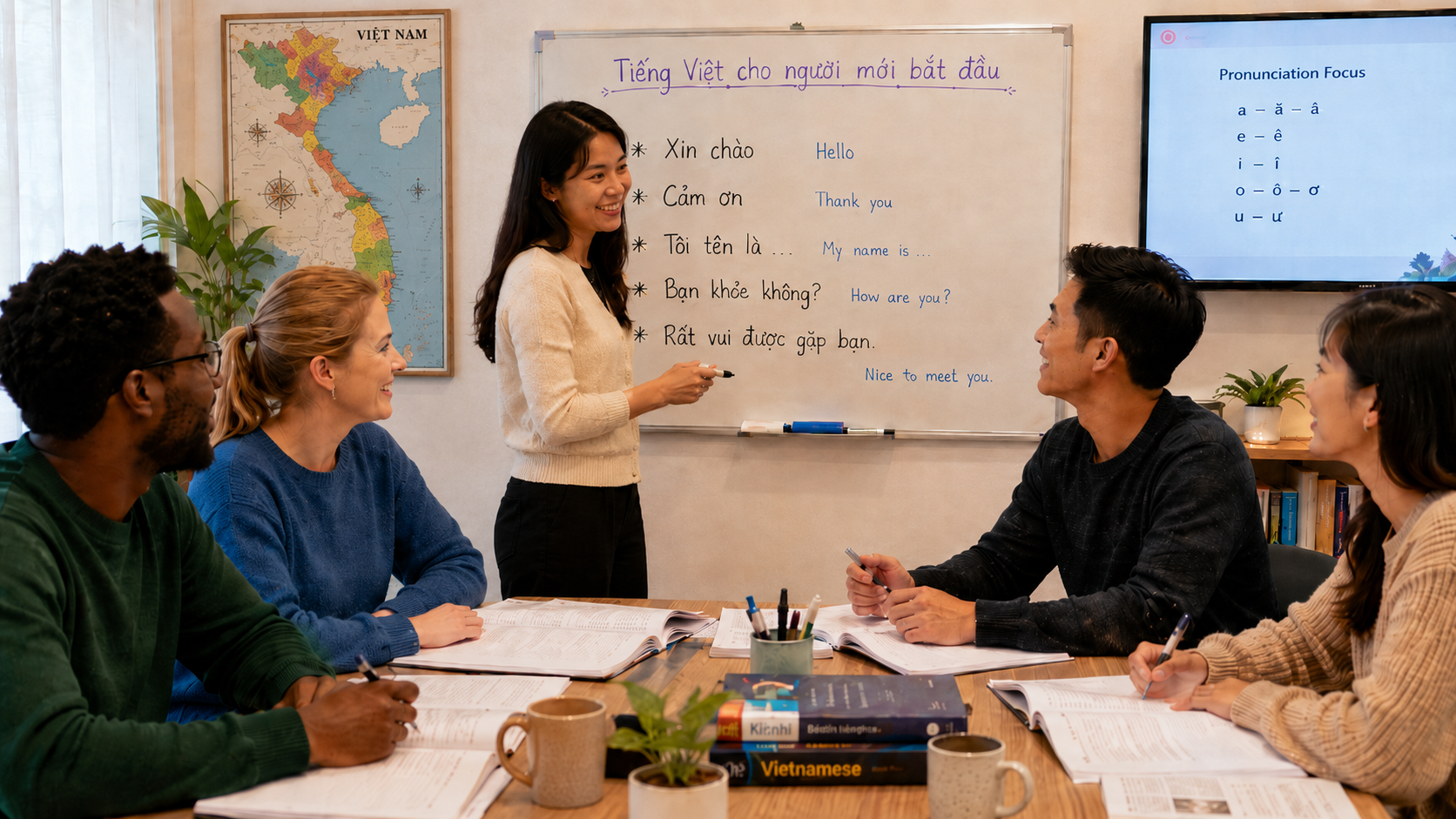
San Jose is one of the best places in the United States to begin learning Vietnamese—not only because of the size and visibility of the Vietnamese-speaking community, but because Vietnamese language and culture are woven into the everyday life of the city. For many Bay Area students, Vietnamese is not an abstract language from a faraway place. It is the language heard in restaurants, family gatherings, markets, temples, community events, nail salons, medical offices, tech workplaces, and neighborhoods across Santa Clara County. It is local, living, practical, emotional, and deeply connected to the history of the Bay Area.
If you live in San Jose, Santa Clara, Milpitas, Sunnyvale, Fremont, Oakland, Berkeley, San Francisco, or anywhere else in the Bay Area, learning Vietnamese can open doors in ways that feel immediate. You may want to speak with your partner’s family. You may be a heritage learner who grew up hearing Vietnamese but never learned to speak it confidently. You may be preparing for a trip to Vietnam. You may work in education, healthcare, community services, tech, or public service and want to connect more meaningfully with Vietnamese-speaking clients, patients, students, or colleagues. Or you may simply love Vietnamese food, culture, history, and travel, and want to understand the language behind it all.
Whatever your reason, starting Vietnamese as a beginner can feel both exciting and intimidating. Vietnamese has tones. It has unfamiliar sounds. It uses accent marks that can look mysterious at first. It has regional dialects, including Northern, Central, and Southern Vietnamese. And if you are an English speaker, you may have heard that Vietnamese is “hard.”
But here is the good news: Vietnamese is also surprisingly logical in many ways. It uses a Latin-based alphabet, so you do not need to learn a new writing system from scratch. It does not have verb conjugations like Spanish, French, or Italian. It does not have grammatical gender like French or German. It does not have noun cases like Russian. Once you understand the basic structure, Vietnamese grammar can feel direct, elegant, and refreshingly efficient.
The real challenge for beginners is not memorizing endless verb charts. It is learning how to hear and produce sounds accurately—especially tones. That is why Vietnamese is a language where live instruction matters. Apps can help you review vocabulary, but they cannot always hear whether your tone is correct, whether your vowel is clear, or whether you are using the right pronunciation for the dialect you want to learn. A real teacher can.
For San Jose and Bay Area students, Vietnamese is also one of the most culturally rewarding languages to study because you do not have to wait until you travel abroad to use it. You can begin practicing locally. You can greet someone at a Vietnamese café. You can recognize words on menus. You can understand signs in Little Saigon. You can say thank you to a shop owner, ask for the price of something, or order phở with more confidence. Even a small amount of Vietnamese can change the way you experience the Bay Area.
This beginner’s guide will walk you through why Vietnamese is worth learning in San Jose, what makes the language challenging and approachable, how beginners can practice, what heritage learners should know, and how to choose the right Vietnamese class if you are just starting out.
Why Learn Vietnamese in San Jose?
San Jose has one of the most significant Vietnamese communities in the United States. The city’s Vietnamese-American population is not only large; it is culturally visible and historically important. Since the arrival of Vietnamese refugees after 1975, San Jose has become a major center of Vietnamese-American life, especially in East San Jose and the Little Saigon area around Story Road.
For language learners, this matters. Learning a language is not just about grammar and vocabulary. It is about connection. When a language is present in your own city, you have more reasons to learn it and more opportunities to use it.
Vietnamese in San Jose is connected to food, family, business, religion, community, politics, festivals, art, and everyday conversation. You can find Vietnamese restaurants, bakeries, supermarkets, cafés, temples, churches, cultural centers, media, and community organizations throughout the area. This gives beginners something incredibly valuable: context.
Instead of learning Vietnamese only from a textbook, you can connect what you study with real places and real people. The word “cảm ơn” is not just a vocabulary item meaning “thank you.” It is something you can say after ordering coffee. “Xin chào” is not just a phrase in a lesson. It is a greeting you can use when entering a shop or meeting someone’s family. Food words, numbers, kinship terms, and polite expressions all become more memorable when they are connected to real situations.
For Bay Area students, Vietnamese can also be personally meaningful. Many learners are part of Vietnamese-American families but did not grow up speaking the language fluently. Others have friends, partners, in-laws, or coworkers who speak Vietnamese. Some are preparing for travel to Vietnam and want to do more than rely on English. Others work in fields where Vietnamese is useful for community engagement.
In a city like San Jose, Vietnamese is not simply “useful.” It is part of the social fabric.
Vietnamese Culture in San Jose and the Bay Area
One of the best reasons to learn Vietnamese in San Jose is that you are surrounded by cultural access. The Bay Area gives beginners opportunities to explore Vietnamese culture through food, markets, festivals, community events, and neighborhoods.
East San Jose’s Little Saigon is one of the most visible centers of Vietnamese culture in the region. For beginners, this area can become a living classroom. You can visit Vietnamese restaurants, bakeries, cafés, and shops. You can become familiar with common words on signs and menus. You can learn the names of dishes and ingredients. You can practice simple greetings and polite phrases in a natural setting.
Vietnamese food is often the first doorway into the language. Many students already know words like phở, bánh mì, bún bò Huế, gỏi cuốn, cà phê sữa đá, and nước mắm. But learning Vietnamese helps you understand these words more deeply. You begin to notice how food names are built. You recognize ingredients. You understand regional references. You can ask questions. You can order more specifically. Food becomes not just something you enjoy, but a language-learning tool.
Festivals and community events are another important part of Vietnamese cultural life in San Jose. Tết, the Vietnamese Lunar New Year, is especially significant. It is a time of family gatherings, food, traditional clothing, music, greetings, and wishes for the new year. For language learners, Tết offers a beautiful introduction to Vietnamese values: respect for elders, family connection, renewal, gratitude, and good fortune.
Vietnamese temples, churches, cultural associations, and community centers also play a role in preserving language and identity. Heritage learners in particular may find that learning Vietnamese helps them better understand family traditions, religious practices, and community events that once felt familiar but linguistically distant.
The Bay Area is also a multilingual region. Many people here are used to hearing multiple languages in daily life. This creates a supportive environment for language learners. You do not need to be perfect to begin. In fact, the willingness to try often matters more than flawless pronunciation.
Is Vietnamese Hard for English Speakers?
Vietnamese is challenging for English speakers, but not impossible. The key is understanding what is hard and what is not.
The most difficult parts of Vietnamese for English speakers are usually pronunciation, tones, and listening comprehension. Vietnamese is a tonal language, which means that the pitch contour of a syllable can change the meaning of a word. In other words, saying the right consonants and vowels is not enough. You also need to say the word with the correct tone.
This can be unfamiliar for English speakers because English uses pitch for emotion, emphasis, and questions, but not usually to distinguish word meaning in the same systematic way. In Vietnamese, tone is part of the word itself.
Vietnamese also has vowel sounds and consonant sounds that may not exist in English, or that may be difficult to distinguish at first. Some sounds may seem very close to one another until your ear becomes trained. Listening can also be challenging because Vietnamese is often spoken quickly, and regional accents can sound quite different from one another.
But Vietnamese also has many features that make it approachable.
Vietnamese grammar does not require verb conjugation. You do not have to memorize different verb forms for “I eat,” “he eats,” “we ate,” “they will eat,” and so on. The verb generally stays the same, while time words or context indicate when something happens.
Vietnamese does not have grammatical gender. You do not need to remember whether a table is masculine or feminine. Vietnamese does not have noun cases like Russian, German, or Latin. Word order and context do much of the work.
The alphabet is also based on the Latin script. Vietnamese writing includes many diacritics, but beginners can still recognize letters. This is a major advantage compared with languages that require learning an entirely new script from the beginning.
So is Vietnamese hard? Yes, in pronunciation and listening. But grammatically, it can feel much simpler than many European languages. With the right teacher, good pronunciation practice, and consistent exposure, beginners can make real progress.
Vietnamese Tones: What Beginners Need to Know
Tones are one of the first things beginners hear about Vietnamese, and they can sound intimidating. But tones are learnable. The mistake many beginners make is treating tones like decorations or optional accents. They are not. Tones are central to meaning.
Vietnamese is often described as having six tones in the Northern standard. Southern Vietnamese has a slightly different tonal system in practice, with some tones merging or sounding closer together depending on the speaker and region. This is one reason dialect choice matters.
At the beginner level, you do not need to master every tone perfectly before you start speaking. You do, however, need to become aware of tones from the beginning. It is much easier to build good habits early than to correct deeply ingrained pronunciation later.
A good Vietnamese class should introduce tones slowly and clearly. Students should hear examples, repeat them, compare them, and receive feedback. Tone practice should not feel like a punishment. It should feel like ear training, music training, and speaking practice combined.
Some students find it helpful to visualize tones as movement: level, rising, falling, dipping, or broken. Others learn best by imitation. Still others need to connect tones with physical sensation: where the voice starts, where it moves, whether the throat feels tense or relaxed, and how the syllable ends.
The most important thing is not to panic. Every beginner struggles with tones at first. Even if you cannot hear the difference immediately, your ear will improve with practice. Vietnamese pronunciation is a skill, not a personality test.
Which Vietnamese Dialect Should You Learn?
One of the most common questions beginners ask is: “Which Vietnamese dialect should I learn?”
Vietnamese has several major regional varieties, commonly grouped into Northern, Central, and Southern Vietnamese. The Northern dialect, especially the Hanoi variety, is often treated as the standard in many textbooks and formal learning materials. The Southern dialect, especially associated with Ho Chi Minh City and many overseas Vietnamese communities, is also extremely important—especially in places like California, where many Vietnamese-American families have Southern roots.
For San Jose students, dialect choice can depend on your goals.
If you are learning Vietnamese for family, you may want to learn the variety your family speaks. If your parents, grandparents, partner, or in-laws speak Southern Vietnamese, then Southern pronunciation may be the most useful for you emotionally and practically.
If you are learning for travel, either Northern or Southern Vietnamese can be useful, but you may want exposure to both. If you plan to spend time in Hanoi, Northern pronunciation will help. If you plan to visit Ho Chi Minh City or southern Vietnam, Southern pronunciation will be especially useful.
If you are learning for general literacy, formal study, or broad communication, a teacher can help you understand standard forms while also explaining regional differences.
The good news is that you do not have to solve the dialect question perfectly before you begin. A strong beginner course can introduce Vietnamese in a structured way while making students aware of regional variation. The most important thing is to start learning clearly and consistently.
Vietnamese for Heritage Learners in San Jose
Many Vietnamese learners in San Jose are heritage learners. They may have grown up hearing Vietnamese at home, at family gatherings, in religious settings, or in the community, but they may not feel confident speaking, reading, or writing it.
Heritage learners often have a unique relationship with the language. Vietnamese may feel deeply familiar and strangely distant at the same time. A student might understand grandparents but struggle to respond. They might know food words, family titles, and household phrases but not know how to form full sentences. They might pronounce some words naturally but feel embarrassed about reading or writing. They might feel that they “should” already know Vietnamese and therefore hesitate to join a beginner class.
If this sounds familiar, it is important to know that heritage learning is normal. Many children of immigrants grow up with partial exposure to a language. They may understand more than they can say. They may speak informally but not know grammar. They may know a family dialect but not standard spelling. They may have emotional pressure around the language because it is connected to identity, family, and belonging.
A beginner Vietnamese class can be very helpful for heritage learners because it provides structure. Instead of relying only on memory or family correction, students can learn systematically. They can understand how the writing system works. They can practice tones consciously. They can build vocabulary beyond household topics. They can ask questions without feeling judged.
For many heritage learners, studying Vietnamese is not just about communication. It is about reconnecting with family history, culture, and identity. It can make conversations with relatives more meaningful. It can make trips to Vietnam more personal. It can transform passive understanding into active participation.
Vietnamese for Travelers
Vietnam is one of the most exciting travel destinations in Asia, and even basic Vietnamese can completely change the experience of visiting. While many people in major tourist areas speak some English, especially in hotels, restaurants, and tour settings, Vietnamese becomes incredibly useful once you move into markets, local cafés, taxis, family-run restaurants, smaller towns, or everyday interactions.
For travelers, you do not need advanced Vietnamese to benefit. You need practical survival phrases, clear pronunciation, and cultural confidence.
Useful beginner situations include greeting people, saying thank you, ordering food, asking for the price, requesting directions, taking taxis, checking into hotels, shopping at markets, and asking simple questions. Even if the conversation continues in English or gestures, starting in Vietnamese often creates warmth.
Vietnamese people are often delighted when foreigners make an effort to speak the language. It shows respect. It also changes your role from passive tourist to curious guest. You begin to notice details that many travelers miss: how people address each other, how politeness works, how food names describe ingredients, how signs are structured, and how everyday interactions unfold.
For Bay Area students planning to visit Vietnam, learning Vietnamese before departure is one of the best ways to prepare. It will not only help you navigate; it will help you listen differently.
Vietnamese for Professionals in the Bay Area
Vietnamese is also useful professionally, especially in the Bay Area. San Jose and Santa Clara County have large Vietnamese-speaking communities, which means Vietnamese can be valuable in healthcare, education, social work, government, law, nonprofit work, public services, business, and community outreach.
Professionals who work with Vietnamese-speaking clients, patients, students, families, or customers may benefit from even basic language knowledge. You may not become fluent enough to replace a professional interpreter, but learning greetings, respectful forms of address, common phrases, and cultural norms can improve trust and rapport.
In healthcare, for example, language and cultural awareness can make interactions feel more respectful. In education, teachers and school staff may better connect with Vietnamese-speaking families. In community organizations, Vietnamese language skills can help with outreach and relationship-building. In business, Vietnamese can help professionals understand customers and communities more deeply.
San Jose is also a major tech hub. While English dominates the tech industry, multilingual and multicultural competence is still valuable. Learning Vietnamese can be part of a broader professional skill set: cultural intelligence, local awareness, and the ability to connect across communities.
Why Online Vietnamese Classes Work Well for San Jose Students
Many Bay Area students are busy. Between commuting, work, school, family responsibilities, and traffic, getting to an in-person class can be difficult. This is one reason online Vietnamese classes can be a strong option for San Jose students.
A live online class is different from watching videos or using an app. In a live class, you interact with a real instructor. You speak. You listen. You receive corrections. You ask questions. You practice with classmates. You have accountability.
For Vietnamese, this is especially important because pronunciation and tones require feedback. An app may show you the word “cảm ơn,” but a teacher can tell you whether your tone is understandable. A video may explain the alphabet, but a teacher can hear if your vowel is slightly off. A textbook may introduce sentence structure, but a live class helps you actually use it in conversation.
Small-group classes are especially useful because they combine structure with interaction. You are not alone, but you are also not lost in a huge class. You hear other students make mistakes, which helps you learn. You practice speaking regularly. You build confidence in a supportive environment.
For San Jose and Bay Area students, online Vietnamese classes offer flexibility without sacrificing human connection. You can study from home while still receiving real instruction.
What to Look for in a Beginner Vietnamese Class
If you are choosing a Vietnamese class, especially as a complete beginner, look for a program that gives you structure, speaking practice, and pronunciation support.
A good beginner Vietnamese class should include:
Clear pronunciation instruction from the beginning. Vietnamese tones and sounds should not be ignored until later. They should be introduced gently but consistently.
Small class size. Beginners need chances to speak. In a large class, it is easy to hide. In a small group, you receive more attention and more practice.
A supportive teacher. Vietnamese can feel intimidating at first, so the learning environment matters. Students should feel comfortable making mistakes.
Practical vocabulary. Beginners should learn phrases they can use right away: greetings, names, polite expressions, food, numbers, family, directions, and everyday questions.
Cultural context. Vietnamese is not just a code. A good class should explain politeness, forms of address, family terms, regional differences, and cultural expectations.
Live interaction. Language is social. You need to hear and produce Vietnamese in real time.
A realistic pace. Beginners should be challenged, but not overwhelmed. A good class builds confidence step by step.
If you are learning Vietnamese in San Jose, you may also want a class that understands the Bay Area context: heritage learners, adult students, busy schedules, and the local importance of Vietnamese in the community.
How to Practice Vietnamese in San Jose
One of the advantages of learning Vietnamese in San Jose is that practice opportunities are close by. You do not need to wait until you are fluent. You can begin with tiny interactions.
Start with Vietnamese food. Learn the names of dishes you already love. Practice saying phở, bánh mì, bún, cơm, gỏi cuốn, cà phê, trà, nước, and cảm ơn. When you go to a Vietnamese restaurant, try reading the menu aloud quietly. Notice repeated words. Ask your teacher what they mean.
Visit Vietnamese markets. Look at labels, signs, ingredients, and packaging. You may recognize words for rice, fish sauce, tea, coffee, noodles, fruit, or sweets. This makes vocabulary more memorable because it is connected to real objects.
Practice greetings. Even a simple “xin chào” or “cảm ơn” can help you build confidence. Do not force conversations, but allow yourself to use small phrases respectfully.
Listen to Vietnamese music and media. At first, you may understand almost nothing. That is fine. The goal is to train your ear. Listen for tones, rhythm, and repeated words.
Watch Vietnamese YouTube channels or travel videos. Food videos, slow language-learning content, and beginner lessons can help you become familiar with natural speech.
Create a weekly routine. For example, you might attend one class per week, review vocabulary for ten minutes a day, listen to Vietnamese audio while walking, and practice ordering one item in Vietnamese each week.
Keep expectations realistic. You will not understand full-speed Vietnamese immediately. But every small step matters.
A Beginner’s Vietnamese Study Plan
If you are starting from zero, here is a realistic approach.
In the first month, focus on sounds, tones, greetings, numbers, basic pronouns, and simple phrases. Your goal is not fluency. Your goal is familiarity. You want Vietnamese to stop feeling completely foreign.
In months two and three, begin building sentence patterns. Learn how to introduce yourself, ask simple questions, talk about likes and dislikes, order food, and describe basic daily activities.
After three to six months, you may be able to handle simple conversations if you practice consistently. You will still struggle with listening, but you will begin recognizing common structures.
After six months to a year, students who study regularly can often talk about familiar topics, understand some slow speech, read simple texts, and feel more comfortable in Vietnamese-speaking environments.
Progress depends on consistency. One hour per week is a good start, but daily review makes a major difference. Even ten minutes a day can help.
The most successful beginners do not study perfectly. They study regularly.
Common Mistakes Beginners Make
One common mistake is ignoring tones. Beginners sometimes think, “I’ll learn vocabulary first and fix pronunciation later.” This usually makes Vietnamese harder. It is better to learn words with tones from the beginning.
Another mistake is relying only on apps. Apps can be useful for review, but Vietnamese pronunciation needs human feedback. If you cannot tell whether you are saying a tone correctly, you need a teacher or native speaker to help.
A third mistake is trying to learn too many words without using them. It is better to know fewer words and use them in real sentences than to memorize long lists passively.
Some students also become discouraged because listening feels impossible. This is normal. Listening is often the slowest skill to develop in Vietnamese. Keep listening even when you understand little. Your ear needs time.
Finally, some heritage learners compare themselves harshly to fluent relatives. Try not to do this. Your learning path is valid. Understanding some Vietnamese from childhood does not mean you were supposed to become fluent automatically. Structured learning can help you turn partial knowledge into real confidence.
Vietnamese Classes vs. Language Apps
Language apps can be helpful, especially for daily review, vocabulary repetition, and habit-building. But they have limits.
Vietnamese is a pronunciation-heavy language. You need feedback on tones, vowels, and rhythm. Apps may mark an answer correct or incorrect, but they cannot always explain what your mouth, voice, or ear needs to change.
A live teacher can slow things down. They can compare similar sounds. They can explain why a word sounds wrong. They can help you choose a dialect focus. They can correct you gently before mistakes become habits.
Classes also provide accountability. Many adults start apps enthusiastically and then stop after a few weeks. A weekly class keeps you moving. It gives you structure, assignments, and a reason to practice.
The best approach is often a combination: use a class as your main structure and use apps, audio, videos, and flashcards as support.
Learn Vietnamese with Polyglottist Language Academy
At Polyglottist Language Academy, we specialize in small-group language classes for adults and serious learners. Our Vietnamese classes are designed to help students build real skills step by step, with live instruction, pronunciation support, cultural context, and plenty of speaking practice.
Because our classes are online, students from San Jose, Santa Clara, Sunnyvale, Milpitas, Fremont, Oakland, Berkeley, San Francisco, and the wider Bay Area can join from wherever they are. You do not need to fight traffic or commute after work. You can study Vietnamese with a real instructor in a small, interactive class while still enjoying the flexibility of online learning.
Whether you are a complete beginner, a heritage learner reconnecting with family language, a traveler preparing for Vietnam, or a professional hoping to better serve the Vietnamese-speaking community, we would be happy to help you begin.
If you are ready to start speaking Vietnamese with confidence, sign up for Vietnamese classes at Polyglottist Language Academy today.
FAQs About Learning Vietnamese in San Jose
Is Vietnamese hard to learn for English speakers?
Vietnamese can be challenging for English speakers because of tones, pronunciation, and listening comprehension. However, the grammar is often more approachable than many European languages. Vietnamese has no verb conjugations, no grammatical gender, and no noun cases. With consistent practice and a good teacher, beginners can make steady progress.
Can I learn Vietnamese online?
Yes. Vietnamese can be learned online very effectively, especially in a live class with a teacher. Online classes are particularly useful for busy San Jose and Bay Area students because they provide flexibility while still offering real-time pronunciation feedback and speaking practice.
Which Vietnamese dialect should I learn?
It depends on your goals. If you are learning for family, learn the dialect your family speaks. If you are learning for travel, consider where in Vietnam you plan to go. Northern Vietnamese is often used in formal learning materials, while Southern Vietnamese is very common among Vietnamese-American communities in California. A good teacher can help you understand the differences.
How long does it take to learn Vietnamese?
It depends on your goals and study habits. Basic phrases can be learned quickly, but comfortable conversation takes time. With weekly classes and regular review, beginners may start forming simple conversations within a few months. Reaching higher proficiency requires longer-term study and consistent listening practice.
Do I need to know tones before joining a beginner Vietnamese class?
No. A beginner class should teach tones from the beginning. You do not need prior knowledge. You just need patience and willingness to practice.
Is Vietnamese useful in San Jose?
Yes. San Jose has one of the largest Vietnamese communities in the United States, and Vietnamese is widely present in local culture, food, business, family life, and community organizations. Learning Vietnamese can help you connect more deeply with the city and its people.
Can heritage learners join beginner Vietnamese classes?
Absolutely. Many heritage learners benefit from beginner classes because they may understand some Vietnamese but need structure, grammar, reading, writing, and pronunciation support. A beginner class can help turn passive familiarity into active communication.
Is Vietnamese grammar difficult?
Vietnamese grammar is often simpler than learners expect. There are no verb conjugations, no grammatical gender, and no noun cases. The main challenge is not grammar but pronunciation, tones, and listening.
What is the best way to start learning Vietnamese?
The best way to start is with a structured beginner class that teaches pronunciation, tones, basic vocabulary, and simple sentence patterns. Combine class time with daily review, listening practice, and small real-life interactions.
Read More on Our Blog
If you enjoyed this article, you may also like these related posts from the Polyglottist Language Academy blog: