
Why Learning Vietnamese Makes Travel in Vietnam More Meaningful
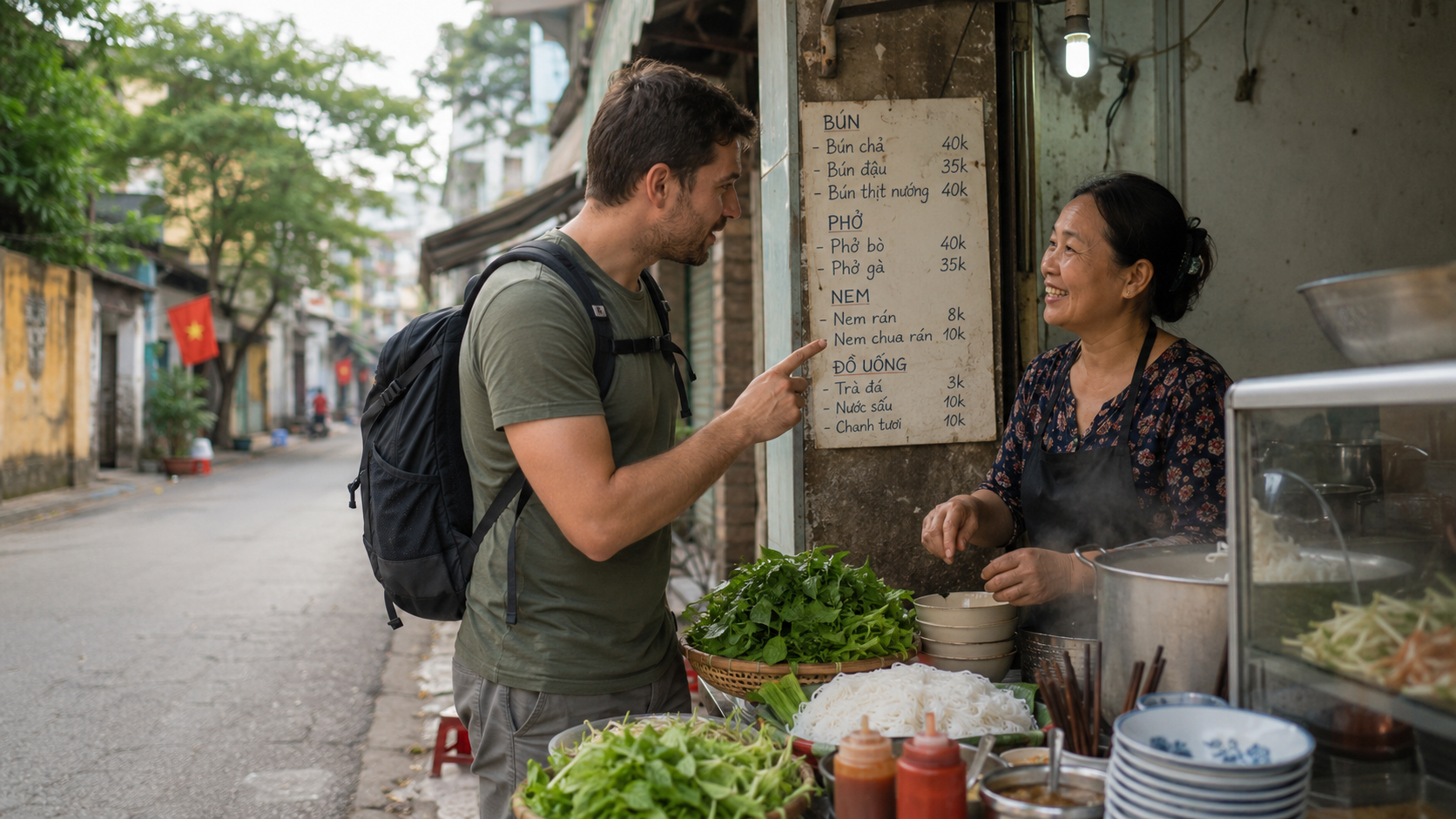
The bowl arrives before you have worked out exactly what you ordered.
You recognize noodles, herbs, and perhaps slices of pork, but there are several ingredients you cannot identify. The woman behind the stall gestures toward a small dish of sauce and says something you do not understand.
You could smile, nod, and begin eating. The exchange would still be pleasant. The food might be excellent.
Or you could ask:
“Cô ơi, cái này là gì ạ?”
Excuse me, what is this?
The sentence is simple. Your pronunciation may not be perfect. Yet something in the interaction changes. The vendor slows down, names the ingredient, and perhaps points to another bowl to show you how it is prepared. She may correct your pronunciation. She may ask where you are from. A transaction lasting thirty seconds becomes a conversation lasting three minutes.
That is the real value of learning Vietnamese before traveling to Vietnam. It is not simply about avoiding confusion or successfully ordering lunch. It is about changing your position in the experience.
Without the language, you can observe Vietnam. With even a little of it, you can begin to participate.
English can help you travel. Vietnamese helps you notice where you are.
A visitor can travel through much of Vietnam without speaking Vietnamese. Hotels, organized tours, airports, and many restaurants in central Hanoi, Ho Chi Minh City, Đà Nẵng, and Hội An regularly serve international travelers. English is also increasingly common among younger Vietnamese people.
But being able to complete a trip in English is not the same as experiencing every layer of it.
English may help you reserve a room, book a tour, or find your gate at the airport. Vietnamese becomes more valuable in the smaller moments: choosing fruit at a neighborhood market, talking to the owner of a family-run guesthouse, asking a driver whether you are going in the right direction, or trying to understand why one local dish is different from a similarly named dish in another region.
These are not necessarily dramatic encounters. Most travel is made up of ordinary moments, not extraordinary ones. Language makes those ordinary moments more visible.
You begin to notice that the same person may be addressed differently depending on age. You hear how customers call to a restaurant owner before ordering. You recognize the words for chicken, beef, rice, ice, milk, tea, and coffee. A menu that once looked like an uninterrupted field of accent marks begins to separate into meaningful parts.
The city has not changed. Your ability to read it has.
The most important travel vocabulary may not be “please” and “thank you”
One of the first surprises for many adult learners is that Vietnamese does not organize social relationships in quite the same way English does.
English gives us the general pronoun “you.” Vietnamese often asks for more information: Is the person older or younger than you? Are they around the age of an older sibling, a parent, or a grandparent? What relationship are you creating through the way you address them?
Vietnamese commonly uses kinship terms for people who are not literal relatives:
anh for a man somewhat older than the speaker
chị for a woman somewhat older
em for a younger person
cô for a woman around an aunt’s or mother’s generation
chú for a man around an uncle’s or father’s generation
bác for someone significantly older
ông and bà for elderly men and women
These terms cannot be translated perfectly into English. Calling a restaurant owner cô does not mean that you are pretending she is your aunt. It means that you are placing the interaction within a recognizable social relationship.
This is one reason a memorized phrase containing tôi for “I” and bạn for “you” can sound more distant or textbook-like than a beginner expects. The phrase may be grammatically understandable, but it can miss the social texture of the conversation.
You do not need to master the entire Vietnamese system of address before your trip. Vietnamese speakers themselves sometimes negotiate these choices when ages are unclear. But learning a few common forms helps you understand that politeness is not created only by adding a word equivalent to “please.” It is built into how speakers acknowledge one another.
For adult learners at Polyglottist Language Academy, this often becomes one of the most interesting parts of studying Vietnamese. Grammar suddenly stops being an abstract system. It becomes a lesson in how a culture notices age, closeness, respect, and belonging.
A few words can move you beyond the tourist version of a place
Tourism tends to concentrate people into predictable spaces: central districts, famous attractions, highly reviewed restaurants, and businesses accustomed to serving foreigners.
There is nothing wrong with visiting those places. Hanoi’s Old Quarter is fascinating. Hội An deserves its popularity. Ho Chi Minh City’s central districts contain extraordinary food, architecture, and history.
The problem comes when travelers mistake the most internationally accessible version of a country for the whole country.
Basic Vietnamese gives you more confidence to enter places where English is limited: a small noodle shop with no translated menu, a market outside the historic center, a local bus, a family café, or a guesthouse in a less-visited town.
It also helps when English is technically available but remains narrow and transactional. A hotel employee may know how to explain check-in procedures but not how to describe the neighborhood where she actually eats. A driver may recognize the English name of a landmark but find it easier to discuss traffic, distance, or an alternative route in Vietnamese.
Language does not guarantee that someone will become your friend, invite you home, reveal a secret restaurant, or offer a better price. Those are romantic travel fantasies, not reasonable expectations.
What language does offer is a greater possibility of exchange.
Instead of asking only, “Where is the tourist attraction?” you can begin to ask, “What is this called?” “Do people here eat this for breakfast?” “Is this dish from this region?” “Which one do you like?”
The difference is subtle but important. You are no longer asking people simply to facilitate your trip. You are showing curiosity about their world.
Food is often the first real Vietnamese lesson
Food is one of the easiest places to see how vocabulary changes travel.
A traveler who recognizes a few recurring words can begin to decode menus rather than relying entirely on photographs or translations.
Consider:
phở bò: phở with beef
phở gà: phở with chicken
bún chả: rice vermicelli served with grilled pork
cà phê sữa đá: coffee with milk and ice
trà đá: iced tea
cơm: cooked rice or a rice-based meal
thịt: meat
cá: fish
rau: vegetables or greens
chay: vegetarian
Once you recognize these components, dish names become less intimidating. You may not know exactly how something will be prepared, but you have clues.
Food language also introduces regional identity. A dish that appears under one name in Hanoi may be prepared, seasoned, or served differently in Huế or Ho Chi Minh City. Vocabulary becomes the beginning of a conversation about geography, climate, migration, and family tradition.
Useful questions include:
Cái này cay không?
Is this spicy?
Ít cay thôi.
Only a little spicy.
Có thịt không?
Does it contain meat?
Tôi ăn chay.
I am vegetarian.
Tôi bị dị ứng với…
I am allergic to…
Travelers with serious allergies should never depend entirely on a newly learned phrase. Carry a clearly written allergy card, confirm ingredients carefully, and remember that cross-contact may be difficult to explain in a busy kitchen. Language is helpful, but it is not a substitute for appropriate medical precautions.
For less urgent conversations, however, food vocabulary creates endless opportunities. Complimenting a meal with Ngon quá!—“So delicious!”—may lead to an explanation of an ingredient, a cooking method, or the correct way to combine herbs and sauces.
You are not merely consuming a dish. You are learning how other people understand it.
Vietnamese tones are not decorative marks
Vietnamese is written in the Latin alphabet, which can initially make it look more accessible to English speakers than languages written in unfamiliar scripts.
Then learners encounter the diacritics.
Vietnamese spelling records vowel qualities and tones, and those marks are not optional decorations. Changing a tone can change the meaning of a word. A traveler who reads only the basic letters while ignoring the marks may produce something quite different from the intended phrase.
This is why pronunciation guides such as “sin chow” for xin chào have limited value. They can provide a rough reminder, but they cannot teach the exact vowels, consonants, rhythm, or tone patterns of Vietnamese.
Many adults approach their first Vietnamese class convinced that they will never be able to hear the tones. What they often discover is that tones become clearer through repeated listening, comparison, and correction. The goal is not to sound indistinguishable from a native speaker before boarding a plane. It is to become understandable and to recognize the most important words when they are spoken back to you.
A good beginner should practice complete phrases with audio rather than memorizing isolated words from a printed list.
Here are several worth learning:
VietnameseMeaningWhen it helpsXin chàoHelloA safe general greetingCảm ơnThank youUseful everywhere; add a form of address when possibleXin lỗiExcuse me / I’m sorryGetting attention or making a light apologyBao nhiêu tiền?How much is it?Markets, shops, transportCho tôi…Please give me… / I’ll have…Ordering food or drinksTôi không hiểuI don’t understandWhen a conversation moves too quicklyNói lại được không?Could you say that again?Asking someone to repeatNgon quá!So delicious!Complimenting foodKhông cayNot spicyRequesting mild foodTạm biệtGoodbyeA general farewell
Do not worry if people answer you in English after you speak Vietnamese. They may be trying to help, practicing their own English, or simply choosing the fastest language for the situation. Your effort has not failed.
The point is not to force every interaction to remain in Vietnamese. It is to open the door.
Hanoi, Huế, and Ho Chi Minh City will not sound the same
Visitors quickly discover that Vietnamese changes as they travel through the country.
Northern, Central, and Southern Vietnamese differ in pronunciation, tone realization, and some vocabulary. Hanoi speech is commonly used in formal teaching and national broadcasting. Southern Vietnamese is heard throughout Ho Chi Minh City and much of the Mekong Delta. Central varieties, including those associated with Huế and surrounding areas, have their own distinctive sound patterns.
Beginners sometimes respond to this diversity by deciding that they must learn every accent before traveling. They do not.
Choose one variety as your foundation. Learn its tones and pronunciation consistently. Then listen to examples from other regions so that variation does not surprise you.
A learner who has studied Northern pronunciation may need time to adjust in Ho Chi Minh City. Someone accustomed to Southern speech may find a Central accent difficult at first. That does not mean the language learned in class is useless or “wrong.”
Vietnamese speakers regularly encounter regional accents through travel, migration, television, work, and family connections. Your speech will already sound foreign. A consistent learner’s accent is far more useful than a confused attempt to imitate several regions at once.
Regional variation can also become part of the pleasure of travel. You begin to hear not one uniform national voice but many local ones.
Tiny words that reveal hospitality and daily life
Some of the most culturally revealing Vietnamese words are not the grand ones found in guidebooks. They are the small words heard around meals, drinks, greetings, and family interactions.
Dạ
Dạ is often used to respond respectfully, especially when speaking to someone older or in a position deserving deference. Depending on context, it may accompany “yes,” acknowledge that you are listening, or soften a reply.
It does not map neatly onto one English word. Its importance lies in the attitude it conveys.
Ạ
The particle ạ can appear at the end of a sentence to make it more respectful or polite.
A beginner may hear:
Cảm ơn cô ạ.
Thank you.
The English translation looks ordinary. The Vietnamese sentence carries additional social information.
Mời
Mời is connected with inviting or offering. You may hear it when someone invites you to eat, drink, enter, sit down, or begin.
At a family meal, expressions containing mời do more than communicate “please eat.” They acknowledge the other people present and frame the meal as a shared social event.
Ngon
Ngon means delicious or tasty.
Ngon quá! means “So delicious!”
Ngon lắm! means “Very delicious!”
It is a small word with great travel value.
Trà and cà phê
Trà means tea, while cà phê means coffee.
Knowing the surrounding vocabulary helps you order more precisely:
nóng: hot
đá: ice or iced
sữa: milk
đường: sugar
đậm: strong or full-bodied
nhạt: light, weak, or bland, depending on context
A cup of tea or coffee is rarely only a beverage. It may create a pause in the day, an opportunity to sit, watch, listen, and talk. Learning the words around that experience helps you pay attention to more than what is in the cup.
The writing system carries Vietnam’s history
Modern Vietnamese uses chữ Quốc ngữ, a Romanized writing system. This makes street signs and menus visually approachable to visitors who use the Latin alphabet, even before they understand the words.
The apparent familiarity can be misleading, but it is also an advantage. With practice, travelers can learn to recognize names, food terms, transportation vocabulary, and recurring signs relatively quickly.
The language itself belongs to the Austroasiatic language family. Its vocabulary also reflects centuries of contact and historical change. Chinese influence contributed a major layer of Sino-Vietnamese vocabulary, particularly in formal, literary, governmental, and educational contexts.
Vietnamese was also written historically using Classical Chinese and chữ Nôm, a character-based system developed for vernacular Vietnamese. The later spread of chữ Quốc ngữ transformed literacy and became closely tied to education, publishing, and modern public life.
French colonial influence remains visible in certain loanwords, including ga, meaning train station, from the French gare, and va-li, meaning suitcase, related to French valise. The word cà phê also reflects the history of coffee’s arrival and adaptation in Vietnam.
A traveler does not need a linguistic history course to order breakfast. Yet knowing that the language carries several historical layers can deepen what you notice in museums, literature, architecture, menus, and conversations.
Words are part of the landscape too.
What can you realistically learn before a trip?
You do not need conversational fluency to make your trip more meaningful.
A well-prepared beginner might focus on five areas:
Pronunciation and tones. Learn how the sound system works rather than guessing from English spelling.
Forms of address. Become comfortable with a few common words such as anh, chị, em, cô, and chú.
Numbers and prices. Practice hearing numbers as well as saying them. Real conversations move faster than textbook exercises.
Food and transport. Learn the vocabulary you are most likely to use repeatedly.
Listening repair. Phrases such as “I don’t understand,” “Please speak more slowly,” and “Could you repeat that?” are often more useful than memorizing dozens of elaborate sentences.
A small amount of focused study is better than downloading a list of one hundred phrases the night before departure. Fifteen or twenty phrases that you understand, can pronounce, and know how to adapt will serve you better than a page of words you cannot recognize when someone responds.
Adult learners sometimes underestimate how much progress comes from repetition. Ordering the same coffee three mornings in a row may feel linguistically modest. In reality, each attempt trains listening, pronunciation, confidence, and social awareness.
Travel turns repeated classroom language into lived memory.
Speak with people, not at them
Using Vietnamese respectfully also means recognizing the limits of the interaction.
A market vendor, waiter, driver, or hotel employee is not automatically available for an extended language lesson. A few sincere words may begin a conversation, but they do not entitle a traveler to someone’s time, praise, friendship, photograph, or personal story.
Notice the context. Is the person busy? Are other customers waiting? Do they seem interested in continuing? Are they answering briefly because they need to work?
It is also wise to let go of the expectation that every Vietnamese person will react with astonishment or delight. Some may smile warmly. Some may correct you. Some may answer in English. Others may simply respond to your question and continue with their day.
All of these reactions are normal.
Language learning becomes meaningful when it is based on curiosity rather than performance. The goal is not to collect compliments for speaking Vietnamese. It is to make communication more attentive and more mutual.
Travel differently by preparing differently
At Polyglottist Language Academy, we believe language study gives travelers more than a set of emergency phrases. It helps them notice how people address elders, invite others to eat, describe flavors, soften requests, and express hospitality.
Our online Vietnamese classes are designed for adults who want to understand both how the language works and how it is used in real life. Students learn pronunciation, vocabulary, listening, and grammar, but they also explore cultural details that make everyday interactions easier to interpret.
That preparation matters whether you are planning a long journey through Vietnam, visiting relatives, exploring family heritage, or simply becoming curious about a country through its language.
Explore current Vietnamese class options
Frequently Asked Questions
How much Vietnamese should I learn before traveling to Vietnam?
Learning greetings, numbers, common food vocabulary, transportation phrases, and several polite forms of address can already make a meaningful difference. Focus on language you can pronounce and understand rather than trying to memorize hundreds of expressions.
Can I travel around Vietnam speaking only English?
Many travelers do, particularly in major cities and established tourism areas. However, English ability varies considerably by region, generation, profession, and setting. Vietnamese becomes especially useful in markets, smaller restaurants, local transportation, family-run accommodations, and less-touristed areas.
Should I learn Northern or Southern Vietnamese?
Either can provide a strong foundation. Northern pronunciation is common in textbooks and formal media, while Southern Vietnamese is widely spoken in Ho Chi Minh City and the South. Choose one variety consistently, then become familiar with the fact that accents and some vocabulary differ across the country.
Are Vietnamese tones too difficult for beginners?
Tones are challenging because they affect meaning, but they are learnable. Beginners benefit from listening to native audio, comparing tones directly, recording themselves, and receiving correction. Printed pronunciation approximations alone are rarely enough.
What are the most useful Vietnamese phrases for tourists?
Useful phrases include cảm ơn for “thank you,” xin lỗi for “excuse me” or “sorry,” bao nhiêu tiền? for “how much?”, tôi không hiểu for “I don’t understand,” and nói lại được không? for “could you repeat that?” Food and dietary vocabulary is also especially valuable.
Can a translation app replace learning Vietnamese?
Translation apps are helpful for addresses, written notices, and unexpected situations. They are less reliable for choosing socially appropriate pronouns, interpreting regional speech, or conveying the right degree of respect. They work best as support rather than as a complete substitute for learning.
Will people mind if my Vietnamese pronunciation is imperfect?
Most reasonable listeners do not expect a beginner to speak perfectly. What matters is being patient, listening carefully, and responding graciously when corrected. Because tones affect meaning, practicing pronunciation before your trip will make your efforts much easier to understand.
Continue Exploring Vietnamese Language and Culture
You do not need to wait until you arrive in Vietnam to begin building these connections. Polyglottist Language Academy offers live online Vietnamese classes that you can take from anywhere.
Our classes are designed for adult learners who want practical language skills, stronger listening comprehension, and a deeper understanding of Vietnamese culture. You will learn useful vocabulary, pronunciation, forms of address, and everyday expressions that can make travel feel more comfortable and meaningful.
Whether you are planning a trip to Vietnam or simply want to explore the language, our online format allows you to learn with an experienced instructor from home, no matter where you live.