
Essential Vietnamese Phrases Every Beginner Should Know
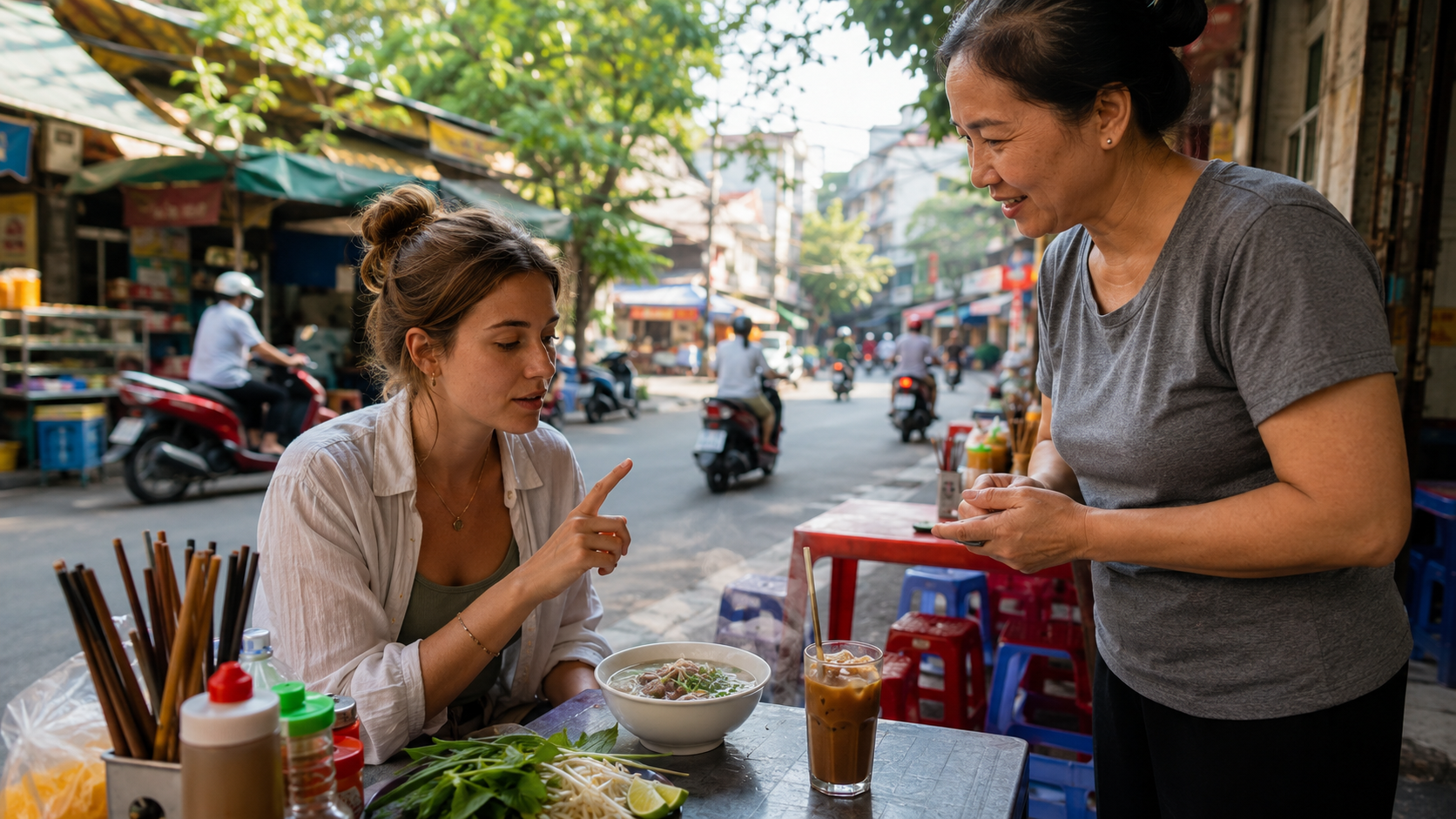
You enter a small café in Ho Chi Minh City, smile at the person behind the counter, and carefully say the phrase you memorized before your trip:
Xin chào.
The words are correct. You have successfully said “hello.” But then the person smiles back and answers with something that sounds less like the phrase in your guidebook and more like:
Chào chị.
Or perhaps:
Chào anh.
That tiny difference reveals one of the most interesting things about Vietnamese. Speaking the language is not simply a matter of replacing an English word with a Vietnamese one. Even a greeting can communicate whether someone appears older or younger, male or female, familiar or respected.
This is why the most useful Vietnamese phrases are not necessarily the longest or most impressive. They are the expressions that help you participate in the social rhythm of a conversation: greeting someone appropriately, asking for clarification without embarrassment, ordering a meal politely, accepting hospitality, and showing that you are paying attention.
Below, you will find practical phrases for real situations. More importantly, you will learn what those phrases are doing beneath the surface.
Before You Memorize Anything, Listen to the Music
Vietnamese uses tones, which means that the pitch pattern of a syllable helps determine its meaning. Tone is not an optional accent added for expression. It is part of the word itself.
The syllable ma, for example, can represent several unrelated words depending on its tone and written mark:
ma — ghost
má — mother or cheek
mà — but
mả — grave
mã — horse or code
mạ — rice seedling
Standard descriptions of Northern Vietnamese distinguish six tones. Some tones merge in Southern pronunciation, although all six remain represented in writing.
This can feel intimidating to English speakers, but beginners do not need to produce every tone perfectly before saying anything. The more realistic goal is to develop good habits immediately:
Listen to native audio rather than relying only on English-style pronunciation guides. Repeat short phrases, not isolated words. Record yourself. Keep every accent and tone mark when you type Vietnamese. Most importantly, allow pronunciation to be part of your study from the beginning rather than something you plan to “fix later.”
Vietnamese spelling is more systematic than it may first appear. Once you understand what the marks represent, the written language becomes a useful map for pronunciation.
“Hello” Is Also a Relationship
Xin chào
Xin chào means “hello” and is perfectly correct. It is useful in formal introductions, public speaking, customer service, or situations in which you want a neutral opening.
However, it can sound slightly formal or textbook-like in ordinary conversation. Many Vietnamese speakers greet people using chào followed by a term of address.
Chào anh / Chào chị / Chào em
These all mean “hello,” but each one positions the speakers in relation to each other.
Chào anh — Hello, said to a man who is somewhat older
Chào chị — Hello, said to a woman who is somewhat older
Chào em — Hello, said to someone younger
The words anh, chị, and em literally relate to family roles—older brother, older sister, and younger sibling—but they are widely used beyond the family.
You may also hear:
Chào cô — Hello, to an older woman, a teacher, or someone of an aunt’s generation
Chào chú — Hello, to an older man of an uncle’s generation
Chào bác — Hello, to a considerably older adult
Chào ông / Chào bà — Hello, to an elderly man or woman
Vietnamese frequently uses kinship terms as pronouns. There is no single universal word for “you” that fits every relationship. A speaker’s choice depends on relative age, gender, familiarity, and context.
Adult learners often find this system complicated during their first lessons. Later, many begin to appreciate what it makes possible: every sentence can acknowledge the other person rather than treating everyone as socially interchangeable.
Rất vui được gặp anh/chị
Rất vui được gặp anh/chị means “Nice to meet you.”
The version often taught in beginner materials is:
Rất vui được gặp bạn.
That is understandable and appropriate when speaking to a peer. In real conversations, however, replace bạn with anh, chị, or another suitable term when you know how you want to address the person.
Anh/chị tên là gì?
Anh/chị tên là gì? means “What is your name?”
To introduce yourself, you can begin with the dependable learner phrase:
Tôi tên là…
My name is…
As you become more comfortable with Vietnamese pronouns, you might use em, anh, or chị for yourself:
Em tên là Maria.
My name is Maria.
The correct choice depends on who is speaking to whom. A 30-year-old woman might call herself em when speaking to a 55-year-old woman, but chị when speaking to a 20-year-old.
Hẹn gặp lại
Hẹn gặp lại means “See you again” or “See you later.”
You can also say Tạm biệt for “goodbye,” although it may sound more formal or final than many everyday parting expressions.
The Four Pronouns That Will Take You Surprisingly Far
A complete Vietnamese pronoun system cannot be reduced to four words, but beginners can start with these:
Tôi
Tôi is a relatively neutral “I.” It works well in formal situations and when you are unsure which relational pronoun to use.
It is safe, but it can sound somewhat distant if used repeatedly in a warm, familiar conversation.
Bạn
Bạn can mean “friend” or “you” when addressing a peer. Many textbooks use it as the default translation of “you.”
It is not appropriate for everyone. Calling an elderly person bạn, for example, may sound impersonal or socially awkward.
Anh and chị
Anh and chị refer to an older man and older woman, respectively. They can mean “you,” but they can also mean “I” when the older person is speaking to someone younger.
Em
Em refers to the younger person in the relationship. It can also be the speaker’s word for “I” when addressing someone older.
Do not worry about making a perfect choice every time. Listen to how people address you and each other. In many situations, you can mirror the term the other person establishes.
When You Do Not Understand, Keep the Conversation Open
The most valuable beginner phrases are often not the ones that display knowledge. They are the ones that help you continue when your knowledge runs out.
Tôi không hiểu
Tôi không hiểu.
I don’t understand.
With an older conversation partner, you might say:
Em không hiểu ạ.
I don’t understand.
The final ạ adds respect.
Tôi chỉ nói được một chút tiếng Việt
Tôi chỉ nói được một chút tiếng Việt.
I only speak a little Vietnamese.
This sentence often changes the mood of an interaction. Instead of leaving the other person to wonder why you are hesitating, you explain that you are making a genuine effort.
Anh/chị nói chậm lại giúp em với
Anh/chị nói chậm lại giúp em với.
Could you speak more slowly for me?
A shorter version is:
Xin nói chậm lại.
Please speak more slowly.
The longer sentence feels more conversational because it includes the listener and uses với as a friendly request softener.
Anh/chị nói lại được không?
Anh/chị nói lại được không?
Could you say that again?
You may also hear:
Anh nói lại giúp em với.
Could you repeat that for me?
Cái này có nghĩa là gì?
Cái này có nghĩa là gì?
What does this mean?
Từ này phát âm như thế nào?
Từ này phát âm như thế nào?
How do you pronounce this word?
Anh/chị có thể viết ra được không?
Anh/chị có thể viết ra được không?
Could you write it down?
This is particularly useful when tones or unfamiliar vowels make a word difficult to recognize. Seeing the full Vietnamese spelling may help you identify the word later.
Politeness Is Bigger Than the Word “Please”
English-speaking beginners often look for one Vietnamese word that functions exactly like “please.” Two expressions commonly offered are làm ơn and vui lòng, but neither should be inserted mechanically into every request.
Vui lòng frequently appears in formal notices and service language. Làm ơn can be used in requests, but a bare command beginning with làm ơn may still sound less natural than a sentence softened through pronouns and particles.
Compare:
Làm ơn đưa thực đơn.
Please give the menu.
With:
Anh cho em xem thực đơn với nhé.
Could you show me the menu, please?
The second sentence feels warmer because it identifies the relationship and uses the softening words với and nhé.
Several small particles carry a great deal of emotional and social meaning:
ạ adds respect or deference
nhé or Southern nha softens a suggestion or request
với makes a request sound more like “help me out, please”
ơi is used when calling or getting someone’s attention
rồi often communicates “already,” “now,” or “done”
chưa means “yet” or “not yet”
mời expresses invitation and hospitality
A phrase such as Dạ, em cảm ơn anh ạ contains very little information in the English sense—it means roughly “Yes, thank you”—but socially it communicates careful respect.
Cảm ơn
Cảm ơn means “thank you.”
You may hear pronunciation closer to cám ơn, especially in some regions and conversational speech. For writing, beginners should learn the standard form cảm ơn.
For greater emphasis:
Cảm ơn nhiều.
Thank you very much.
Xin lỗi
Xin lỗi means both “I’m sorry” and “Excuse me.”
Use it to apologize, attract someone’s attention, or move through a crowded space.
Không sao
Không sao means “No problem” or “It’s okay.” It is a natural response to a small apology.
Không có gì
Không có gì means “You’re welcome” or “It was nothing.”
In Central Vietnam, you may also hear không có chi.
Ordering Food Without Sounding Like a Phrasebook
Food is often where beginners have their first genuinely satisfying conversation. You point to a dish, ask a question, understand part of the answer, and finally taste something you ordered yourself.
Cho tôi món này
Cho tôi món này.
I’ll have this dish.
Literally, the structure resembles “Give me this dish,” but it is a normal ordering pattern. Depending on the relationship, tôi may become em, anh, or chị.
For example:
Chị cho em món này nhé.
I’ll have this one, please.
Anh/chị giới thiệu món nào ạ?
Anh/chị giới thiệu món nào ạ?
Which dish do you recommend?
A simpler option is:
Món nào ngon ạ?
Which dish is good?
Món này là món gì?
Món này là món gì?
What dish is this?
Món này có cay không?
Món này có cay không?
Is this spicy?
Không cay nhé
Không cay nhé.
Not spicy, please.
Or:
Cay một chút cũng được.
A little spicy is okay.
Tôi ăn chay
Tôi ăn chay.
I am vegetarian.
Travelers with strict dietary requirements should be more specific. A dish described as vegetarian may still require questions about fish sauce, shrimp paste, or meat-based broth.
Useful additions include:
Tôi không ăn thịt.
I don’t eat meat.
Tôi không ăn cá hoặc hải sản.
I don’t eat fish or seafood.
Không có nước mắm nhé.
No fish sauce, please.
Tôi bị dị ứng với…
Tôi bị dị ứng với…
I am allergic to…
For example:
Tôi bị dị ứng với đậu phộng.
I am allergic to peanuts.
When an allergy is serious, carry a clearly written explanation in Vietnamese rather than relying only on spontaneous pronunciation.
Tính tiền giúp em nhé
Tính tiền giúp em nhé.
The bill, please.
And when the meal was excellent:
Ngon quá!
So delicious!
Few expressions produce a more immediate smile.
A Cup of Tea Can Teach an Entire Social Lesson
Vietnamese hospitality is often expressed through offering food, tea, coffee, or a place to sit. The word mời is especially useful because it conveys an invitation.
Mời anh uống trà.
Please have some tea.
Mời chị ngồi.
Please sit down.
The literal English translation does not fully capture the warmth of mời. It can introduce an offer, welcome someone to begin eating, or politely invite a person to do something.
A few food and tea words are useful even for complete beginners:
trà — tea
cà phê — coffee
nước — water or a drink, depending on context
ngon — delicious or tasty
ngọt — sweet
đắng — bitter
đậm — strong or rich in flavor
nhạt — mild, weak, or insufficiently seasoned
nóng — hot
lạnh — cold
You might say:
Trà này ngon quá.
This tea is delicious.
Cà phê này đậm quá.
This coffee is very strong.
Cho tôi một ly trà đá.
I’ll have a glass of iced tea.
Adult learners sometimes focus so intently on constructing a correct sentence that they forget the social moment around it. When someone offers you tea, the interaction is not only a vocabulary exercise. It may be a welcome, a pause in the day, or an invitation to stay and talk.
Markets, Prices, and Choosing What You Want
Cái này bao nhiêu tiền?
Cái này bao nhiêu tiền?
How much is this?
A shorter version is:
Bao nhiêu tiền?
How much?
Đắt quá
Đắt quá.
That’s too expensive.
Bớt được không?
Bớt được không?
Can you lower the price?
Bargaining may be appropriate in a traditional market or certain informal sales situations. It is not appropriate in supermarkets, shopping centers, convenience stores, and other places where prices are fixed.
Tôi chỉ xem thôi
Tôi chỉ xem thôi.
I’m just looking.
Tôi muốn cái này
Tôi muốn cái này.
I want this one.
Có thể trả bằng thẻ không?
Có thể trả bằng thẻ không?
Can I pay by card?
For prices, you may hear nghìn in Northern speech and ngàn in Southern speech. Both mean “thousand.”
Getting Somewhere Without Knowing Every Word
Nhà vệ sinh ở đâu?
Nhà vệ sinh ở đâu?
Where is the restroom?
The pattern …ở đâu? means “Where is…?” and is easy to reuse:
Sân bay ở đâu?
Where is the airport?
Bến xe ở đâu?
Where is the bus station?
Đi đến… như thế nào?
Đi đến… như thế nào?
How do I get to…?
Có xa không?
Có xa không?
Is it far?
Rẽ trái / Rẽ phải / Đi thẳng
Rẽ trái — Turn left
Rẽ phải — Turn right
Đi thẳng — Go straight
Cho tôi đến địa chỉ này
Cho tôi đến địa chỉ này.
Please take me to this address.
Show the written address on your phone as well. Even when your sentence is correct, a place name may be difficult to pronounce clearly.
Dừng ở đây giúp tôi
Dừng ở đây giúp tôi.
Please stop here.
Tôi bị lạc
Tôi bị lạc.
I’m lost.
Hotels, Problems, and Asking for Help
Tôi có đặt phòng
Tôi có đặt phòng.
I have a reservation.
Tôi muốn nhận phòng
Tôi muốn nhận phòng.
I would like to check in.
Giờ trả phòng là mấy giờ?
Giờ trả phòng là mấy giờ?
What time is check-out?
Mật khẩu Wi-Fi là gì?
Mật khẩu Wi-Fi là gì?
What is the Wi-Fi password?
Máy lạnh không hoạt động
Máy lạnh không hoạt động.
The air conditioner is not working.
In Northern Vietnam, you may hear điều hòa where Southern speakers frequently use máy lạnh.
Không có nước nóng
Không có nước nóng.
There is no hot water.
Anh/chị có thể gọi taxi giúp tôi không?
Anh/chị có thể gọi taxi giúp tôi không?
Could you call a taxi for me?
Giúp tôi với!
Giúp tôi với!
Please help me!
For a more urgent emergency:
Cứu tôi với!
Help me! / Save me!
Other important expressions include:
Tôi cần bác sĩ.
I need a doctor.
Tôi không thở được.
I can’t breathe.
Bệnh viện gần nhất ở đâu?
Where is the nearest hospital?
Tôi bị mất hộ chiếu.
I lost my passport.
Save critical medical information and emergency contacts before traveling. In a serious situation, a written Vietnamese message on your phone may communicate more reliably than a phrase you are trying to remember under stress.
Small Talk That May Not Feel Small
Vietnamese conversations may include questions that some Americans consider personal, such as age, family, occupation, or marital status.
Anh/chị bao nhiêu tuổi?
How old are you?
Anh/chị làm nghề gì?
What do you do for work?
Anh/chị sống ở đâu?
Where do you live?
These questions are not always intended as intrusion. Age, in particular, helps speakers determine which pronouns to use. Asking it can be a practical way of establishing the relationship.
Of course, Vietnamese speakers are individuals, and conversational habits vary by generation, region, family, and personality. You can politely avoid a subject:
Xin lỗi, tôi không tiện nói về chuyện này.
Sorry, I would rather not discuss that.
Other friendly phrases include:
Đây là lần đầu tiên tôi đến Việt Nam.
This is my first time in Vietnam.
Tôi thích đồ ăn Việt Nam.
I like Vietnamese food.
Bạn có muốn uống cà phê không?
Would you like to have coffee?
Giữ liên lạc nhé.
Let’s keep in touch.
You may also hear Ăn cơm chưa?—literally, “Have you eaten rice yet?” Depending on the situation, it can be a genuine question about food or a warm social check-in.
Why “Yes” Is Not Always One Word
Vietnamese answers often repeat the main verb or adjective instead of relying on a universal word for “yes.”
Consider:
Bạn có hiểu không?
Do you understand?
Possible answers:
Có.
Yes.
Hiểu rồi.
I understand now.
Không hiểu.
I don’t understand.
Or:
Bạn đi không?
Are you going?
Đi.
Yes, I’m going.
Không đi.
No, I’m not going.
You will also hear:
vâng — a polite “yes,” especially common in Northern usage
dạ — a respectful acknowledgment, especially common in Southern and Central usage
đúng — correct
đúng rồi — that’s right
được — okay, possible, or permitted
không được — not possible or not permitted
Repeating the relevant verb often makes an answer clearer than saying only có or không.
Hanoi, Huế, and Ho Chi Minh City Will Not Sound Identical
Vietnamese has significant regional variation. Northern, Central, and Southern speakers may differ in pronunciation, vocabulary, and preferred particles.
Common examples include:
nghìn in the North and ngàn in the South for “thousand”
quả in the North and trái in the South for fruit
lợn in the North and heo in the South for pig or pork
bố in the North and ba in the South for father
vâng in the North and dạ more commonly in the South for polite acknowledgment
nhé and nha as regional preferences for a friendly softening particle
Textbooks often select either a Northern or Southern pronunciation model. Beginners usually make faster progress by choosing one primary accent based on their teacher, family connections, or travel plans. You can then learn to recognize common alternatives without trying to reproduce every variety at once.
An accent difference is not a mistake. It is evidence that Vietnamese, like English, is spoken by diverse communities with distinct voices.
A Better Way to Study These Phrases
Do not try to memorize this entire article as one enormous list. Choose a handful of phrases connected to one situation.
For example, create a restaurant set:
Chào chị
Món này có cay không?
Cho em món này nhé
Ngon quá
Tính tiền giúp em nhé
Cảm ơn chị
Then practice the sequence as a miniature conversation. Listen to native recordings, repeat the complete sentences, and vary one element at a time.
Next, create a “conversation repair” set:
Tôi chỉ nói được một chút tiếng Việt
Tôi không hiểu
Anh nói chậm lại giúp tôi với
Anh nói lại được không?
Anh có thể viết ra được không?
Phrase sets are easier to remember because they belong to a scene. They also prepare you to communicate rather than merely recite vocabulary.
At Polyglottist Language Academy, we encourage adult learners to notice both language and context. Learning Vietnamese helps students understand not only grammar and vocabulary, but also cultural details such as pronoun choice, tea hospitality, food customs, regional speech, and the small everyday expressions that make conversations feel human.
Explore our online Vietnamese classes
Continue Exploring Vietnamese Language and Culture
Why Learning Vietnamese Makes Travel In Vietnam More Meaningful
Vietnamese Tones Explained: Why They Matter And How To Practice Them
How Long Does It Take To Learn Vietnamese? A Realistic Timeline
How To Learn Vietnamese Online From The San Francisco Bay Area
A Beginner’s Guide To Vietnamese Culture, Etiquette, And Everyday Life
Northern Vs. Southern Vietnamese: Which Dialect Should You Learn?
Is Vietnamese Hard To Learn? What English Speakers Should Know
Frequently Asked Questions About Essential Vietnamese Phrases
Is Vietnamese difficult for English speakers?
Vietnamese pronunciation requires careful listening because tones and vowel distinctions can change meaning. The pronoun system also takes time to understand. On the other hand, Vietnamese verbs do not conjugate in the same way as English, Spanish, or French verbs, and learners do not need to memorize grammatical gender or extensive case endings. The difficulty is real but uneven.
How many Vietnamese phrases should a beginner learn first?
A practical starting goal is approximately 30 to 40 phrases covering greetings, clarification, food, transportation, shopping, and emergencies. It is better to pronounce and use 30 phrases confidently than to recognize 300 isolated expressions without understanding their social context.
Is xin chào a natural way to say hello?
Yes. Xin chào is correct and widely understood. In everyday conversation, however, many people use chào followed by a term such as anh, chị, or em. Learning these forms will help your greetings sound warmer and more natural.
Should beginners use tôi and bạn for “I” and “you”?
They are useful starting points, but they are not universal replacements for English pronouns. Tôi works well as a neutral or formal “I,” while bạn is most appropriate for a peer. As soon as possible, become familiar with anh, chị, and em.
Which Vietnamese accent should I study?
Choose an accent that matches your teacher, family, community, or travel destination. Northern and Southern Vietnamese are both valid. Consistency is more helpful at the beginner stage than trying to imitate several pronunciation systems simultaneously.
How can I practice Vietnamese tones by myself?
Listen to native recordings, repeat short syllables and complete phrases, record your voice, and compare the pitch movement rather than only the consonants. Practice little and often. Feedback from a teacher or native speaker is especially valuable because learners may not initially hear their own tone errors.
Will people understand me if my tones are imperfect?
Context, gestures, and written words may help, but tones can change meaning, so they should not be ignored. Most learners will make mistakes at first. Speak clearly, retain the written diacritics, and use repair phrases such as Tôi không hiểu or Anh nói lại được không? when communication breaks down.
Every Phrase Is a Small Act of Attention
The goal of beginner Vietnamese is not to perform flawless sentences for an imaginary exam. It is to look at another person, choose your words with care, listen to the answer, and remain present even when you understand only part of it.
A greeting such as chào chị, an invitation beginning with mời, or a delighted ngon quá may consist of only a few syllables. Yet each one can change you from an observer into a participant.
And sometimes that door opens over something very simple: a steaming bowl of phở, a small cup of tea, and the realization that language begins when we pay closer attention—to sound, to relationships, and to the person sitting across from us.