
How Long Does It Take to Learn Vietnamese? A Realistic Timeline
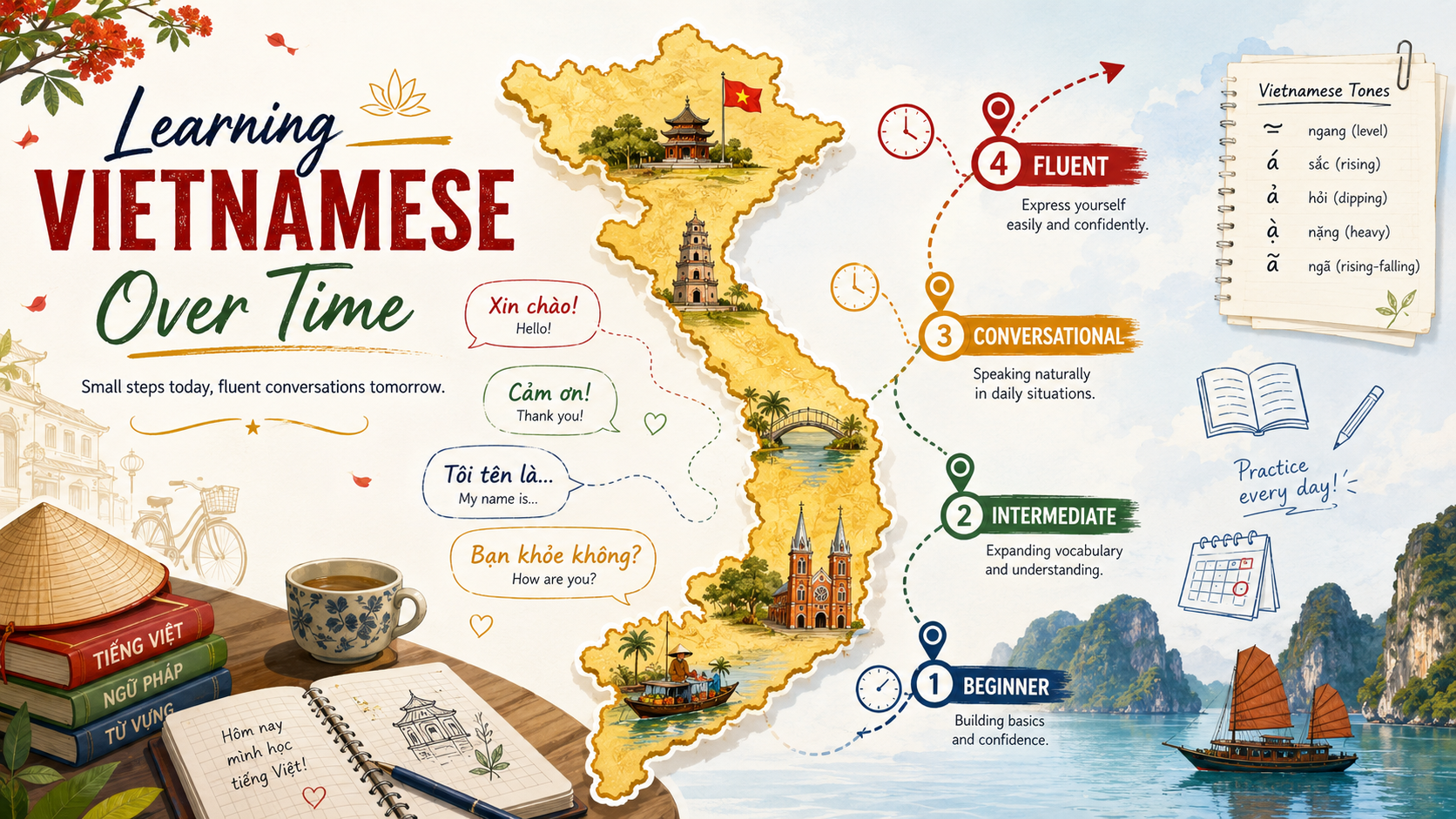
Learning Vietnamese can begin with something as small as memorizing xin chào before a vacation, ordering a bowl of phở without switching to English, or finally understanding a phrase you have heard from Vietnamese relatives for years, but as those first words gradually turn into conversations, stories, jokes, opinions, and genuine human connections, most learners eventually ask the same practical question: How long does it actually take to learn Vietnamese?
The honest answer is that Vietnamese can be learned relatively quickly at a basic level, but becoming genuinely comfortable in the language takes time.
You may be able to memorize essential travel expressions within a few weeks. With several months of consistent study, you may be able to introduce yourself, order food, talk about your family, ask for directions, and participate in short conversations. Reaching the point where you can speak confidently about unfamiliar topics, understand natural Vietnamese speech, watch television, or use Vietnamese professionally usually requires hundreds—or even more than a thousand—hours of focused learning.
That may initially sound discouraging. However, language learning is not an all-or-nothing process.
You do not have to wait until you are “fluent” before Vietnamese becomes useful. Every stage gives you something new. After your first few lessons, you may recognize tone marks and pronounce common greetings more accurately. After a few months, you may be able to navigate basic interactions. After a year, you may find yourself holding conversations that would once have seemed impossible.
The more useful question is therefore not simply, “How many years will Vietnamese take?”
It is:
What level of Vietnamese do you want, how many hours can you study each week, and what methods will you use?
A learner studying for two hours each week will follow a very different timeline from someone taking intensive daily lessons while living in Vietnam. A student who works regularly with an instructor and receives pronunciation feedback will usually progress differently from someone who depends entirely on an app. A heritage learner who already understands Vietnamese family conversations may develop speaking skills faster than a complete beginner who has never heard the language before.
Vietnamese also presents an unusual combination of difficulties and advantages. Its grammar is often more approachable than learners expect. Verbs do not change through long conjugation tables. Nouns do not have grammatical gender. The language uses a Latin-based writing system, so you do not have to learn thousands of characters before reading basic words.
At the same time, Vietnamese pronunciation, tones, listening comprehension, regional accents, and forms of address can be challenging for English speakers. Many learners discover that forming a basic sentence is easier than pronouncing it clearly enough to be understood.
This guide offers a realistic timeline for English-speaking adults learning Vietnamese. It explains how many study hours different levels may require, what you may be able to accomplish after one month, six months, one year, and two years, and what factors can either accelerate or delay your progress.
The goal is not to promise instant fluency. It is to help you create a practical plan that fits your life.
What Does It Mean to “Learn Vietnamese”?
Before estimating how long Vietnamese takes, you need to define what “learning Vietnamese” means to you.
Different learners can use the same phrase while imagining completely different goals.
A traveler may want to learn greetings, numbers, directions, polite expressions, and restaurant vocabulary. A person with Vietnamese relatives may want to participate in family conversations and use appropriate kinship terms. A professional may need to write emails, participate in meetings, and understand specialized vocabulary. Another learner may want to read Vietnamese novels, follow political discussions, or watch films without subtitles.
These goals require very different amounts of time.
Basic survival Vietnamese
At the survival level, you can use memorized phrases in predictable situations. You might be able to:
Greet someone politely
Say your name and nationality
Order food and drinks
Ask how much something costs
Understand basic numbers
Ask for directions
Say that you do not understand
Request help
Use essential courtesy expressions
A motivated learner can build this kind of phrasebook-level Vietnamese in approximately 30 to 60 hours.
Beginner Vietnamese
At a beginner level, you move beyond isolated phrases. You begin forming simple sentences, asking basic questions, and understanding slow speech about familiar topics.
You may be able to discuss your family, job, interests, daily schedule, hometown, and immediate plans. Conversations are still limited, and you will rely heavily on familiar patterns, repetition, and patient conversation partners.
Conversational Vietnamese
“Conversational” is one of the most frequently used—and most poorly defined—language-learning goals.
Conversational Vietnamese generally means that you can participate in everyday discussions about familiar topics. You may still pause, make grammatical mistakes, mispronounce tones, or ask people to repeat themselves, but you can communicate without relying entirely on memorized scripts.
At this level, you may be able to:
Discuss work, family, travel, food, and hobbies
Describe past experiences and future plans
Handle routine social and practical situations
Ask follow-up questions
Explain basic opinions
Maintain a conversation for an extended period
For many learners, this corresponds roughly to an upper A2 or B1 level on the Common European Framework of Reference for Languages.
Strong conversational or independent Vietnamese
At approximately the B2 level, you can communicate with considerably more independence. You understand the main points of many natural conversations and can discuss a broader range of subjects.
You will still encounter unfamiliar slang, regional pronunciation, and specialized vocabulary, but you can usually find another way to express what you mean.
Professional Vietnamese
Professional proficiency requires more than casual conversation. You need to understand formal language, workplace expectations, technical vocabulary, different levels of politeness, and the communication style of your industry.
You may need to:
Participate in meetings
Communicate with clients
Write professional messages
Give presentations
Read reports
Understand complex instructions
Discuss abstract or specialized topics
Reaching this level generally requires advanced study and extensive real-world use.
Near-native Vietnamese
Near-native proficiency means understanding fast conversations, humor, cultural references, idioms, regional speech, and subtle differences in register. It also includes the ability to express complex ideas naturally and appropriately.
This level is usually a long-term project requiring years of study, extensive listening, and sustained interaction with Vietnamese speakers.
How Difficult Is Vietnamese for English Speakers?
Vietnamese is often considered one of the more challenging languages for native English speakers.
The U.S. Foreign Service Institute has traditionally placed Vietnamese among the languages requiring approximately 1,100 classroom hours for English-speaking diplomats to reach professional working proficiency.
That number needs context.
The Foreign Service Institute does not measure the time required to learn tourist phrases or hold a short conversation. Its estimates relate to a high professional level in an intensive government program. Students typically spend many hours in class each week, complete additional homework, and receive highly structured instruction.
Therefore, 1,100 hours does not mean that you must study for 1,100 hours before speaking Vietnamese. It means that professional proficiency is a substantial goal, even under intensive conditions.
You can achieve meaningful communication much sooner.
A Realistic Vietnamese-Learning Timeline
The following estimates are approximate. Progress depends on lesson quality, consistency, prior language experience, speaking opportunities, pronunciation feedback, and the amount of Vietnamese you encounter outside formal study.
Goal or level Approximate total study hours What you may be able to do
Survival Vietnamese30–60 hours Use greetings, numbers, basic questions, restaurant phrases, and travel expressions
CEFR A 180–120 hours Introduce yourself, answer simple questions, and understand basic familiar language
CEFR A2 180–250 hours Handle common daily situations and discuss familiar subjects in simple language
CEFR B1 350–500 hours Maintain everyday conversations and describe experiences, plans, and opinions
CEFR B2 600–800 hours Communicate independently on many topics and understand much natural speech
CEFR C1 900–1,100+ hours Use Vietnamese flexibly in professional, academic, and complex social situations
Near-native ability 1,500–2,200+ hours Understand nuanced speech, media, idioms, humor, and culturally specific language
These numbers should be treated as planning ranges rather than guarantees.
Some learners progress faster in speaking but more slowly in reading. Others read confidently but struggle to understand natural conversation. Heritage learners may have excellent listening comprehension but limited literacy. Your skills will not necessarily develop at the same speed.
How Long Does Vietnamese Take at Different Weekly Study Rates?
Your weekly study commitment has a major effect on your calendar timeline.
Studying one to two hours per week
At this pace, Vietnamese can remain an enjoyable hobby, but progress will be gradual.
You may need:
Four to eight months for survival phrases
Around one year or longer for a basic A1 foundation
Two to four years to approach A2
Several additional years to become comfortably conversational
The greatest challenge at this pace is not intelligence or ability. It is maintaining continuity. When several days pass between study sessions, part of each lesson may be spent relearning material.
Studying three to five hours per week
This is a practical pace for many working adults.
You may reach:
Survival Vietnamese in two to four months
A1 in approximately four to eight months
A2 in approximately ten to eighteen months
B1 conversational ability in roughly two to three years
B2 in approximately three to five years
Consistent learners at this pace can make meaningful progress, especially when their weekly schedule includes live speaking and listening practice.
Studying seven to ten hours per week
This is a serious but manageable commitment.
At this pace, you may reach:
A1 within two to four months
A2 within six to ten months
B1 within approximately twelve to eighteen months
B2 within two to three years
Seven to ten weekly hours do not have to consist entirely of formal lessons. A productive schedule might include one live class, vocabulary review, listening practice, speaking sessions, reading, pronunciation drills, and short daily study periods.
Studying fifteen to twenty hours per week
This is an intensive schedule, particularly effective when combined with immersion.
You may reach:
Survival Vietnamese in two to four weeks
A1 within six to ten weeks
A2 within three to five months
B1 within six to nine months
B2 within approximately nine to fourteen months
These results require focused study, good instruction, frequent interaction, and regular review. Simply living in Vietnam without deliberately studying does not guarantee the same progress.
What Can You Learn in Your First Month?
During your first month, you will probably spend a significant amount of time learning how Vietnamese sounds.
You may study:
The Vietnamese alphabet
Tone marks
Basic vowel and consonant combinations
Greetings and introductions
Numbers
Countries and nationalities
Essential question words
Common pronouns
Basic sentence order
Polite everyday expressions
By the end of the month, a consistent learner may be able to introduce themselves, say where they are from, ask someone’s name, order a few familiar items, and understand simple classroom instructions.
Your pronunciation will not be perfect. You may be able to produce tones accurately in isolated words but lose them when speaking in full sentences. This is normal.
The first month is not about sounding fluent. It is about building habits that will support everything you learn later.
What Can You Learn in Three Months?
After three months, your results will depend heavily on intensity.
A casual learner may have acquired a useful set of memorized travel expressions. A learner studying five or more hours each week may be approaching A1 and beginning to create original sentences.
You may be able to:
Talk about your immediate family
Discuss your occupation
Describe your daily routine
Tell the time
Order food
Shop for basic items
Ask and answer simple questions
Understand slow speech on familiar subjects
Write short messages
Recognize common signs and words
You will probably still find spontaneous listening difficult. Textbook Vietnamese is usually slower and clearer than natural conversation. Native speakers may combine words, reduce sounds, use local vocabulary, or speak in an accent you have not studied.
Three months can create a strong foundation, but it is rarely enough for comfortable fluency.
What Can You Learn in Six Months?
Six months of serious study can produce visible and motivating progress.
At approximately seven to ten hours per week, you may accumulate between 180 and 250 hours—roughly enough to approach an A2 level.
You may be able to:
Handle many travel situations
Talk about familiar experiences
Describe what you did recently
Explain future plans
Participate in simple social conversations
Understand frequently used phrases
Read short messages and simple texts
Follow beginner-friendly videos
Communicate with supportive Vietnamese speakers
You will still make errors, particularly with tones, pronouns, word choice, and listening comprehension. However, you may begin to experience moments when you respond without first translating every sentence into English.
That is an important milestone. It signals that Vietnamese is becoming a communication system rather than a collection of vocabulary lists.
What Can You Learn in One Year?
A learner studying four to six hours each week may accumulate approximately 200 to 300 hours in one year. A more serious learner studying seven to ten hours weekly may reach 350 to 500 hours.
This means one learner may finish the year around A2, while another may approach B1.
After one year of consistent study, you may be able to:
Maintain conversations on familiar topics
Describe experiences in more detail
Express preferences and basic opinions
Handle common situations independently
Read short articles with assistance
Understand slow or carefully spoken media
Write messages and simple personal texts
Ask for clarification when you do not understand
Communicate despite gaps in vocabulary
You will probably not understand every group conversation, television program, or casual exchange. Fast native speech may still feel overwhelming, particularly when several speakers are involved.
Nevertheless, one year can be enough to become functionally conversational if you have studied consistently and spoken regularly.
What Can You Learn in Two Years?
After two years, consistent learners often become much more independent.
A learner studying approximately five hours each week may accumulate around 500 hours. Someone studying ten hours weekly may approach 1,000 hours.
Depending on the quality of practice, this could place a learner anywhere from B1 to B2, with some skills potentially stronger than others.
You may be able to:
Hold sustained conversations
Explain opinions and experiences
Understand a wider range of speakers
Participate in family or community interactions
Read simple news articles
Follow familiar television programs
Work with Vietnamese in limited professional contexts
Communicate when traveling without constantly using English
Develop friendships primarily through Vietnamese
At this stage, progress often becomes less visible. Early learners can easily notice when they learn their first hundred words. Intermediate learners may spend months improving subtle listening, vocabulary range, cultural knowledge, and natural phrasing.
This plateau is not a sign that learning has stopped. It is a normal transition from basic competence to deeper proficiency.
Why Vietnamese Can Feel Difficult at First
Vietnamese is not difficult for only one reason. Several unfamiliar features appear at the same time.
Vietnamese is tonal
Tones are not optional decorations placed on words. They help determine meaning.
A syllable pronounced with one tone may have a completely different meaning when pronounced with another. English speakers are accustomed to using pitch to show emotion, emphasis, or whether a sentence is a question. Vietnamese uses pitch patterns as part of the identity of individual words.
This means that vocabulary learning must include pronunciation from the beginning.
Do not memorize a Vietnamese word as a sequence of letters and plan to learn its tone later. The word and its tone belong together.
The vowel system is unfamiliar
Vietnamese contains vowel distinctions that can be difficult for English speakers to hear and produce. Two sounds that initially seem identical may represent different words.
You will also encounter vowel combinations and final consonants that behave differently from their English equivalents.
Natural listening is challenging
Beginner materials often present Vietnamese in a slow, carefully articulated form. Natural conversations are faster and less predictable.
Learners must identify syllables, tones, vocabulary, and sentence structure almost simultaneously. Regional pronunciation can add another layer of difficulty.
Listening usually develops more slowly than learners expect. The solution is not simply to watch hours of incomprehensible television. It is to listen repeatedly to material that is slightly above your current level.
Pronouns and kinship terms require social awareness
Vietnamese forms of address communicate information about age, gender, relationship, family role, and social position.
Instead of relying only on neutral words equivalent to “I” and “you,” speakers often choose kinship terms. Selecting the appropriate term requires understanding the relationship between the speakers.
This system becomes more intuitive with exposure, but it can feel complicated at first.
Regional differences matter
Vietnamese varies across Northern, Central, and Southern regions.
The differences include:
Tone realization
Consonant pronunciation
Vowels
Everyday vocabulary
Rhythm and intonation
Learning one variety first provides consistency. Later, you can gradually expose yourself to other accents.
What Makes Vietnamese Easier Than Many Learners Expect?
Vietnamese is challenging, but it also contains several learner-friendly features.
Vietnamese uses a Latin-based alphabet
Modern Vietnamese is written with quốc ngữ, a Romanized writing system that includes additional vowel symbols and tone marks.
English speakers do not have to memorize an entirely new character system before reading. Once you learn the sound-spelling relationships, written Vietnamese can provide useful pronunciation information.
Verbs do not have large conjugation systems
Vietnamese verbs generally do not change according to person.
For example, you do not need separate verb endings corresponding to “I speak,” “she speaks,” and “they speak.” Time and aspect are usually expressed through context or additional words.
This allows beginners to form useful sentences without memorizing extensive conjugation charts.
There is no grammatical gender
Vietnamese nouns are not divided into masculine, feminine, or neuter categories. Adjectives do not need to agree with grammatical gender.
There are no traditional noun declensions
You do not have to memorize case endings for subjects, direct objects, indirect objects, or possession.
Vietnamese relies heavily on word order, context, and function words.
Basic word order can feel familiar
Many basic Vietnamese sentences follow a subject-verb-object structure similar to English.
This does not mean that Vietnamese grammar is identical to English. However, beginners can often understand the basic logic of simple sentences relatively quickly.
How Long Does It Take to Master Vietnamese Tones?
You can begin recognizing and producing tones during your first weeks, but mastering tones in spontaneous speech takes much longer.
A typical learner may experience the following progression:
After two to four weeks
You may reproduce tones in isolated syllables and carefully practiced words. You may still confuse similar tones or lose accuracy when concentrating on vocabulary.
After two to three months
You may become understandable in familiar phrases, particularly when speaking slowly. Patient listeners can often use context to interpret occasional errors.
After six to twelve months
Your control of common words may become more automatic. You may begin hearing tone differences more reliably, although unfamiliar accents and fast speech remain challenging.
After one to two years
With consistent listening and speaking practice, your pronunciation may become considerably more natural. You may still have a foreign accent, but that does not prevent effective communication.
You do not need a special musical talent to learn Vietnamese tones. Musical training may help some learners notice pitch differences, but repetition, careful listening, feedback, and consistent practice are more important.
Northern or Southern Vietnamese: Which Should You Learn?
There is no universally correct dialect for every learner.
Northern Vietnamese, particularly Hanoi pronunciation, is often used in formal learning materials and is associated with the national standard. Southern Vietnamese is widely spoken in Ho Chi Minh City and throughout many Vietnamese communities abroad, especially in the United States.
Choose based on your goals.
Learn Northern Vietnamese when:
You plan to live or work in northern Vietnam
Your instructor or course uses Northern pronunciation
You want to follow Hanoi-based media
Your family or conversation partners speak a Northern variety
Learn Southern Vietnamese when:
You plan to spend time in southern Vietnam
You want to communicate with Southern Vietnamese relatives
Your local Vietnamese community primarily uses Southern speech
Your teacher and learning materials consistently use the Southern variety
Do not try to speak every dialect as a beginner. Choose one primary pronunciation model. As your listening improves, gradually expose yourself to other regional varieties.
The goal is not to judge one dialect as better. The goal is to build a stable foundation and then broaden your comprehension.
Four Sample Vietnamese Study Plans
The casual learner: approximately two hours per week
A casual schedule might include one weekly lesson and a small amount of review.
After one month, you may know basic greetings and courtesy phrases. After three months, you may handle a few predictable travel situations. After one year, you may approach A1. After two years, you may reach an elementary A2 level.
This schedule works well for enjoyment and gradual progress, but it is unlikely to produce rapid conversational fluency.
The consistent part-time learner: four to six hours per week
This learner takes a weekly class and studies independently on several additional days.
After three months, A1 may be within reach. After six months, you may move toward A2. After one year, you may communicate in many familiar situations. After two years, conversational B1 is a realistic goal.
This is one of the most sustainable schedules for busy adults.
The serious learner: seven to ten hours per week
A serious learner combines structured instruction, daily review, listening, speaking, reading, and vocabulary practice.
After six months, you may reach A2. After one year, B1 may be realistic. After two years, you may approach B2, particularly if you interact frequently with Vietnamese speakers.
The intensive learner: fifteen to twenty hours per week
An intensive learner may take daily classes, live in Vietnam, work with a private instructor, or use Vietnamese throughout the day.
After three months, A2 may be possible. After six to nine months, B1 may be achievable. After one year, some learners approach B2.
Intensive study produces faster results, but it also requires energy, discipline, and a strong review system.
How to Learn Vietnamese Faster Without Looking for Shortcuts
You cannot eliminate the need for practice, but you can use your time more effectively.
Work with a qualified instructor
An experienced Vietnamese teacher can identify pronunciation problems that you may not hear yourself. Immediate correction prevents recurring errors from becoming deeply established habits.
Practise pronunciation from the beginning
Spend time on vowels, consonants, tone patterns, and common syllables before attempting long conversations.
This may feel slower initially, but it makes later vocabulary and speaking practice more efficient.
Study frequently rather than occasionally
Twenty or thirty minutes on most days is usually more effective than a single three-hour session followed by a week of inactivity.
Frequent contact keeps sounds, vocabulary, and sentence patterns active in your memory.
Use flashcards with audio and context
Do not memorize isolated written words. Include:
Audio
Tone marks
A useful example sentence
A translation
Information about dialect when relevant
Shadow short recordings
Shadowing means listening to a speaker and repeating immediately, attempting to copy pronunciation, tone, rhythm, and pacing.
Start with very short recordings. Repeat the same sentence many times rather than constantly moving to new content.
Record yourself
Recording can reveal differences between what you think you are saying and what you are actually producing.
Compare your version with a native recording. Focus on one feature at a time, such as the vowel, final consonant, or tone.
Speak before you feel fully ready
Waiting for perfect grammar and pronunciation delays the development of real communication skills.
Begin with short, controlled conversations. Use language you know, ask for correction, and gradually increase the difficulty.
Use comprehensible input
Choose content you can mostly understand.
Beginner dialogues, graded stories, slow podcasts, subtitled videos, and instructor-created listening exercises are often more helpful than jumping directly into fast television dramas.
Common Mistakes That Slow Vietnamese Learners Down
Ignoring tones
Treating tones as optional creates pronunciation habits that may be difficult to correct later.
Memorizing words without hearing them
Written Vietnamese contains valuable pronunciation information, but text alone cannot teach accurate rhythm, vowel quality, or tone realization.
Depending entirely on an app
Apps can support vocabulary and review, but they rarely provide enough spontaneous speaking, personalized feedback, or natural interaction.
Avoiding conversation
Speaking is a skill. It develops through speaking, not through waiting until you feel perfectly prepared.
Studying inconsistently
Long gaps force you to repeatedly rebuild knowledge that could have become automatic.
Switching dialects constantly
Hearing different accents is valuable, but beginners benefit from one clear pronunciation model.
Translating every sentence word for word
Vietnamese does not organize every idea exactly as English does. Learn complete phrases and natural sentence patterns.
Using material that is far too difficult
Advanced content can be motivating occasionally, but most daily listening should be understandable enough to produce learning rather than frustration.
Can You Learn Vietnamese in Three Months?
You can learn a meaningful amount of Vietnamese in three months.
With daily study, you may be able to introduce yourself, order food, discuss familiar topics, ask basic questions, and manage common travel situations.
An intensive learner may reach A1 or A2. A part-time learner may build a solid survival foundation.
However, three months is generally not enough for comfortable fluency. You will still need considerable help with natural listening, unfamiliar situations, vocabulary, and spontaneous conversation.
Can You Learn Vietnamese in Six Months?
Six months can be enough for basic conversational ability when you study consistently and intensively.
A serious learner may reach A2 or low B1. You may be able to discuss daily life, travel independently, and maintain short conversations.
Full fluency is a different goal. Understanding fast speech, using culturally appropriate forms of address, discussing complex ideas, and following media generally requires much more time.
Can Vietnamese Be Learned Effectively Online?
Yes. Vietnamese can be learned successfully online, especially when your program includes live interaction.
A strong online learning plan may combine:
Live small-group classes
Individual pronunciation coaching
Structured homework
Recorded listening materials
Audio flashcards
Conversation exchanges
Vietnamese videos and podcasts
Regular progress assessments
Live instruction is particularly valuable because Vietnamese pronunciation errors can be difficult to identify independently.
Recorded courses and apps can support your learning, but they should ideally be combined with opportunities to speak and receive feedback.
Learning Vietnamese in the United States
Learners in the United States may have more opportunities to practise Vietnamese than they realize.
Large Vietnamese communities can be found in areas such as San Jose, Orange County, Houston, Seattle, Northern Virginia, and parts of the San Francisco Bay Area.
You can supplement classes by:
Attending Vietnamese cultural festivals
Visiting Vietnamese restaurants and markets
Reading menus and signs
Joining community organizations
Finding language-exchange partners
Listening to Vietnamese-American media
Participating in online community groups
Attending public cultural events
Community exposure does not replace structured learning, but it gives the language a real social context.
Staying Motivated During a Multi-Year Journey
Fluency is too broad to serve as your only goal.
Create smaller goals that you can actually observe.
Examples include:
Introduce yourself without notes
Order a complete meal in Vietnamese
Understand a beginner podcast
Speak with a relative for five minutes
Write a short message
Learn 300 useful words
Complete your first Vietnamese book
Watch a familiar video without English subtitles
Hold a fifteen-minute conversation
Track your study hours as well as your results. You cannot always control how quickly a new sound becomes natural, but you can control whether you practise it.
Expect periods of rapid improvement and periods when progress feels invisible. Language development is rarely linear.
Frequently Asked Questions
Is Vietnamese difficult for English speakers?
Vietnamese is challenging for English speakers primarily because of its tones, pronunciation, unfamiliar vocabulary, listening demands, and forms of address. However, its Latin-based alphabet and relatively streamlined grammar make certain aspects easier than expected.
How long does it take to become conversational in Vietnamese?
With approximately seven to ten hours of effective weekly study, a motivated learner may reach a B1 conversational level within twelve to twenty-four months. Learners studying fewer hours will generally need longer.
Can I learn Vietnamese in six months?
You can reach survival or elementary conversational ability in six months, particularly with consistent study. Serious learners may approach A2 or low B1. Comfortable fluency usually takes considerably longer.
How many hours per day should I study Vietnamese?
Thirty to sixty minutes per day is a strong sustainable target for many learners. Your study should include listening, pronunciation, vocabulary review, and speaking—not only passive reading.
Is Vietnamese grammar difficult?
Basic Vietnamese grammar is often easier than learners expect because verbs do not have extensive conjugation systems, nouns have no grammatical gender, and there are no traditional case endings. Advanced usage, pronouns, particles, and natural phrasing can still be subtle.
Are Vietnamese tones hard to learn?
Tones are challenging at first, but adults can learn them. Focused listening, imitation, recording, repetition, and feedback from an instructor can produce major improvement.
Do I need a musical ear to learn Vietnamese?
No. Musical experience may help some people notice pitch, but consistent practice and accurate feedback are far more important.
Should I learn Northern or Southern Vietnamese?
Choose the dialect that matches your family, teacher, local community, work, or travel plans. Both are legitimate varieties. Begin with one and expand your listening exposure later.
Can I learn Vietnamese entirely online?
Yes. Online learning can be highly effective when it includes structured lessons, audio materials, regular speaking, and personalized pronunciation correction.
Is Vietnamese easier than Mandarin?
Vietnamese uses a Latin-based alphabet, so basic reading and writing may feel more accessible to English speakers than learning Chinese characters. Both languages use tones, and Vietnamese pronunciation and listening can still be highly challenging.
How long does it take to read Vietnamese?
You can learn to decode the alphabet relatively quickly. Reading simple messages may develop at A1 or A2. Reading newspapers, essays, and literature comfortably generally requires upper-intermediate or advanced vocabulary.
Are Vietnamese-learning apps enough?
Apps are useful supplements, but they are rarely sufficient for complete speaking and listening development. Vietnamese learners benefit greatly from real conversation and corrective feedback.
How long does it take to understand Vietnamese television?
At B1, you may understand parts of slow or familiar programs. At B2, television becomes more accessible, although slang and regional accents remain challenging. Fast news, comedy, and complex dramas may require advanced proficiency.
Do I have to live in Vietnam to become fluent?
No. You can become highly proficient through online lessons, Vietnamese-speaking communities, media exposure, conversation partners, and disciplined independent study. Living in Vietnam can accelerate progress, but immersion only works when you actively use the language.
What is the fastest way to learn Vietnamese?
Combine structured live lessons, daily pronunciation practice, spaced vocabulary review, comprehensible listening, and frequent speaking. The fastest method is not a secret shortcut; it is a consistent system that develops all major skills.
Final Answer: How Long Does It Really Take?
For most English-speaking adults, a realistic Vietnamese timeline looks something like this:
One to three months for survival phrases
Four to ten months for a basic A1 foundation
Eight to eighteen months for A2
One to three years for conversational B1
Two to five years for strong B2 communication
Several years for advanced or professional proficiency
The exact timeline depends less on the number of calendar years and more on the number and quality of hours you invest.
Vietnamese is not a language you have to master before enjoying it. Your first successful greeting matters. Your first restaurant interaction matters. Your first conversation with a relative matters. Fluency is built from hundreds of these small moments.
Learn Vietnamese with Polyglottist Language Academy
The most effective way to make steady progress is to combine independent practice with structured guidance, regular conversation, and feedback from an experienced instructor.
Polyglottist Language Academy offers live language instruction for adults in a welcoming and supportive environment. Our small-group online classes are designed to give students consistent practice, personal attention, and opportunities to communicate from the beginning.
Whether you are learning Vietnamese for travel, family, cultural connection, professional reasons, or personal enrichment, explore our current and upcoming Vietnamese programs and our wider selection of live online language classes.
Visit Polyglottist Language Academy to learn more about upcoming courses and register for a class.
Continue Exploring Vietnamese Language and Culture
You may also enjoy these articles: