
Vietnamese Tones Explained: Why They Matter and How to Practice Them
For many English speakers, the first encounter with Vietnamese can feel both beautiful and bewildering: the words are short, the writing system uses the familiar Latin alphabet, and yet the moment you hear a native speaker pronounce even a simple syllable like ma, you realize that something entirely different is happening beneath the surface. Vietnamese is not only about consonants and vowels. It is also about melody. A word does not simply have sounds; it has a shape, a movement, a pitch, a direction. It may rise, fall, dip, break, stop suddenly, or stay level. That movement is not decoration. It is not emotion. It is not optional. In Vietnamese, tone is part of the word itself.
This is one of the biggest surprises for beginners. In English, we use pitch all the time, but we usually use it to express attitude, emotion, or sentence meaning. Say “Really?” with a rising voice, and it sounds like a question. Say “Really.” with a flat or falling voice, and it sounds like a statement. Say “Really!” with excitement, and it sounds like surprise. But the word itself does not change. It is still “really.”
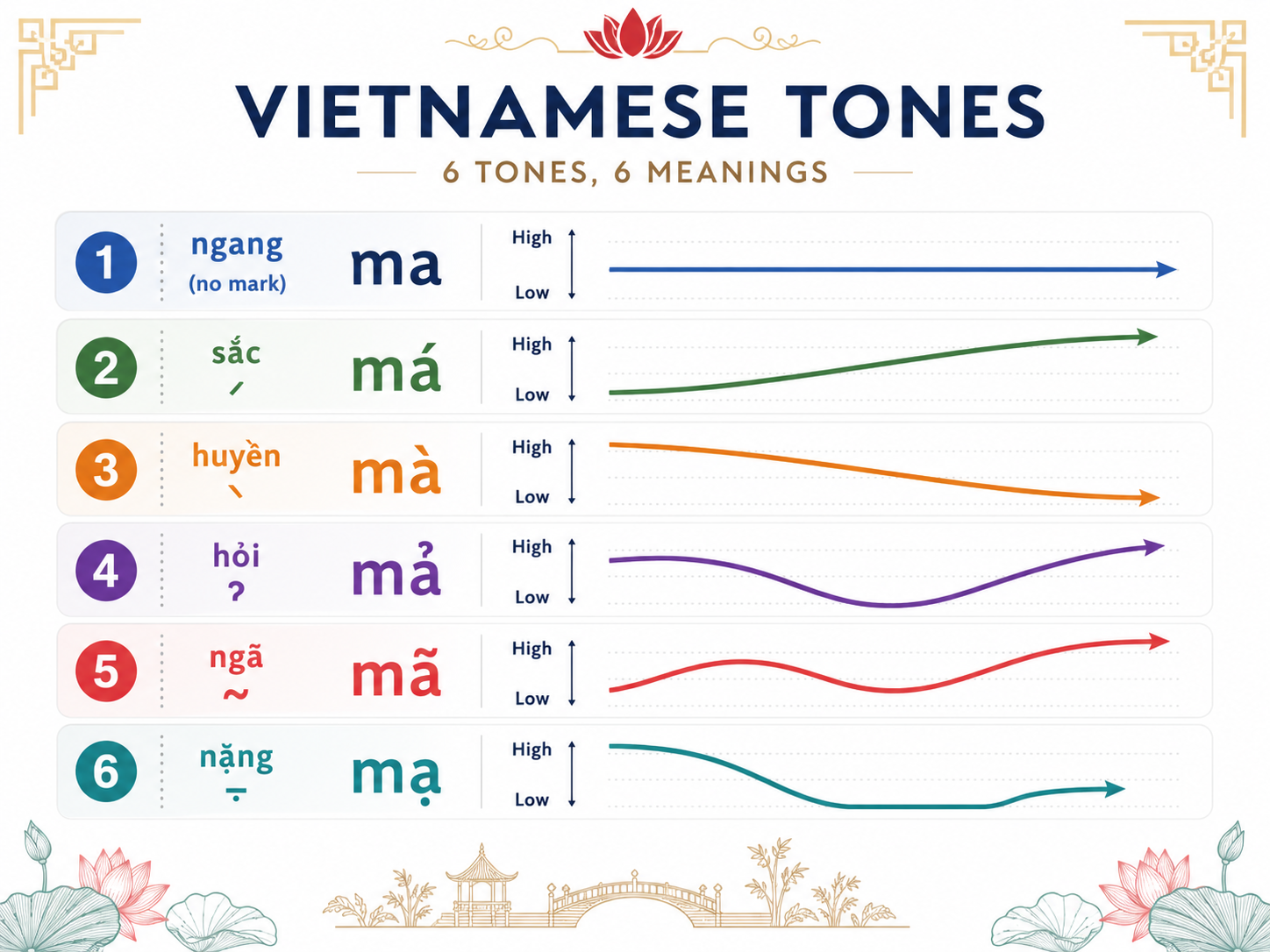
Vietnamese works differently. In Vietnamese, changing the pitch pattern of a syllable can create an entirely different word. The classic example is ma. Depending on the tone, ma, má, mà, mả, mã, and mạ are not six emotional versions of the same word. They are different words. The tone mark changes meaning just as much as changing a vowel or consonant would. This means that if you want to speak Vietnamese clearly, you cannot treat tones as an advanced pronunciation detail to fix later. They belong at the very beginning of the learning process.
That may sound intimidating, but it should not discourage you. Vietnamese tones are challenging because they ask your ear and mouth to do something unfamiliar, not because they are impossible. English speakers can absolutely learn them. You do not need perfect pitch. You do not need to be musical. You do not need to sound like a native speaker after one month. What you do need is a different way of practicing: slower, more intentional, more focused on listening, and more respectful of the way Vietnamese organizes meaning.
In fact, learning tones can become one of the most satisfying parts of studying Vietnamese. At first, you may hear only a blur of rising and falling sounds. Then, little by little, patterns begin to emerge. You start to notice that one word feels high and sharp, another feels low and heavy, another seems to dip before coming back up. You begin to recognize tone marks not as mysterious accents sprinkled over letters, but as helpful pronunciation guides. You stop seeing Vietnamese diacritics as visual clutter and start seeing them as a map.
This article will explain what Vietnamese tones are, why they matter, how the six tones work, what makes them difficult for English speakers, and how to practice them in a realistic and beginner-friendly way. We will focus mainly on the six tones of Northern Vietnamese, often associated with the Hanoi accent, while also discussing Southern and Central differences. Most importantly, we will look at practical exercises you can use immediately, whether you are studying with a teacher, practicing at home, preparing for travel, or learning Vietnamese to connect with family, friends, culture, food, or community.
What Are Vietnamese Tones?
Vietnamese is a tonal language. This means that the pitch pattern of your voice changes the meaning of a word. A tone is the “melody” attached to a syllable. It tells your voice whether to stay level, rise, fall, dip, break, or stop sharply.
For beginners, the easiest way to understand tone is to compare it to singing a tiny musical shape on each word. But unlike singing, Vietnamese tones do not require musical talent. They require awareness. You are not trying to sing beautifully; you are trying to move your voice in the correct direction.
In English, pitch usually works across a whole sentence. We may raise our voice at the end of a question or lower it to sound serious. In Vietnamese, pitch is built into individual syllables. Since many Vietnamese words are short, often one syllable, the tone becomes especially important. A tiny change in pitch can create a completely different meaning.
Consider the famous Vietnamese practice set:
ma
má
mà
mả
mã
mạ
To an English-speaking beginner, these may look almost identical. They all contain the letters m and a. But to a Vietnamese speaker, they are separate words because each one has a different tone.
This is why learners should never memorize Vietnamese words without their tone marks. Learning ma without noticing whether it is má, mà, or mạ is like learning an English word while ignoring one of its letters. Imagine trying to remember the difference between “bat,” “bet,” “bit,” and “but,” but deciding that vowels are not important yet. That would create confusion very quickly. The same is true for Vietnamese tones.
The Six Tones in Northern Vietnamese
Northern Vietnamese has six tones. These are usually taught as:
ngang — level tone, no mark
sắc — rising tone, written with an acute accent: á
huyền — falling tone, written with a grave accent: à
hỏi — dipping tone, written with a hook above: ả
ngã — broken or creaky rising tone, written with a tilde: ã
nặng — heavy tone, written with a dot below: ạ
Let’s look at each tone more closely.
1. Ngang: The Level Tone
The ngang tone has no written tone mark. In the example ma, there is no accent above or below the vowel. This tone is usually described as level, steady, and relaxed. Your voice does not rise dramatically or fall dramatically. It stays relatively even.
For English speakers, this can be harder than it sounds because we often naturally add movement to our voice. We may accidentally turn a level tone into a question-like rising tone or a falling statement tone. With ngang, the goal is calm stability.
Try saying ma in a neutral, steady voice. Do not make it sound like a question. Do not sigh downward. Keep it smooth and level.
Example words with the level tone include:
ma — ghost
ba — father or number three, depending on context
cơm — cooked rice or meal
When practicing ngang, imagine your voice moving along a straight horizontal line. The challenge is not drama; the challenge is control.
2. Sắc: The Rising Tone
The sắc tone is written with an acute accent, as in má. This tone rises. It often starts around the middle of your pitch range and moves upward. For English speakers, it may feel a little like the rising intonation at the end of a yes-or-no question.
If you say “Ma?” in English as if you are calling for your mother or asking a surprised question, you are getting close to the feeling of sắc. But be careful: Vietnamese sắc is not just a question intonation. It is part of the word.
Example words include:
má — mother or cheek, depending on region and context
cá — fish
lá — leaf
When practicing sắc, let your voice climb upward clearly. At the beginner stage, it is helpful to exaggerate the rise. Later, as your pronunciation becomes more natural, you can make it less dramatic.
A useful hand gesture is to move your hand upward as you say the word. This may feel childish at first, but physical movement can help your brain connect sound and pitch direction.
3. Huyền: The Falling Tone
The huyền tone is written with a grave accent, as in mà. This tone falls. It often starts around the middle or slightly lower part of your pitch range and moves downward. It can sound a little like a sigh.
For English speakers, huyền may feel easier than some of the more complex tones because falling intonation exists in English. We often lower our voice at the end of statements. But again, in Vietnamese, this falling movement belongs to the word itself.
Example words include:
mà — but
bà — grandmother or older woman
cà — as in cà phê or cà chua
To practice huyền, say the word gently and let your pitch slide downward. Do not force it. Do not make it too sharp or theatrical. Think of a calm downward movement.
The contrast between sắc and huyền is especially useful for beginners:
má — rising
mà — falling
Practice them back and forth:
má, mà, má, mà
This teaches your ear and mouth to feel the difference between up and down.
4. Hỏi: The Dipping Tone
The hỏi tone is written with a hook above the vowel, as in mả. This tone is often described as dipping. It goes down and then comes back up slightly. In Northern Vietnamese, it may also have a slightly tense or creaky quality, depending on the speaker and context.
This tone can be difficult for English speakers because English does not usually use this kind of pitch movement inside a single syllable to change word meaning. You need to compress the movement into a short space.
A simple way to imagine hỏi is: start in the middle, dip lower, then lift a little. It is not a full dramatic fall and rise like a long musical note. It is more compact.
Example words include:
mả — tomb
cả — all, whole, or entire
hỏi — to ask
When practicing hỏi, use a small downward-and-upward hand motion. Your hand drops slightly, then rises. This physical cue can help prevent you from turning hỏi into either a simple falling tone or a simple rising tone.
One common mistake is making hỏi sound too much like huyền. Another common mistake is making it sound too much like sắc. The key is the dip.
Practice:
mà — falling
mả — dipping
má — rising
Say them slowly and listen for the difference.
5. Ngã: The Broken or Creaky Rising Tone
The ngã tone is written with a tilde, as in mã. In Northern Vietnamese, it is often described as a rising tone with a break, catch, or creaky quality in the middle. Your voice may briefly tighten or interrupt, almost like a tiny vocal “hiccup,” before continuing upward.
This tone is one of the most challenging for many learners because it involves not only pitch, but also voice quality. You are not simply rising. You are creating a slightly broken or glottalized sound.
Example words include:
mã — horse or code
ngã — to fall
sẽ — will
For beginners, it is okay if your ngã is not perfect right away. Start by making it different from sắc. Since both can rise, the difference is that ngã has that broken, creaky, or interrupted quality. Native speakers vary in how strongly they produce it, and regional differences also matter.
Try this: say ma with a rising tone, but allow your voice to briefly catch in the middle. Do not strain your throat. It should be small and controlled, not painful or exaggerated.
Practice:
má — smooth rising
mã — broken rising
Say them slowly:
má, mã, má, mã
The goal is to hear and feel the difference between a clean rise and a broken rise.
6. Nặng: The Heavy Tone
The nặng tone is written with a dot below the vowel, as in mạ. This tone is low, short, and heavy. It often has a sharp downward movement and may end with a glottal stop, meaning your voice closes off abruptly.
For English speakers, this tone can feel strange because it is shorter and more compressed than the others. It does not float. It drops and stops.
Example words include:
mạ — rice seedling
nặng — heavy
một — one
To practice nặng, start low and stop firmly. Imagine the sound being pulled downward and cut off. But again, avoid hurting your throat. The stop should be controlled, not forced.
Compare:
mà — falling and open
mạ — low, heavy, stopped
The difference is important. Huyền falls gently. Nặng feels shorter and more closed.
The Classic “Ma” Tone Set
The syllable ma is often used to practice Vietnamese tones because it allows learners to focus on tone without worrying about complicated consonants or vowels. Here is the full set:
ma — level tone
má — rising tone
mà — falling tone
mả — dipping tone
mã — broken rising tone
mạ — heavy tone
A beginner-friendly drill is to say them in order:
ma, má, mà, mả, mã, mạ
Then reverse the order:
mạ, mã, mả, mà, má, ma
Then practice pairs:
ma — má
má — mà
mà — mả
mả — mã
mã — mạ
Finally, shuffle them. Ask a teacher, tutor, language partner, or audio resource to say one of the six words randomly while you identify the tone. This develops listening, not just speaking.
Northern, Southern, and Central Tone Differences
Vietnamese is not pronounced exactly the same everywhere. Northern, Southern, and Central Vietnamese all use tone, but the tones can sound different depending on the region.
Many textbooks and formal courses begin with Northern Vietnamese, especially the Hanoi accent, because it preserves the six-tone distinction often presented in standard descriptions. Southern Vietnamese, especially the Ho Chi Minh City accent, typically merges hỏi and ngã in pronunciation. This means that while the writing still shows both tone marks, the spoken distinction may be reduced or absent in many Southern speakers’ everyday speech.
Central Vietnamese varieties, such as those associated with Huế, may preserve six tones but pronounce them with different pitch shapes, tighter movement, or stronger glottal qualities. To learners, some Central accents may sound more compressed or harder to parse at first.
So which accent should you learn?
The best answer is: choose the accent that matches your goals. If you have family from Southern Vietnam, learn Southern Vietnamese. If you are studying for academic reasons or using a Northern-based textbook, focus on Northern Vietnamese. If you plan to live in a particular region, prioritize the accent spoken there.
What you should avoid at the beginning is mixing everything randomly. Vietnamese pronunciation includes tones, vowels, consonants, rhythm, and regional habits. If you learn a Northern tone system, Southern consonant habits, and random vocabulary pronunciation from different sources, your speech may become inconsistent. Native speakers can still understand mixed accents in many cases, but beginners benefit from having one clear model.
Choose one main accent first. Later, as your listening improves, you can learn to understand other regional varieties.
Why Vietnamese Tones Matter
Tones matter because they change meaning. They are not simply about sounding polished or elegant. They are essential for being understood.
If you pronounce the wrong tone, you may say a different word. Sometimes context will help. If you are ordering food and say something slightly wrong, the server may still understand from the situation. But if your tones are consistently unclear, listeners may have to guess too much. Conversation becomes tiring for both sides.
Imagine someone learning English who regularly confuses “ship,” “sheep,” “shop,” and “shape.” You might understand them in context, but not always. The listener has to work harder. Vietnamese tone errors create a similar problem.
Tone mistakes can also be funny. This is not necessarily a disaster; language learning always includes awkward moments. But if you want to communicate clearly and respectfully, tones deserve attention from the beginning.
There is another reason tones matter: they improve listening comprehension. Many learners think of tones as a speaking problem, but tones are just as important for listening. If you cannot hear the difference between má and mà, or between mả and mã, Vietnamese speech may sound much faster and more confusing than it really is. Once your ear begins to recognize tones, words become easier to separate.
Accurate tones also help you sound more natural. You do not need a perfect native accent, but if your tones are reasonably clear, Vietnamese speakers will usually understand you more easily and appreciate the effort.
Why English Speakers Struggle with Vietnamese Tones
English speakers struggle with Vietnamese tones for predictable reasons. The problem is not intelligence or talent. It is training.
First, English does not use tone in the same way. English uses stress, rhythm, vowel quality, and sentence intonation. Vietnamese uses pitch at the syllable level to distinguish words. Your brain may initially treat Vietnamese tones as emotional coloring rather than lexical information.
Second, English speakers may not hear the differences clearly at first. If your brain has never needed to separate words by tone, it may group several tones together as “basically the same.” This is normal. With practice, your brain creates new sound categories.
Third, learners often memorize vocabulary without tones. They may write a word down without the accent mark or type it without Vietnamese diacritics. Later, they know the word visually but cannot pronounce it correctly. This creates a habit that is difficult to fix.
Fourth, some Vietnamese tones involve voice qualities that English does not use in the same way. Ngã may involve creakiness or a break. Nặng may involve a glottal stop. These are not just pitch movements; they involve how the voice is produced.
Finally, beginners may be able to say tones correctly in isolation but lose them in sentences. This is extremely common. Saying má by itself is one skill. Saying a full sentence with correct tones, vowels, consonants, rhythm, and meaning is another skill. You build that gradually.
How to Practice Vietnamese Tones
The best way to practice Vietnamese tones is to combine listening, repetition, visual support, and feedback. You need to train both your ear and your mouth.
1. Start with Listening Before Speaking
Many learners want to start speaking immediately, but tones require careful listening. Spend time hearing the tones before forcing yourself to produce them. Listen to a native speaker pronounce the six-tone set slowly. Do not repeat at first. Just listen and notice the direction of the voice.
Ask yourself:
Does the tone rise?
Does it fall?
Does it stay flat?
Does it dip?
Does it sound broken?
Does it stop suddenly?
This kind of focused listening prepares your brain to produce the tones later.
2. Use Minimal Pairs
Minimal pairs are words that differ by only one sound feature. In Vietnamese tone practice, this often means words that have the same consonant and vowel but different tones.
For example:
ma, má, mà, mả, mã, mạ
ba, bá, bà, bả, bã, bạ
ca, cá, cà, cả, cã, cạ
Do not rush through these. Practice slowly. First repeat after a native speaker. Then record yourself. Then try identifying tones when you hear them in random order.
Minimal pairs are powerful because they force your ear to focus on the exact feature that changes meaning.
3. Learn Tone Marks as Part of the Word
Never write Vietnamese vocabulary without tone marks. If you learn ca when the word is really cá, you are learning an incomplete word.
In your notes, flashcards, and vocabulary lists, always include the correct Vietnamese spelling. When you review a word, say the tone name or at least notice the tone mark. For example:
cá — fish — sắc tone
bà — grandmother — huyền tone
một — one — nặng tone
This turns tone into part of your memory from the beginning.
4. Use Hand Gestures
Hand gestures can help because they turn sound into movement. For each tone, use a simple motion:
ngang — move your hand straight across
sắc — move your hand upward
huyền — move your hand downward
hỏi — move your hand down, then slightly up
ngã — move your hand upward with a little break or wave
nặng — move your hand sharply downward and stop
This may feel silly, but it works. Your body helps your memory.
5. Record Yourself
Your voice may sound correct inside your head, but recordings reveal what you are actually producing. Use your phone. Record yourself saying a tone set, then compare it to a native model.
Do not judge yourself harshly. Listen for one thing at a time. For example:
Today, focus only on whether sắc rises.
Tomorrow, focus only on whether huyền falls.
Next week, compare hỏi and ngã.
The goal is gradual improvement, not perfection.
6. Practice in Short Phrases
Do not stay forever at the single-syllable stage. Once you can produce tones slowly, begin practicing short phrases. Vietnamese tones occur in real speech, not in isolated laboratory conditions.
Start with very short examples:
Má ăn cá.
Bà uống cà phê.
Một, hai, ba.
Say them slowly. Keep the tones clear. Then increase speed only when you can stay accurate.
A 10-Minute Daily Tone Practice Routine
If you are a beginner, you do not need to practice tones for an hour every day. Ten focused minutes can be very effective if you do it consistently.
Here is a simple routine:
Minute 1–2: Listen Only
Play a native-speaker recording of the six tones. Listen without speaking. Follow the pitch with your finger or hand.
Minute 3–4: Repeat Slowly
Repeat after the recording:
ma, má, mà, mả, mã, mạ
Exaggerate the tones slightly.
Minute 5–6: Practice Pairs
Choose two tones that confuse you. For example:
má — mà
mả — mã
mà — mạ
Repeat them slowly and clearly.
Minute 7–8: Record Yourself
Record the six-tone set. Listen back. Choose one tone to improve.
Minute 9–10: Use Real Words
Practice five real vocabulary words with tones. Say each word three times, then use one or two in a phrase.
This routine is short enough to maintain, but focused enough to build real skill over time.
Common Tone Practice Mistakes
Mistake 1: Ignoring Tone Marks
Some learners think they can learn vocabulary first and fix tones later. This is usually a bad strategy. If you memorize words without tones, you may have to relearn them later.
Mistake 2: Practicing Only by Reading
Vietnamese spelling is helpful, but tones are sounds. You need audio. Always connect written tone marks with native pronunciation.
Mistake 3: Speaking Too Fast Too Soon
Speed can destroy tone accuracy. Practice slowly first. Clear slow Vietnamese is better than fast unclear Vietnamese.
Mistake 4: Treating Tones as Emotion
A rising tone is not “happy.” A falling tone is not “sad.” A heavy tone is not “angry.” Tone is linguistic meaning, not mood.
Mistake 5: Giving Up Too Early
At first, tones may feel impossible. After several weeks, they become more familiar. After several months, they begin to feel natural. You need time.
Do You Need Perfect Pitch to Learn Vietnamese Tones?
No. This is one of the most common myths about tonal languages. Perfect pitch is the ability to identify exact musical notes without a reference. Vietnamese tones do not require that.
You are not trying to identify whether a syllable is an A or a C-sharp. You are learning relative pitch movement: level, rising, falling, dipping, broken, or heavy. This is a skill that can be trained.
Many people who are not musical learn Vietnamese tones successfully. Likewise, being musical may help, but it does not automatically make someone good at Vietnamese pronunciation. Language tones are not the same as music. They involve timing, voice quality, vowels, consonants, and context.
How Long Does It Take to Learn Vietnamese Tones?
There is no exact timeline, but beginners can think in stages.
First Week
In the first week, your main goal is awareness. You should learn that tones exist, recognize the six tone marks, and begin hearing obvious differences such as rising versus falling. You may still confuse hỏi, ngã, and nặng, and that is normal.
First Month
After a month of consistent practice, you may be able to pronounce the six tones in isolation and recognize them in slow recordings. You will still make mistakes in real conversation, especially when you are thinking about grammar or vocabulary.
First Six Months
After several months, tones should feel less foreign. You may still have an accent, but you should be able to produce many common words clearly enough for native speakers to understand. Listening comprehension also improves because tones begin to sound meaningful rather than random.
One Year and Beyond
With regular speaking practice, feedback, and exposure to native speech, your tones become more automatic. You stop consciously thinking about every mark and start feeling the shape of words naturally.
The key is consistency. Five to ten minutes of tone practice every day is better than one long session once a month.
Are Vietnamese Tones Harder Than Mandarin Tones?
Many learners ask whether Vietnamese tones are harder than Mandarin tones. The answer depends on the learner and the dialect. Mandarin has four main tones plus a neutral tone. Northern Vietnamese has six tones, including tones with creaky or glottal qualities such as ngã and nặng. In that sense, Vietnamese can feel more complex.
However, Vietnamese spelling gives learners a major advantage: tone marks are written directly on the word. In Mandarin written with Chinese characters, pronunciation is not always obvious unless you also have pinyin. In Vietnamese, the writing system constantly reminds you of the tone.
If you already know Mandarin, Thai, or Cantonese, you may have an advantage because your ear is already trained to notice pitch. But you still need to learn Vietnamese tones on their own terms. Do not assume that a Vietnamese tone is exactly the same as a Mandarin or Thai tone.
Why Tone Practice Is Also Cultural Practice
Pronunciation is not only technical. It is also social. When you make an effort to pronounce Vietnamese tones clearly, you show respect for the language and for the people who speak it.
Vietnamese speakers are usually very patient with learners, especially beginners. They do not expect perfection. But they often appreciate when a learner takes tones seriously because tones are central to the language. Trying to speak without tones can sound like you are ignoring a major part of Vietnamese.
This does not mean you should be afraid to speak. You will make mistakes. Everyone does. The goal is not to avoid embarrassment forever. The goal is to keep improving.
In real communication, clear tones make conversations smoother. They reduce guessing. They help you order food, ask for directions, understand names, recognize family terms, and participate more fully in Vietnamese-speaking environments.
A Practical Beginner Study Plan
If you are just beginning Vietnamese, here is a realistic way to include tones in your study routine.
Week 1: Learn the Six Tone Marks
Memorize the names and symbols:
ngang — no mark
sắc — á
huyền — à
hỏi — ả
ngã — ã
nặng — ạ
Practice with ma every day.
Week 2: Add Minimal Pairs
Practice two or three syllable sets:
ma, má, mà, mả, mã, mạ
ba, bá, bà, bả, bã, bạ
ca, cá, cà, cả, cã, cạ
Listen, repeat, record, compare.
Week 3: Add Real Vocabulary
Choose ten useful Vietnamese words. Learn each word with its tone. Do not separate spelling from sound.
Week 4: Practice Short Phrases
Begin saying short phrases slowly. Focus on clarity, not speed.
Month 2 and Beyond: Get Feedback
Work with a teacher, tutor, or native speaker. Ask them not only “Was that understandable?” but also “Which tone was wrong?” Specific feedback is essential.
Frequently Asked Questions About Vietnamese Tones
How many tones does Vietnamese have?
Northern Vietnamese is usually described as having six tones: ngang, sắc, huyền, hỏi, ngã, and nặng. Southern Vietnamese often has five surface tones because hỏi and ngã are commonly merged in pronunciation, though both are still written differently.
Do all Vietnamese dialects use the same tones?
No. All major Vietnamese dialects use tone, but they do not pronounce the tones in exactly the same way. Northern, Southern, and Central Vietnamese differ in pitch patterns, voice quality, and tone mergers.
Which Vietnamese accent should beginners learn?
Beginners should choose one accent based on their goals. If you are learning for family or community reasons, choose the accent your family or community uses. If you are using a formal textbook or academic course, you may begin with Northern Vietnamese. If you plan to travel or live in Southern Vietnam, Southern Vietnamese may be more practical.
Can Vietnamese speakers understand me if my tones are wrong?
Sometimes, yes, especially if context is clear. But frequent tone mistakes can make your speech confusing or force listeners to guess. Clear tones greatly improve communication.
Do I need perfect pronunciation to speak Vietnamese?
No. You do not need perfect pronunciation to communicate. But you do need to take tones seriously. Reasonably clear tones are much more important than sounding exactly like a native speaker.
What is the hardest Vietnamese tone?
Many English speakers find hỏi, ngã, and nặng the hardest because they involve dipping movement, creaky voice, or a sudden stop. However, difficulty depends on the learner and the accent being studied.
Should I learn tone names?
Yes, at least at the beginning. Knowing the names sắc, huyền, hỏi, ngã, and nặng helps you talk about pronunciation with teachers and understand textbooks. Over time, you will recognize the marks automatically.
Is Southern Vietnamese easier because it has fewer tones?
Not necessarily. While Southern Vietnamese often merges hỏi and ngã, it has other pronunciation features that may be challenging. Choose Southern Vietnamese if it matches your goals, not simply because it seems easier.
Can I learn Vietnamese tones by myself?
You can begin by yourself using audio, videos, recordings, and pronunciation tools. However, feedback from a teacher or native speaker is extremely helpful. Learners often cannot hear their own tone mistakes at first.
How often should I practice tones?
A short daily routine is best. Ten minutes per day of focused listening, repetition, minimal pairs, and recording can make a major difference over time.
Final Thoughts: Vietnamese Tones Are a Doorway, Not a Wall
Vietnamese tones may seem intimidating at first, but they are not a wall blocking you from the language. They are a doorway into how Vietnamese really works. Once you begin to hear them, Vietnamese becomes less mysterious. Words become sharper. Listening becomes clearer. Pronunciation becomes more intentional. The writing system starts to make sense. The marks above and below vowels become friendly guides instead of confusing decorations.
The most important thing is to begin correctly. Do not wait until you have “more vocabulary” to practice tones. Do not ignore diacritics. Do not assume context will always save you. Instead, learn every Vietnamese word as a complete sound package: consonant, vowel, and tone together.
You do not need perfection. You need patience, repetition, listening, and feedback. Start slowly. Practice daily. Record yourself. Work with native audio. Use tone marks. Choose one accent. Celebrate small improvements. The moment you correctly hear or produce a tone that once sounded impossible, you will realize that Vietnamese pronunciation is not magic. It is training.
Learn Vietnamese with Polyglottist Language Academy
If you are interested in learning Vietnamese in a structured, supportive, and beginner-friendly environment, Polyglottist Language Academy can help you build a strong foundation from the very beginning. Vietnamese tones are much easier to learn when you have a knowledgeable instructor who can model the sounds, correct your pronunciation, and help you practice step by step.
At Polyglottist Language Academy, we offer language classes for adults who want practical, culturally rich, and communicative instruction. Whether you are learning Vietnamese for travel, family, heritage, work, food, culture, or personal enrichment, studying with a teacher can help you avoid bad pronunciation habits and build confidence faster.
We also offer classes in a wide range of languages, including French, Spanish, Italian, German, Russian, Japanese, Tagalog, Portuguese, Dutch, Korean, and more. Our classes are designed for real adult learners: small groups, clear structure, supportive teachers, and practical communication from the beginning.
If Vietnamese has been on your list for a while, now is a wonderful time to begin. Start with the tones, build your ear, and let the language open itself one sound at a time.
Contact Polyglottist Language Academy today to learn more about our current language classes and upcoming Vietnamese options.
Check Out Our Other Blog Articles
If you enjoyed this article, you may also like these related posts from the Polyglottist Language Academy blog: