
Is Japanese Worth Learning? What the Numbers (and Millions of Learners) Say
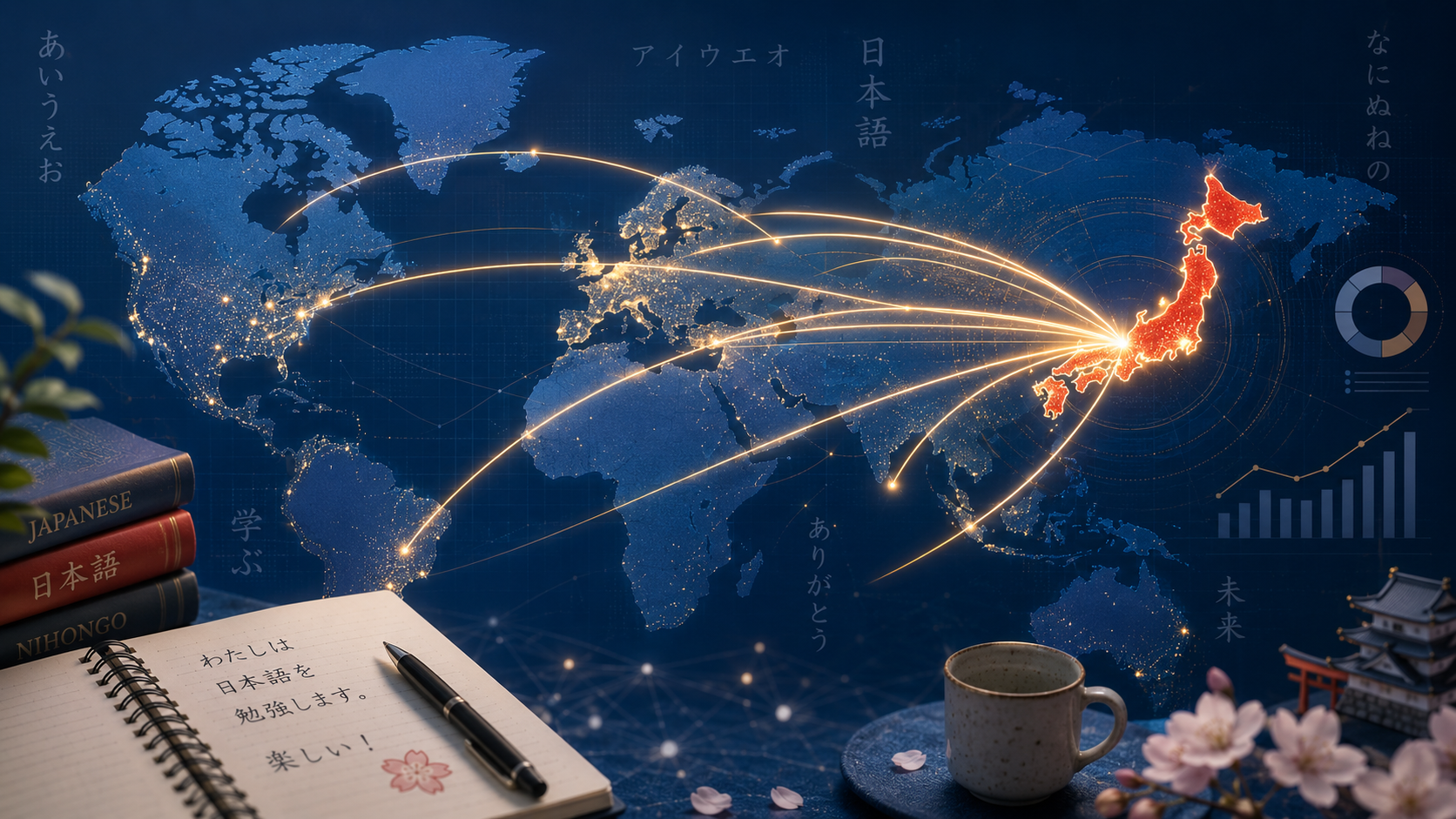
There are languages people choose because they are practical, languages people choose because they are beautiful, languages people choose because they open career doors, and languages people choose because they have quietly lived inside their imagination for years before they ever buy a textbook, sign up for a class, or learn how to say their first awkward sentence out loud. Japanese belongs to that last category more than almost any other language in the world. For many learners, Japanese begins not with a spreadsheet of economic benefits, but with a feeling: the first time they hear the rhythm of spoken Japanese in an anime series, the first time they walk through Tokyo or Kyoto and realize how much meaning is hidden in signs they cannot read, the first time they discover Japanese food, design, cinema, gardens, video games, literature, or a single word like komorebi and sense that this language carries a way of seeing the world that is different from English.
But fascination alone is not always enough. Japanese has a reputation. It is often described as one of the hardest languages for English speakers to learn. It has three writing systems. It has thousands of kanji. It has particles that seem tiny but change the whole logic of a sentence. It has politeness levels, indirectness, honorifics, and cultural rules that cannot always be translated neatly into English. For a beginner, Japanese can look mysterious, elegant, intimidating, and irresistible all at the same time.
So the question is fair: is Japanese worth learning?
The honest answer is yes — for the right learner. Japanese is absolutely worth learning if you are interested in Japan, Japanese culture, travel, media, technology, design, food, history, literature, gaming, anime, manga, business, or simply the challenge of learning a language that stretches your mind in a completely new direction. But it is not a language to choose casually if your only goal is quick fluency or maximum usefulness across many countries. Japanese asks for patience. It rewards consistency. It gives you small victories early and deep rewards slowly.
And yet, millions of people around the world still choose it.
That matters.
Japanese is not a forgotten, obscure, or purely niche language. It is one of the world’s most popular languages to study. The Japan Foundation’s 2021 survey recorded roughly 3.79 million learners of Japanese in formal educational settings worldwide, and Japanese language education was confirmed in 141 countries and regions. From the first Japan Foundation survey in 1974 to the 2021 survey, the number of Japanese learners increased nearly 30 times. That is not a minor trend. That is a global movement.
On major learning platforms, Japanese is also consistently among the most popular languages. Duolingo has ranked Japanese as one of the top five most-studied languages globally, and in the United States it has ranked especially high among younger learners. In other words, people are not just asking whether Japanese is worth learning. They are already learning it — in classrooms, online courses, universities, apps, community programs, private lessons, and self-study routines all over the world.
But numbers alone do not tell the whole story. The deeper question is why. Why would millions of learners choose a language that takes so long? Why would busy adults, college students, travelers, anime fans, engineers, artists, gamers, food lovers, and career-minded professionals commit themselves to hiragana, katakana, kanji, particles, and verb forms when there are easier languages available?
The answer is that Japanese offers something rare: a combination of cultural depth, intellectual challenge, emotional reward, and practical value. It is difficult, yes. But difficulty is not the same as futility. Some things are worth learning precisely because they take time.
Japanese Is One of the World’s Most Popular Languages to Study
When people ask whether Japanese is worth learning, they often assume it is a niche interest. That may have been easier to believe decades ago, when Japanese language study outside Asia was more specialized and often tied to diplomacy, business, or university programs. Today, that assumption no longer fits reality.
Japanese is one of the major global language-learning choices.
According to Japan Foundation data, there are millions of formal learners worldwide. Asia is the strongest center of Japanese study, with large numbers of students in China, Indonesia, South Korea, Thailand, Vietnam, Malaysia, and the Philippines. China alone has more than one million Japanese learners in formal settings, while Indonesia and South Korea also have very large learner populations. Five Southeast Asian countries — Indonesia, Malaysia, the Philippines, Thailand, and Vietnam — account for a significant share of global Japanese learners.
This is important because it shows that Japanese is not only studied by Western anime fans or travelers planning a vacation. It is also studied by people who see Japan as a serious regional, academic, professional, and economic partner. In many parts of Asia, Japanese is connected to study abroad, employment opportunities, scholarships, tourism, manufacturing, technology, and long-term professional mobility.
Outside Asia, Japanese has also become a major choice in the United States, Australia, Europe, and other regions. Some learners come to it through anime and manga. Others come through video games, Japanese cinema, martial arts, food, travel, design, literature, or business. Some simply want a language that feels genuinely different from English.
Japanese now competes for learner attention with Spanish, French, German, Mandarin Chinese, Korean, and Italian. It may not have the same global speaker distribution as Spanish or French, and it does not have the huge native-speaker population of Mandarin. But as a language people actively want to learn, Japanese is undeniably one of the most important languages in the world.
That alone tells us something. A language does not attract millions of learners by accident.
Why Are Millions of People Learning Japanese?
The most obvious answer is pop culture, and we should not dismiss it. Anime, manga, video games, J-pop, Japanese cinema, fashion, design, and internet culture have introduced millions of people to Japanese words, names, sounds, gestures, humor, and storytelling styles.
For some learners, the first motivation is simple: they want to understand anime without subtitles. They want to read manga in the original. They want to play Japanese video games before localization. They want to understand song lyrics, interviews, voice actors, fan communities, or cultural references that translations only partially capture.
Some people treat pop-culture motivation as shallow, but that is unfair. Many serious language learners begin with joy. A teenager who starts Japanese because of anime may later become interested in Japanese history, literature, linguistics, translation, travel, or international business. A gamer may become a localization specialist. A manga fan may become a translator. A traveler may become a lifelong student of Japanese culture.
Motivation does not have to begin academically to become serious.
Japanese also attracts learners because Japan itself has an unusually strong cultural presence. Japan is associated with both tradition and modernity: Buddhist temples and bullet trains, tea ceremony and robotics, calligraphy and Nintendo, kimono and street fashion, ancient poetry and neon cityscapes, minimalist design and maximalist pop culture. Few countries have such a powerful global image across so many different fields.
For language learners, that means Japanese opens many doors. It is not just a tool for ordering food or asking directions. It is a key to a whole cultural world.
You begin to understand why certain phrases are said before eating. You notice how politeness changes depending on the relationship. You recognize words on signs, menus, train stations, packaging, and advertisements. You hear repeated expressions in shows and suddenly understand them without translation. You begin to notice that language and culture are not separate.
That moment — when Japanese stops being a wall of sound and starts becoming meaningful — is one of the reasons people keep going.
Is Japanese Useful for Travel?
Yes, Japanese is extremely useful for travel in Japan, even at a beginner level.
Japan is one of the most popular travel destinations in the world, and for good reason. It is safe, efficient, visually stunning, culturally rich, and full of experiences that feel unforgettable to visitors: Tokyo neighborhoods, Kyoto temples, Osaka food streets, Hokkaido nature, Okinawan beaches, hot springs, mountain villages, bullet trains, convenience stores, traditional inns, tiny restaurants, department-store food halls, and seasonal festivals.
It is possible to travel in Japan without speaking Japanese, especially in major cities and tourist areas. English signage has improved in many transportation hubs, hotels, and popular destinations. Translation apps can also help. But “possible” and “easy” are not the same thing, and “easy” and “deeply enjoyable” are not the same thing either.
Even basic Japanese can transform a trip.
If you can greet people politely, ask simple questions, count, order food, understand common menu items, read hiragana and katakana, recognize basic kanji, and use phrases like “I would like this,” “Where is the station?” or “Do you have an English menu?” you will feel more confident and more connected. You will be less dependent on translation apps. You will notice more. You will make small interactions warmer.
Japanese also helps outside major tourist zones. In small restaurants, local trains, rural inns, family-owned shops, neighborhood cafés, and traditional settings, English may be limited. A little Japanese signals respect. It shows that you are not only consuming Japan as a tourist experience, but making an effort to meet people in their language.
You do not need fluency to benefit. Survival Japanese can be genuinely useful. Reading kana alone can help you understand station names, food labels, and basic signs. Recognizing a few kanji can make daily life easier. Knowing polite phrases can make interactions smoother.
For travelers, Japanese is worth learning even if the goal is modest. You may not need advanced grammar for a two-week trip, but you will never regret knowing more than “arigatou.”
Is Japanese Valuable for Careers?
Japanese can be very valuable professionally, but the answer depends strongly on your field.
Japan remains one of the world’s major economies and a global force in technology, automotive manufacturing, robotics, gaming, electronics, finance, design, publishing, tourism, and cultural production. Companies such as Toyota, Sony, Nintendo, Panasonic, Mitsubishi, SoftBank, Honda, Canon, and many others have shaped global industries. For professionals who work with Japanese companies, Japanese clients, Japanese media, Japanese technology, or Japan-related markets, the language can be a serious advantage.
Japanese is especially useful in fields such as:
Technology and IT
Gaming and localization
Automotive and manufacturing
Robotics and engineering
International business
Finance and consulting
Tourism and hospitality
Translation and interpreting
Education and academia
Publishing and media
Cultural organizations
Import/export and trade
Customer support for Japanese markets
For someone with technical skills, Japanese can be a differentiator. A software engineer who knows Japanese may be more useful to a company working with Japanese clients. A game developer who understands Japanese can better engage with Japanese studios and source materials. A translator or localization specialist obviously needs deep language knowledge. A business professional who speaks Japanese may build trust more easily with Japanese partners.
However, Japanese is not a magic career shortcut. Beginner Japanese will not automatically raise your salary. Many professional roles require advanced proficiency, often around JLPT N2 or N1, especially if the job involves meetings, documents, negotiation, management, or client-facing work in Japanese.
The real career value comes when Japanese combines with another skill. Japanese plus engineering. Japanese plus finance. Japanese plus marketing. Japanese plus game design. Japanese plus teaching. Japanese plus tourism. Japanese plus translation. Japanese plus international relations.
If your career has no connection to Japan, Asia, global business, media, technology, or travel, Japanese may not offer immediate professional benefits. But if Japan intersects with your work or future ambitions, Japanese can make you stand out.
How Hard Is Japanese for English Speakers?
Japanese is hard for English speakers. There is no need to pretend otherwise.
The U.S. Foreign Service Institute places Japanese among the most difficult languages for native English speakers, along with languages such as Arabic, Mandarin Chinese, Cantonese, and Korean. The estimate often cited for Japanese is around 2,200 classroom hours to reach professional working proficiency. By comparison, languages such as Spanish or French are often estimated at around 575 to 600 classroom hours.
That difference is significant.
But what does “hard” actually mean?
Japanese is not hard because it is illogical. In many ways, Japanese is beautifully logical. Basic pronunciation is relatively consistent. Verbs do not conjugate according to person the way they do in many European languages. There is no grammatical gender. Once you understand certain patterns, Japanese sentences can feel elegant and structured.
Japanese is hard because it is different from English.
The writing system is the most obvious challenge. Learners must study hiragana, katakana, and kanji. Hiragana and katakana are manageable and can be learned early, but kanji requires long-term commitment. To read adult Japanese comfortably, learners need to recognize a large number of characters, many of which have multiple readings and meanings.
Grammar is also different. Japanese typically uses subject-object-verb word order, meaning the verb often comes at the end of the sentence. Particles such as は, が, を, に, and で mark relationships between words, and they can be subtle. Japanese also relies heavily on context, so subjects are often omitted when they are understood. For English speakers, this can feel strange at first.
Then there is politeness. Japanese has casual, polite, honorific, and humble forms. The way you speak changes depending on who you are talking to, your relationship, the setting, and the social context. This is not just grammar; it is culture built into language.
So yes, Japanese is challenging. But challenge should not be confused with impossibility. Millions of learners make progress. Many adults learn enough Japanese to travel confidently, hold conversations, read simple texts, enjoy media, and build meaningful connections.
The key is realistic expectations.
What Can You Learn in the First Year?
One of the biggest mistakes learners make is thinking only in terms of fluency. “How long until I’m fluent?” is not the most helpful question at the beginning. A better question is: “What can I realistically do after three months, six months, or one year?”
In the first few months, a motivated beginner can learn hiragana and katakana, basic pronunciation, greetings, numbers, self-introductions, simple sentence patterns, classroom expressions, and survival travel phrases. This is already useful. You can begin reading simple Japanese instead of relying entirely on romaji. You can recognize words. You can understand that the language is no longer just a mystery.
After six to twelve months of consistent study, many learners can reach a beginner level where they can introduce themselves, talk about likes and dislikes, describe simple routines, ask basic questions, order food, understand classroom Japanese, read simple passages, and begin learning more kanji. They may still speak slowly, but they have a foundation.
After one to three years, depending on intensity, learners may reach lower-intermediate or intermediate levels. They can handle more grammar, understand more natural conversations, read graded materials, follow parts of shows or videos, and express opinions in simple but meaningful ways.
Advanced Japanese takes years. That is normal. But you do not need advanced Japanese before the language becomes rewarding. Japanese gives useful rewards along the way.
The first time you read a word in kana without thinking, it feels good. The first time you understand a phrase in a show, it feels good. The first time you order in Japanese and the person understands you, it feels good. The first time you recognize a kanji on a sign in Japan, it feels good.
Those small victories matter because they keep learners motivated.
Japanese Compared with Korean, Mandarin, Thai, and Vietnamese
Many learners interested in Asia compare Japanese with other Asian languages. Should they learn Japanese, Korean, Mandarin, Thai, or Vietnamese?
The best answer depends on motivation.
Japanese and Korean share some structural similarities. Both use subject-object-verb word order. Both have politeness systems. Both rely heavily on context. Korean writing, however, is generally easier at the beginning because Hangul is a phonetic alphabet that can be learned quickly. Japanese has the greater writing-system challenge because of kanji.
Mandarin Chinese is also considered very difficult for English speakers. Mandarin has tones, which many learners find challenging. Japanese does not have tones in the same way, though it does have pitch accent. Mandarin has a much larger native-speaker population and may offer broader business utility in some contexts. Japanese, however, has its own powerful appeal through culture, travel, media, and Japan-specific industries.
Thai and Vietnamese are also fascinating and useful languages, especially for people interested in Southeast Asia. Vietnamese uses the Latin alphabet but has tones. Thai has its own writing system and tones. Both are valuable for regional travel, culture, and business. Japanese, however, has stronger global cultural reach in areas such as anime, manga, games, technology, design, and automotive industries.
So which one should you choose?
Choose Japanese if Japan itself interests you deeply. Choose Korean if Korean media, society, or travel motivates you more. Choose Mandarin if China, Taiwan, or broader Chinese-speaking business contexts are central to your goals. Choose Vietnamese or Thai if Southeast Asia is your main focus.
No language is universally “best.” The best language is the one you will keep studying when it becomes difficult.
The Emotional Reward of Learning Japanese
The practical benefits of Japanese are real, but they do not fully explain why people stay with the language. Many learners continue because Japanese becomes emotionally rewarding.
Japanese gives you access to details you never noticed before. You begin to understand why people say itadakimasubefore eating and otsukaresama desu after work. You notice how names change with suffixes like -san, -chan, -kun, and -sama. You begin to understand why direct translation often fails. You see how politeness, modesty, hierarchy, warmth, humor, and distance appear in grammar.
You also begin to experience Japanese media differently. Subtitles are useful, but they are interpretations. Translation can communicate meaning, but it cannot always carry tone, wordplay, politeness, dialect, sound symbolism, or cultural nuance. When you understand even a little Japanese, you begin to hear more.
Japanese also changes how you think about language in general. English speakers often assume that sentences need explicit subjects, that word order must work a certain way, or that politeness is mostly a matter of adding “please.” Japanese challenges those assumptions. It teaches you that grammar can organize reality differently. It teaches you to listen for context. It teaches you that silence, implication, and indirectness can carry meaning.
This is one of the greatest gifts of learning a distant language. You are not just collecting vocabulary. You are learning another way to arrange thought.
Reasons Not to Learn Japanese
A balanced answer must also say when Japanese may not be the best choice.
If you want the fastest possible path to basic conversation, Japanese is probably not the easiest option. Spanish, Italian, French, or Portuguese will usually give English speakers quicker early progress because they share more vocabulary, alphabetic writing, and familiar grammar structures.
If you want a language used across many countries, Japanese is not as geographically widespread as Spanish, French, Arabic, or English. Japanese is primarily connected to Japan. It has around 125 million native speakers, which is significant, but they are concentrated overwhelmingly in one country.
If your professional goals have no connection to Japan or Japanese-speaking contexts, the career return may be limited compared with the effort required. Japanese can be powerful professionally, but mostly when paired with Japan-related work.
If your only motivation is a temporary interest in one show, game, or trend, you may struggle when the novelty fades. Japanese requires deeper motivation than “this looks cool.” It helps to connect the language to several meaningful goals: travel, culture, media, friendship, career, intellectual challenge, personal growth, or long-term curiosity.
None of this means Japanese is not worth learning. It means Japanese is worth learning for learners who understand what they are choosing.
So, Is Japanese Worth Learning?
Yes, Japanese is worth learning — but not because it is easy, and not because everyone needs it.
Japanese is worth learning because it gives you access to one of the world’s richest cultural landscapes. It is worth learning because millions of people around the world have decided that the effort is meaningful. It is worth learning because Japan remains influential in technology, gaming, manufacturing, design, food, travel, film, literature, and global pop culture. It is worth learning because even basic Japanese can improve a trip to Japan. It is worth learning because the language itself teaches patience, attention, and cultural sensitivity.
Japanese is especially worth it for learners who:
Love Japanese culture deeply
Want to travel to Japan with more confidence
Enjoy anime, manga, games, film, literature, or music
Work in Japan-related industries
Want to study or live in Japan
Are interested in translation or localization
Want an intellectually challenging language
Enjoy learning writing systems
Want to understand a culture through its own words
Japanese may not be the most practical language for every person. But for the right person, it can become one of the most meaningful languages to learn.
The numbers show that Japanese is not a passing trend. Millions of learners around the world are studying it. The cultural influence is real. The professional value is real in the right fields. The difficulty is real too. But so is the reward.
FAQs About Learning Japanese
Is Japanese really worth learning?
Yes, Japanese is worth learning if you have a genuine interest in Japan, Japanese culture, travel, media, or Japan-related career opportunities. It is not the easiest language for English speakers, but it is one of the most rewarding.
How many people are learning Japanese worldwide?
The Japan Foundation’s 2021 survey recorded roughly 3.79 million learners of Japanese in formal educational settings worldwide, across 141 countries and regions. The true number may be higher when informal learners using apps, online courses, and self-study are included.
Is Japanese hard for English speakers?
Yes. Japanese is considered one of the more difficult languages for English speakers because of its writing systems, grammar, particles, word order, kanji, and politeness levels. However, it is logical and learnable with consistent study.
How long does it take to learn Japanese?
It depends on your goal. Basic travel Japanese may take a few months. A beginner conversational level may take six months to a year of steady study. Intermediate Japanese may take several years. Professional proficiency often requires thousands of hours.
Do I need to learn kanji?
Yes, if you want to read Japanese seriously. However, beginners do not need to master kanji all at once. Most learners start with hiragana and katakana, then gradually build kanji over time.
Can I learn Japanese for travel only?
Absolutely. Many learners study Japanese for travel and focus on greetings, numbers, restaurant phrases, transportation vocabulary, shopping expressions, and basic reading. Even a small amount of Japanese can make travel in Japan much more enjoyable.
Is Japanese useful for business?
Japanese is useful for business if you work with Japanese companies, clients, markets, or industries such as technology, gaming, automotive, robotics, finance, tourism, education, translation, or international trade. For serious professional use, higher proficiency is usually needed.
Is Japanese harder than Korean?
For English speakers, both Japanese and Korean are difficult. Korean writing is usually easier at the beginning because Hangul is more straightforward than Japan’s writing system. Japanese becomes especially challenging because of kanji. However, the better choice depends on your personal motivation.
Is Japanese harder than Mandarin?
Both Japanese and Mandarin are considered very difficult for English speakers. Mandarin has tones, which Japanese does not have in the same way. Japanese has three writing systems and complex kanji readings. The best choice depends on whether you are more interested in Japan or Chinese-speaking regions.
Can adults learn Japanese successfully?
Yes. Adults can absolutely learn Japanese. Adults often bring discipline, motivation, cultural curiosity, and clear goals. The key is to study consistently, take structured classes, practice speaking, and avoid expecting instant fluency.
Learn Japanese with Polyglottist Language Academy
If you are interested in learning Japanese, Polyglottist Language Academy can help you begin in a structured, supportive, and realistic way.
At Polyglottist Language Academy, our classes are small, friendly, and personal. We understand that Japanese can feel intimidating at first, especially for complete beginners. That is why we guide students step by step through pronunciation, hiragana, katakana, basic grammar, useful phrases, and cultural context.
You do not need to know Japanese before joining a beginner class. You only need curiosity, consistency, and a willingness to begin.
Explore our current Japanese classes and sign up for a course with Polyglottist Language Academy.
Check Out Our Other Blog Articles
If you enjoyed this article, you may also like these related posts from the Polyglottist Language Academy blog:
Why Japanese Feels Difficult At First—And How To Push Through
The Best Way To Start Learning Japanese As A Complete Beginner
Japanese Pronunciation For Beginners: What English Speakers Get Wrong
How To Practice Japanese Every Day Even With A Busy Schedule
Japanese Classes In San Francisco For Adults: Where To Start
Learn Japanese In Oakland: Small Group Classes That Actually Help You Speak