
Is Vietnamese Hard to Learn? What English Speakers Should Know
If you have ever listened to Vietnamese spoken naturally—in a busy market in Hanoi, in a street-food stall in Ho Chi Minh City, or in a Vietnamese café where conversations seem to move with music, speed, laughter, and tones that rise and fall like little melodies—you may have wondered whether this beautiful language is simply too difficult for an English speaker to learn, or whether it only feels mysterious because it works so differently from the languages most Americans study in school.
The honest answer is this: Vietnamese is hard, but it is not impossible. In fact, it is one of those languages that can feel intimidating at first but surprisingly logical once you understand how it works. For English speakers, the hardest parts of Vietnamese are usually pronunciation, tones, listening comprehension, and regional accents. The easier parts are grammar, sentence structure, and the writing system. Vietnamese uses a Latin-based alphabet, has no verb conjugations, no grammatical gender, no case endings, and no complicated tense system like many European languages.
So yes, Vietnamese is challenging. But it is also wonderfully learnable.
Many adult learners assume that if a language has tones, they are automatically doomed. They imagine that every word will sound the same, that native speakers will never understand them, and that they will spend years trying to say “hello” correctly. This fear is understandable, but it is also exaggerated. Vietnamese tones require patience, repetition, and feedback, but they are not magic. They are patterns. They can be trained. With a good teacher, consistent listening, and regular speaking practice, English speakers can absolutely learn to communicate in Vietnamese.
The real question is not “Is Vietnamese hard?” The better question is: “Which parts of Vietnamese are hard, which parts are easier than expected, and how should I study so I do not waste time?”
That is exactly what this guide will explain.
Whether you want to learn Vietnamese for travel, family, heritage, business, relationships, culture, food, or personal curiosity, this article will give you a realistic picture of what to expect. We will look at pronunciation, tones, grammar, vocabulary, the Vietnamese alphabet, dialects, study timelines, common mistakes, and the best ways to make steady progress as an English-speaking adult.
Is Vietnamese Hard for English Speakers?
Vietnamese is usually considered a difficult language for native English speakers, especially compared to Spanish, French, Italian, Dutch, or German. The main reason is not grammar. It is sound.
Vietnamese belongs to a completely different language family from English. Its rhythm, sound system, tones, and pronunciation patterns are unfamiliar to most English speakers. A word can change meaning depending on pitch. Vowels may sound much more precise than English learners expect. Final consonants may be short, unreleased, or nasal. And because Vietnamese is spoken in different regional varieties, the version you hear in Hanoi may not sound exactly like the version you hear in Ho Chi Minh City, Da Nang, or a Vietnamese-American household in California.
That said, Vietnamese is not difficult in the same way that Japanese, Korean, Arabic, or Mandarin may be difficult. Japanese and Korean have complex grammar systems, honorifics, and writing systems that require a major investment of time. Mandarin has characters and tones. Arabic has a non-Latin script, complex grammar, and regional spoken varieties that can differ significantly from formal Arabic.
Vietnamese, by contrast, gives learners several gifts. It uses a Latin-based writing system. Words are written with tone marks, so the tones are visible. Verbs do not change according to tense or subject. You do not need to memorize masculine and feminine nouns. You do not have to learn tables of endings. In many ways, Vietnamese grammar is refreshingly direct.
For many learners, Vietnamese feels like a language with a steep beginning and a more manageable middle. The first stage can be frustrating because you are training your ear and mouth to notice distinctions that English does not use. But once you get through the pronunciation barrier, the grammar often feels much less overwhelming than expected.
The Biggest Challenge: Vietnamese Pronunciation
For English speakers, pronunciation is usually the first and most serious hurdle in Vietnamese. You cannot simply look at a Vietnamese word and pronounce it as if it were English. The letters may look familiar, but the sound values are different. Vietnamese spelling is actually quite systematic, but only once you understand how the system works.
The biggest challenge is that Vietnamese requires accuracy in three areas at the same time: consonants, vowels, and tones. In English, you can often mispronounce a vowel or use slightly strange intonation and still be understood. In Vietnamese, small changes can create a different word entirely.
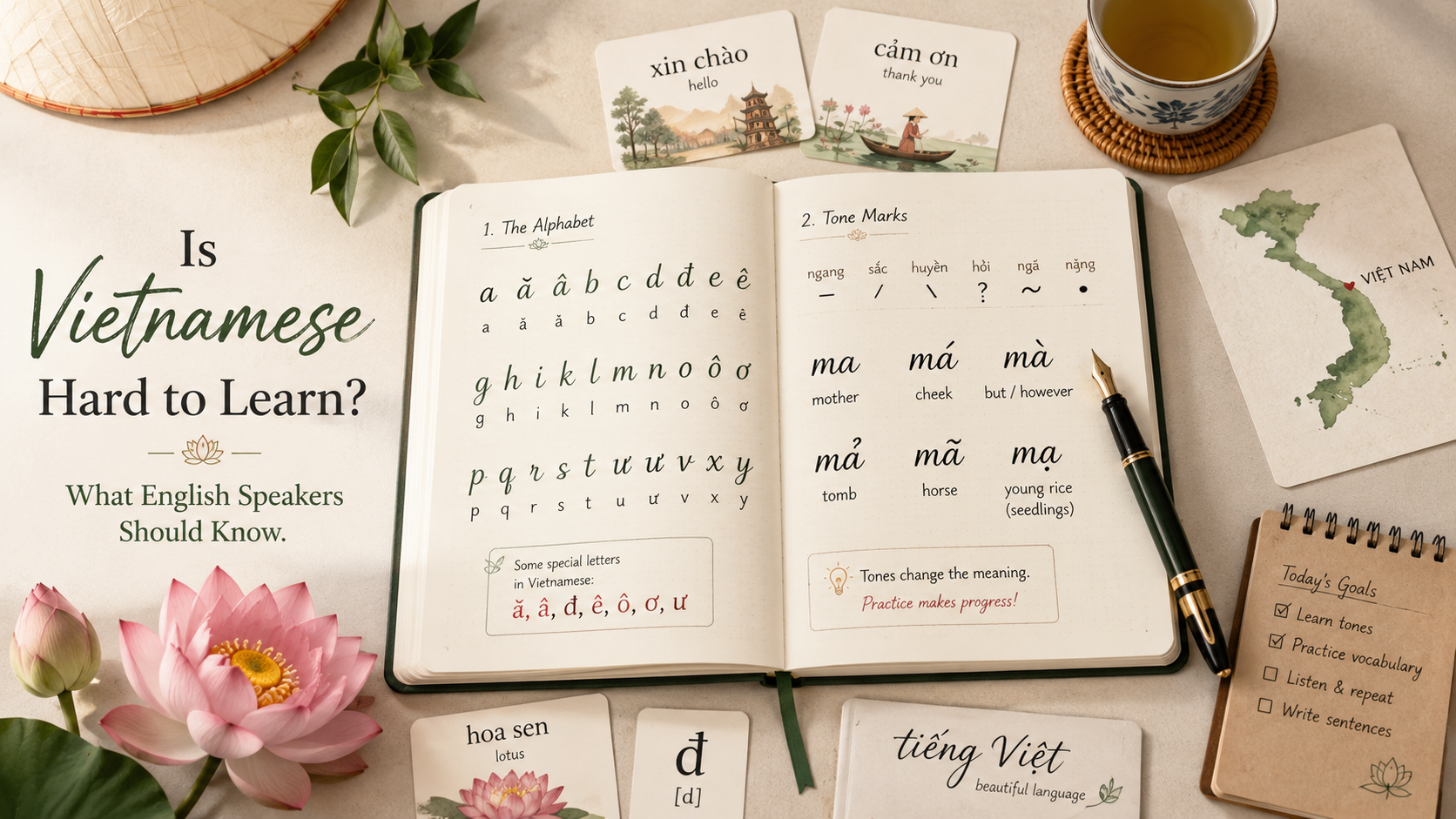
For example, a syllable like “ma” can have several meanings depending on the tone. That means tone is not decoration. It is part of the word. If you use the wrong tone, you may not just sound foreign—you may be saying a different word.
Vietnamese also has vowel sounds that do not map neatly onto English vowels. English vowels are flexible and often change depending on accent. Vietnamese vowels are more precise. A small difference between two vowel sounds can matter. Learners must train themselves to hear and produce these differences clearly.
Final consonants can also be tricky. Some Vietnamese syllables end in sounds like -ng, -nh, -c, or -ch. These endings may be pronounced more briefly or with less release than English speakers expect. English speakers often want to “finish” the sound too strongly, but Vietnamese may require a shorter and cleaner ending.
This is why pronunciation should not be treated as something to fix later. In Vietnamese, pronunciation is the foundation. If you build your vocabulary with incorrect tones and unclear vowels, those habits become harder to correct later. It is much better to study slowly and accurately from the beginning.
Vietnamese Tones Explained
Vietnamese is a tonal language, which means that pitch changes the meaning of a word. In English, pitch usually communicates emotion, emphasis, surprise, sarcasm, or whether a sentence sounds like a question. In Vietnamese, pitch is part of the word itself.
In the Northern standard, Vietnamese has six tones. These are often introduced using the syllable “ma,” because the same basic sound changes meaning depending on the tone.
Here is a simplified version:
ma – level tone, often translated as “ghost”
má – rising tone, often translated as “mother”
mà – falling tone, often translated as “but”
mả – dipping or falling-rising tone, often translated as “tomb”
mã – broken rising tone, often translated as “code” or “horse”
mạ – low heavy tone, often translated as “rice seedling”
For a beginner, this can feel overwhelming. Six versions of the same syllable? Six different meanings? How can anyone hear that?
But learners do improve. At first, tones may sound like vague musical movements. Then, slowly, you begin to notice the difference between rising, falling, heavy, and broken tones. With practice, tones become less like music theory and more like muscle memory.
The key is not to memorize tone descriptions intellectually. You need to hear them, repeat them, and receive correction. A teacher can help you notice when your tone is too flat, too high, too low, too long, or not sharp enough. Recording yourself can also help. Many learners are surprised when they hear that what they thought they said does not match the native audio.
The best tone practice combines three things: minimal pairs, real phrases, and live feedback. Minimal pairs help you hear the difference between similar words. Real phrases help you use tones naturally in speech. Live feedback prevents you from repeating mistakes for months without realizing it.
Most importantly, tones should be practiced from day one. Do not wait until you “know more vocabulary.” Every new word should be learned with its tone, pronunciation, and audio.
Is Vietnamese Grammar Easy?
Compared to pronunciation, Vietnamese grammar is much easier for many English speakers.
One of the most encouraging features of Vietnamese is that verbs do not conjugate. In English, we say “I go,” “he goes,” “I went,” “I have gone,” “I will go.” In Vietnamese, the verb itself does not change in that way. Instead, Vietnamese uses time markers, context, and particles to show when something happens.
For example, instead of changing the verb form for past tense, Vietnamese can use a marker such as đã. For something happening right now, it can use đang. For the future, it can use sẽ. This is very different from English, but it is often easier than memorizing irregular verb forms.
Vietnamese also has no grammatical gender. You do not need to learn whether a table is masculine or feminine. There are no noun cases like in Russian or German. There are no plural endings like English “cats” or “books” that must always be added. Plurality is often clear from context or expressed with separate words.
The basic sentence structure is also familiar. Vietnamese commonly uses Subject–Verb–Object word order, similar to English. For example, the basic logic of “I eat rice” or “She learns Vietnamese” is not difficult for English speakers to understand.
However, Vietnamese grammar is not “easy” in the sense that everything works like English. There are still new habits to learn. Adjectives often come after nouns. Classifiers are used with nouns, especially when counting or specifying things. Sentence-final particles can add politeness, softness, emphasis, friendliness, or a question-like feeling. Pronouns are deeply connected to age, relationship, respect, and social context.
So Vietnamese grammar is simple in structure but rich in nuance. You will not spend years memorizing verb endings, but you will need to learn how Vietnamese expresses relationship, politeness, and context.
The Vietnamese Alphabet: Easier Than You Think
One of the biggest advantages of Vietnamese is that it uses a Latin-based alphabet. This is a major relief for English speakers. You do not need to learn Chinese characters, Japanese kanji, Arabic script, or a new alphabet like Korean Hangul or Russian Cyrillic.
Vietnamese writing is called quốc ngữ, and it uses Roman letters with additional marks. These marks do two important jobs. Some marks change the vowel sound, while others indicate tone.
At first, Vietnamese words may look covered in accents: người, tiếng Việt, cảm ơn, phở, đường, học, mẹ. Beginners may feel that the writing looks complicated. But the system is actually helpful. The tone marks tell you how the word should sound. Instead of hiding pronunciation, Vietnamese spelling gives you clues.
The Vietnamese alphabet includes letters that English speakers recognize, but not every English letter is part of the standard Vietnamese alphabet. Vietnamese also has special letters and vowel combinations, such as ă, â, ê, ô, ơ, ư, and the letter đ, which is different from d.
Once learners become familiar with the sound system, reading Vietnamese can become much more predictable than reading English. English spelling is famously inconsistent. Words like “though,” “through,” “tough,” and “thought” are confusing even for native speakers. Vietnamese spelling, by contrast, is more systematic when you understand the rules.
This means that reading simple Vietnamese can begin fairly early. You may not understand every word, but you can start recognizing patterns, tone marks, and common phrases much sooner than you could with a character-based writing system.
Vocabulary: What Feels Familiar and What Feels New
Vocabulary is another area where Vietnamese can feel difficult for English speakers. Because Vietnamese is not closely related to English, many common words will not look familiar. In Spanish or French, you may recognize words like “familia,” “universidad,” “important,” or “restaurant.” In Vietnamese, much of the core vocabulary feels new.
However, Vietnamese vocabulary is not random. Many words have roots connected to Chinese influence, especially in formal, academic, political, and literary vocabulary. Vietnamese also has loanwords from French and English. For example, cà phê comes from French “café,” and words connected to modern technology or global culture may sound familiar.
Still, beginners should expect a period where vocabulary feels hard to remember. The best solution is not to memorize long lists silently. Vietnamese vocabulary should be learned with audio, tone marks, and example sentences. If you learn a word without its correct pronunciation, you may recognize it on paper but fail to understand it in speech.
A useful strategy is to learn vocabulary by situation: greetings, family, food, directions, shopping, transportation, work, travel, and everyday conversation. This gives words a practical context. It also helps you speak sooner, because you are not just collecting isolated words—you are learning how to use them.
Northern, Central, and Southern Vietnamese
Another challenge for learners is regional variation. Vietnamese is not spoken exactly the same way everywhere. The three major dialect regions are Northern, Central, and Southern Vietnamese.
Northern Vietnamese, especially the Hanoi accent, is often treated as the standard in textbooks, formal education, and national media. Southern Vietnamese, especially the Ho Chi Minh City or Saigon accent, is widely used in business, popular culture, overseas communities, and many Vietnamese-American families. Central Vietnamese has its own distinctive pronunciation patterns and can be especially challenging for learners at first.
The differences include pronunciation, tones, vocabulary, and sentence-final particles. Some consonants are pronounced differently in the North and South. Some tones that are distinct in the North may merge in the South. Everyday words may differ. Even small conversational particles can vary from region to region.
So which dialect should you learn?
The best answer depends on your goals. If you plan to travel mostly in Hanoi or northern Vietnam, Northern Vietnamese may make sense. If your family is from southern Vietnam, or you plan to spend time in Ho Chi Minh City, Southern Vietnamese may be more useful. If you are learning for a partner, in-laws, business contacts, or heritage reasons, choose the dialect that matches the people you most want to speak with.
The good news is that the dialects are largely mutually intelligible. You do not need to master every regional variety at the beginning. It is usually better to choose one main accent first, build a foundation, and then gradually expose yourself to other accents.
A good Vietnamese teacher can help you understand which dialect you are learning and why. This matters because many learners accidentally mix Northern textbook pronunciation with Southern media or family speech, which can create confusion.
What Makes Vietnamese Easier Than Expected?
Vietnamese has a reputation for being hard, but several features make it more approachable than many learners expect.
First, the alphabet is Latin-based. That alone saves learners a huge amount of time compared to languages with unfamiliar scripts or character systems.
Second, Vietnamese verbs do not conjugate. You do not need to memorize different endings for “I,” “you,” “he,” “we,” and “they.” You also do not need to memorize long lists of irregular past-tense verbs.
Third, there is no grammatical gender. You do not need to remember whether a word is masculine or feminine.
Fourth, the basic word order is often similar to English. Vietnamese does not always work like English, but the basic sentence structure is not as alien as many beginners fear.
Fifth, Vietnamese grammar often relies on separate words rather than changing the form of a word. This can make the language feel more transparent once you understand the patterns.
Finally, Vietnamese is very practical even at a beginner level. A few phrases can help you order food, greet people, thank someone politely, ask for prices, or show respect to elders. Even imperfect Vietnamese can create warm reactions, especially when locals see that you are making an effort.
What Makes Vietnamese Difficult?
The hardest parts of Vietnamese are real and should not be ignored.
The first difficulty is tones. English speakers are not used to treating pitch as part of word meaning. It takes time to hear tones clearly and reproduce them consistently.
The second difficulty is pronunciation. Vietnamese vowels, consonants, and final sounds require careful attention. Many English speakers accidentally use English sound habits, which can make their Vietnamese difficult to understand.
The third difficulty is listening comprehension. Even if you can read a sentence slowly, natural spoken Vietnamese can feel fast and compressed. Native speakers may reduce sounds, use slang, or speak with regional pronunciation.
The fourth difficulty is dialect variation. A learner who studies Northern Vietnamese may feel lost when hearing Southern speech, and a learner used to Southern Vietnamese may need time to adjust to Northern media.
The fifth difficulty is pronouns and politeness. Vietnamese pronouns are connected to age, family roles, social distance, and respect. Instead of one simple word for “you,” Vietnamese uses terms that reflect the relationship between speakers. This can be fascinating but also confusing.
The sixth difficulty is confidence. Many learners become afraid to speak because they worry that wrong tones will make them sound silly. But avoiding speech does not solve the problem. Speaking, correction, and repetition are exactly what make tones improve.
Vietnamese for Heritage Learners
Vietnamese is not only studied by complete beginners. Many learners are heritage learners—people who grew up hearing Vietnamese at home but never formally studied it, or who understand some family conversations but struggle to speak, read, or write confidently.
Heritage learners often have a very different experience from non-heritage learners. They may already know the rhythm of the language. They may understand certain family phrases, food words, household expressions, or emotional tones. But they may also feel embarrassed because they “should” know more. Some feel judged by relatives. Others can understand grandparents but cannot answer back. Many can speak casually but cannot read Vietnamese well or use formal vocabulary.
Structured Vietnamese classes can be extremely helpful for heritage learners. Classes connect spoken family language to the writing system. They explain grammar patterns that heritage learners may have absorbed but never consciously understood. They also fill vocabulary gaps, especially for education, work, travel, culture, and formal situations.
Heritage learners may also need support with dialect. A student whose family speaks Southern Vietnamese may feel confused by a textbook based on Northern pronunciation. A good teacher can help them understand the differences without making them feel that their family dialect is “wrong.” Vietnamese is a living language with regional richness, and heritage learners deserve instruction that respects their background.
Vietnamese for Travelers
Vietnamese is incredibly rewarding for travelers. You do not need to be fluent to benefit from learning it. Even basic Vietnamese can change your experience in Vietnam.
Imagine being able to greet a street-food vendor politely, order phở or bánh mì, ask how much something costs, thank a driver, read signs, understand menu items, or ask for directions. These small moments can make travel feel less distant and more human.
Vietnam is a country where food, hospitality, family, and local interaction matter deeply. When travelers use even simple Vietnamese, it often creates smiles and warmer conversations. Locals may still switch to English if they know it, but the effort itself is meaningful.
For travelers, the most useful Vietnamese topics include greetings, numbers, food, coffee, transportation, shopping, hotel phrases, allergies, directions, and polite expressions. Pronunciation is especially important because a phrasebook version of Vietnamese may not be understood if tones are ignored. A short beginner course before traveling can make a major difference.
Vietnamese for Professionals
Vietnamese is also useful for professionals. Vietnam has become increasingly important in business, technology, manufacturing, education, tourism, and international relations. Professionals who work with Vietnamese colleagues, clients, suppliers, students, or partners can benefit from even basic language skills.
In business contexts, language is not only about transactions. It is about relationship-building. Learning Vietnamese shows respect. It demonstrates that you are not treating Vietnam merely as a market or destination, but as a culture with its own language and social norms.
Professional learners may want to focus on introductions, polite greetings, scheduling, workplace vocabulary, email etiquette, small talk, dining situations, and cultural expectations. Even when meetings take place in English, Vietnamese can help you navigate informal moments before and after business discussions.
How Long Does It Take to Learn Vietnamese?
The answer depends on your goals, consistency, teacher, study method, and previous language-learning experience.
If your goal is basic survival Vietnamese for travel, you may be able to learn useful phrases in a few months with steady practice. With 3–5 hours per week, a motivated beginner can learn greetings, numbers, basic questions, food vocabulary, and simple sentence patterns within 2–3 months.
If your goal is everyday conversation, expect a longer timeline. Many learners need 6–12 months of consistent study to feel comfortable with basic conversations, especially if they are practicing speaking and listening regularly. This does not mean perfect fluency. It means being able to introduce yourself, talk about daily life, ask questions, understand slow speech, and participate in simple conversations.
For upper-intermediate or advanced proficiency, Vietnamese usually requires years of consistent exposure. Pronunciation, listening comprehension, vocabulary, dialects, and cultural nuance all take time. A professional level may require a much larger number of study hours.
However, progress is not only measured in years. A learner who studies 30 minutes most days, attends live classes, listens regularly, and speaks from the beginning will usually progress faster than someone who studies passively once a week.
Frequency matters. Vietnamese rewards regular contact. Short, consistent practice is better than occasional long sessions.
Can You Learn Vietnamese by Yourself?
You can learn some Vietnamese by yourself. Apps, YouTube channels, textbooks, podcasts, flashcards, and online dictionaries can all be useful. Self-study is especially helpful for vocabulary review, alphabet practice, listening exposure, and basic grammar.
But Vietnamese is not an ideal language to study only through apps. The reason is pronunciation. If you practice tones incorrectly for months, you may build habits that are hard to change. Apps may tell you whether you selected the right answer, but they cannot always explain why your tone sounds unnatural or why a native speaker might misunderstand you.
Live instruction is especially valuable in Vietnamese because you need feedback. A teacher can hear whether your vowel is too open, your tone is too flat, your final consonant is too strong, or your rhythm sounds too English. A teacher can also explain cultural nuance, pronouns, politeness, and regional differences in a way that apps cannot.
The best approach is usually a combination: live classes for structure, speaking, correction, and accountability; self-study tools for review and daily exposure.
Best Ways to Learn Vietnamese
The best way to learn Vietnamese is to build your foundation carefully. Do not rush through pronunciation. Do not memorize hundreds of words without tones. Do not rely only on silent reading. Vietnamese must be heard and spoken.
Start with the sound system. Learn the alphabet, vowels, consonants, and tones. Practice slowly. Listen to native audio. Repeat out loud. Record yourself. Get feedback.
Next, learn useful words in context. Instead of memorizing random vocabulary lists, study phrases you can actually use: greetings, introductions, family, food, daily routines, numbers, travel, and polite expressions.
Then, practice speaking from the beginning. Even if your sentences are short, use them. Vietnamese pronunciation improves through use, not just study.
Listening should also be part of your routine. Begin with slow learner audio, then gradually add natural speech. Vietnamese music, children’s programs, short videos, travel vlogs, cooking videos, and podcasts can help your ear adjust.
Finally, choose one dialect as your main focus at first. You can learn about other dialects later, but beginners need consistency.
Common Mistakes English Speakers Make
One common mistake is ignoring tones. Some learners treat tone marks as optional accents, but in Vietnamese they are essential. A word without the correct tone may not be understood.
Another mistake is pronouncing Vietnamese as if it were English. The alphabet looks familiar, but the sounds are not identical. Learners must resist the temptation to use English vowel habits.
A third mistake is learning vocabulary without audio. Vietnamese words should be learned with sound, tone, and example sentences.
A fourth mistake is avoiding speaking because of fear. Yes, you will make mistakes. Everyone does. But Vietnamese cannot be learned silently. Speaking is where your mouth, ear, and memory begin to work together.
A fifth mistake is mixing dialects too early. It is fine to be exposed to different accents, but beginners should know whether they are learning Northern or Southern pronunciation as their main model.
A sixth mistake is relying only on apps. Apps can help, but they cannot replace conversation, correction, and cultural explanation.
So, Is Vietnamese Worth Learning?
Absolutely.
Vietnamese is one of the most rewarding languages an English speaker can learn. It opens the door to a rich culture, a remarkable cuisine, a fascinating history, a dynamic country, and vibrant Vietnamese communities around the world. It can connect you to family, travel, business, literature, music, film, and everyday human relationships that would otherwise remain distant.
It is not the easiest language. The tones require discipline. Pronunciation demands patience. Listening takes time. Regional variation can be confusing. But the grammar is approachable, the alphabet is accessible, and the rewards are immediate.
If you are an adult learner, do not let the difficulty scare you away. Adults can learn Vietnamese successfully. In fact, adults often bring focus, motivation, and learning strategies that help them progress steadily. You do not need to sound perfect to begin. You need a clear method, regular practice, and the courage to speak.
Vietnamese is hard enough to be interesting, but not so hard that you cannot learn it.
Learn Vietnamese with Polyglottist Language Academy
If you are ready to begin learning Vietnamese, Polyglottist Language Academy offers supportive, live language classes for adult learners who want real instruction, not just an app. Our Vietnamese classes are designed to help beginners build a strong foundation in pronunciation, tones, everyday vocabulary, grammar, and conversation.
At Polyglottist Language Academy, we understand that Vietnamese can feel intimidating at first. That is why live instruction matters. With a knowledgeable teacher, you can receive feedback on your tones, practice real-life conversations, understand cultural context, and learn at a pace that feels structured and encouraging.
Our classes are ideal for complete beginners, heritage learners, travelers, professionals, and anyone who wants to connect more deeply with Vietnamese language and culture. We also offer a wide range of other language classes, including French, Italian, Spanish, German, Russian, Japanese, Mandarin, Portuguese, Dutch, Korean, and more.
Whether you are learning Vietnamese for family, travel, culture, business, or personal growth, we would love to help you get started.
Visit Polyglottist Language Academy and sign up for a Vietnamese class today. Your first Vietnamese conversation may be closer than you think.
FAQs About Learning Vietnamese
Is Vietnamese harder than Chinese?
Vietnamese and Mandarin Chinese are both tonal languages, so both are challenging for English speakers. Mandarin has fewer tones than Northern Vietnamese, but it uses Chinese characters, which require a major writing-system investment. Vietnamese uses a Latin-based alphabet, which makes reading and writing more accessible. The difficulty is different rather than simply easier or harder.
Is Vietnamese harder than Japanese or Korean?
Vietnamese is difficult mainly because of pronunciation and tones. Japanese and Korean are difficult for different reasons, including grammar, honorifics, and writing systems. Vietnamese grammar is generally simpler than Japanese or Korean grammar, but Vietnamese pronunciation may feel harder at the beginning.
Can I learn Vietnamese without learning tones?
You can memorize phrases without understanding tones, but you will struggle to be understood. Tones are part of the meaning of Vietnamese words. Ignoring them will seriously limit your communication. The good news is that tones can be learned with practice, listening, and correction.
How long does it take to speak Vietnamese?
Many learners can reach a basic conversational level within 6–12 months of consistent study, especially with live classes and regular speaking practice. Basic travel phrases can be learned much sooner. Advanced fluency takes longer and requires sustained listening, speaking, and vocabulary development.
Is Vietnamese grammar easy?
Vietnamese grammar is easier than many learners expect. There are no verb conjugations, no grammatical gender, no case endings, and no complex tense endings. However, learners still need to understand classifiers, particles, pronouns, word order, and cultural nuance.
Should I learn Northern or Southern Vietnamese?
Choose based on your goals. If you plan to travel to Hanoi or northern Vietnam, Northern Vietnamese may be useful. If your family is from southern Vietnam or you plan to spend time in Ho Chi Minh City, Southern Vietnamese may be better. Both are valid, and you can learn to understand other accents over time.
Can adults learn Vietnamese successfully?
Yes. Adults can absolutely learn Vietnamese. The key is consistency, pronunciation practice, listening exposure, and feedback from a teacher. Adults often progress well because they understand how to study intentionally and can connect the language to clear personal goals.
Are Vietnamese classes better than apps?
Apps are helpful for review, vocabulary, and daily practice, but they are not enough for most learners. Vietnamese pronunciation and tones require live feedback. A teacher can correct mistakes, explain culture, and help you speak naturally.
You May Also Enjoy These Articles
If you enjoyed this article, you may also like these other posts from the Polyglottist Language Academy blog: