
What You Learn After Your First Russian Grocery Trip
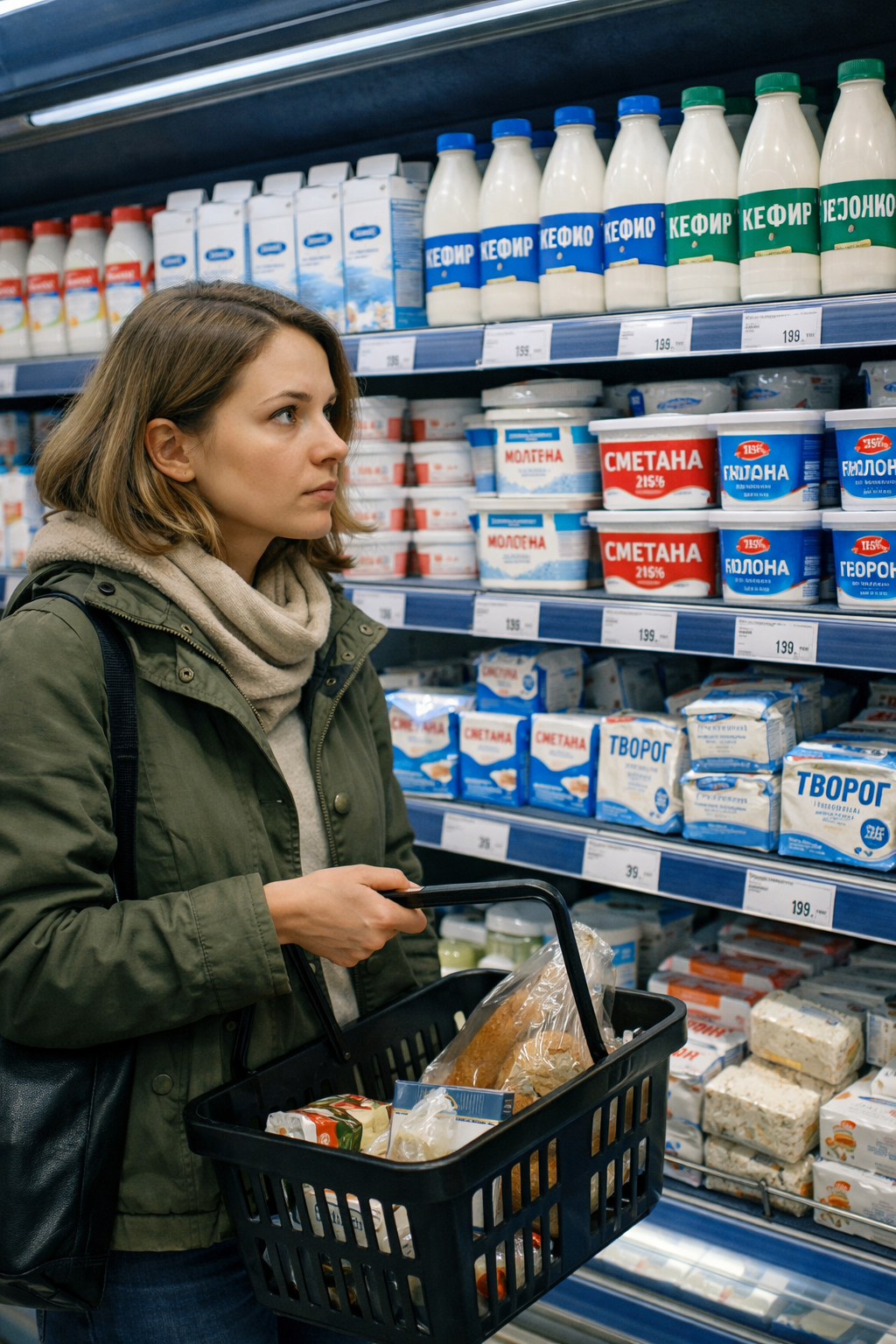
You walk in thinking you’re just buying milk and bread. Ten minutes later, you’re holding a mystery carton of кефир, trying to decode Cyrillic while a cashier fires questions at you at machine‑gun speed. That first Russian grocery trip—whether in a Moscow Пятёрочка, a Магнит in a provincial town, or a Russian grocery store in New York—does something your textbook can’t. It drops you into living Russian: smells, sounds, brisk interactions, and tiny social rules that suddenly make all those “dry” grammar points feel very real.
Walking into a Russian Grocery Store for the First Time
The sliding doors open, and you’re hit by two things at once: bright strip lighting and the smell of fresh bread mixed with dill, smoked meats, and cleaning solution. Russian supermarkets are compact, functional, and densely packed. Instead of the wide, airy aisles you might know from the US, you often navigate tighter rows of products, tall shelves, and practical signage that favors information over design.
Near the entrance, there’s usually a bread section and a fresh produce area. Bread shelves are stacked with dark rye loaves, white loaves, sliced packaged bread, and small pastries in see‑through bags. The produce section can look a little more “real” than perfectly polished—apples with blemishes, seasonal vegetables in bulk crates, plastic gloves and thin plastic bags nearby. You might see digital scales where you weigh fruits and vegetables yourself, or a small staffed counter where someone in a white coat weighs them for you and prints a sticker.
As you move deeper into the store, you start to notice what Russians prioritize: a long refrigerated wall of dairy products—milk, кефир, творог (fresh curd), сметана (sour cream), yogurt, ряженка—and often an equally impressive stretch of cured meats and sausages. There’s a grain aisle full of buckwheat (гречка), rice, barley, oats, and a surprisingly large section dedicated to pickles, canned fish, and preserves. Drinks, snacks, sweets, and household goods fill out the rest.
The overall atmosphere tends to be task‑oriented. People aren’t strolling around as a leisure activity; they are shopping to get things done. Background music, if there is any, is generic and quiet. Staff move quickly, sometimes silently, restocking shelves or running between the deli counter and the back room. No one is trying to create a “shopping experience” for you. The experience is: buy your food, efficiently.
For a language learner, this “no fluff” environment has a hidden advantage. There’s less distraction. Your brain can focus on the language printed on labels, the short functional phrases you hear around you, and the rhythm of everyday Russian life unfolding in real time.
Supermarkets vs. Open‑Air Markets (рынок)
To understand Russian food culture and how people actually shop, you have to see both the modern supermarket and the traditional рынок.
Chain Supermarkets: Пятёрочка, Магнит and Friends
Chains like Пятёрочка and Магнит are everywhere—from big cities to tiny towns. They are the everyday workhorses of Russian food shopping. Their priorities are clear: low prices, promotions, and basic convenience. Inside, they tend to have:
Compact but fully stocked layouts
Strong focus on staple products: bread, dairy, grains, sugar, oil
Ready‑to‑eat foods and salads near the deli
Frequent discounts and “special offer” tags
Long hours, often from early morning to late night
The design is improving in newer stores—brighter colors, better lighting, more attractive bakery sections—but the core remains: affordable, functional, and close to home. Many people go almost daily, picking up bread, milk, and something for dinner on the way back from work.
Open‑Air Markets: The Social Heart of Food
By contrast, the рынок (open‑air market) feels like a different world. Instead of a single company running everything, you have dozens or hundreds of small vendors with their own stalls. You walk through rows of tables and counters piled with:
Seasonal fruits and vegetables
Buckets and barrels of pickles and sauerkraut
Fresh meat and poultry
Cheese, butter, sour cream from local producers
Honey, dried fruits, nuts, herbs, baked goods
People call out prices, offer samples, and invite you to “try this” or “look at that.” There may be a section for clothes and household items, a food court corner with shawarma, chebureki, or pirogi, and sometimes a fish hall or meat pavilion that feels almost like a separate market within the market.
At the рынок, interaction is part of the experience. You ask, you compare, you choose. Vendors often specialize: one family sells only honey, another only cheese, another only spices and dried fruits. Regular customers build relationships and come back to “their” seller. If you buy a lot, you might get a small gift—an extra apple, a handful of greens, a discount “for you.”
Where the supermarket is anonymous and predictable, the рынок is personal and lively. It can be slightly chaotic, but it gives you intense exposure to spoken Russian: accents, slang, negotiation phrases, and lots of numbers.
What Surprises First‑Time Visitors
Many foreigners walk into a Russian grocery store expecting it to feel like a slightly different version of what they know from home. They quickly realize that the differences are not huge or dramatic—but they are constant, and they matter.
Self‑Service vs. Counters
At first glance, Russian supermarkets look fully self‑service. You pick up a basket, walk the aisles, and choose what you want. But in key sections, you suddenly hit “counter culture”:
Deli counters: You order sliced sausages, hams, salami, cooked meats, and prepared salads. A staff member stands behind glass, you point, name a quantity in grams, and sometimes specify how you want it sliced.
Meat and fish counters: In larger stores and markets, you ask for specific cuts or fish, and everything is weighed and wrapped individually.
Bakery/cake counters: Everyday bread may be self‑service, but elaborate cakes, custom pastries, and fancy desserts are often behind glass with a staff member serving you.
At an open‑air market, counter service is the rule. Almost everything goes through a person who weighs, wraps, and hands it to you. This creates a lot of short, intense language exchanges—perfect for learning, but also intimidating if you are shy or unsure of your vocabulary.
Cashiers and the Direct Communication Style
Another shock comes at the checkout. If you’re used to American‑style small talk, where the cashier smiles and asks, “How’s your day going?”, you may interpret Russian cashiers as cold or unfriendly. In reality, they are often just being efficient.
A typical cashier interaction might go like this:
«Здравствуйте.» (Hello.)
Scanning items at high speed
«Пакет нужен?» (Need a bag?)
«С картой или наличными?» (Card or cash?)
«Карта магазина есть?» (Do you have the store loyalty card?)
«Это всё?» (Is that everything?)
«С вас триста двадцать.» (Three hundred twenty from you.)
No comment on your purchases, no chitchat, no “Have a nice day!” spoken with the same intonation to every single person. For Russians, this is normal and even desirable. You don’t waste people’s time. You do your job. Emotional warmth is reserved for family and friends, not strangers at the cash register.
Bagging Groceries, Payment Habits, and Queues
Three more surprises:
You bag your own groceries. Items fly down the conveyor belt, and you are expected to pack quickly and move aside if you have a lot. The space at the end of the belt is small. If you’re slow, you feel the full pressure of the line behind you.
Payment is straightforward but fast. In big cities, contactless cards and phone payments are standard. In smaller towns and markets, cash is still important. Asking for exact change is common. Using a huge bill for a tiny purchase can cause eye‑rolling.
Queues are serious. People do not “sort of hover” near the cash register. There is a clear line, and “who’s last?” (Кто последний?) is the classic phrase you use to establish your place. Cutting or trying to pretend you didn’t see the line is a direct challenge to social order.
For a learner, these habits can be stressful the first few times. But they also give structure: once you know the rhythm and the phrases, you can predict what will happen long before you reach the front.
Essential Russian Vocabulary for Grocery Trips
If you want to survive your first Russian grocery store visit—and actually enjoy it—memorize a small, focused set of words and phrases. You don’t need to know everything. You need the words that unlock typical situations.
Core Nouns You’ll See Everywhere
магазин – store, shop
супермаркет – supermarket
рынок – open‑air market
корзина – basket
тележка – shopping cart
касса – checkout, cash register
кассир – cashier
отдел – section (e.g., молочный отдел – dairy section)
пакет – plastic bag
чек – receipt
деньги – money
наличные – cash
карта – bank card
скидка – discount
акция – promotion / special offer
цена – price
весы – scales
грамм / килограмм – gram / kilogram
Verbs and “Magic” Phrases
покупать / купить – to buy
платить / заплатить – to pay
стоить – to cost
взвесить – to weigh
показать – to show
дать – to give
Useful phrases:
Можно…? – May I…? / Is it allowed…?
Подскажите, пожалуйста… – Could you please tell me…
Мне, пожалуйста… – For me, please…
Сколько стоит…? – How much does … cost?
Где находится…? – Where is … located?
Mini Dialogues You Will Actually Hear
At the produce scale or counter:
You: «Подскажите, пожалуйста, где взвесить фрукты?»
(Excuse me, where can I weigh the fruit?)
Staff: «Там, около молочного отдела.»
(Over there, near the dairy section.)
You: «Взвесьте, пожалуйста, яблоки. Двести грамм.»
(Please weigh the apples. Two hundred grams.)
At the deli counter:
You: «Мне, пожалуйста, триста грамм этой колбасы.»
(For me, please, 300 grams of this sausage.)
Staff: «Порезать?»
(Cut it?)
You: «Да, тонко, пожалуйста.»
(Yes, thin, please.)
At checkout:
Cashier: «Здравствуйте. Пакет нужен?»
(Hello. Need a bag?)
You: «Да, один, пожалуйста.» / «Нет, спасибо.»
(Yes, one please. / No, thanks.)
Cashier: «Картой или наличными?»
(Card or cash?)
You: «Картой.»
(By card.)
Cashier: «Это всё?»
(Is that everything?)
You: «Да, это всё.»
(Yes, that’s all.)
Formal vs. Informal Speech
In Russian stores, you almost always use the formal «вы» and polite constructions. Even if the tone is brisk, the structure stays formal. Notice how politeness is built in:
«Подскажите, пожалуйста…» – Could you (formally) tell me, please…
«Будьте добры…» – Would you be so kind as to…
«Не подскажете…?» – You wouldn’t happen to know…?
It would be unusual and a bit rude to address staff with «ты» unless you know them personally. The formality is a sign of respect, even if the interaction itself is short and serious rather than warmly expressive.
Typical Russian Products You’ll Encounter
As you walk the aisles, the products themselves tell you what Russian families eat, what they consider “real food,” and what childhood tastes they carry into adulthood.
Dairy and Fermented Products
The dairy section is a gold mine for cultural insight and vocabulary practice. You’ll find:
молоко – milk, in different fat percentages (e.g., 3.2%, 2.5%, 1%)
кефир – fermented milk drink, from very liquid to yogurt‑thick
ряженка – baked fermented milk with a slightly caramelized flavor
простокваша – another sour‑milk drink, soft and mild
творог – fresh curd, similar to cottage cheese but typically denser
сыр – cheese, from cheap processed slices to aged hard cheeses
сметана – sour cream, which Russians treat almost as a universal sauce
These products aren’t “health trends” or niche items; they are everyday foods: for breakfast, for dinner, for baking, for feeding kids and grandparents alike. Learning to read their labels—fat percentage, flavor, brand, “traditional” vs. “light”—is an excellent Cyrillic workout.
Grains, Pickles, and Prepared Salads
The grain aisle shows you the backbone of many home meals:
гречка – buckwheat
рис – rice
перловка – pearl barley
овсяные хлопья – oat flakes
Buckwheat in particular has a special status. It’s cheap, filling, considered healthy, and associated with everything from school cafeterias to hospital food to cozy home dinners.
Nearby, you’ll see shelves full of:
солёные огурцы – pickled cucumbers
маринованные помидоры – pickled tomatoes
квашеная капуста – sauerkraut
маринованные грибы – marinated mushrooms
In the deli area, another world opens: prepared salads and ready‑to‑eat dishes. These can include:
Оливье – a hearty, mayonnaise‑based salad with potatoes, pickles, peas, eggs, and meat
Селёдка под шубой – layered salad with herring, beets, potatoes, and mayonnaise
Винегрет – beet‑based salad with pickles and sauerkraut
Морковь по‑корейски – spicy grated carrot salad
These dishes blur the line between “home cooking” and “store convenience.” Busy people buy them for dinner, holidays, or as a quick snack. As a learner, reading their labels and asking for them at the deli gives you a crash course in vocabulary and cultural tradition at the same time.
Bread, Pastries, and Sweets
The bread aisle may be your favorite part. You’ll see:
чёрный хлеб – dark rye bread
бородинский – a famous sweetish rye bread with coriander
батон – white loaf similar to a soft baguette
булочки – small buns, often sweet or with fillings
There may also be open trays or glass cases with:
пирожки – small baked or fried pies with cabbage, potato, meat, or sweet fillings
слоеная выпечка – puff‑pastry items
торты – whole cakes, from simple to very elaborate
Even if you don’t buy anything, walking past these sections tells you what “comfort food” looks like in Russian culture: bread, pastries, and sweets that are accessible, affordable, and deeply tied to memory.
Hidden Social Rules in Aisles and Lines
One of the most valuable things your first Russian grocery trip teaches you is that politeness doesn’t always look like you expect.
Queue Behavior and Etiquette
Russians take queues seriously. There’s an unwritten code:
You identify the last person by asking: «Кто последний?»
You remember who you’re behind; this defines your place in line.
If you need to step away briefly, you tell the person after you so they can “hold” your spot.
Trying to sneak ahead, form a “second line,” or pretend confusion about who was first is a quick way to get corrected—publicly. You might hear sharp but direct comments: “Мы здесь стоим” (“We’re standing here”) or “Очередь там” (“The line is there”).
At the same time, Russians often let people with one or two items go ahead, especially if they’re holding a heavy child or an armful of things. This is done quietly, as a practical kindness, not as a big performance.
How Russians Interact in Public Spaces
In public, including stores, Russians often:
Avoid loud conversation, especially about personal topics
Keep their faces relatively neutral
Avoid eye contact with strangers for too long
Do not smile automatically at everyone they pass
To someone from the US, this can seem “cold.” To Russians, this is normal and comfortable. Your emotions and warmth are for your inner circle. In public, you respect others by not forcing interaction, noise, or fake cheerfulness on them.
Why Politeness Looks Different
If you grew up where “polite” means smiling, using a warm tone, and asking friendly questions, Russian directness can feel harsh at first. But notice what people actually do:
They move quickly to free up the line
They step aside to make space in narrow aisles
They give up seats on public transport for elderly people
They follow the unwritten queue rules to keep things fair
Politeness here is less about emotional “softness” and more about respecting time, space, and fairness. Once you see that, those swift, no‑nonsense interactions at the касса make much more sense.
How a Grocery Trip Teaches Real Russian Faster Than a Textbook
Textbooks are clean. Real life is messy. That’s exactly why the grocery store is such a powerful language classroom.
You Hear Natural, Fast Speech
In a store, you don’t hear careful, slow, teacher‑style Russian. You hear:
Endings reduced or swallowed
Words blended together
Familiar phrases delivered at high speed
At first, «Пакетнужен?» sounds like one word. After a few trips, you start to separate it mentally and hear each piece. You learn what real questions sound like at natural speed, which is something textbooks often hide from beginners.
You Read Meaningful Text in Context
Instead of reading random dialogues, you’re decoding:
Product names
Ingredients lists
“No sugar,” “low fat,” “gluten‑free” labels
“Promotion,” “discount,” “best before” signs
Because you care about what you’re buying, you’re motivated to figure it out. You see the same words across different products (e.g., вкус, свежий, натуральный, без добавок), so repetition happens naturally.
You Build Embodied Memory
It’s one thing to know the word пакет. It’s another to have the feeling of saying, «Пакет не нужен» while hurriedly stuffing your groceries into your backpack with a line behind you. That physical, emotional context makes the word “stick” in a way a flashcard never could.
Your brain links each word or phrase with a specific action:
корзина – the moment you pick up the basket
взвесить – putting fruit on the scale and sticking the label
гречка – the distinct texture of buckwheat you cook later at home
This is embodied language learning, and grocery shopping forces you into it.
Common Mistakes Foreigners Make (and How to Avoid Them)
You don’t have to make these mistakes yourself; it’s enough to learn from those who went before you.
1. Misunderstanding Weights and Prices
If you’re used to pounds and ounces, kilograms and grams can play tricks on you. You might:
Ask for 100 grams when you meant 1 kilogram (and get a tiny slice of cheese)
Fail to notice that the price on the shelf is per kilogram, not per package
Get surprised at the final price because you didn’t do the mental math
Before you go:
Learn how quantities feel: 100 g (~3.5 oz), 200 g, 500 g, 1 kg
Practice saying: «сто грамм», «двести грамм», «полкило», «килограмм»
2. Expecting Western‑Style Customer Service
If you equate “good service” with constant smiles and friendly chat, you will misread Russian behavior. Many foreigners describe staff as “rude” when they are simply being efficient and emotionally neutral.
Adjust your expectations:
Don’t take the lack of small talk personally
Pay attention to what actually happens: Did they help you find the item? Did they solve the problem? Did they process your purchase correctly?
Understand that emotional reserve in public is a cultural norm, not a negative judgment of you
3. Not Bringing Bags or Small Change
In many Russian supermarkets:
Bags cost extra and are not automatically offered until the end
You are expected to re‑use bags or bring your own
Having small bills or coins makes life easier, especially in smaller shops and markets
A simple phrase to remember:
«Пакет не нужен, спасибо.» – I don’t need a bag, thanks.
Or if you do:
«Один пакет, пожалуйста.» – One bag, please.
4. Freezing at the Checkout
The cashier speaks quickly, and you know they just asked you something, but your brain blanks. This is the classic “learner freeze.”
To avoid it, pre‑learn your answers:
Phrases you will almost certainly hear:
«Пакет нужен?»
«Картой или наличными?»
«Карта магазина есть?»
«Это всё?»
Answers you can memorize like a script:
«Нет, спасибо.» / «Да, один, пожалуйста.»
«Картой.»
«Нет, карты нет.»
«Да, это всё.»
Once you’ve answered correctly a few times, the panic fades and you realize: “I can actually do this.”
Russian vs. US and Western European Stores: A Quick Comparison
Here’s a brief overview to situate your Russian grocery experience:
Efficiency vs. friendliness
Russia: Efficient, brisk, minimal small talk.
US: Emphasis on friendly, chatty service.
Western Europe: Somewhere in between—polite, but not as “performatively friendly” as the US.
Layout and priorities
Russia: Dense aisles, big dairy and grains sections, strong presence of pickles and preserves.
US: Large physical space, many brands per product, strong snack culture.
Western Europe: Heavy focus on fresh produce, bakery, and local specialties.
Pricing and promotions
Russia: Many discounts and promotions on staples, strong competition on everyday items.
US: Wide price range depending on store type (discount vs. premium).
Western Europe: Higher average prices, with strong emphasis on organic, regional, and quality labels.
Role of markets
Russia: Open‑air markets (рынки) are still important, especially for produce and traditional foods.
US: Farmers’ markets exist but are more weekend/seasonal and often more expensive.
Western Europe: Weekly markets are common, but large chains dominate everyday shopping.
This context helps you see that what feels “different” in Russia isn’t random. It comes from a specific mix of history, economy, and cultural values.
Mini Survival Guide: How to Shop Successfully in a Russian Grocery Store
Putting it all together, here’s a step‑by‑step map for your first visit.
Step 1: Before You Go
Learn 15–20 key words and phrases (from the vocabulary section above).
Decide on 2–3 items you absolutely want to buy (e.g., хлеб, кефир, гречка).
Bring a reusable bag and a bank card, plus some cash if you plan to visit a market.
Step 2: Enter and Orient Yourself
Grab a корзина or тележка at the entrance.
Look around: where are bread, dairy, produce, and the касса?
Take a quick walk through the store without buying anything, just reading labels and sections.
Step 3: Choose and Weigh Produce
Put fruits/vegetables into a thin plastic bag.
Find the весы (scales).
If you’re confused, ask:
«Подскажите, пожалуйста, здесь нужно взвешивать фрукты?»
(Excuse me, do I need to weigh the fruit here?)If staff weigh it, hand it over and say:
«Взвесьте, пожалуйста.»
Step 4: Explore “Russian Classics”
Pick a few things to make your first “Russian at home” meal:
гречка (buckwheat)
кефир or ряженка
творог and сметана
баночка солёных огурцов (a jar of pickles)
Even if you don’t know how you’ll use them yet, reading labels at home and looking up simple recipes reinforces vocabulary and cultural understanding.
Step 5: Face the Checkout
As you approach the касса:
Mentally rehearse your answers to likely questions.
Place items on the belt quickly.
When you hear «Пакет нужен?», answer clearly and briefly.
When asked about payment: «Картой» or «Наличными».
After paying, grab your чек and pack as efficiently as you can, moving aside if you have many items.
Step 6: Reflect Afterwards
Once you’re home, take five minutes to write down:
3–5 new words you noticed on labels
1–2 phrases you heard from staff or announcements
Anything that surprised you culturally
This transforms a simple chore into a structured learning session.
Connecting Your Grocery Trip to Russian Classes at Polyglottist Language Academy
A single visit to a Russian grocery store can show you what you need to learn. Regular, guided practice can actually get you there.
At Polyglottist Language Academy, we take these everyday situations—like grocery shopping—and incorporate them directly into our Russian classes. Instead of treating language as an abstract system, we build lessons around real‑life, high‑frequency experiences:
Role‑plays of supermarket and рынок interactions
Listening exercises using authentic speech patterns from cashiers and announcements
Reading activities based on actual product labels, price tags, and promotion signs
Vocabulary sessions focused on functional phrases you will definitely hear at the касса
In a typical class, you might:
Practice a full “store dialogue” with your teacher before trying it in the real world
Learn how to adjust your pronunciation so “Пакет не нужен, спасибо” comes out smoothly under pressure
Explore cultural norms around politeness, queues, and public behavior, so you don’t misread neutral behavior as rudeness
Get feedback on your real experiences: you describe what happened at the store, and your teacher helps you refine the language
If you’re planning a trip to Russia, living near a Russian grocery abroad, or simply fascinated by Russian food culture, structured classes can turn your curiosity into confidence. You don’t just memorize words like кефир and гречка—you learn how to use them in natural sentences, ask questions, and understand the answers.
To start integrating real‑life Russian into your learning routine, explore the Russian courses at Polyglottist Language Academy here:
Explore Russian classes at Polyglottist Language Academy
FAQs: Russian Grocery Stores and Language Learning
Do I need to speak Russian to shop in a Russian grocery store?
Strictly speaking, no—you can point, gesture, and use numbers. But even a tiny toolkit of Russian phrases makes the experience smoother and much less stressful. It also signals respect, which people notice.
Is it okay to speak English with staff?
In big cities and touristy areas, some younger staff may understand basic English, but you can’t count on it. In most places, especially outside Moscow and St. Petersburg or in smaller neighborhood stores, Russian is the only language in active use. Learning just a handful of phrases gives you a big advantage.
Are Russian cashiers really “rude”?
They may seem rude by US standards, but most are simply focused on speed and efficiency. They’re not paid to chat; they’re paid to process a lot of customers quickly. If they scan your items correctly, handle your payment, and resolve issues, that’s considered good service—even if they never smile.
How do I avoid making mistakes with quantities?
Practice expressing weights in grams and kilograms before you go. Decide in advance what you want to buy and in what quantities (for example, “200 grams of cheese, 500 grams of apples”). If you’re unsure, you can also say “половина” (half) or use your hands to show approximate size.
Are Russian open‑air markets cheaper than supermarkets?
It depends on the region, product, and season. Markets can be cheaper for seasonal produce and local specialties, but sometimes supermarkets undercut prices with promotions. Many Russians use both: supermarkets for basics and markets for better quality fruits, vegetables, dairy, and meat.
How can I use grocery shopping to actively learn Russian?
Turn each trip into a small mission. Focus on:
Reading and decoding 3–5 labels
Listening for specific phrases at checkout
Using one new question each time (e.g., asking where something is)
Recording or writing down new words at home
Combine that with guided practice in a class, and your progress accelerates.