
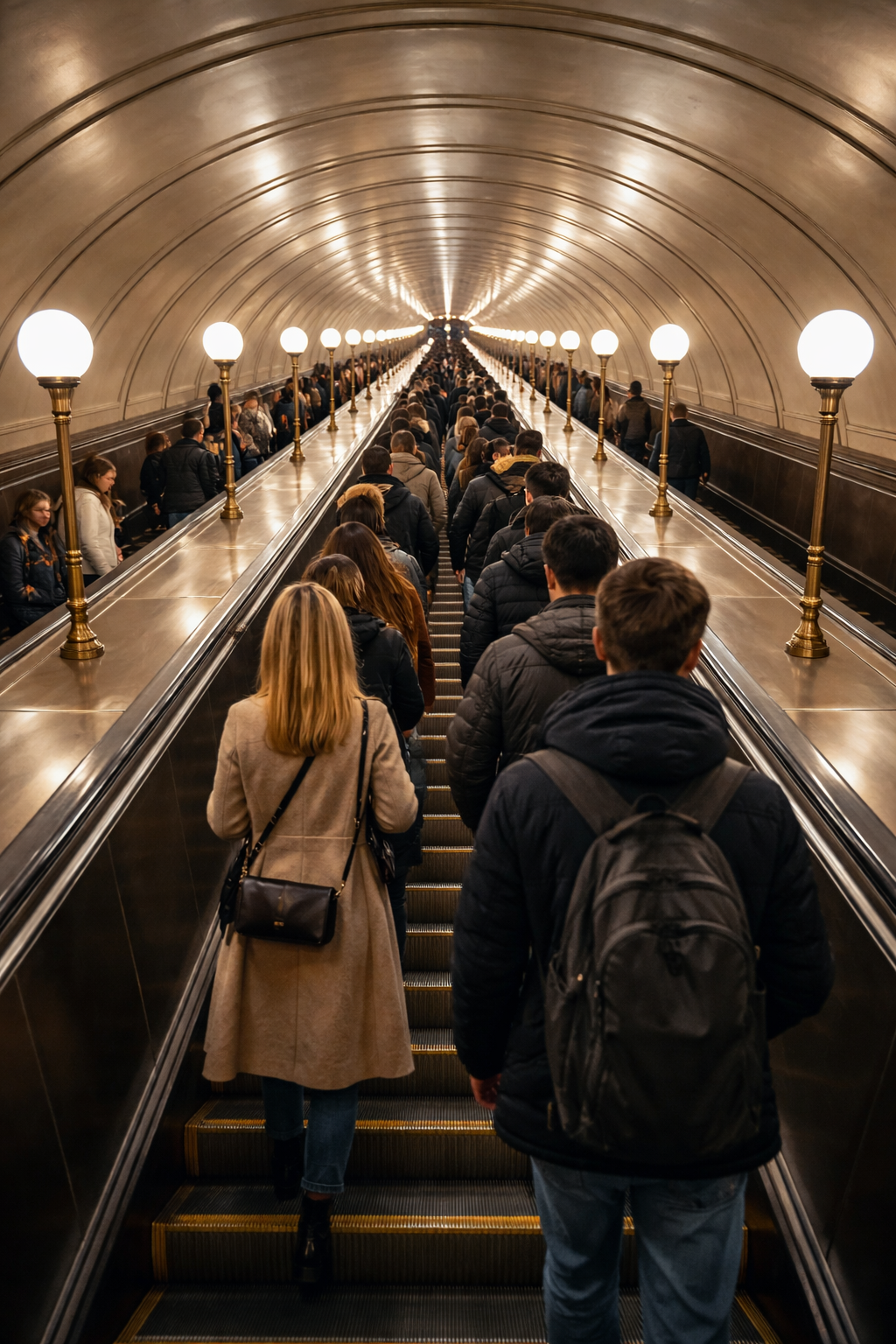
Movement through a city reveals more about a society than its monuments, museums, or official narratives ever could, and nowhere is this truer than in Russia, where public transport functions not merely as infrastructure but as a living social space shaped by history, practicality, collective habits, and an unspoken code of behavior that surprises, fascinates, and sometimes confuses foreigners during their first encounters underground or aboard a crowded tram.
For many visitors, the first real cultural lesson in Russia does not happen in a classroom or historical site. It happens on an escalator descending deep beneath Moscow, inside a Saint Petersburg tram rattling past imperial façades, or on an overnight train quietly crossing vast landscapes while strangers share tea and conversation. Public transport in Russia is not simply a way to get from point A to point B—it is a reflection of how Russians organize public space, respect shared environments, and navigate social interaction without excessive verbal communication.
Understanding Russian public transport culture helps travelers and language learners grasp something deeper: how Russians coexist collectively in dense urban environments while maintaining personal boundaries, efficiency, and social harmony.
Public Transport as a Cultural Institution
In many countries, transportation systems feel purely functional. In Russia, they carry symbolic weight.
Historically, public transport represented modernization, equality, and collective progress. Soviet-era planning emphasized accessibility and shared infrastructure, creating systems designed to serve millions efficiently.
Today, metros, buses, trams, and commuter trains remain central to daily life across social classes. Students, executives, pensioners, artists, and families all share the same spaces.
This shared experience creates a subtle social contract: public transport belongs to everyone, and everyone participates in maintaining order.
The Metro: Underground Cities
The Moscow Metro is often described as one of the most beautiful transit systems in the world—and newcomers quickly understand why.
Stations feature:
marble walls
chandeliers
mosaics
sculptures
grand architectural symmetry
Many stations resemble museums or palaces rather than transportation hubs.
But beyond aesthetics lies cultural meaning. The metro was designed as a public space that elevated everyday life. Ordinary citizens entered environments traditionally reserved for elites, reinforcing the idea that shared spaces deserved dignity and beauty.
Foreigners frequently experience a moment of surprise: commuting becomes an aesthetic experience.
The Unspoken Rules of Silence
One of the most noticeable aspects of Russian public transport is quietness.
Passengers typically:
avoid loud conversations
speak softly on phones
keep music contained within headphones
respect shared auditory space
For visitors accustomed to lively chatter, the silence may feel unusual at first. Yet it creates a calm atmosphere that many quickly appreciate.
Silence in Russia often signals respect rather than discomfort.
Personal Space Without Distance
Russian public transport can become crowded, especially during rush hours. Despite physical proximity, social boundaries remain strong.
People generally:
avoid prolonged eye contact
maintain neutral expressions
minimize unnecessary interaction
This behavior protects psychological personal space even when physical space is limited.
Foreigners sometimes interpret this as coldness, but it actually allows millions of daily commuters to coexist peacefully.
Escalator Etiquette: A Lesson in Efficiency
Few experiences introduce Russian transport culture more clearly than metro escalators.
Key rule:
👉 Stand on the right, walk on the left.
This rule is followed almost universally, and ignoring it immediately marks someone as unfamiliar with local norms.
Escalators in Moscow are famously long—some descending over 80 meters underground—turning them into transitional spaces between city and subterranean world.
Reading Culture Underground
Visitors often notice how many passengers read.
Books remain common companions on Russian transport, alongside smartphones and e-readers.
Reading reflects:
strong literary tradition
comfort with solitude
productive use of commuting time
The sight of entire train cars quietly absorbed in books surprises many foreigners accustomed to noisier environments.
Offering Seats: A Social Expectation
Courtesy plays an important role.
Passengers typically offer seats to:
elderly individuals
pregnant women
parents with small children
injured passengers
Failing to do so may attract disapproving looks from others.
This expectation reflects respect for age and vulnerability embedded in cultural norms.
Efficiency Over Performance
Customer service culture differs from Western expectations.
Transport staff may appear serious or direct, yet systems function with remarkable efficiency.
Announcements are concise. Instructions are practical. Interaction focuses on results rather than emotional display.
Many foreigners eventually find this refreshing.
The Role of Marshrutkas (Minibuses)
In addition to metros and buses, many cities operate marshrutkas, shared minibuses running flexible routes.
Unique features include:
passengers requesting stops verbally
cash or card payments directly to driver
informal but efficient operation
Riding a marshrutka often feels like participating in a local rhythm of urban life.
Overnight Trains: Social Microcosms
Long-distance trains occupy a special place in Russian culture.
Compartments create temporary communities where strangers share space for hours or days.
Common experiences include:
tea served in glass holders
shared snacks
quiet conversations
mutual respect for privacy
These journeys often become memorable cultural encounters.
Fashion and Presentation
Even during commutes, many Russians dress thoughtfully.
Public appearance reflects self-respect and social awareness.
Foreigners often notice a level of intentional style rarely associated with daily transportation elsewhere.
Why Foreigners Feel Watched (But Aren’t)
New visitors sometimes feel self-conscious due to fewer smiles or casual interactions.
In reality, passengers are usually focused inward—reading, thinking, or resting.
Neutral expressions simply represent default public behavior.
Understanding this reduces cultural misunderstanding.
Safety and Order
Russian public transport systems are generally perceived as safe and organized.
Features contributing to this include:
visible staff presence
clear infrastructure
cultural expectations of order
high usage across demographics
Public spaces feel collectively monitored rather than individually controlled.
Language Learning Opportunities on Public Transport
For language learners, public transport becomes an immersive classroom.
Learners hear:
natural speech rhythms
announcements
everyday vocabulary
conversational patterns
Observing interactions teaches cultural communication styles beyond textbooks.
What Public Transport Reveals About Russian Society
Several cultural values emerge clearly:
practicality over performance
respect for shared spaces
emotional reserve in public
efficiency and endurance
quiet coexistence
Public transport demonstrates how large populations maintain social harmony without constant verbal negotiation.
Adjusting as a Foreigner
Most visitors adapt quickly by observing behavior.
Helpful tips include:
follow crowd movement
keep voice volume moderate
stand right on escalators
offer seats when appropriate
avoid blocking doors
Observation becomes the best teacher.
The Emotional Experience of Riding
Many foreigners describe unexpected feelings while riding Russian transport:
calmness
reflection
curiosity
connection without conversation
The rhythm of movement encourages introspection rarely experienced in fast-paced urban environments elsewhere.
FAQs: Russian Public Transport Culture
Is Russian public transport difficult for foreigners?
Not usually. Systems are logical, and navigation apps help significantly.
Do I need Russian language skills?
Basic phrases help, but signage increasingly includes English in major cities.
Why are people so quiet?
Silence shows respect for shared public space.
Is it rude not to give up a seat?
Yes, especially for elderly passengers.
Are metros safe late at night?
Major city systems are generally safe and well monitored.
Can tourists use transport cards easily?
Yes, rechargeable cards simplify travel.
Why are metro stations so deep?
Historical engineering and Cold War-era design influenced depth.
Do people socialize with strangers?
Usually not immediately, though conversations may arise naturally in longer journeys.
Learn Russian with Polyglottist Language Academy
Understanding Russian public transport culture becomes far richer when you understand the language behind everyday interactions. Announcements, conversations, humor, and social cues reveal layers of meaning that translations cannot capture.
At Polyglottist Language Academy, we help students move beyond vocabulary lists toward real cultural fluency.
Our Russian programs include:
Small-group classes
Private lessons tailored to travel or professional goals
Flexible online scheduling
Native-speaking instructors
Conversation-focused learning
Cultural insights integrated into every lesson
Whether you plan to travel, work abroad, or explore Russian culture more deeply, our courses help you build confidence step by step.
👉 Ready to start learning Russian? Sign up today and experience the language behind the culture.
Continue Reading: Explore More from Our Blog
If you enjoyed this article, check out:
Traveling From St. Petersburg To Moscow By Train: A First-Hand Account
What It’s Like To Take The Saint Petersburg Metro For The First Time
Why Russian Bakeries Matter In St. Petersburg: Pekarni, Rum Baba, And Everyday Life
A DAY AT DOM KNIGI: BOOKSTORES, COFFEE, AND KAZAN CATHEDRAL IN ST. PETERSBURG
Walking In Saint Petersburg In December: A Winter City That Has Adapted
My First Morning In St. Petersburg: Snow, Silence, And The Smell Of Fresh Bread