
Understanding Russian Conjunctions: How to Connect Sentences Naturally
Learning a new language is often described as building a bridge between two worlds, and in Russian that bridge becomes particularly strong and elegant once you learn how to connect ideas seamlessly. Vocabulary gives you the building blocks, grammar provides the scaffolding, but conjunctions—the small, often overlooked words that tie thoughts together—are what make your speech flow like that of a native. Without conjunctions, you can list words, state facts, and express simple ideas, but the moment you want to compare, contrast, explain reasons, or add nuance, you need these connectors. They may be small, but in Russian, conjunctions have the power to transform your speech from choppy and mechanical into natural and sophisticated.
This article will guide you through the fascinating world of Russian conjunctions. We’ll explore how they work, how they differ from their English counterparts, and how to use them to express complex thoughts with elegance. Whether you’re writing essays, chatting with friends, or trying to understand Russian literature, mastering conjunctions is one of the surest steps toward sounding authentic. By the end of this deep dive, you’ll have not just a list of useful words, but also an understanding of their rhythm, cultural nuances, and the patterns that make them indispensable in everyday Russian communication.
Why Conjunctions Matter in Russian
Conjunctions (союзы) are the glue of the Russian language. They don’t carry meaning in the way nouns or verbs do, but they establish relationships between words, phrases, and sentences. Without them, Russian would be reduced to short, disconnected statements. With them, you can:
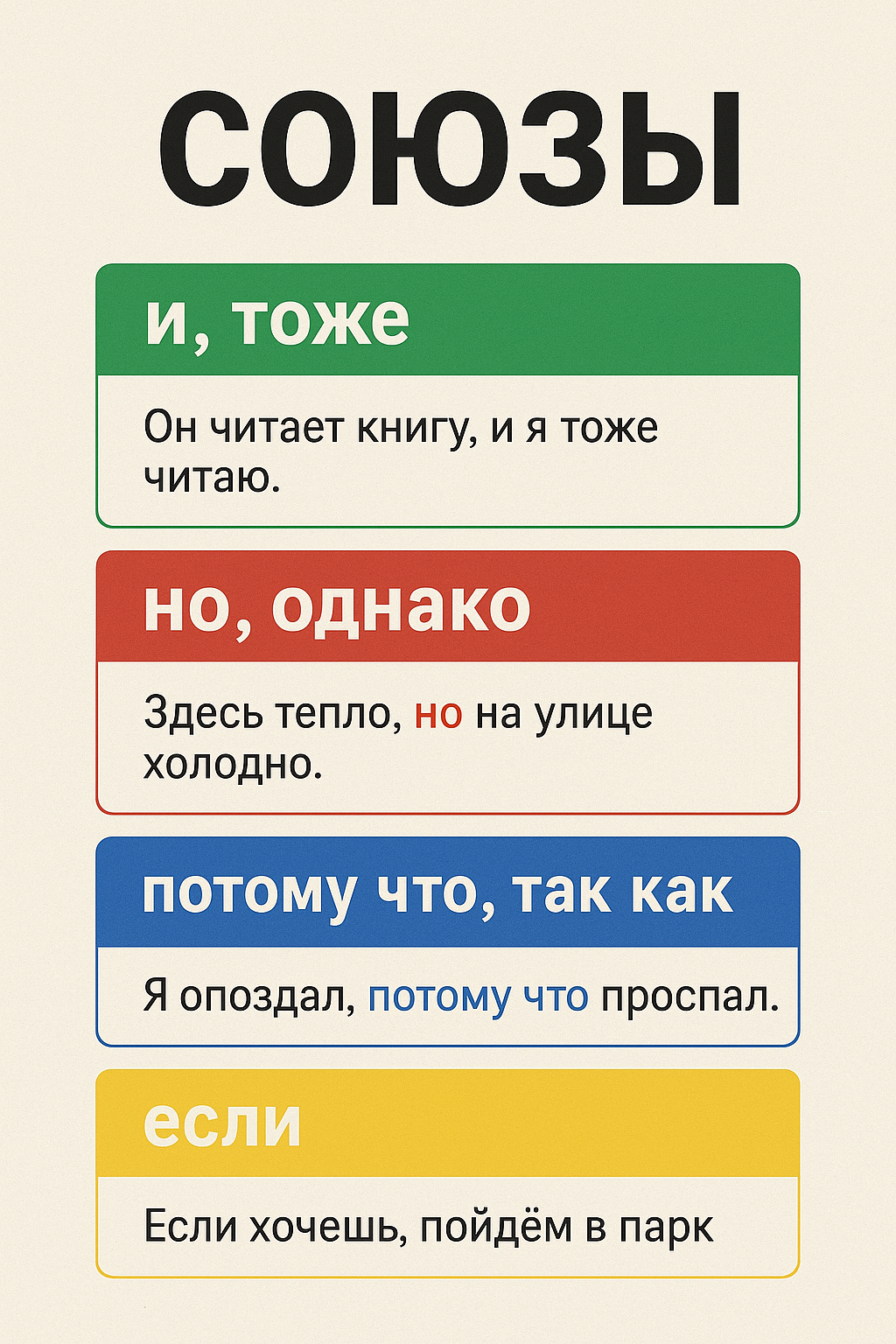
Add information: и (“and”), тоже (“also”)
Contrast ideas: но (“but”), однако (“however”)
Show cause and effect: потому что (“because”), так как (“since”)
Express conditions: если (“if”), раз (“provided that”)
Indicate time: когда (“when”), пока (“while”)
Think about it: in English, you rarely notice how often you use words like “and,” “but,” or “because.” Yet they structure nearly every conversation. In Russian, the same is true, but with its own set of conjunctions that often have subtle shades of meaning or stylistic preferences.
Categories of Russian Conjunctions
1. Coordinating Conjunctions (Сочинительные союзы)
These link words or clauses of equal weight.
И (and) – The most basic connector.
Example: Я люблю кофе и чай. (“I like coffee and tea.”)
А (and/but) – Shows contrast without strong opposition.
Example: Я люблю чай, а он любит кофе. (“I like tea, and he likes coffee.”)
Но (but) – Stronger contrast, often unexpected.
Example: Хотел пойти в кино, но пошёл домой. (“I wanted to go to the movies, but I went home.”)
Или / либо (or) – Offering alternatives.
Example: Ты хочешь чай или кофе? (“Do you want tea or coffee?”)
То есть (that is / in other words) – Clarification.
Example: Он филолог, то есть специалист по языку. (“He’s a philologist, that is, a language specialist.”)
2. Subordinating Conjunctions (Подчинительные союзы)
These introduce clauses that depend on another clause.
Потому что (because) – Expressing reasons.
Я остался дома, потому что шёл дождь.
(“I stayed home because it was raining.”)
Так как (since, as) – Softer than потому что.
Мы пошли домой, так как стало темно.
(“We went home since it got dark.”)
Если (if) – Expressing conditions.
Если будет дождь, мы останемся дома.
(“If it rains, we’ll stay home.”)
Когда (when) – Expressing time.
Я читал книгу, когда ты позвонил.
(“I was reading a book when you called.”)
Хотя (although, though) – Showing contrast.
Он пошёл гулять, хотя было холодно.
(“He went for a walk although it was cold.”)
3. Correlative Conjunctions (Парные союзы)
Pairs that work together, much like “either…or” in English.
И…и (both…and)
Она любит и петь, и танцевать.
(“She likes both singing and dancing.”)
Не только…но и (not only…but also)
Он не только умный, но и добрый.
(“He is not only smart but also kind.”)
То…то (sometimes…sometimes)
Он бывает то весёлый, то грустный.
(“He’s sometimes cheerful, sometimes sad.”)
Либо…либо (either…or)
Мы поедем либо в Москву, либо в Петербург.
(“We’ll go either to Moscow or to Petersburg.”)
Nuances and Usage Tips
А vs. но: Both translate to “but,” but а is milder and often simply contrasts two things, while но emphasizes opposition.
Потому что vs. так как: Both mean “because,” but потому что feels more conversational, while так как is more formal or literary.
Хотя: This versatile word can often be placed at the beginning of a sentence, similar to “although” in English, but in spoken Russian, it also carries a tone of “well, though…”
Understanding these distinctions is key to sounding natural.
Conjunctions in Russian Literature and Everyday Speech
One fascinating aspect of Russian conjunctions is how they shape the tone of storytelling. Russian literature, from Tolstoy to Chekhov, relies heavily on conjunctions to weave long, flowing sentences that capture emotional nuance. A single аcan subtly shift the meaning of an entire paragraph. Meanwhile, in casual speech, Russians love dropping conjunctions into conversation for emphasis: и всё (“and that’s it”), а потом (“and then”), ну и (“well, and?”).
Practice Ideas
Read aloud: Take a short Russian story or dialogue and underline all the conjunctions. Notice how they structure the flow.
Substitute: Practice swapping но for а in sentences and see how the meaning shifts.
Combine sentences: Write two short sentences and join them with different conjunctions. For example:
Я учусь в университете. Я работаю в кафе.
Я учусь в университете, и я работаю в кафе.
Я учусь в университете, а работаю в кафе.
Я учусь в университете, но работаю в кафе.
Common Mistakes
Direct translation: Beginners often translate “but” as но in all cases, even when а is better.
Overusing потому что: Learners love потому что, but mixing it with так как and ведь will make speech sound richer.
Forgetting word order: Subordinate clauses in Russian often require different word order than English.
FAQs About Russian Conjunctions
Q: Are Russian conjunctions always placed between two clauses?
A: Not always. Sometimes they appear at the beginning of a sentence for emphasis (Но я не согласен – “But I don’t agree”).
Q: Can I drop conjunctions in Russian like in English?
A: In spoken Russian, yes, people sometimes omit them. But in writing, conjunctions are essential for clarity.
Q: What’s the difference between и and да (both meaning “and”)?
A: Да is archaic or literary, used in older texts. In modern speech, always use и.
Q: How can I practice using conjunctions naturally?
A: Listen to native Russian speakers (movies, podcasts, YouTube), and pay attention to how they connect ideas. Mimic those patterns.
Q: Are some conjunctions considered formal?
A: Yes. Так как, однако, and ибо sound more formal or literary, while потому что and но are everyday.
Q: What’s the hardest conjunction for learners?
A: Many struggle with а because it doesn’t translate neatly to English. It’s somewhere between “and” and “but,” depending on context.
Q: Can conjunctions be stressed in speech?
A: Yes. Stressing но in conversation makes the contrast sharper.
Q: Are correlative conjunctions common in casual speech?
A: Yes, especially и…и and не только…но и, which are widely used.
Conclusion
Russian conjunctions may seem small and simple, but they are the keys to making your speech flow, your writing persuasive, and your understanding of native Russian deeper. By learning how to use them correctly and recognizing their subtle differences, you unlock the ability to think and communicate in Russian more naturally.
At Polyglottist Language Academy, we specialize in helping students not just memorize words but also internalize the patterns of real communication. Our Russian classes—taught by experienced instructors—give you the tools to use conjunctions naturally in conversation, literature, and professional contexts. If you’re serious about mastering Russian, now is the time to join us.
👉 Sign up today for Russian classes at Polyglottist Language Academy and start speaking more fluently.
And don’t stop here! If you enjoyed this deep dive, check out our other blog articles that will expand your Russian skills even further: