
Russian Reflexive Verbs: How to Use “-ся” and “-сь” Endings
Introduction
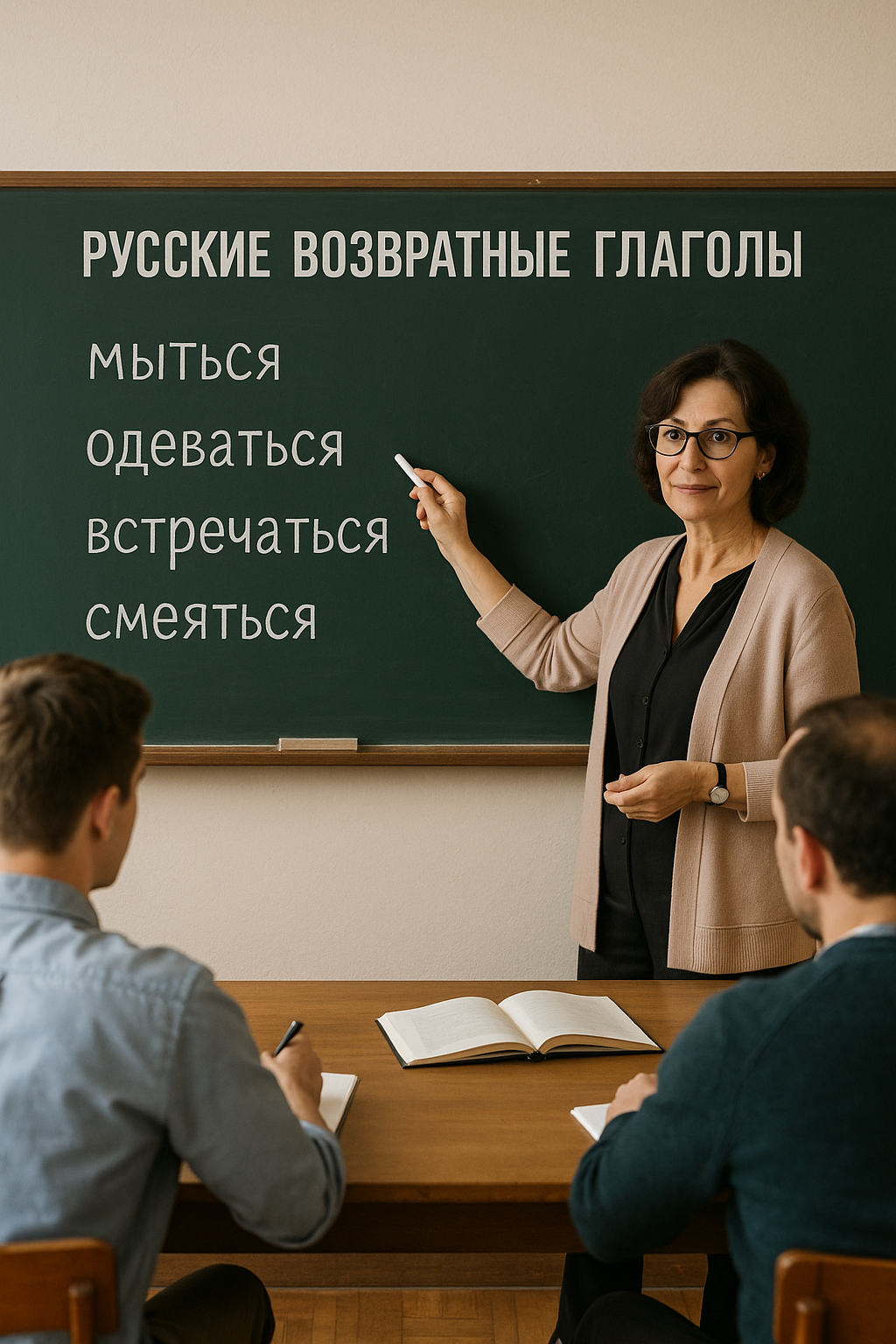
Few aspects of Russian grammar capture the imagination of learners as much as the small but mighty endings “-ся” and “-сь,” which transform an ordinary verb into something richer, more layered, and often more personal. At first glance, these endings might seem like minor additions, just a couple of letters tucked at the end of a word, but in reality, they open the door to an entire universe of meaning, from describing daily routines like мыться (“to wash oneself”) and одеваться (“to get dressed”) to capturing abstract states like надеяться (“to hope”) and смеяться (“to laugh”). Reflexive verbs in Russian aren’t just about grammar—they reveal how Russians conceptualize actions, relationships, and even emotions. To understand them is to unlock one of the most elegant mechanisms of the Russian language.
Unlike English, which usually requires pronouns such as “myself” or “yourself” to indicate reflexivity, Russian simply modifies the verb itself, making the action feel seamless and compact. The beauty of this system lies in its versatility: reflexive verbs can indicate that the subject is performing an action on themselves, that the action is mutual, or that the verb is impersonal—expressing actions or states without focusing on who is performing them. Once you start seeing these verbs in action, you’ll realize that Russian speech would feel incomplete, even unnatural, without them.
In this article, we’ll dive deep into the world of Russian reflexive verbs: their history, grammar, meanings, and everyday usage. We’ll explore the difference between “-ся” and “-сь,” examine the categories of reflexive verbs, look at common pitfalls learners face, and practice with plenty of examples. By the end, you’ll not only understand the mechanics but also appreciate the cultural nuances that reflexive verbs carry in Russian communication.
What Are Reflexive Verbs in Russian?
A reflexive verb is a verb that “reflects” the action back onto the subject, or that expresses an action that happens to the subject without explicitly stating an object. In Russian, this reflexivity is marked by adding the suffix “-ся” (or its shortened form “-сь”) to the end of the verb.
Examples:
мыть = to wash → мыться = to wash oneself
одевать = to dress (someone else) → одеваться = to get dressed
находить = to find → находиться = to be located
This small change in form can lead to significant shifts in meaning, and those shifts can range from very literal to completely idiomatic.
The Difference Between “-ся” and “-сь”
Learners often wonder why sometimes they see “-ся” and other times “-сь.” The explanation is actually straightforward:
“-ся” is used after consonants.
“-сь” is used after vowels.
Examples:
Он моется. (“He is washing himself.”)
Она смеётся. (“She is laughing.”)
So the choice is not about meaning—it’s purely a matter of phonetics and ease of pronunciation.
Categories of Reflexive Verbs
Russian reflexive verbs are not one-size-fits-all. Their meanings fall into several categories. Let’s explore the most important ones.
1. Reflexive Actions (Self-Directed)
These verbs describe actions the subject performs on themselves.
мыться = to wash oneself
одеваться = to get dressed
бриться = to shave oneself
These are the most intuitive for learners, since they resemble the English use of “myself,” “yourself,” etc.
2. Reciprocal Actions (Mutual)
These verbs describe actions two or more people perform on each other.
встречаться = to meet (with each other)
целоваться = to kiss (each other)
обниматься = to hug (each other)
Context usually makes it clear that the action is mutual.
3. Passive or Middle Voice
Reflexive verbs often create passive-like meanings, where the action happens without naming the agent.
Книга читается легко. = The book reads easily.
Дом строится быстро. = The house is being built quickly.
This use is very common in Russian, giving verbs a neutral, impersonal flavor.
4. Impersonal Constructions
Sometimes reflexive verbs are used to indicate that an action takes place without reference to any specific subject.
Мне не спится. = I can’t sleep (literally: “It doesn’t sleep to me”).
Ему работается хорошо. = He works well (literally: “It works well to him”).
These constructions are hard to translate directly, but they capture shades of meaning that English often needs extra words to express.
5. Idiomatic Reflexives
Some reflexive verbs have meanings that don’t correspond directly to their non-reflexive forms.
смеяться = to laugh (not “to laugh oneself”)
надеяться = to hope
бояться = to be afraid
These must be learned as vocabulary, since their reflexive form has become standard.
Reflexive Verbs in Everyday Life
Reflexive verbs are everywhere in Russian daily speech. Morning routines alone are packed with them:
просыпаться = to wake up
умываться = to wash up
одеваться = to get dressed
собираться = to get ready
In conversations, reflexive verbs often appear in common expressions:
Мне не верится. = I can’t believe it.
Это не забывается. = That won’t be forgotten.
Давай встречаться чаще. = Let’s meet more often.
If you listen closely to Russian speakers, you’ll hear reflexive verbs forming the backbone of casual dialogue.
Common Mistakes Learners Make
Using reflexive endings unnecessarily
Not every verb in Russian can take “-ся.” Beginners sometimes try to attach it to any verb, but that often produces nonsense.Forgetting context in reciprocal verbs
Reflexive forms like встречаться need context. “Мы встречаемся” could mean “We meet each other” or “We are dating,” depending on the situation.Translating too literally
Learners often assume смеяться must mean “to laugh at oneself,” but it simply means “to laugh.” Idiomatic reflexives need to be learned in context.Neglecting impersonal constructions
Phrases like мне не спится or ему не работается feel strange at first but are crucial for sounding natural.
Cultural Nuances of Reflexive Verbs
The Russian language uses reflexive verbs not only as a grammatical feature but also as a cultural expression of perspective. The impersonal use reflects a worldview in which actions and states often happen to people rather than being fully controlled by them. This is why sentences like Мне холодно (“It is cold to me”) or Мне не верится (“It doesn’t believe to me”) feel natural in Russian. They reveal an attitude toward experience that is less about agency and more about circumstance.
Understanding reflexive verbs, therefore, is not just about learning forms—it’s about appreciating the way Russian speakers perceive action and responsibility in their world.
Practical Tips for Mastering Reflexive Verbs
Group them by category. Learn reflexives in sets—self-directed actions, mutual actions, impersonal states.
Memorize idiomatic ones. Don’t try to decode them; just treat them as separate vocabulary items.
Pay attention to frequency. Reflexives like смеяться and надеяться are extremely common—learn these first.
Listen and repeat. Hearing native speakers use reflexives naturally will help you internalize them faster.
Practice Sentences
Я моюсь каждый день утром и вечером. (I wash myself every morning and evening.)
Мы часто встречаемся в кафе. (We often meet in a café.)
Эта песня легко поётся. (This song is easy to sing.)
Мне сегодня плохо спится. (I can’t sleep well tonight.)
Он всегда смеётся над шутками друга. (He always laughs at his friend’s jokes.)
FAQs about Russian Reflexive Verbs
Q1: Do all Russian verbs have reflexive forms?
No. While many verbs can take reflexive endings, not all do, and some reflexive verbs don’t have corresponding non-reflexive forms.
Q2: What’s the difference between reflexive and reciprocal verbs?
Reflexive verbs describe actions the subject does to themselves; reciprocal verbs describe actions two or more people do to each other.
Q3: Are reflexive verbs always written with “-ся” at the end?
Yes, though after vowels the form shortens to “-сь.”
Q4: How do I know if a reflexive verb is idiomatic?
If the reflexive meaning doesn’t match the root verb (like смеяться = to laugh), it’s idiomatic and must be memorized.
Q5: Can reflexive verbs be used in all tenses?
Yes. Reflexive verbs conjugate normally in past, present, and future, with “-ся” or “-сь” added at the end.
Q6: Are reflexive verbs important for fluency?
Absolutely. Russians use reflexive verbs constantly; ignoring them will make your speech sound unnatural and incomplete.
Q7: Do reflexive verbs exist in other Slavic languages?
Yes, most Slavic languages (like Polish, Ukrainian, and Bulgarian) have similar reflexive verb systems.
Q8: How should I practice reflexive verbs?
Start with the most common ones, use them in sentences about your daily routine, and listen to Russian conversations to hear them in context.
Conclusion
Mastering Russian reflexive verbs is about much more than adding “-ся” or “-сь” to the end of a verb—it’s about unlocking a way of thinking and speaking that is uniquely Russian. Reflexive verbs allow you to describe actions upon yourself, mutual interactions, impersonal states, and abstract emotions with elegance and brevity. They appear in proverbs, daily routines, literature, and conversation. Once you grasp them, your Russian will not only improve grammatically but also sound far more authentic.
At Polyglottist Language Academy, we believe that learning Russian means engaging deeply with its grammar, culture, and everyday expressions. Our expert instructors will help you master reflexive verbs in context, practice them in conversation, and understand how they shape the Russian worldview.
👉 Sign up today for Russian classes at Polyglottist Language Academy and start building confidence with reflexive verbs and beyond.
And don’t stop here—continue your journey into Russian language and culture with these articles: