
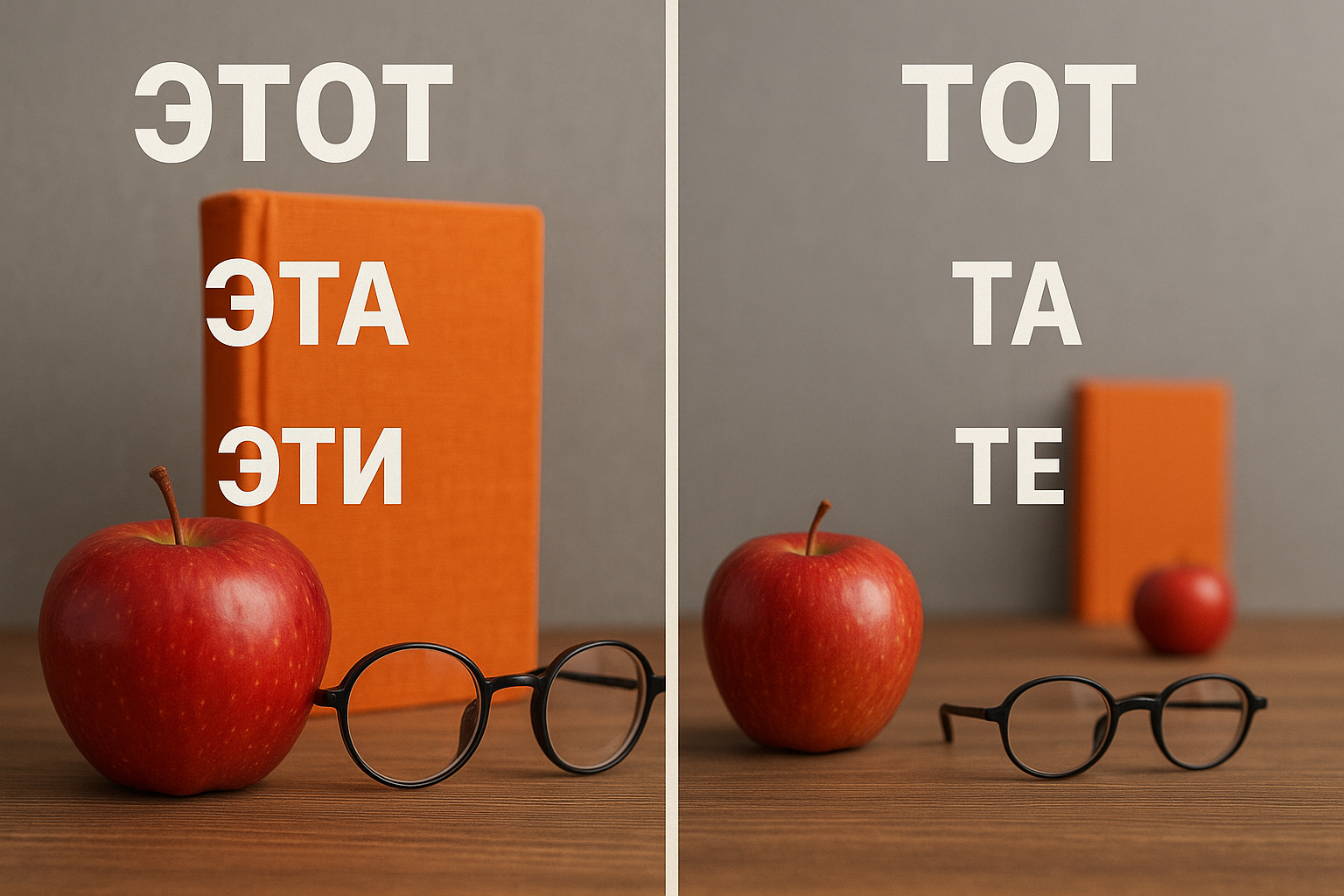
Learning Russian often feels like standing at the edge of a vast forest—you see the patterns of the language, its beauty and mystery, but you’re never quite sure which path to take first. One of the earliest crossroads that learners encounter is between two deceptively simple words: “это” (this/it) and “тот” (that). At first glance, they seem interchangeable, both pointing to things, both functioning as demonstratives, both giving the learner the sense of “showing” something. But in practice, they serve distinct roles that shape not only meaning, but also nuance, clarity, and even politeness in everyday Russian.
Many learners, even those who are comfortable holding a basic conversation, stumble when choosing between “это” and “тот.” They wonder: Why does one sentence say “Это книга,” while another says “Та книга интересная”? Why do native speakers sometimes shorten “это” to just “то”? And perhaps most confusing of all, how do I know when I should use one or the other in natural conversation?
This article will guide you through the tangled paths of these two little words, helping you understand not only their grammatical functions but also their cultural and conversational resonance. By the end, you’ll be able to confidently point, identify, and compare in Russian, using “это” and “тот” like a native speaker.
The Big Picture: Why “Это” and “Тот” Matter
Demonstratives like this, that, these, and those are fundamental in every language. They allow us to establish reference points: this book right here, that friend over there, these ideas we’re discussing. In Russian, “это” and “тот” carry much of this work, but unlike in English, their distribution follows rules that are not always obvious to learners.
“Это” usually acts as a pointing word of identification: it tells you what something is. It can mean this is, it is, or simply this.
“Тот” usually acts as a distinguishing word of contrast: it tells you which one out of several things. It often translates as that (one) in English.
Understanding this distinction is key to mastering how Russians organize reference in conversation.
Breaking Down “Это”
1. “Это” as “This is” or “It is”
One of the first phrases every Russian learner hears is:
Это книга. – This is a book.
Это мой брат. – This is my brother.
Here, “это” functions almost like a subject pronoun (“it/this”) that introduces something new. Russians use it constantly in introductions, explanations, and everyday identifications.
Key point: “Это” doesn’t change for gender, case, or number in this usage. Whether you’re talking about a feminine noun (книга), a masculine noun (стол), or a plural noun (яблоки), the word stays the same:
Это стол. – This is a table.
Это яблоки. – These are apples.
Notice how simple that is: one form, all contexts.
2. “Это” as “This” (Modifier)
Sometimes, “это” works like the English “this,” modifying a noun:
Эта книга интересная. – This book is interesting.
Этот фильм длинный. – This movie is long.
Эти студенты устали. – These students are tired.
Now, the word changes according to gender and number:
Masculine: этот
Feminine: эта
Neuter: это
Plural: эти
This is when beginners often get confused: “Wait, why does ‘это’ suddenly look different?” The answer lies in grammar. When “это” introduces something (“Это мой друг”), it stays in the invariable “это” form. When it modifies a noun, it must agree in gender and number, just like adjectives.
3. “Это” as “It” in Explanations
In Russian, “это” can also stand in as “it” when giving explanations or clarifications:
Что это? – What is this?
Это сложно. – It’s difficult.
Это правда? – Is it true?
This usage is part of why “это” feels so flexible—it covers many of the functions that “this” and “it” both cover in English.
Breaking Down “Тот”
1. “Тот” as “That (one)”
Where “это” introduces or identifies, “тот” distinguishes. It points to something not here, not this one, often something more distant or already known in context:
Тот дом красивый. – That house is beautiful.
Тот человек был врачом. – That person was a doctor.
Unlike “это,” the word “тот” changes with gender and number:
Masculine: тот
Feminine: та
Neuter: то
Plural: те
2. “Тот” in Contrast
One of the most common uses of “тот” is when contrasting:
Этот фильм скучный, а тот интересный. – This movie is boring, but that one is interesting.
Эта улица шумная, а та тихая. – This street is noisy, but that one is quiet.
Here, “тот” doesn’t just mean “that”—it really means “the other one,” helping speakers separate two or more things.
3. “Тот” in Expressions
You’ll also find “тот” in fixed expressions that emphasize “the very same” or “exactly that”:
в тот день – on that day
в то время – at that time
тот самый – the very same
Comparing “Это” vs. “Тот” Side by Side
To really understand the difference, it helps to put the words in parallel:
Это мой брат. – This is my brother.
Тот мой брат. – That (one) is my brother.
Эта книга новая. – This book is new.
Та книга старая. – That book is old.
Эти студенты здесь. – These students are here.
Те студенты там. – Those students are there.
Think of it this way:
Use “это” when you are presenting or identifying something.
Use “тот” when you are contrasting or specifying which one.
Common Mistakes Learners Make
Overusing “это” for everything. Beginners tend to stick with “это,” because it feels safe. But saying “Это книга интересная” sounds unnatural; you need “Эта книга интересная.”
Forgetting agreement with “тот.” Learners often say “тот книга” instead of “та книга.” Always match gender and number.
Mixing up “это” (identification) and “этот” (modifier). Remember: “Это книга” (This is a book) vs. “Эта книга” (This book).
Practical Tips for Mastery
Listen carefully in real conversations. Russians use “это” constantly in speech—it’s one of the most frequent words. Pay attention to when it stands alone versus when it modifies a noun.
Practice with contrasts. Pair “этот/эта/эти” with “тот/та/те” to get used to the contrastive function. Example: “Эта чашка моя, а та твоя.”
Use visual aids. Point to objects in your environment and say sentences aloud: “Это стол. Этот стол новый. Тот стол старый.”
Cultural Note: Russian Directness
Russian tends to use “это” for clear identification much more frequently than English does. Saying “Это правда” feels normal and direct in Russian, whereas in English “It is true” might sound stilted in casual speech. Using “это” frequently makes your Russian sound more natural.
Mini Exercises
Translate:
This is my friend. → Это мой друг.
That house is big. → Тот дом большой.
These apples are sweet. → Эти яблоки сладкие.
Those streets are quiet. → Те улицы тихие.
Correct the mistake:
❌ “Это книга интересная.”
✅ “Эта книга интересная.”
Fill in the blank:
___ фильм длинный, а ___ фильм короткий.
Answer: Этот фильм длинный, а тот фильм короткий.
FAQs
Q: Can “это” mean both “this” and “it”?
Yes, context decides. “Это мой брат” = “This is my brother.” “Это правда” = “It is true.”
Q: Is “это” always neutral?
As a standalone word, yes—it doesn’t change for gender or number. But when modifying a noun, it must take the appropriate form: этот, эта, это, эти.
Q: What’s the difference between “это” and “этот”?
“Это” identifies something: “Это книга.” “Этот” modifies: “Этот стол большой.”
Q: Can “тот” ever mean “the same”?
Yes, in expressions like “тот самый” = “the very same.”
Q: Is there a difference in politeness between “это” and “тот”?
Not in politeness, but in clarity. Russians expect you to use “тот” when contrasting, not just overusing “это.”
Q: Do Russians ever shorten “это” to “то”?
Yes, especially in colloquial speech. “То правда” = “That’s true.”
Q: Should I memorize all the forms of “тот”?
Absolutely—тот, та, то, те are essential building blocks.
Q: Which one should I practice more as a beginner?
Start with “это,” since it covers more ground in introductions and identifications. But don’t neglect “тот,” because it helps you sound precise.
Conclusion & Call to Action
Mastering the difference between “это” and “тот” is like learning to focus a camera lens: one brings the subject into sharp clarity, while the other distinguishes it from everything else. Both are essential tools for making your Russian sound natural, precise, and confident.
At Polyglottist Language Academy, we specialize in helping students navigate exactly these kinds of challenges. Whether you’re a complete beginner or an advanced learner polishing your skills, our Russian courses—taught by expert instructors—will help you gain fluency step by step. If you’re ready to take your Russian beyond the textbook and into real conversation, sign up today and join our community of language learners around the world.
And if you enjoyed this article, don’t stop here! Check out more of our in-depth guides on Russian language and culture: