
Introduction
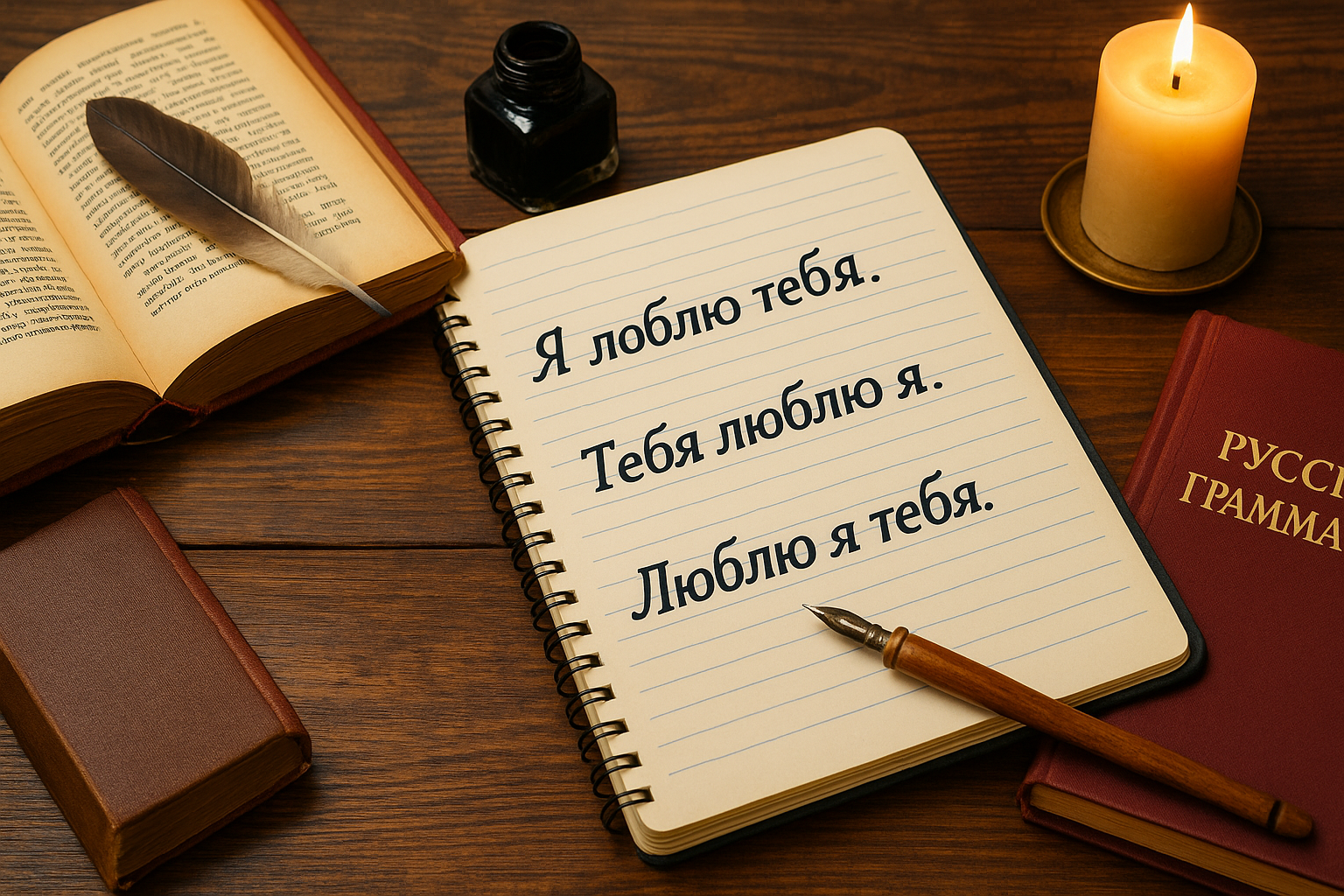
One of the first surprises English speakers encounter when they begin studying Russian is that a sentence can be expressed in multiple word orders without necessarily becoming “incorrect,” and yet each variation seems to change the nuance, rhythm, or emotional color of what is being said, showing that Russian syntax is at once freer and more subtle than what many learners are used to. This flexibility often puzzles newcomers: how can Я люблю тебя (“I love you”), Тебя люблю я, and Люблю я тебя all be grammatically valid sentences, and why do they sound different to native speakers even though the dictionary meanings of the words remain unchanged? The answer lies in Russian’s reliance on case endings, intonation, and context to carry grammatical meaning, which frees word order to serve functions of emphasis, style, and discourse.
Understanding Russian word order is not just a matter of memorizing patterns—it’s about learning to hear how syntax interacts with meaning and emotion. For Russians, shifting a word to the front or back of a sentence can make a statement sound formal or casual, affectionate or dismissive, emphatic or understated. For learners, mastering this skill means moving beyond literal translation and beginning to think in Russian.
In this article, we will explore Russian word order in depth: how it works, how it compares with English, what “neutral” order looks like, when and why it changes, and what cultural insights it offers. By the end, you will see that Russian syntax, while flexible, is not random—it is guided by rules of information structure, emphasis, and stylistic choice.
Why Russian Syntax is Flexible
The key reason Russian word order can be flexible is that grammatical relations in Russian (subject, object, indirect object, etc.) are primarily marked by case endings rather than by word order.
For example:
Мама любит сына. = Mother loves (her) son.
Сына любит мама. = Mother loves (her) son.
Любит мама сына. = Mother loves (her) son.
In all three sentences, it is clear who loves whom because мама (mother) is in the nominative case (subject) and сына(son) is in the accusative case (object). Unlike English, where “Mother loves son” and “Son loves mother” mean very different things depending on word order, Russian uses endings to clarify roles, leaving word order free to highlight other aspects of communication.
Neutral Word Order in Russian
While Russian allows variation, there is still a “default” or neutral word order:
Subject – Verb – Object (SVO)
Я читаю книгу. = I am reading a book.
This order is the most common in neutral statements and is usually what learners are first taught. It is safe and widely understood in almost all contexts.
However, Russian also permits Subject–Object–Verb (SOV), Verb–Subject–Object (VSO), and other permutations. These alternatives do not change the core meaning but alter focus, style, and emphasis.
Word Order and Emphasis
Shifting word order in Russian is often about emphasizing certain parts of the sentence.
Я люблю тебя. = I love you. (neutral, straightforward)
Тебя люблю я. = It is you I love (emphasis on you).
Люблю я тебя. = I do love you (emphasis on the act of loving).
Я тебя люблю. = I love you (natural emphasis on you, often affectionate).
Each version is grammatically correct but communicates slightly different shades of emotion.
The Role of Intonation
Word order in Russian cannot be understood without intonation. The rise and fall of voice often signals what is being emphasized. A sentence like Сына любит мама can either sound like a factual statement (“It’s the mother who loves the son”) or a correction to someone else’s claim, depending on stress and pitch.
Functional Perspectives in Russian Sentences
Linguists often analyze Russian word order through the concepts of theme (known information) and rheme (new information).
Theme: What the sentence is about (old or assumed knowledge).
Rheme: The new, important, emphasized part.
For example:
Мама любит сына. (Theme: мама, Rheme: любит сына.)
Сына любит мама. (Theme: сына, Rheme: любит мама.)
Russian word order is thus tied not just to grammar but also to discourse structure—what the speaker assumes the listener already knows and what they want to highlight.
Word Order in Questions
In English, questions often require word order changes (e.g., “Do you like tea?”). Russian, however, often uses the same order as statements, relying instead on intonation or question words.
Ты любишь чай? = Do you like tea?
Любишь ты чай? (less common, slightly emphatic).
Чай ты любишь? = Is it tea you like?
The question particle ли also adds nuance:
Ты ли это сделал? = Was it you who did it?
Word Order in Negatives
Negative sentences often place the negative particle не before the verb, but word order shifts can emphasize the object.
Я не видел его. = I didn’t see him.
Его я не видел. = It’s him I didn’t see (implying perhaps I saw others).
Inversion in Poetry and Literature
Russian poets and writers often use unusual word orders for rhythm, rhyme, or stylistic effect. For example, in classical poetry you may find verbs at the end of sentences or objects placed first. This is part of why reading Russian literature in the original requires sensitivity to syntax beyond simple grammar.
Colloquial vs. Formal Word Order
In colloquial speech, Russians tend to use shorter, more flexible orders: Я тебя люблю.
In formal writing, the neutral SVO is preferred: Я люблю тебя.
Recognizing the difference between spoken rhythm and written clarity is key to mastering Russian fluency.
Word Order in Complex Sentences
In subordinate clauses, word order becomes slightly more rigid but still allows variation.
Я знаю, что он любит её. = I know that he loves her.
Я знаю, что её он любит. = I know that it’s her he loves (emphasis on her).
Common Mistakes by Learners
Overusing English SVO
Learners often stick rigidly to subject–verb–object, missing opportunities to emphasize or sound natural.Ignoring intonation
Word order without correct intonation can confuse meaning.Using free order randomly
Russian word order is flexible but not chaotic—each choice signals something. Random variation often sounds odd.Misplacing pronouns
Russian prefers pronouns earlier in the sentence: Я тебя видел, not Я видел тебя (though both are possible, the first is more natural in speech).
Cultural Insight: Russian Directness and Subtlety
Flexibility in word order reflects a balance in Russian communication between directness (getting to the point quickly) and subtlety (conveying shades of meaning through structure and intonation). A Russian speaker may move words around to soften a statement, to correct someone politely, or to make a sentence sound more emotional. Understanding this flexibility helps learners grasp not only grammar but also the cultural texture of the language.
Practical Tips for Mastering Word Order
Learn the default SVO first. Use it as your safe baseline.
Notice emphasis. When you hear a Russian speaker stressing a particular word, observe if it moves forward.
Read Russian literature aloud. Pay attention to unusual orders in poetry or prose.
Practice small shifts. Try changing Я люблю тебя into its variants and feel the nuance.
Listen to dialogues. Movies and podcasts are full of real-life variations.
Practice Sentences
Я читаю книгу. (Neutral: I am reading a book.)
Книгу я читаю. (It’s a book I’m reading.)
Читаю я книгу. (I do read a book, emphasis on the action.)
Я книгу читаю. (Colloquial, softer, focus on the book.)
FAQs about Russian Word Order
Q1: Is Russian word order completely free?
Not completely. While flexible, it follows rules of theme-rheme, emphasis, and intonation. Random order can sound unnatural.
Q2: What is the safest word order for beginners?
Subject–Verb–Object (SVO). It’s neutral, widely accepted, and works in most contexts.
Q3: How does word order differ in spoken and written Russian?
Spoken Russian is more flexible, with pronouns often shifted earlier. Written Russian, especially formal writing, sticks closer to neutral SVO.
Q4: Does Russian word order affect politeness?
Yes, shifting words can soften or emphasize statements, making them more polite or more forceful.
Q5: Is Russian word order like Latin or German?
In some ways. Like Latin, Russian relies on case endings rather than word order, but Russian is less rigid than German.
Q6: Why do Russians move words around so much in conversation?
To highlight new information, correct misunderstandings, or add emotional nuance.
Q7: Do all native speakers agree on what sounds natural?
Not always—regional, generational, and stylistic differences exist. But most follow the same core patterns.
Q8: How can I practice Russian word order effectively?
Read short dialogues, imitate native speakers, and try reordering sentences to see how meaning shifts.
Conclusion
Russian word order might look intimidating to learners used to fixed syntactic rules, but in reality, its flexibility is one of the most fascinating and expressive features of the language. It gives speakers tools to adjust meaning, highlight what matters, and shape communication in subtle ways. Once you understand that cases carry the grammar, you can start to hear word order as a system of emphasis, style, and emotion.
At Polyglottist Language Academy, we help students not only master Russian grammar but also feel confident navigating these nuances in real conversations. Our expert teachers guide learners through examples, cultural context, and practical exercises that bring word order to life.
👉 Sign up for Russian classes at Polyglottist Language Academy today and learn how to make Russian syntax work for you.
And don’t stop here—explore more of our blog articles to deepen your understanding of Russian language and culture: