
How to Learn Hiragana in 1 Week: A Step-by-Step Plan With Memory Tips
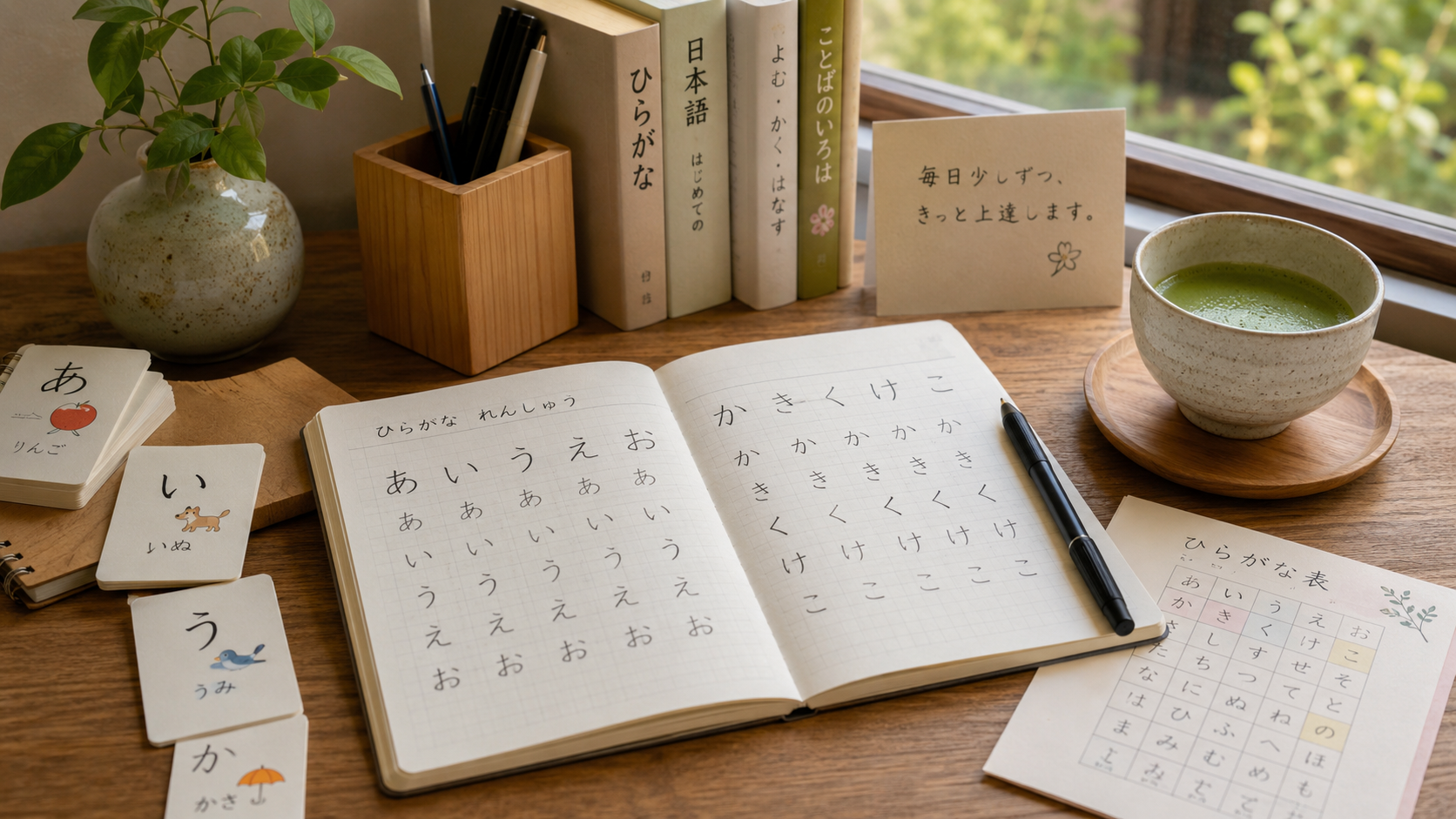
If you have ever opened a Japanese textbook, looked at a menu in Tokyo, watched anime with subtitles, seen a handwritten note in Japanese, or tried to follow a beginner lesson online, you probably noticed something immediately: before Japanese can become a language you speak, understand, and enjoy, it first asks you to step into a new visual world where simple curved symbols like あ, さ, ま, and の suddenly carry sound, rhythm, meaning, and the promise of an entirely different way of reading.
For many beginners, this first encounter with Japanese writing feels both exciting and intimidating. Hiragana looks beautiful, but unfamiliar. It is not an alphabet in the English sense. It is not made of letters that represent individual consonants and vowels separately. Instead, each hiragana character usually represents a full syllable-like sound: か is “ka,” み is “mi,” す is “su,” and so on. At first, this can feel like a lot to memorize. But the good news is that hiragana is one of the most manageable parts of Japanese to learn, especially if you approach it with a clear plan.
You do not need months to learn hiragana. You do not need to be “good at languages.” You do not need to have artistic handwriting. You do not need to understand Japanese grammar yet. What you need is one focused week, a realistic daily schedule, a few memory tricks, and the willingness to review the same symbols several times from different angles.
Hiragana is the foundation of written Japanese. It is used for native Japanese words, grammatical endings, particles, verb endings, children’s books, beginner textbooks, pronunciation guides, and words that do not use kanji. Even after you learn katakana and kanji, hiragana remains everywhere. It is the script that holds Japanese grammar together. Without hiragana, Japanese remains filtered through romaji, the Latin-letter spelling system used for beginners. Romaji can be useful for a few days, but staying with it too long can slow your progress because it makes Japanese look like English. Hiragana helps you begin thinking in Japanese sounds.
The goal of this article is simple: to show you how to learn hiragana in one week without panic, without random memorization, and without giving up halfway through. You will find a day-by-day plan, practical memory tips, pronunciation guidance, review strategies, and common mistakes to avoid. By the end of the week, you should be able to recognize all basic hiragana, read simple words, write the characters with reasonable confidence, and continue into katakana, vocabulary, and beginner grammar with a much stronger foundation.
What Is Hiragana?
Hiragana is one of the three writing systems used in Japanese. The other two are katakana and kanji.
Hiragana is a phonetic script, which means the symbols represent sounds. For example:
あ = a
い = i
う = u
え = e
お = o
Most hiragana characters combine a consonant and a vowel:
か = ka
き = ki
く = ku
け = ke
こ = ko
This structure makes hiragana much more regular than English spelling. Once you know the character, you usually know how to pronounce it. That is a huge advantage for beginners.
Japanese has five basic vowel sounds: a, i, u, e, o. These are consistent and short. Unlike English vowels, they do not change dramatically from word to word. This is one reason hiragana is such a helpful first step. It teaches you the sound system of Japanese at the same time as the writing system.
Hiragana is organized in a chart called the gojūon, often translated as the “fifty sounds” chart. The chart is arranged by vowel sounds and consonant rows. You begin with the vowel row, then move through rows such as k, s, t, n, h, m, y, r, and w. Although the chart does not contain exactly fifty active modern symbols, the structure gives beginners a clear map.
Why Learn Hiragana Before Grammar?
Many beginners want to start speaking immediately, and that is understandable. You probably want to say useful phrases, introduce yourself, order food, ask directions, or understand what characters say in a show. Speaking is important, but hiragana gives you something equally important: independence.
When you know hiragana, you can read beginner textbook examples without relying on romaji. You can pronounce new words more accurately. You can understand how particles such as は, を, and に appear in real Japanese sentences. You can use flashcards, children’s materials, graded readers, and beginner exercises more effectively. You also begin to recognize Japanese as Japanese, not as an English-letter approximation.
Learning hiragana early also helps pronunciation. Romaji can create bad habits because English speakers often pronounce Latin letters according to English rules. For example, “r” in romaji does not sound like the English “r.” The “u” in “su” is not the same as the English “oo.” Hiragana helps you stop seeing Japanese through English spelling.
This does not mean you must master hiragana perfectly before learning anything else. You can learn greetings and basic phrases at the same time. But by the end of your first serious week, hiragana should become your main reading tool.
Can You Really Learn Hiragana in One Week?
Yes, you can learn hiragana in one week if you define the goal correctly.
In one week, you can realistically learn to recognize and write all basic hiragana, including dakuten and handakuten variations such as が, ざ, だ, ば, and ぱ. You can also learn common combinations such as きゃ, しゅ, and ちょ. You may not read quickly yet. You may still confuse similar-looking characters. You may need more practice to write smoothly. That is normal.
The goal of one week is not instant fluency. The goal is functional familiarity. You want to move from “these symbols look impossible” to “I know what these are, and I can read them slowly.” Speed comes later through exposure.
Think of hiragana like learning to recognize musical notes. In the first week, you can learn the notes. Playing music beautifully takes longer. But once you know the notes, you can begin practicing real melodies. Hiragana works the same way.
The Best Daily Routine for Learning Hiragana
Before we begin the seven-day plan, here is the daily routine you should use.
Each day, spend about 30 to 45 minutes on focused hiragana study. If you have more time, divide it into two shorter sessions instead of one long session. A morning review and an evening practice session work especially well.
Your daily routine should include five parts:
First, look at the new characters and say them out loud. Never study hiragana silently only. Japanese is a sound system, so connect every symbol to pronunciation.
Second, write each character several times while saying the sound. Writing helps memory because it gives your brain a physical action connected to the shape.
Third, use a mnemonic or visual memory trick. For example, you might remember き as “key” because it sounds like “ki.” The exact image does not matter as long as it helps you recall the sound.
Fourth, quiz yourself without looking. Recognition is more important than copying. Cover the chart and test yourself.
Fifth, read simple syllables and words. Even if the words are basic, reading real combinations makes the symbols feel alive.
Day 1: Learn the Vowels and K-Row
Start with the five vowels:
あ = a
い = i
う = u
え = e
お = o
These are the heart of Japanese pronunciation. Every other hiragana sound connects to them. Practice them slowly and clearly. Avoid turning them into English-style vowels. あ is like “ah,” い is like “ee,” う is a short “oo” sound with less lip rounding than English, え is like “eh,” and お is like “oh,” but shorter.
Memory tips:
あ looks like a person opening their mouth wide to say “ah.”
い looks like two small strokes, easy and simple, like the clean sound “ee.”
う can be imagined as a rounded shape making an “oo” sound.
え has a shape that can remind you of an energetic “eh!”
お has a round part that can remind you of “oh.”
After the vowels, learn the k-row:
か = ka
き = ki
く = ku
け = ke
こ = ko
Memory tips:
か can look like someone doing a karate kick: ka.
き sounds like “key,” so imagine a key shape hidden in the character.
く looks like a beak opening: ku.
け can remind you of a keg or a gate: ke.
こ looks like two short lines, like two coins: ko.
On Day 1, do not rush. These first ten characters teach your brain how hiragana works. Write each one ten times. Then quiz yourself. Then read combinations:
あい
いえ
おか
かき
ここ
くき
こえ
Do not worry about meaning yet. Focus on sound.
Day 2: Learn the S-Row and T-Row
Today you will learn:
さ = sa
し = shi
す = su
せ = se
そ = so
And:
た = ta
ち = chi
つ = tsu
て = te
と = to
Notice something important: not every row follows a perfect pattern in romaji. In the s-row, し is “shi,” not “si.” In the t-row, ち is “chi,” not “ti,” and つ is “tsu,” not “tu.” This is normal.
Memory tips:
さ can remind you of a “saw” cutting through a line: sa.
し looks like a fishing hook; imagine “she” is fishing: shi.
す has a loop and tail; imagine a swirling soup: su.
せ can look like a person saying “set”: se.
そ has a zigzag shape; imagine sewing quickly: so.
た can look like the letters “ta” hiding in a symbol.
ち has a curve that can remind you of a “cheerful” shape: chi.
つ looks like a wave, and “tsunami” begins with tsu.
て looks like a hand reaching out: te.
と can remind you of a toe touching the ground: to.
Practice reading:
さけ
すし
そこ
した
ちか
つき
てき
とけい
Now you are beginning to read recognizable Japanese sounds. For example, すし is sushi. さけ can be sake. つき means moon. Even a few real words can make hiragana feel less abstract.
Day 3: Learn the N-Row and H-Row
Today’s characters are:
な = na
に = ni
ぬ = nu
ね = ne
の = no
And:
は = ha
ひ = hi
ふ = fu
へ = he
ほ = ho
The n-row is common and useful. The character の is especially important because it appears often as a possessive particle, similar in some uses to “of” or apostrophe-s in English.
Memory tips:
な can remind you of a knot: na.
に looks like two parallel lines with a small mark, simple like “knee”: ni.
ぬ looks a little like a noodle: nu.
ね has a loop that can remind you of a net: ne.
の looks like a “no” sign or a spiral: no.
は can look like a person waving “hi,” but remember the sound is ha when used as a character.
ひ looks like a smiling face: hi.
ふ is soft and airy, like blowing gently: fu.
へ looks like a small hill or “hay” roof: he.
ほ is like は with an extra line: ho.
Important note: は is pronounced “ha” in most words, but when used as a topic particle, it is pronounced “wa.” You do not need to master particles yet, but it is useful to know this early so you are not confused later.
Practice reading:
なに
ねこ
いぬ
のこ
はな
ひと
ふね
ほし
Some meanings:
なに = what
ねこ = cat
いぬ = dog
はな = flower or nose, depending on context
ひと = person
ふね = boat
ほし = star
By Day 3, you now know 30 characters. This is the point where many learners start mixing symbols up. That is not a failure. It is the natural middle stage. Review is now more important than speed.
Day 4: Learn the M-Row, Y-Row, R-Row, W-Row, and ん
Today you will finish the main hiragana chart.
M-row:
ま = ma
み = mi
む = mu
め = me
も = mo
Y-row:
や = ya
ゆ = yu
よ = yo
R-row:
ら = ra
り = ri
る = ru
れ = re
ろ = ro
W-row and final n:
わ = wa
を = wo/o
ん = n
Memory tips:
ま can remind you of “mama”: ma.
み can look like musical notes: mi.
む has a loop and tail like a cow saying “moo”: mu.
め looks similar to ぬ, but simpler; think of an eye, because め means eye.
も looks like a fishhook catching “more”: mo.
や can look like a yak’s head: ya.
ゆ has a flowing shape, like a unique “you”: yu.
よ has a little hook, like “yo!” calling someone.
ら looks like a quick sound, like the Japanese r tap: ra.
り has two strokes, light and quick: ri.
る has a loop, like a route turning around: ru.
れ can look like a person ready to run: re.
ろ looks like a road turning: ro.
わ is similar to れ, but think of a softer “wa.”
を is usually used as a grammar particle and is often pronounced “o.”
ん is the only standalone consonant-like hiragana sound.
Practice reading:
やま
ゆき
よる
まる
みみ
むし
め
もも
らく
りす
るす
れきし
ろく
わたし
ほん
Some meanings:
やま = mountain
ゆき = snow
よる = night
みみ = ear
むし = insect
め = eye
もも = peach
りす = squirrel
ろく = six
わたし = I/me
ほん = book
At the end of Day 4, you have learned the basic hiragana set. This is a major achievement. The remaining days will make the system stronger.
Day 5: Learn Dakuten and Handakuten
Dakuten are the two small marks that look like quotation marks: ゛. They change the sound of certain hiragana.
か becomes が
き becomes ぎ
く becomes ぐ
け becomes げ
こ becomes ご
The k-row becomes the g-row.
さ becomes ざ
し becomes じ
す becomes ず
せ becomes ぜ
そ becomes ぞ
The s-row becomes the z-row, with し changing to じ.
た becomes だ
ち becomes ぢ
つ becomes づ
て becomes で
と becomes ど
The t-row becomes the d-row, though ぢ and づ are less common in modern Japanese.
は becomes ば
ひ becomes び
ふ becomes ぶ
へ becomes べ
ほ becomes ぼ
The h-row becomes the b-row.
Handakuten are the small circle marks: ゜. They apply to the h-row and create p-sounds:
ぱ = pa
ぴ = pi
ぷ = pu
ぺ = pe
ぽ = po
This part is easier than learning brand-new symbols because the base characters stay the same. You are simply adding sound changes.
Practice reading:
がくせい
かぎ
ごはん
じかん
すず
どうぞ
でんわ
ばんごう
ぱん
ぴかぴか
Some meanings:
がくせい = student
かぎ = key
ごはん = rice/meal
じかん = time
どうぞ = please/go ahead
でんわ = telephone
ばんごう = number
ぱん = bread
A good memory trick is to think of dakuten as “voicing marks.” They make sounds heavier or more voiced: k becomes g, s becomes z, t becomes d, h becomes b. Handakuten creates the poppier p-sound.
Day 6: Learn Small や, ゆ, よ and Double Consonants
Now learn combinations with small や, ゆ, and よ. These create sounds such as kya, shu, cho, and ryo.
Examples:
きゃ = kya
きゅ = kyu
きょ = kyo
しゃ = sha
しゅ = shu
しょ = sho
ちゃ = cha
ちゅ = chu
ちょ = cho
にゃ = nya
にゅ = nyu
にょ = nyo
ひゃ = hya
ひゅ = hyu
ひょ = hyo
みゃ = mya
みゅ = myu
みょ = myo
りゃ = rya
りゅ = ryu
りょ = ryo
You will also see voiced versions:
ぎゃ = gya
じゃ = ja
びょ = byo
ぴゅ = pyu
The key is to notice that the や, ゆ, or よ is smaller than normal. Compare:
きや = kiya
きゃ = kya
Those are different. Small characters matter.
Next, learn small っ. This marks a double consonant or brief pause before the next consonant.
For example:
きて = kite
きって = kitte
The small っ creates a short stop. You hold the sound for a beat before releasing the next consonant. This can change meaning, so it is important.
Practice reading:
きょう
しゃしん
ちょっと
りょこう
じゃま
きっぷ
がっこう
ざっし
Some meanings:
きょう = today
しゃしん = photo
ちょっと = a little
りょこう = travel
じゃま = obstacle/interruption
きっぷ = ticket
がっこう = school
ざっし = magazine
Day 6 may feel more advanced, but you are still working with hiragana. These combinations appear constantly in real Japanese.
Day 7: Review, Read, Write, and Test Yourself
Day 7 is not for learning many new symbols. It is for making hiragana usable.
Start with a blank sheet of paper. Try to write the full hiragana chart from memory. Do not worry if you forget some characters. Circle the ones you miss, then review only those.
Next, shuffle flashcards or use a quiz app. Test recognition from hiragana to sound and from sound to hiragana. You need both directions.
Then read short word lists:
あさ
いす
うみ
えき
おちゃ
かさ
きた
くるま
けさ
ここ
さくら
すき
たべる
なまえ
にほん
ねこ
はし
ふゆ
ほし
まち
みず
むずかしい
やすみ
ゆめ
よむ
らいねん
りょうり
わたし
Finally, read short beginner phrases:
おはよう
こんにちは
こんばんは
ありがとう
すみません
はじめまして
わたしは がくせい です
にほんごを べんきょうします
You may read slowly. That is completely fine. Your goal is accuracy first, speed later.
End the week by writing five simple Japanese words or phrases from memory. Choose words you like. This emotional connection matters. If you like cats, write ねこ. If you love travel, write りょこう. If you want to visit Japan, write にほん. Words connected to your real interests are easier to remember.
Memory Tips That Actually Work
The best hiragana memory tricks are simple, visual, and personal. A mnemonic does not need to be clever to anyone else. It only needs to work for you.
One powerful method is shape association. Look at the character and ask, “What does this remind me of?” For example, の looks like a spiral. し looks like a hook. つ looks like a wave. く looks like a bird’s beak. Once your brain connects a shape to an image, recall becomes easier.
Another method is sound association. Connect the sound to an English word: き = key, す = soup, ね = net, め = eye because め actually means eye, も = more. These associations do not have to be perfect.
A third method is physical writing. Do not only tap answers on an app. Write hiragana by hand. Stroke order helps because Japanese characters are not just pictures; they are movements. When you write them correctly, your hand begins to remember the rhythm.
A fourth method is spaced repetition. Review new characters after 10 minutes, then later the same day, then the next day. Short repeated exposure is much better than one long study session.
A fifth method is reading real words as soon as possible. Isolated symbols are easy to forget. Words give them context.
Common Hiragana Confusions
Some hiragana look similar, especially at the beginning.
さ and ち can be confused because both have curves and crossing lines. Pay attention to the direction and structure.
ぬ, め, and ね can feel similar. Remember that ぬ has a loop and extra tail-like detail, め is simpler, and ね has a different final shape.
れ, わ, and ね can also be confusing. Practice them side by side.
る and ろ look related. る has a loop at the bottom; ろ is more open.
は and ほ are similar. ほ has an extra horizontal line.
The solution is not to stare at the chart longer. The solution is contrast practice. Put confusing characters next to each other and quiz yourself:
ぬ / め
れ / わ / ね
る / ろ
は / ほ
さ / ち
When you make a mistake, do not feel frustrated. Mistakes are part of the sorting process. Your brain is learning which details matter.
Should You Learn Hiragana With Romaji?
Romaji can help during the first few days, but you should move away from it quickly. At the very beginning, romaji tells you that か is ka and す is su. That is useful. But if you continue relying on romaji, you may delay your reading progress.
A good rule is this: use romaji to learn the chart, but use hiragana to study Japanese.
Once you have learned a character, cover the romaji. When you make flashcards, put hiragana on one side and the sound or word meaning on the other. Avoid writing full Japanese sentences only in romaji. The sooner you make hiragana normal, the faster your brain adapts.
How to Keep Hiragana After the First Week
After the first week, your main job is not to relearn the chart. It is to use it.
Read something in hiragana every day, even if it is only five minutes. Beginner dialogues, children’s words, textbook examples, and vocabulary lists are all useful. Write a few words daily. Label objects in your room if you enjoy visual practice. Keep a notebook of words you can read.
You can also start learning katakana after hiragana becomes familiar. Katakana is used for many foreign loanwords, names, onomatopoeia, and emphasis. It is just as important, but hiragana should usually come first because it appears constantly in grammar and beginner materials.
At the same time, begin learning simple grammar and phrases. Hiragana becomes more memorable when it is attached to real communication. Read and write phrases such as:
わたしは ___ です。
I am ___.
にほんごを べんきょうします。
I study Japanese.
これは なんですか。
What is this?
The more you connect hiragana to meaning, the less it feels like memorization.
The One-Week Hiragana Plan at a Glance
Day 1: Vowels and k-row
Learn あ, い, う, え, お and か, き, く, け, こ.
Day 2: S-row and t-row
Learn さ, し, す, せ, そ and た, ち, つ, て, と.
Day 3: N-row and h-row
Learn な, に, ぬ, ね, の and は, ひ, ふ, へ, ほ.
Day 4: M-row, y-row, r-row, w-row, and ん
Learn ま, み, む, め, も; や, ゆ, よ; ら, り, る, れ, ろ; わ, を, ん.
Day 5: Dakuten and handakuten
Learn が, ざ, だ, ば, ぱ sound changes.
Day 6: Small や, ゆ, よ and small っ
Learn combinations such as きゃ, しゅ, ちょ, and double consonants.
Day 7: Full review
Write the chart from memory, quiz yourself, read words, and practice simple phrases.
What to Do If You Fall Behind
Many learners begin with enthusiasm, miss one day, and then feel they have failed. Do not do this. A one-week plan is a structure, not a punishment.
If you fall behind, simply repeat the day. If Day 3 takes two days, that is fine. If you need ten days instead of seven, that is still excellent progress. The purpose of the plan is to keep you moving, not to make you feel rushed.
The most important thing is not learning hiragana quickly. The most important thing is learning it well enough to keep going.
FAQs About Learning Hiragana
Is hiragana hard to learn?
Hiragana is not hard compared with many other parts of Japanese, but it does require focused memorization. Most beginners can learn the basic characters in one to two weeks with daily practice. The challenge is not understanding the system; the challenge is reviewing enough so the symbols become automatic.
How many hiragana characters are there?
There are 46 basic modern hiragana characters. In addition, you need to learn sound changes with dakuten and handakuten, plus combinations with small や, ゆ, よ, and small っ. These additions may look like more characters, but they are built from the basic set.
Should I learn hiragana or katakana first?
Most beginners should learn hiragana first. Hiragana is used for native Japanese words, grammar, verb endings, particles, and beginner reading. Katakana is also essential, but hiragana gives you a stronger foundation for early Japanese study.
Can I learn hiragana without writing it by hand?
You can learn to recognize hiragana without handwriting, but writing helps memory. Even if you plan to type Japanese most of the time, writing each character several times will help you remember its shape and structure.
How long should I study hiragana each day?
Thirty to forty-five minutes per day is enough for many learners. Two shorter sessions can be better than one long session. For example, review for 15 minutes in the morning and practice for 20 minutes in the evening.
Is romaji bad?
Romaji is not bad, but relying on it too long can slow you down. It is useful for the first stage of learning sounds, but beginners should move into hiragana as soon as possible.
Why do some hiragana have unexpected pronunciations?
Some kana are written one way in romaji because of historical or pronunciation conventions. For example, し is written “shi,” ち is “chi,” and つ is “tsu.” Also, は is pronounced “wa” when used as a topic particle, and を is usually pronounced “o” as a particle.
What should I learn after hiragana?
After hiragana, learn katakana, basic greetings, pronunciation, beginner vocabulary, particles, and simple sentence patterns. Kanji can come gradually. You do not need to master kanji before learning basic Japanese conversation.
Can adults learn hiragana as easily as children?
Adults can absolutely learn hiragana. Adults often have advantages: stronger study habits, clearer goals, and the ability to use memory strategies. The key is consistency.
What is the biggest mistake beginners make?
The biggest mistake is trying to memorize the chart passively without reading or writing real words. Hiragana becomes much easier when you use it immediately in simple words and phrases.
Learn Japanese With Polyglottist Language Academy
Learning hiragana is a wonderful first step, but it is only the beginning. Once you can read basic Japanese sounds, you are ready to build real language skills: pronunciation, vocabulary, grammar, listening, speaking, and cultural understanding.
At Polyglottist Language Academy, we offer Japanese classes for adult learners who want structure, guidance, and real progress. Whether you are a complete beginner learning hiragana for the first time or a continuing student ready to move into conversation, our classes can help you build confidence step by step. We offer small-group and individual language classes, with options for students in Berkeley, Oakland, San Francisco, the wider Bay Area, and online.
Japanese is a beautiful language, but it is much easier to learn with a teacher, a plan, classmates, and regular practice. If you are ready to move beyond apps and start learning Japanese in a more organized way, visit our Japanese classes page and sign up for a class with Polyglottist Language Academy.
Explore Japanese classes at Polyglottist Language Academy
Check Out Our Other Blog Articles
Want to keep learning? You may also enjoy these related articles from the Polyglottist Language Academy blog
The Best Way To Start Learning Japanese As A Complete Beginner
How To Practice Japanese Every Day Even With A Busy Schedule
Japanese Classes In San Francisco For Adults: Where To Start
Japanese Pronunciation For Beginners: What English Speakers Get Wrong
Japanese Lessons In Palo Alto: A Smarter Way To Learn The Language
Learn Japanese In Walnut Creek: Small Classes, Real Progress