
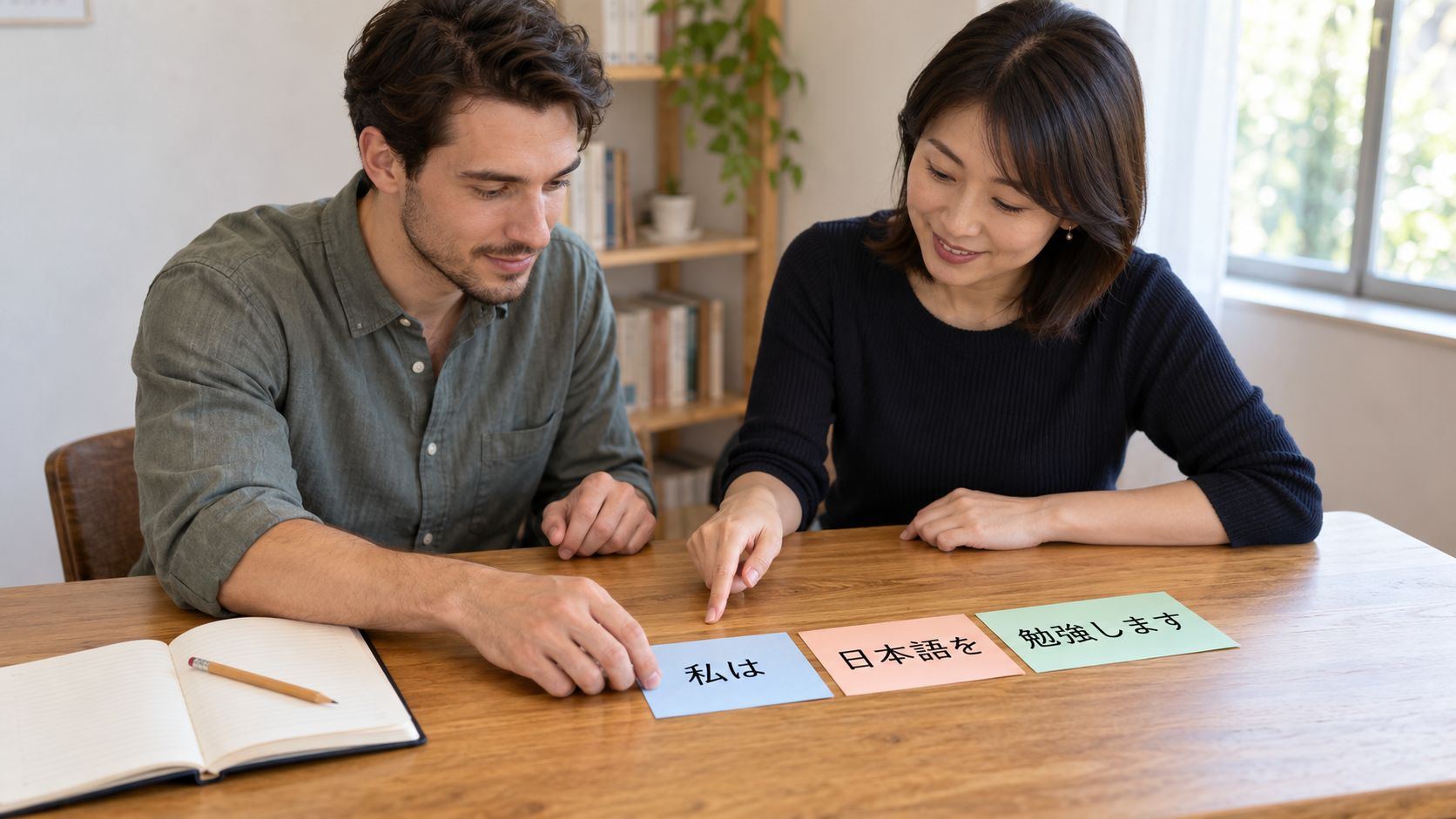
Japanese grammar often looks terrifying before anyone explains what is actually happening.
English speakers open a textbook and encounter particles, verb endings, omitted subjects, three writing systems, sentences that seem to run backward, and expressions whose literal translations make very little sense. It is easy to conclude that Japanese grammar must be fundamentally chaotic.
It is not.
Japanese is very different from English, but much of its grammar is surprisingly regular. In some areas, it is considerably more predictable than English. Verbs do not change according to person. Nouns do not usually have grammatical gender. There are no articles corresponding neatly to “a,” “an,” and “the.” Plurals often work without changing the noun at all.
The real difficulty is not that Japanese lacks logic. It is that its logic is organized around assumptions English speakers are not used to making.
The fastest way to make Japanese grammar feel less alien is to stop asking, “Why doesn't Japanese work like English?” and start noticing the few principles that Japanese uses again and again.
The first big difference: Japanese builds sentences from the end
English tends to reveal the main action fairly early.
I ate sushi yesterday.
Japanese normally puts the verb at the end:
昨日、寿司を食べました。
Kinō, sushi o tabemashita.
Yesterday, sushi, ate.
A more natural translation is simply:
“Yesterday, I ate sushi.”
The Japanese sentence is not literally “backward.” It is following a different structure.
English is broadly a subject-verb-object language:
I eat sushi.
Japanese is generally subject-object-verb:
私は寿司を食べます。
Watashi wa sushi o tabemasu.
Literally:
I — sushi — eat.
This feels strange for a while because an English speaker is waiting for the verb. In longer sentences, that waiting can become significant.
Consider:
田中さんは来年、日本で働くと思います。
Tanaka-san wa rainen, Nihon de hataraku to omoimasu.
“I think Tanaka will work in Japan next year.”
The main verb, 思います (omoimasu), “think,” arrives at the end. Everything before it prepares the information that belongs to that verb.
This is one of the most useful habits to develop early: when listening to Japanese, do not panic because the sentence has not “finished” yet. The ending often tells you what the entire sentence is doing.
Particles do the work that word order does in English
English depends heavily on word order.
Compare:
“The dog bit the man.”
“The man bit the dog.”
The vocabulary is identical. Word order tells us who did what.
Japanese uses small grammatical markers called particles to show the role of words in a sentence.
For example:
犬が男の人を噛みました。
Inu ga otoko no hito o kamimashita.
The dog bit the man.
Here:
が (ga) marks the dog as the grammatical subject.
を (o) marks the man as the direct object.
Because those roles are marked, Japanese word order can be somewhat more flexible than English word order.
Particles are one of the most important parts of Japanese grammar, but beginners often make them harder than they need to be by trying to find exact English translations for each one.
That usually fails.
A particle is better understood by asking what grammatical relationship it signals.
The particles worth learning first
Japanese has many particles, but a beginner does not need all of them at once.
A small group does most of the early work.
は (wa): the topic
The particle は, pronounced wa when used as a particle, introduces what the sentence is about.
私は学生です。
Watashi wa gakusei desu.
I am a student.
A very literal way to feel the structure is:
“As for me, student.”
That may sound awkward in English, but the idea matters. は does not simply mean “subject.” It marks the topic being discussed.
This becomes clearer in sentences such as:
今日は寒いです。
Kyō wa samui desu.
It is cold today.
Literally, something like:
“As for today, it is cold.”
The sentence does not need an English-style subject.
が (ga): the grammatical focus or subject
Beginners often struggle with は versus が, partly because textbook explanations can become overly complicated very quickly.
At the beginning, it is enough to know that が frequently identifies who or what has the property or performs the action being highlighted.
猫がいます。
Neko ga imasu.
There is a cat.
誰が来ますか。
Dare ga kimasu ka.
Who is coming?
田中さんが来ます。
Tanaka-san ga kimasu.
Tanaka is coming.
The distinction between は and が becomes more nuanced later. Trying to master every subtlety during week one is unnecessary.
を (o): the direct object
コーヒーを飲みます。
Kōhī o nomimasu.
I drink coffee.
本を読みます。
Hon o yomimasu.
I read a book.
This particle is comparatively straightforward.
に (ni): destination, time, target, location of existence
学校に行きます。
Gakkō ni ikimasu.
I go to school.
七時に起きます。
Shichi-ji ni okimasu.
I wake up at seven.
東京に住んでいます。
Tōkyō ni sunde imasu.
I live in Tokyo.
The particle has several functions, but there is a useful underlying idea: it often points toward a target, destination, point in time, or location.
で (de): place of action or means
レストランで食べます。
Resutoran de tabemasu.
I eat at a restaurant.
電車で行きます。
Densha de ikimasu.
I go by train.
A helpful first distinction is:
に often marks where something exists or where something is going.
で often marks where an action happens.
That distinction will not explain every use, but it gets beginners surprisingly far.
Japanese subjects disappear constantly, and that is normal
English strongly prefers explicit subjects.
“I went to the store.”
“She likes coffee.”
“We studied Japanese.”
Japanese often leaves the subject out when it is obvious from context.
A simple sentence might be:
昨日、映画を見ました。
Kinō, eiga o mimashita.
“Yesterday, [I] watched a movie.”
There is no 私 (watashi), “I,” in the sentence.
Japanese speakers do not experience this as incomplete. If everyone knows who is being discussed, repeating the subject can sound unnecessary.
In fact, beginners often overuse watashi because English requires “I.”
A textbook learner may say:
私は朝七時に起きます。私はコーヒーを飲みます。私は仕事に行きます。
“I wake up at seven. I drink coffee. I go to work.”
Grammatically, this is possible.
Natural Japanese would usually drop most of those repeated subjects because the topic has already been established.
Once learners become comfortable with omission, Japanese starts sounding much lighter.
Japanese verbs are strange at first and beautifully regular later
English verbs look simple until you start explaining them to a foreign learner.
I go.
He goes.
Yesterday I went.
I have gone.
I am going.
Japanese verbs have their own complexity, but they do not change according to the person performing the action.
食べます (tabemasu) can mean:
I eat.
You eat.
He eats.
She eats.
We eat.
They eat.
Context tells you who.
That is a major simplification compared with many European languages.
Japanese verbs do change according to tense, politeness, negation, and other grammatical functions.
For example:
食べる (taberu)
to eat / eat, plain form
食べます (tabemasu)
eat, polite form
食べました (tabemashita)
ate, polite past
食べません (tabemasen)
do not eat, polite negative
食べませんでした (tabemasen deshita)
did not eat, polite past negative
At first this looks like a lot of endings.
The good news is that Japanese verb conjugation is highly patterned. Once learners understand the major verb groups, they begin to recognize systems rather than memorizing isolated forms.
English, by contrast, contains irregularities that simply have to be accepted:
go → went
eat → ate
buy → bought
teach → taught
Japanese has irregular verbs too, but remarkably few of them.
The two major ones beginners encounter immediately are:
する (suru)
to do
来る (kuru)
to come
For a language with a reputation for difficulty, Japanese is unexpectedly kind here.
There are only two basic tenses
This surprises many English speakers.
Japanese grammar does not divide time into the elaborate tense system familiar from English.
English distinguishes:
I eat.
I am eating.
I have eaten.
I have been eating.
I ate.
I was eating.
I had eaten.
Japanese grammar handles many of these meanings differently and relies heavily on context and aspect.
At the most basic level, Japanese verbs contrast between:
non-past
and
past
For example:
食べます (tabemasu)
eat / will eat
食べました (tabemashita)
ate
The non-past form can refer to either present habitual action or future action.
毎朝コーヒーを飲みます。
Maiasa kōhī o nomimasu.
I drink coffee every morning.
明日コーヒーを飲みます。
Ashita kōhī o nomimasu.
I will drink coffee tomorrow.
The time expression and context do much of the work.
This is one of those moments when Japanese becomes easier once an English speaker stops looking for a one-to-one tense equivalent.
The て-form looks complicated because it does many jobs
No beginner gets very far in Japanese before meeting the て-form.
A verb such as:
食べる (taberu)
becomes:
食べて (tabete)
And:
飲む (nomu)
becomes:
飲んで (nonde)
At first, students may reasonably ask: what does the て-form actually mean?
The answer is that it does not have one English equivalent.
It is a connector and grammatical building block used in many constructions.
Connecting actions
朝ごはんを食べて、仕事に行きます。
Asagohan o tabete, shigoto ni ikimasu.
I eat breakfast and go to work.
Making requests
見てください。
Mite kudasai.
Please look.
Talking about ongoing actions
今、日本語を勉強しています。
Ima, Nihongo o benkyō shite imasu.
I am studying Japanese now.
Giving permission
ここで写真を撮ってもいいです。
Koko de shashin o totte mo ii desu.
It is okay to take photos here.
Prohibiting something
ここで食べてはいけません。
Koko de tabete wa ikemasen.
You must not eat here.
Instead of thinking of the て-form as something with a single translation, it is better to treat it as a grammatical connector used to build larger patterns.
That approach makes it much less mysterious.
Adjectives behave more like verbs than English speakers expect
English adjectives are relatively passive.
“Cold” stays “cold.”
Japanese adjectives can change form.
For example:
寒い (samui)
cold
寒くない (samukunai)
not cold
寒かった (samukatta)
was cold
寒くなかった (samukunakatta)
was not cold
This group is known as い-adjectives, because their dictionary form typically ends in い.
There is another major group called な-adjectives, such as:
静か (shizuka)
quiet
静かな町
shizuka na machi
a quiet town
This is initially unfamiliar because English speakers expect tense and negation to belong mainly to verbs.
In Japanese, descriptive words participate more directly in grammar.
Once this becomes familiar, sentences such as:
昨日は寒かったです。
Kinō wa samukatta desu.
Yesterday was cold.
feel entirely normal.
Japanese has no grammatical articles, which is easier and harder than it sounds
English speakers spend enormous amounts of time using three tiny words:
a
an
the
Japanese has no direct grammatical equivalents.
本を買いました。
Hon o kaimashita.
can mean:
“I bought a book.”
or, depending on context:
“I bought the book.”
Japanese does not require the distinction to be marked every time.
That sounds wonderful, and sometimes it is.
But it also means English speakers have to become comfortable allowing context to determine whether something is new, known, specific, or general.
There is a broader lesson here. Japanese often expresses less information grammatically when listeners can infer it.
English likes to package more of that information explicitly into the sentence.
Singular and plural are often left unspecified
English forces speakers to choose:
book
books
cat
cats
student
students
Japanese nouns usually do not change this way.
本 (hon) can mean “book” or “books.”
猫 (neko) can mean “cat” or “cats.”
学生 (gakusei) can mean “student” or “students.”
If the number matters, Japanese can make it clear through context, numbers, counters, or additional wording.
Again, the language avoids marking information that may already be obvious.
English speakers sometimes interpret this as imprecision.
Japanese speakers are more likely to interpret unnecessary specification as unnecessary specification.
Counters are genuinely difficult, but not as random as they first appear
If Japanese grammar has one feature that deserves its intimidating reputation, counters are a strong candidate.
English usually counts nouns directly:
one book
two cats
three people
Japanese commonly combines numbers with specialized counting words.
For flat objects:
一枚 (ichimai)
one flat object
For long cylindrical objects:
一本 (ippon)
one long object
For people:
一人 (hitori)
one person
二人 (futari)
two people
For small animals:
一匹 (ippiki)
one small animal
And so on.
There are many counters, and pronunciation changes can occur depending on the number.
This is not the part of Japanese grammar anyone needs to pretend is effortlessly logical.
Still, beginners make one common mistake: trying to memorize every counter they encounter.
That is unnecessary.
Learn the counters relevant to ordinary life first: people, general objects, books or machines, flat objects, long objects, small animals, times, days, and ages. The obscure ones can wait until they actually become useful.
Japanese speakers themselves sometimes choose a more general counter when a specialized one is unfamiliar.
Politeness is built into grammar
English has polite vocabulary and indirect phrasing:
“Give me that.”
“Could you give me that?”
“Would you mind giving me that?”
Japanese goes further by building formality into verb forms and vocabulary.
A beginner usually starts with polite ます (masu) forms:
食べます (tabemasu)
eat
行きます (ikimasu)
go
見ます (mimasu)
see
Later, learners encounter plain forms:
食べる (taberu)
eat
行く (iku)
go
見る (miru)
see
Neither form is inherently “better Japanese.”
The appropriate form depends on the social situation.
Polite forms are common with unfamiliar people, customers, teachers, and formal interactions. Plain forms appear constantly with friends and family and in casual conversation.
Then there is keigo (敬語), the broader system of honorific and humble language.
This is where Japanese can become intimidating again.
A verb such as “to see” may appear as:
見る (miru)
ordinary
ご覧になる (goran ni naru)
respectful
拝見する (haiken suru)
humble
Beginners do not need to master advanced keigo early. What they do need is an awareness that social relationship affects grammatical choice.
That feature of Japanese is not decorative. It is part of how speakers position themselves relative to other people.
Questions are simpler than in English
English questions require considerable rearrangement.
You eat sushi.
Do you eat sushi?
He went home.
Did he go home?
Japanese generally does not need this kind of structural transformation.
A polite statement might be:
寿司を食べます。
Sushi o tabemasu.
You eat sushi.
A question is:
寿司を食べますか。
Sushi o tabemasu ka.
Do you eat sushi?
Add か (ka) and the statement becomes a question.
In casual speech, even that particle may disappear and intonation can do the job.
This is one place where Japanese grammar is noticeably simpler than English.
Relative clauses come before the noun
English says:
“the book that I bought yesterday”
Japanese reverses the relationship:
昨日買った本
kinō katta hon
Literally:
“yesterday bought book”
The entire description comes before the noun.
This structure appears everywhere.
日本に住んでいる友達
Nihon ni sunde iru tomodachi
a friend who lives in Japan
駅の前にあるレストラン
Eki no mae ni aru resutoran
the restaurant that is in front of the station
先週見た映画
Senshū mita eiga
the movie I saw last week
Japanese does not need separate relative pronouns equivalent to “who,” “which,” or “that.”
Once the structure clicks, it is elegant.
A whole clause simply behaves like a description placed in front of the noun.
Japanese often describes states where English describes actions
One recurring difficulty comes from assuming that a Japanese verb should behave exactly like its English translation.
Take:
知る (shiru)
to know / to come to know
A beginner may expect:
知ります
to mean “I know.”
Usually, “I know” is:
知っています。
Shitte imasu.
Literally, it has the form associated with an ongoing state: something like “I am in the state of having come to know.”
Similarly:
結婚しています。
Kekkon shite imasu.
often means:
“I am married.”
not “I am currently getting married.”
And:
住んでいます。
Sunde imasu.
means:
“I live [somewhere].”
The grammar is perfectly systematic, but the categories do not always align neatly with English ones.
This is why learning Japanese grammar through translated labels alone can cause trouble.
What English speakers should learn first
The order matters.
Many learners waste time trying to understand advanced distinctions before the basic architecture of Japanese has become intuitive.
A more sensible early sequence is:
Basic word order: topic/object/verb, with the verb at the end.
Core particles: は, が, を, に, で, と, も, の.
Polite verb forms: present/non-past, past, negative, past negative.
Plain verb forms: because real Japanese uses them constantly.
い-adjectives and な-adjectives.
The て-form: especially 〜てください and 〜ています.
Existence verbs: ある and いる.
Basic comparison and desire: 〜より, 〜のほうが, 〜たい.
Relative clauses: because they dramatically expand what you can say.
Conditional and explanatory forms: 〜たら, 〜なら, 〜んです.
What should not dominate the beginning?
Advanced keigo. Rare counters. Every nuance of は versus が. Formal written grammar. Obscure conjugation patterns.
Those things matter later.
A beginner's goal should be to internalize how ordinary Japanese sentences are built.
Do not learn grammar as disconnected formulas
Japanese textbooks sometimes produce students who can complete worksheets but cannot understand an ordinary sentence quickly.
The problem is not the textbook itself. The problem is learning constructions as isolated equations.
For example:
〜たいです = want to
That is useful, but compare these actual sentences:
日本に行きたいです。
Nihon ni ikitai desu.
I want to go to Japan.
今日は何を食べたい?
Kyō wa nani o tabetai?
What do you want to eat today?
あまり行きたくない。
Amari ikitakunai.
I don't really want to go.
Now the pattern begins to live inside real Japanese.
Grammar becomes easier when the learner sees the same construction repeatedly in slightly different situations.
The goal is not to memorize the English label attached to a grammar point. It is to develop an instinct for what that pattern does.
The strange parts eventually become the logical parts
Beginners often identify Japanese particles, omitted subjects, verb-final sentences, and politeness levels as the language's strangest features.
After enough exposure, something interesting happens.
Those features begin to feel normal, and English starts looking odd.
Why does English require speakers to repeat “I” in sentence after sentence when everyone already knows who is speaking?
Why does “go” suddenly become “went”?
Why do nouns need articles even when everyone knows which object is being discussed?
Why should the position of a noun determine its grammatical role when a particle could simply label it?
That does not make Japanese objectively easier than English. It means learners have crossed an important threshold.
The language has stopped feeling like English rearranged into a strange order.
It has started feeling like Japanese.
At Polyglottist Language Academy, our Japanese classes for adults are designed around that transition. We teach the grammar students actually need for communication, including how sentence patterns function in ordinary speech rather than treating Japanese as a list of rules to memorize. Polyglottist offers live online classes and selected in-person classes in Berkeley, California.
The most productive way to approach Japanese grammar is not to ask whether it is difficult.
Some parts certainly are.
A better question is whether the system becomes predictable once its organizing principles are understood.
Very often, it does.
Frequently asked questions about Japanese grammar
Is Japanese grammar harder than English grammar?
It is very different rather than uniformly harder. Japanese word order, particles, counters, and politeness levels can challenge English speakers. On the other hand, Japanese has no grammatical gender, relatively few irregular verbs, no person-based verb conjugation, and no article system comparable to English “a” and “the.”
Do I need to understand は and が before moving forward?
No. Beginners should understand their basic roles but should not wait to master every nuance. The distinction becomes clearer through repeated exposure to real sentences.
Should beginners learn polite or casual Japanese first?
Most courses begin with polite forms because they are broadly useful and socially safe. Learners should encounter plain forms fairly early, however, because casual conversation and many grammar constructions depend on them.
How much grammar should I memorize?
Memorize core forms and patterns, but learn them through sentences rather than definitions alone. Japanese grammar becomes much easier when the same structure appears repeatedly in meaningful contexts.
Is Japanese sentence order strict?
The verb normally comes at or near the end, but other elements can move because particles indicate their grammatical roles. Topic and emphasis also influence word order.
Why does Japanese omit so many subjects?
Because information that is obvious from context is often left unstated. Repeating the subject every time can sound unnatural. Learning to follow context is therefore an important part of understanding Japanese.