Las Vegas has a large enough Filipino community that a search for Tagalog classes feels as if it should produce one obvious answer. In practice, learners find something more complicated: Filipino cultural life is highly visible, while structured language courses can depend on the academic term, instructor availability, and the exact level you need.
That makes choosing a course less about finding the first result and more about understanding what kind of learning environment will actually keep you studying.
Start by checking the College of Southern Nevada
The College of Southern Nevada (CSN) is the first institutional resource worth checking.
CSN’s World Languages resources include FIL among the subject codes used to search for language courses, and the college has recently advertised for part-time Filipino instructors. That indicates real Filipino-language instructional infrastructure.
At the same time, course availability can fluctuate. A subject code in a catalog or faculty recruitment notice does not guarantee that the exact beginner section you want is open this semester at a convenient time.
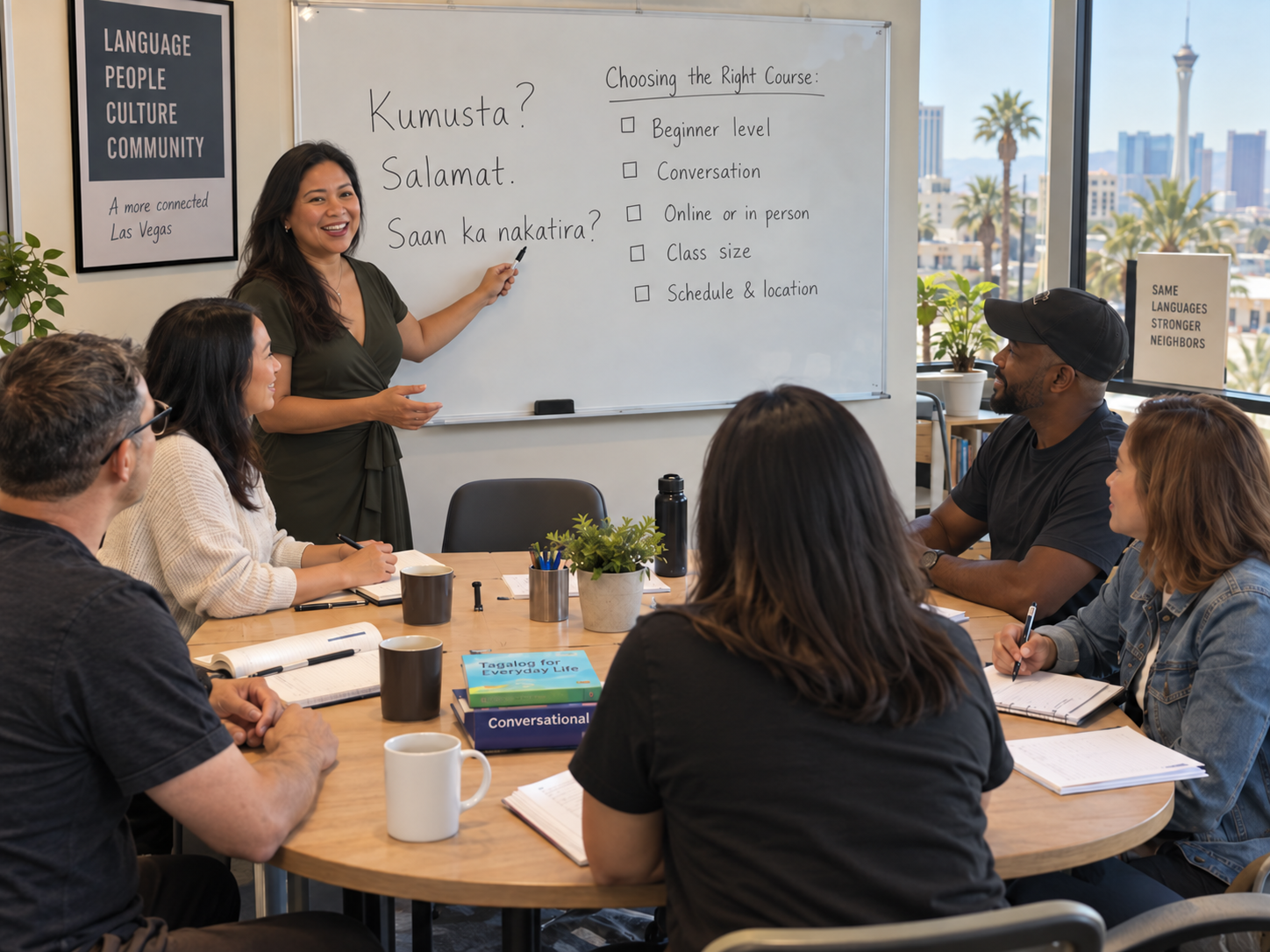
Use CSN’s live class search for the current term, and check whether the class is:
Filipino/Tagalog language rather than a culture course;
beginner or continuing level;
in person, hybrid, or online;
scheduled on a campus you can realistically reach;
open to non-degree students if that applies to you.
College courses are often a good fit for learners who like a defined syllabus, regular assignments, and academic accountability. They can be less convenient for an adult whose work schedule changes week to week.
Filipino Town Las Vegas changes the cultural landscape
Las Vegas now also has a formally recognized Filipino Town Las Vegas cultural district along Maryland Parkway. Community organizations have been building events around the district, including cultural celebrations, food, performances, and business/community networking.
That matters for a language learner even when no one is handing out grammar worksheets.
A language survives because people use it in relationships. Cultural events give learners chances to hear Filipino/Tagalog in announcements, family conversations, food vocabulary, jokes, and casual exchanges. They also help heritage learners connect language study to a community larger than their own household.
But cultural participation and systematic language instruction do different jobs. Attending a festival every few months will not automatically teach you pronouns, verb aspect, or sentence markers. Treat community events as practice and motivation, not as a substitute for a course.
Las Vegas schedules can make “local” less convenient than online
Many adults in Southern Nevada work schedules that do not follow a standard Monday-through-Friday office pattern. Hospitality, healthcare, entertainment, transportation, and service industries can involve evenings, weekends, rotating shifts, or long workdays.
A course can therefore be geographically close and still be impossible to attend consistently.
Before choosing an in-person class, look at the full commitment rather than the advertised lesson time. Add travel, parking, and the possibility of a shift running late. If you will miss one lesson in four, the class is probably not the right format.
Live online instruction can be more practical because it preserves scheduled interaction with a teacher and classmates while removing the commute. For Tagalog, that interaction matters. Learners need to answer questions spontaneously, hear natural word order, and receive correction when they transfer English sentence patterns directly.
Heritage learners should avoid automatic “beginner” placement
Las Vegas, like many Western U.S. cities, has Filipino American families with very different migration histories and home-language patterns.
A heritage learner may understand Tagalog but answer in English. Another may speak some Tagalog but read slowly. Another may discover that the grandparents actually spoke Ilokano or Cebuano more often than Tagalog.
These learners should not be sorted only by the question “Have you taken a Tagalog class before?”
A useful placement process should look separately at listening, speaking, reading, writing, and grammar.
Someone with strong listening comprehension may need a different beginner experience from someone encountering the language for the first time.
What a good beginner course should include
Do not choose a class because the description says “conversational” without asking what the conversation is built on.
A strong beginner course should include:
pronunciation and listening;
greetings and politeness;
pronouns and relationship terms;
common question forms;
sentence patterns;
ang, ng, and sa in context;
practical vocabulary;
gradual introduction to the verb system;
frequent speaking practice.
If a course is six or eight weeks long and never moves beyond memorized phrases, you may finish knowing several dialogues without knowing how to create a new sentence.
Conversely, a grammar-heavy course that gives you no chance to speak can produce knowledge that disappears under conversational pressure.
Look for both structure and interaction.
Private lessons are useful when your goal is unusually specific
A private instructor can be worth the additional cost when you have a narrow goal: speaking with one family member, preparing for a trip, learning professional vocabulary, rebuilding heritage speaking after years of English dominance, or working around an unpredictable schedule.
The advantage is customization. The disadvantage is that you lose the peer interaction of a small group unless you create conversation opportunities elsewhere.
Some learners do well with a hybrid strategy: private lessons for targeted work plus Filipino community events for broader listening and social practice.
Live online small groups can be the middle ground
For many working adults, a small live online class sits between college and private tutoring.
You still have classmates, a schedule, a teacher, and a curriculum, but the logistics are lighter. A good group is small enough that every student has to speak.
Polyglottist Language Academy offers live online Tagalog classes for adults, including complete-beginner levels and placement for students with previous exposure.
Las Vegas now has more Filipino cultural infrastructure than it did only a few years ago, and that is good news for language learners. The most effective plan is not to wait for culture alone to turn into fluency. Use the community for connection, use a structured course for progression, and choose a schedule you can actually keep.
The right Tagalog class is the one you can attend consistently and in which you are required to do more than recognize the language—you have to use it.