
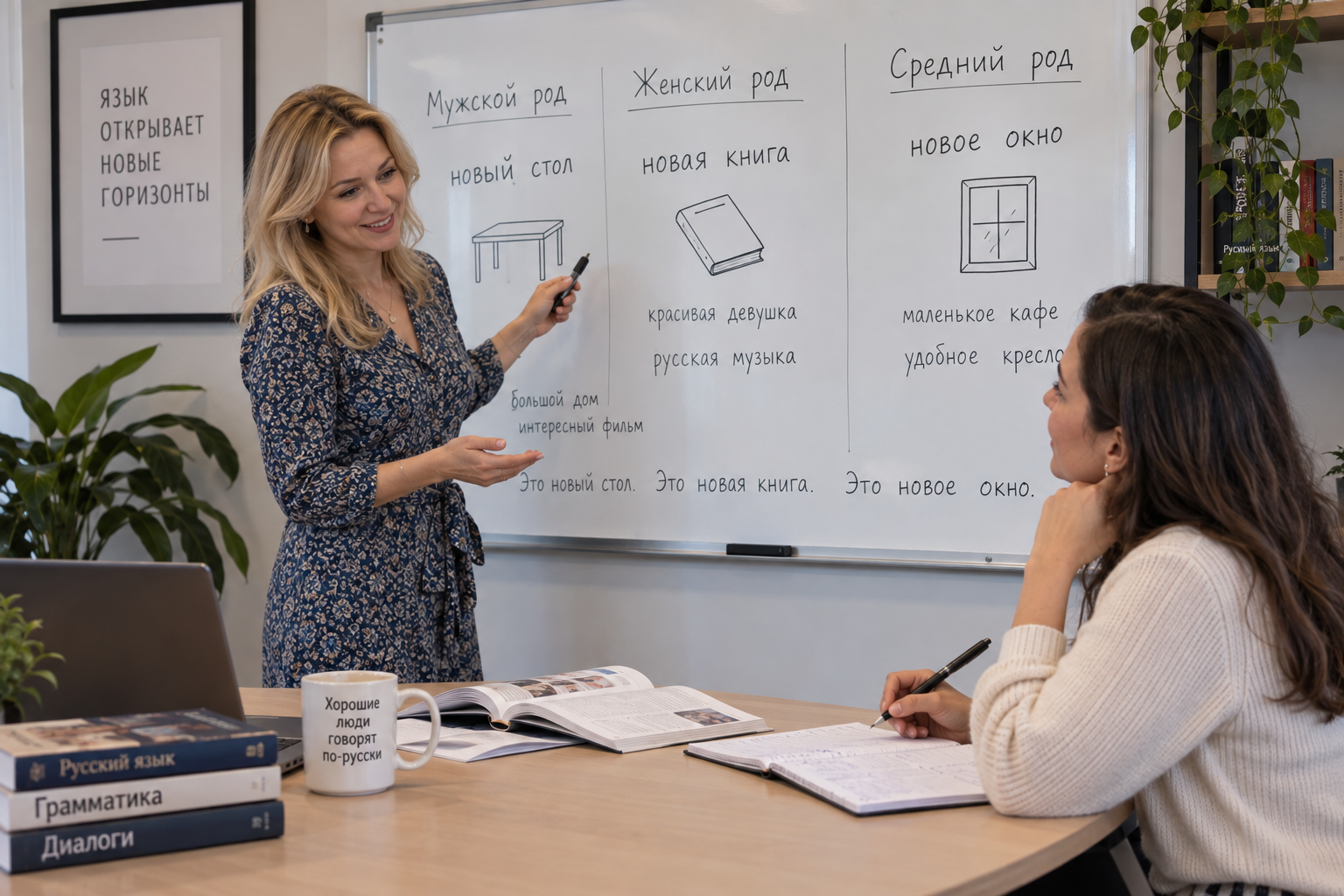
Russian noun gender looks more arbitrary than it really is. Beginners sometimes imagine that they will have to memorize a separate gender label for every noun, the way students of German often memorize articles with vocabulary.
Russian is kinder than that. In most cases, the final letter of the noun tells you what gender it is.
The part that needs real memorization is smaller than it first appears.
The basic pattern
Look at the noun in its dictionary form, which is normally the nominative singular.
If it ends in a consonant or usually -й, it is generally masculine:
стол — table
дом — house
музей — museum
If it ends in -а or -я, it is generally feminine:
книга — book
машина — car
неделя — week
If it ends in -о, -е, or -ё, it is generally neuter:
окно — window
море — sea
ружьё — gun
Those three patterns cover a huge amount of beginner vocabulary.
Why English speakers find gender strange
English nouns do not normally force surrounding words to change according to grammatical gender. A table is not linguistically masculine in English, and a book is not feminine.
In Russian, gender is grammatical rather than a statement about the actual object. стол is masculine because of the grammatical system, not because Russians think tables are male.
This matters because gender affects other words around the noun.
Compare:
новый стол — a new table
новая книга — a new book
новое окно — a new window
The adjective "new" changes to agree with the noun.
Gender also appears in the past tense
Russian past-tense verbs agree with the gender of a singular subject.
Он работал. — He worked.
Она работала. — She worked.
Оно работало. — It worked.
This is why a beginner who ignores noun gender eventually runs into problems beyond adjective endings. Gender is woven through the grammar.
The first important exception: people can override the ending pattern
Some masculine nouns referring to male people end in -а or -я even though those endings usually signal feminine nouns.
The classic examples are:
папа — dad
дядя — uncle
мужчина — man
These nouns are grammatically masculine because they refer to male people.
So you say:
мой папа — my dad
not моя папа.
Learners often know the meaning of папа perfectly and still produce the wrong adjective or possessive ending because the visual pattern is so strong.
The soft sign is where you actually have to memorize
Nouns ending in ь can be masculine or feminine.
Masculine examples:
день — day
словарь — dictionary
учитель — teacher
Feminine examples:
ночь — night
дверь — door
тетрадь — notebook
There is no simple ending rule that lets a beginner identify every soft-sign noun correctly.
This is the part where vocabulary learning has to include gender.
Instead of memorizing дверь = door, learn эта дверь or новая дверь. Instead of memorizing словарь = dictionary, learn этот словарь or новый словарь. The extra word stores the gender in a phrase rather than as an abstract label.
Do not confuse natural gender and grammatical gender
Words for people often follow biological sex, but not always in the simple way learners expect.
врач — doctor — is grammatically masculine in its traditional form and can refer to a man or a woman in ordinary usage. Context and agreement may signal the person's sex in actual sentences, and contemporary usage around professional titles continues to vary.
For beginner grammar, the important point is that grammatical form and real-world sex are related but not identical systems.
What about words borrowed from other languages?
Indeclinable borrowed nouns can behave differently because their endings do not follow normal Russian declension patterns.
кафе — café — is neuter.
такси — taxi — is neuter.
метро — metro — is neuter.
Some words referring to people take gender from the person they refer to. These are better learned case by case once you have the basic system under control.
Beginners do not need to memorize a catalog of rare exceptions before they can speak.
One famous noun learners notice: кофе
Traditional standard Russian treats кофе as masculine even though the final -е looks neuter.
So the conventional standard phrase is:
горячий кофе — hot coffee.
You may hear neuter agreement in everyday speech, but if you are learning standard Russian, masculine is the safe form to use.
This is worth remembering precisely because it breaks the visual rule so neatly.
A common classroom mistake: learning the noun without its grammar
Students often make vocabulary cards like this:
book — книга
window — окно
dictionary — словарь
That works for meaning but throws away useful grammatical information.
A better set would be:
новая книга — new book
новое окно — new window
новый словарь — new dictionary
Now every review teaches meaning and gender at the same time.
You do not need to say “masculine, feminine, neuter” in your head forever
At the beginning, you may consciously reason: книга ends in -а, therefore feminine, therefore новая книга.
With enough exposure, that chain shortens. новый книга simply begins to sound wrong.
That is the goal. Grammar becomes faster when repeated patterns turn into expectation rather than calculation.
Structured Russian classes help because learners repeatedly use gender in actual sentences instead of studying it only as a chart. The rule is simple enough to learn quickly; automatic agreement takes longer and comes from use.
If you remember only one thing, remember the endings. Consonant or -й: usually masculine. -а/-я: usually feminine. -о/-е/-ё: usually neuter. Soft sign: check and memorize. That small system will correctly predict the gender of most nouns a beginner meets.