
The Secret Meanings in Dutch Still-Life Paintings
Introduction
In the 17th century, when the Dutch Republic was at the height of its Golden Age, artists in the Netherlands developed a unique genre of painting that at first glance might seem modest or even mundane: the still life. Tables crowded with fruit, cheeses, and oysters; elaborate bouquets of tulips and roses; or simple arrangements of bread and pewter jugs became not just decorative art but profound meditations on wealth, morality, and the transience of life. What makes Dutch still-life painting so captivating is not only its dazzling technical brilliance but also the fact that nearly every object within these compositions carried a hidden meaning — sometimes obvious to contemporary viewers, sometimes subtle, sometimes ironic, and sometimes deeply moralizing.
These paintings were not simply aesthetic celebrations of everyday objects. They were coded visual texts, loaded with allegory and symbolism, serving as both reflections of prosperity and reminders of its fragility. A rotting peach might warn of decay beneath beauty; a skull could hint at mortality; a toppled glass might whisper of fleeting pleasures. To modern viewers, Dutch still-life paintings are windows into a lost symbolic language, one that spoke to issues of faith, wealth, mortality, and the ethical struggles of a society grappling with sudden global power.
In this article, we’ll explore the layered meanings of Dutch still-life paintings, looking beyond the surface to reveal the moral, cultural, and even spiritual messages encoded within. By the end, you’ll be able to look at a seemingly simple bowl of fruit from the 1600s and understand it as a text full of warnings, aspirations, and cultural identity.
The Dutch Golden Age and the Rise of Still Life
The 17th century in the Netherlands was a time of immense prosperity. With the expansion of overseas trade through the Dutch East India Company (VOC) and the Dutch West India Company, Amsterdam became the hub of a global economy. Exotic spices, textiles, porcelain, and fruits poured into Dutch ports, enriching merchants and fueling a culture of luxury and display.
Unlike in Catholic Southern Europe, where religious art still dominated, the largely Protestant Dutch society discouraged grand church commissions. Instead, art shifted toward domestic spaces, focusing on subjects that resonated with everyday life: portraits, landscapes, interiors, and still lifes. For a burgeoning middle class of wealthy merchants, a still-life painting was both a decoration and a cultural statement — proof of refinement, taste, and moral awareness.
Types of Dutch Still-Life Paintings
1. Breakfast Pieces (Ontbijtjes)
Simple tables with bread, cheese, butter, and beer, often presented with meticulous detail. These paintings reflected modesty, nourishment, and domestic order.
2. Banquet or Pronk Still Lifes
Lavish spreads of lobsters, silver goblets, imported citrus fruits, and fine glassware. The word pronk means “ostentatious display,” and these works celebrated wealth and abundance — but often with subtle reminders of its fragility.
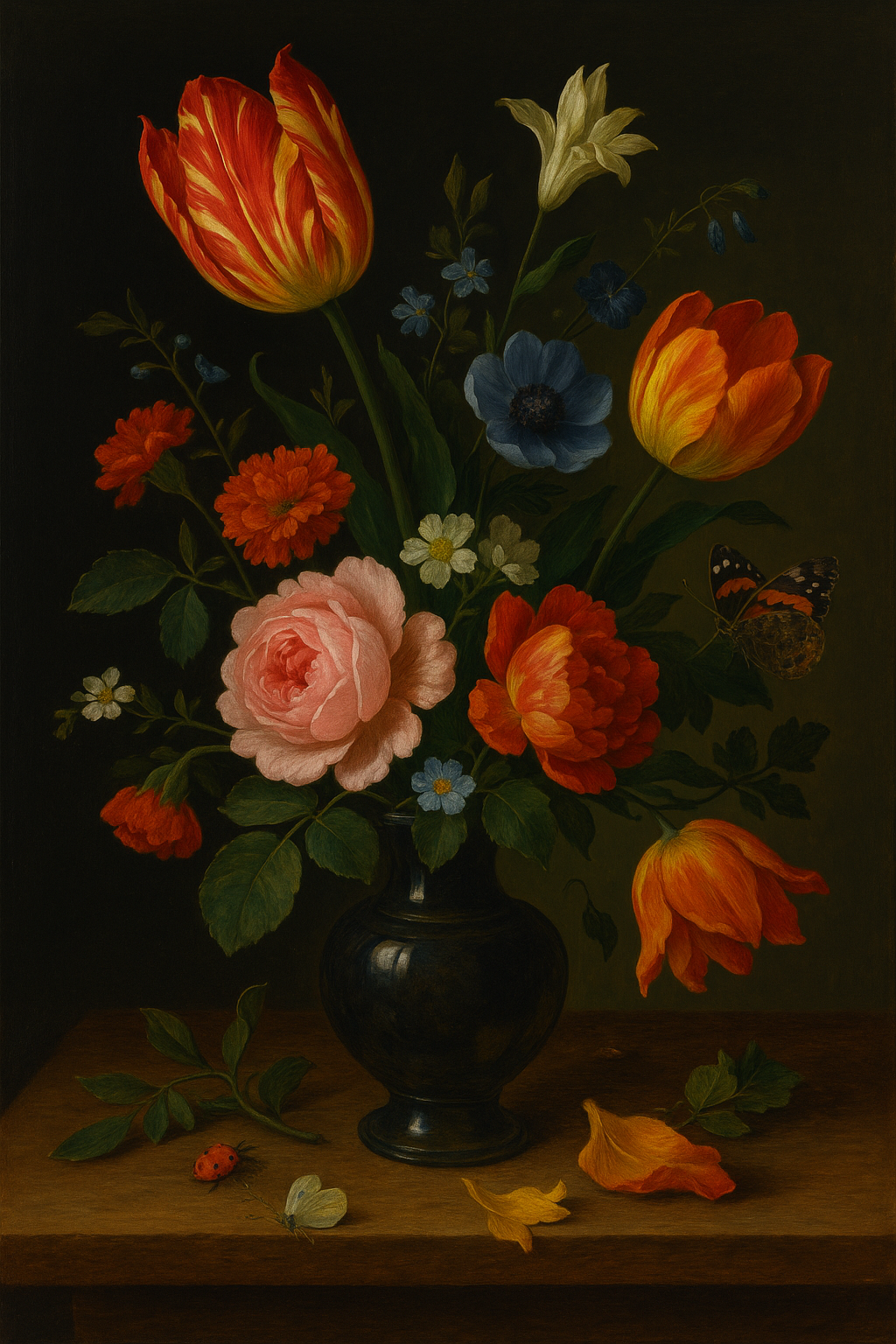
3. Floral Still Lifes
Bouquets of flowers, often including species that never bloomed at the same time of year. These works were studies of color and form but also symbols of beauty’s impermanence.
4. Vanitas Still Lifes
Paintings explicitly meant as moral lessons, filled with skulls, hourglasses, extinguished candles, and books. These images warned viewers that earthly pleasures are temporary and that death comes for all.
Symbolism in Dutch Still Life
Food and Drink
Bread and Wine: Allusions to Christian communion.
Lobster and Oysters: Luxury, but also indulgence and lust.
Peeled Lemon: Life’s pleasures are attractive but sour once consumed.
Spilled Wine Glass: The fleeting nature of pleasure.
Flowers
Tulips: Exotic beauty, tied to Tulip Mania, but also vanity.
Roses: Love and passion, often contrasted with thorns (pain).
Wilting Flowers: Reminder of mortality and decay.
Butterflies: Resurrection and transformation.
Everyday Objects
Books: Knowledge, sometimes vanity if paired with luxury.
Musical Instruments: Joy, but also impermanence, as music fades.
Skulls (Memento Mori): The inevitability of death.
Hourglasses and Watches: The passage of time.
Soap Bubbles: Fragility of life.
The Moral Messages Behind the Beauty
While these paintings dazzled with technical skill and rich subject matter, they often carried sobering undertones. A lavish feast depicted with unmatched realism could simultaneously celebrate abundance and criticize overindulgence. A beautiful bouquet could stand as a metaphor for fleeting life and inevitable death.
This duality is what makes Dutch still-life paintings so powerful: they hold pleasure and warning in the same frame, appealing to the pride of wealthy patrons while gently reminding them of their spiritual duties and mortality.
Notable Artists and Their Works
Pieter Claesz (1597–1660): Known for his restrained color palettes and subtle vanitas themes.
Willem Claesz Heda (1594–1680): Master of reflective surfaces and complex compositions of glass, metal, and food.
Rachel Ruysch (1664–1750): A female painter who specialized in floral still lifes, achieving great fame in her lifetime.
Jan Davidsz de Heem (1606–1684): Created sumptuous, almost theatrical still lifes filled with rich symbolism.
Harmen Steenwijck (1612–after 1656): His “Vanitas Still Life” is among the most famous meditations on mortality.
The Global Dimension of Dutch Still Life
It’s important to remember that many of the objects depicted — Chinese porcelain, citrus fruits, spices, exotic shells — were symbols of the Dutch Republic’s global reach. These paintings were not just about private households but also about a nation asserting itself as a global power. The presence of such objects in paintings reminded viewers of the riches of trade and the complex global networks of the time.
Why These Paintings Still Resonate
For modern viewers, Dutch still-life paintings remain fascinating because they combine technical mastery with layered meaning. Their subtle warnings against vanity, greed, and overindulgence feel surprisingly modern, especially in a consumer-driven world. Moreover, their ability to turn everyday objects into meditations on life and death continues to inspire reflection.
Looking at them with symbolic awareness transforms the experience: you’re not just seeing bread, oysters, or a bouquet — you’re reading a story about ambition, faith, and mortality told through paint and canvas.
FAQs about Dutch Still-Life Paintings
Q: Why did Dutch artists paint so many still lifes?
A: The Protestant culture of the Netherlands discouraged religious imagery, creating a market for domestic art like still lifes that could be morally instructive while still decorative.
Q: Were still-life paintings only for the wealthy?
A: While the most elaborate banquet scenes were expensive, simpler breakfast still lifes and floral arrangements were within reach of the middle class.
Q: Did people in the 17th century really understand the symbolism?
A: Yes — viewers of the time would have recognized the symbolic associations of food, flowers, and objects, which were common in sermons, literature, and everyday proverbs.
Q: Were flowers painted from real bouquets?
A: Not exactly. Many floral paintings combined blossoms that bloom in different seasons, showing off artistic imagination rather than botanical accuracy.
Q: Why are vanitas paintings filled with skulls and hourglasses?
A: These symbols reminded viewers of mortality and the futility of earthly pleasures — a spiritual message wrapped in aesthetic beauty.
Q: Were female artists involved in still-life painting?
A: Yes, most notably Rachel Ruysch, who achieved international fame and was appointed court painter in Düsseldorf.
Q: Are Dutch still-life paintings only about morality?
A: No — while many had moral themes, they also celebrated artistic skill, national wealth, and the pleasures of beauty.
Q: Can I see these paintings today?
A: Absolutely. Major collections are housed in the Rijksmuseum (Amsterdam), Mauritshuis (The Hague), and the Metropolitan Museum of Art (New York).
Conclusion
Dutch still-life paintings are far more than beautiful arrangements of objects. They are coded messages from a society grappling with wealth, mortality, and morality. Their layered meanings transform everyday items into profound allegories, reminding viewers that abundance is fragile, beauty fleeting, and life short.
At Polyglottist Language Academy, we believe that language and culture are inseparable. Learning Dutch isn’t just about grammar and vocabulary — it’s about entering a world where tulips, cheese, and still-life paintings carry centuries of meaning. If you want to deepen your understanding of Dutch culture while building real language skills, our online Dutch classes are the perfect place to start.
Explore More on Our Blog
If you found this article fascinating, don’t miss our other deep dives into Dutch language and culture: