
Introduction
In the early seventeenth century, when Dutch merchants dominated global trade routes, Amsterdam’s stock exchange was in its infancy, and windmills were transforming landscapes into productive farmland, a flower — delicate, colorful, and originally foreign — captured the imagination of an entire society and spiraled into what would later be described as the world’s first financial bubble. Tulip Mania, as it came to be known, is more than a quirky historical anecdote about people paying outrageous sums for bulbs that would bloom only briefly each spring; it is a profound story about human psychology, speculation, and the timeless tendency to believe that prices will keep rising simply because they already have.
This tale is not just about tulips but about the rise of capitalism, the birth of futures trading, and the very human struggle to separate genuine value from fleeting desire. In the Netherlands of the 1600s — a nation basking in its Golden Age, wealthy from trade with Asia, Africa, and the Americas — tulips arrived as exotic imports and quickly became status symbols. Their rarity, unusual colors, and delicate beauty made them desirable possessions among the Dutch elite. Yet desire soon crossed into obsession, and obsession into speculation. Bulbs were bought and sold not for their blooms but for the profits they promised, and in this frenzy, fortunes were made — and just as quickly lost.
In this article, we will trace the story of Tulip Mania from its botanical origins to its social and financial climax, examine what really happened (separating myth from reality), and explore why this centuries-old episode continues to fascinate economists, historians, and casual readers alike. By the end, you may see not only tulips in a new light but also your own assumptions about value, markets, and human nature.
The Arrival of the Tulip in the Netherlands
Tulips were not native to the Netherlands. Their origins trace back to the Ottoman Empire, where the flower was prized in royal gardens and celebrated in poetry and art. The tulip was introduced to Europe in the mid-sixteenth century, first cultivated in the botanical gardens of Vienna and quickly spreading to other parts of Europe.
By the late 1500s, Carolus Clusius, a pioneering botanist, planted tulip bulbs in the Leiden University garden. His efforts to study and cultivate the flower turned Leiden into a center of tulip knowledge. But as often happens, exclusivity bred intrigue — tulip thefts became common, as people snuck into gardens to steal bulbs.
This early scarcity established tulips not only as exotic but as luxurious, a product that symbolized sophistication, wealth, and refined taste. In a society already proud of its mercantile wealth and eager for status markers, tulips were perfectly positioned to move from botany to fashion to finance.
The Dutch Golden Age: Fertile Ground for Speculation
The seventeenth century was a time of unparalleled prosperity for the Dutch Republic. Amsterdam was the beating heart of world trade, with the Dutch East India Company (VOC) transporting spices, silk, and porcelain across oceans. The Dutch were innovators in finance, establishing the Amsterdam Stock Exchange in 1602, creating joint-stock companies, and even inventing some of the tools of modern capitalism.
In this atmosphere of wealth and financial experimentation, tulips became more than flowers — they became commodities. The culture of investment was already thriving: merchants and artisans speculated in shares, trade routes, and commodities. Adding tulips to the mix was, in retrospect, almost inevitable.
How Tulip Mania Worked
Rarity and Value
The value of tulips was linked to their rarity and uniqueness. Certain patterns, caused by a mosaic virus that altered the color of the petals, made some tulips especially prized. Varieties such as the Semper Augustus, with its vivid red and white flames, were valued far above others.
Contracts and Futures
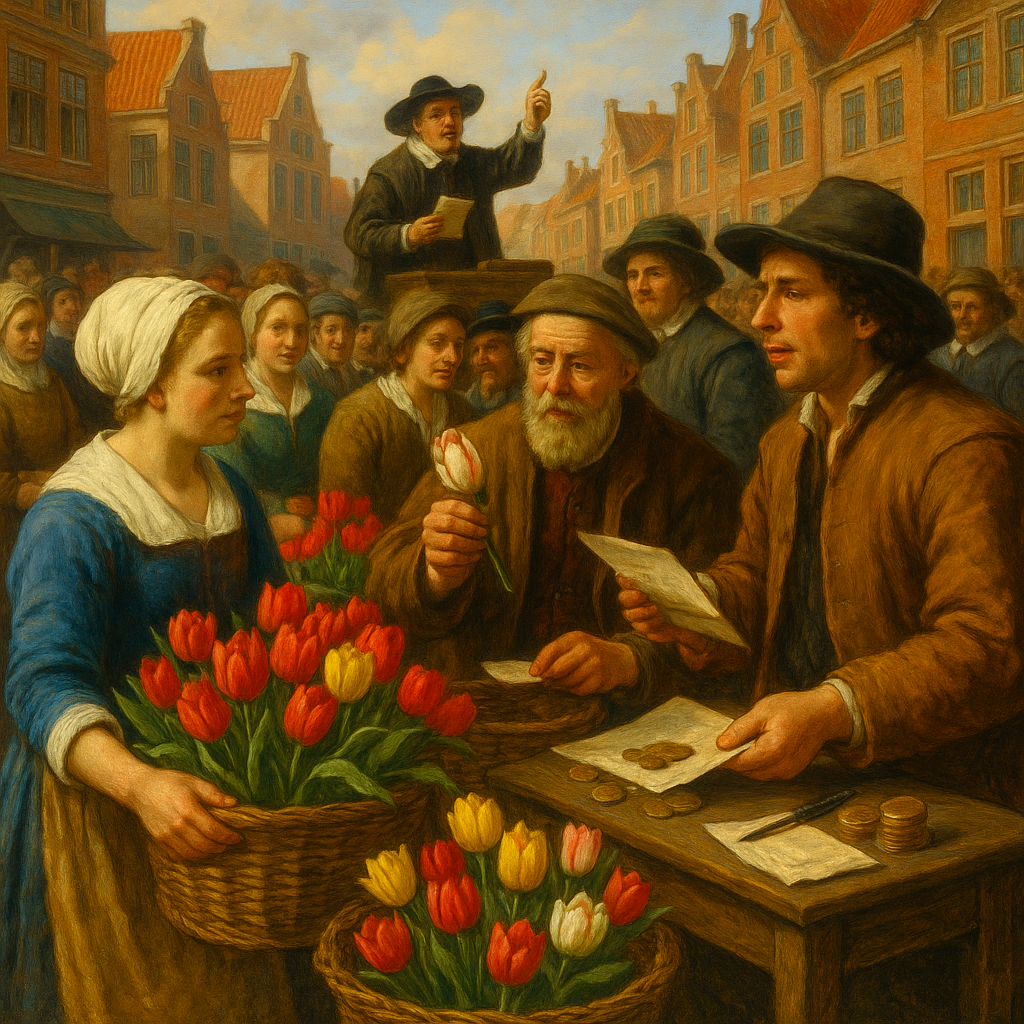
The tulip trade became formalized through contracts. Buyers would agree to purchase bulbs at a set price for future delivery. This was effectively a futures market, one of the earliest of its kind in Europe. As prices rose, people bought contracts not to acquire bulbs but to resell them for profit.
Social Spread
What began among the wealthy elite spread to the middle classes. Craftsmen, merchants, and even farmers participated, believing tulips offered a quick path to riches. Tulip Mania was no longer just an aristocratic fad; it was a national craze.
The Peak of the Mania
By 1636–1637, tulip prices had reached astonishing levels. A single bulb of a rare variety might sell for more than the price of a canal house in Amsterdam. Records suggest that some bulbs changed hands ten times in a single day. Tavern auctions became common, with crowds of ordinary people pooling money to speculate on tulip contracts.
The mania was fueled not by the flowers themselves — most bulbs were still underground, waiting to bloom — but by the contracts that promised future ownership. This abstraction made tulips into pure financial instruments, detached from their physical reality.
The Collapse
The crash came suddenly in February 1637. At a routine auction in Haarlem, buyers simply failed to appear. Confidence evaporated, and within days, prices plummeted. Contracts became worthless, and many who had speculated heavily were ruined.
It is important to note, however, that the collapse did not destroy the Dutch economy, as some exaggerated accounts claim. While many individuals lost money, the Republic’s wealth and trade networks remained strong. Tulip Mania was dramatic, but it was a contained bubble, more social than systemic.
Separating Myth from Reality
Historians debate the true extent of Tulip Mania. Later writers, especially in the nineteenth century, exaggerated the scale of the bubble as a cautionary tale. Modern research suggests that while prices were indeed inflated, only a limited number of people were financially devastated. The image of bakers and artisans losing everything for a single bulb is partly myth, though it reflects genuine anxieties about speculation.
What is undeniable is that Tulip Mania entered cultural memory as a symbol of irrational markets. The Dutch themselves used it as a moral story about greed and foolishness, much like fables warn children of danger.
Lessons from Tulip Mania
Human psychology drives markets. Speculation thrives when people believe prices will keep rising.
Symbols of status can become commodities. Tulips were valuable not for utility but for social meaning.
Financial innovation cuts both ways. Futures contracts were revolutionary but also risky.
Exaggeration shapes memory. The story of Tulip Mania is as much about cultural storytelling as about economics.
Tulip Mania in Art and Literature
The tulip craze was immortalized not only in economic history but also in Dutch paintings, satire, and pamphlets. Satirical prints mocked tulip buyers as foolish, greedy, or even animal-like, chasing after meaningless flowers. Writers compared the collapse to divine punishment for vanity.
Today, the tulip remains a proud Dutch symbol, adorning postcards, souvenirs, and spring festivals. Ironically, what once symbolized folly now represents resilience and cultural identity.
Modern Parallels: From Dot-Com to Crypto
Tulip Mania resonates because its pattern repeats. The dot-com bubble of the late 1990s, the housing crisis of 2008, and more recently, the meteoric rise and fall of cryptocurrencies — all bear echoes of seventeenth-century Holland. Each bubble combines novelty, optimism, speculation, and eventual collapse.
Yet just as the Dutch continued to grow tulips after 1637, societies recover, adapt, and often cherish the very innovations that first sparked irrational exuberance.
FAQs about Tulip Mania
Q: Was Tulip Mania the first financial bubble in history?
A: Yes, it is widely considered the first speculative bubble, though earlier instances of market speculation existed in smaller forms.
Q: Did people really trade houses for tulip bulbs?
A: Stories of entire houses being exchanged for a bulb are likely exaggerated, though some bulbs were worth the equivalent of years of wages.
Q: Did the Dutch economy collapse after Tulip Mania?
A: No, the broader Dutch economy remained strong. The impact was significant for individuals but limited on a national scale.
Q: Why were tulips so valuable?
A: Their rarity, striking colors, and association with social status made them highly desirable, especially varieties with unusual patterns.
Q: Do tulips still play a role in Dutch culture today?
A: Absolutely. The Netherlands is now one of the world’s largest producers of tulips, and the flower is a national symbol.
Q: Can Tulip Mania teach us about modern investing?
A: Yes — it highlights the dangers of speculative bubbles and the importance of understanding intrinsic value.
Q: Were only the wealthy involved?
A: Initially yes, but eventually middle-class artisans and merchants also joined in, believing they could profit.
Q: Did anyone actually profit from Tulip Mania?
A: Yes, some early sellers made fortunes before the collapse, though many latecomers suffered losses.
Conclusion
Tulip Mania is more than a curious tale about overpriced flowers. It is a window into the Dutch Golden Age, a study of human behavior in markets, and a reminder that speculation, status, and risk are timeless forces shaping economies. The tulip itself, once a fleeting fad, has endured as a beloved emblem of Dutch culture, while the mania around it serves as a cautionary story that continues to resonate in modern financial debates.
Explore More on Our Blog
If you enjoyed this article, check out some of our other pieces on language and culture: