
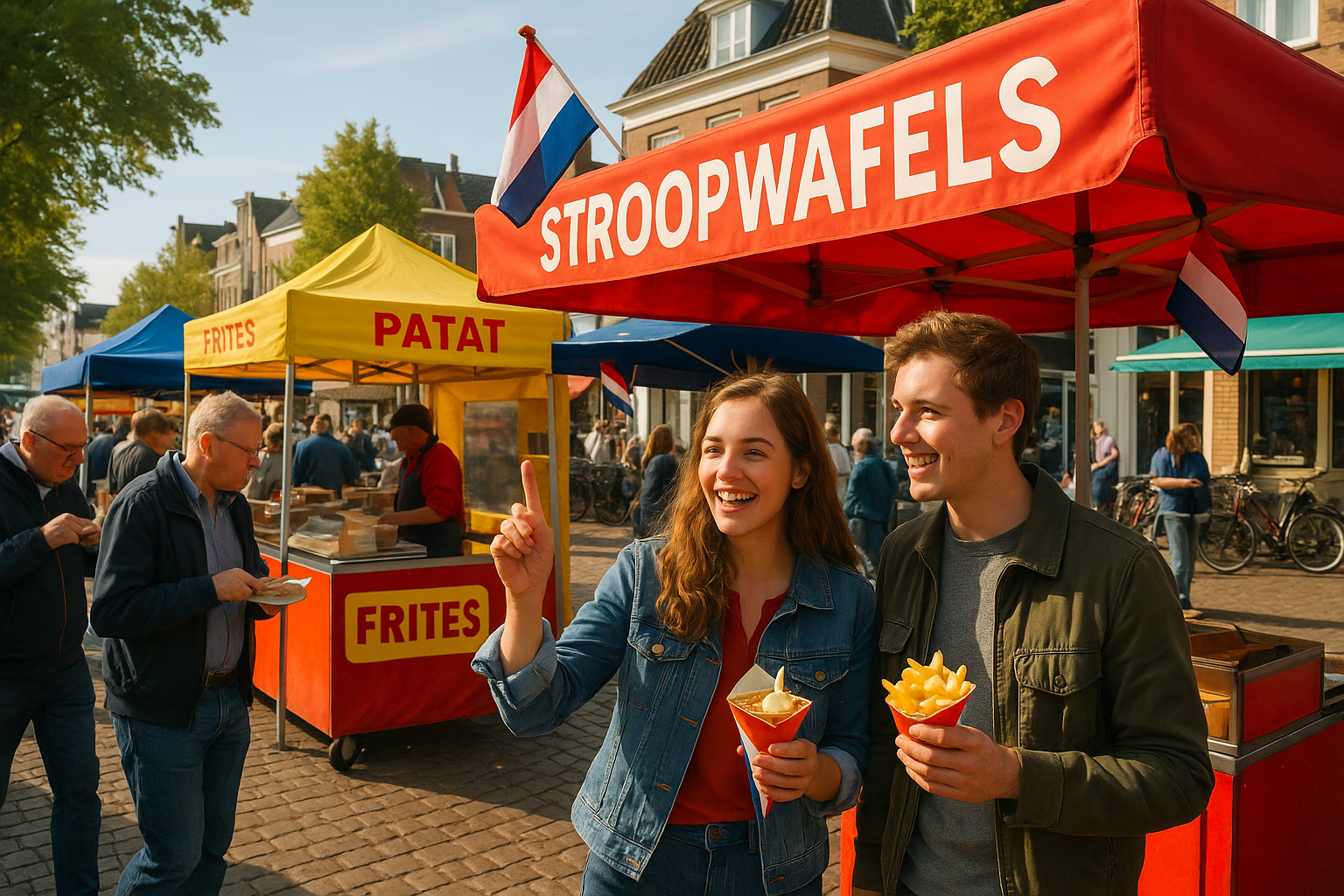
When you set foot on a bustling Dutch market square in the early evening, the hum of conversation mixes with sizzling oil, the tang of vinegar-fried fish drifts on the air, and locals — young and old — inch closer to snack stands as though they’re magnetized by deliciousness. That irresistible energy, that moment when your stomach rumbles before you even see what’s on offer — that is the magic of Dutch street food. In a country where cozy cafés, historic canal-side eateries, and gastronomic innovation often get much of the attention, the street food scene quietly holds a special place in Dutch culture. It’s a bridge between everyday life and culinary tradition, a place where people eat on the go, share simple pleasures, and taste history with every bite.
In this post, we’ll take you on a journey through the Netherlands’ most beloved street eats — from salty to sweet, from fishy to fried, from sweet-toothed indulgence to savory comfort — all while exploring how these snacks reflect Dutch history, regional variation, and cultural character. Whether you speak Dutch fluently or you're building your vocabulary, these food names are part of the flavor of the language and the land. By the end, you'll be ready to order with confidence, impress locals, and maybe even snag a few recipe ideas for home.
Why Dutch Street Food Deserves More Attention
Before we dive into the must-try bites, it helps to pause and appreciate why street food in the Netherlands is more than a convenience — it’s a cultural expression.
1. A history of “snacken” and frituren
The Dutch have a long tradition of frituur (“fryer” or “frying shop”) culture. In many towns, you’ll find frituren — small shops specializing in deep-fried snacks — that have operated for generations. These venues are places not only to eat but to gather. The quick, fried snack (snackbars) is so embedded in life that many Dutch people grew up getting a kroket or frikandel after school or on the way home.
2. A language of food
Every snack has a name in Dutch, often compact and evocative. Learning to say stroopwafel, bitterbal, kaassoufflé, patat oorlog, haring gives you more than vocabulary — it gives you a passport into conversation, menus, and local banter. Ordering street food is a practical, fun way to build confidence.
3. Regional variation and local pride
Though many street snacks are available everywhere, you'll find regional specialties and local tweaks. For instance, the way people top patat (fries) in Rotterdam might differ slightly from how they do it in Groningen or Zeeland. Similarly, fish stands near the coast or island regions may have fresher offerings or local fish specialties not found inland. Walking around different Dutch cities, you’ll discover subtle differences in how snacks are served, in the sauces offered, and in the context of where they’re sold (markets, food trucks, harbor stalls, etc.).
4. A food for every time and mood
Street food in the Netherlands spans all kinds — savory, sweet, snacky, filling, light, daytime, nighttime. Some are eaten for breakfast, some late in the evening, some as dessert. The variety means whether you’re chasing sweets or craving something salty, walking around a Dutch city will almost always offer something appealing nearby.
With that in mind, let’s embark on a flavorful tour through the very best Dutch street food you have to try.
The Ultimate Dutch Street Food List
Below you’ll find a curated list of 15 iconic (and delicious) street eats. For each, we’ll look at what it is, how it’s served, tips for ordering, and any regional or historical nuance.
1. Stroopwafel — the syrup waffle that stole the world
What it is
A stroopwafel is a thin waffle made in a special iron, then sliced horizontally while warm, and filled with a rich syrupy caramel mixture (stroop).Where to find it
Almost everywhere — street markets, cafés, train stations, souvenir stalls. But the freshest ones are often at market stands, where they make them on the spot.Tips for enjoying it
The best ones are warm, soft, and slightly gooey in the middle. A trick: place the stroopwafel over a hot cup of coffee or tea — the steam gently warms the syrup inside.
You can also find variations with chocolate drizzle or extra toppings.Linguistic note
“Stroop” means syrup, “wafel” means waffle. It’s one of the easiest Dutch compound words to remember.
2. Bitterbal / Bitterballen — the crunchy, savory pub snack
What it is
The bitterbal is a deep-fried, breadcrumbed sphere (about 3–4 cm in diameter) filled with a thick, meaty ragout. It’s often served with mustard.Where to find it
Widely available in cafés, bars, and snackbars. It’s also part of a bittergarnituur — a platter of snacks served alongside drinks.Tips for ordering / eating
Order a serveurtje (small serving) or portie of bitterballen.
Use the toothpicks provided.
Mustard is the classic accompaniment, but some places also offer dip sauces.
Best eaten hot: the crispy exterior and creamy interior are part of the experience.
Variation
The kroket is a larger, oblong version of a croquette; bitterballen are the smaller, round version.
3. Kroket / Kroketten — the Dutch croquette
What it is
Similar in principle to bitterballen, a kroket is a deep-fried croquette with a meat-based filling (ragout) encased in breadcrumbs. The Dutch kroket comes in various flavors: beef, veal, chicken satay, shrimp, and even vegetarian.Where to find it
Very common in snackbars, vending automats (automatiek), cafés, and train stations. Many Dutch cafés offer a broodje kroket — kroket in a soft bun with mustard.Tips for ordering / eating
Ask for “een broodje kroket” if you want it in a bun.
Try different flavors if you see them (e.g. satay, goulash).
Be quick — warm kroketten are best, before the crust softens.
Some automats let you get one straight from the machine — classic Dutch convenience.
4. Patat / Friet / Frietjes — Dutch-style fries (with flair)
What it is
Thick-cut fries (friet or frietjes) deep-fried and often double-fried for crispness. The Dutch serve them in a cone or tray, loaded with sauces.Popular toppings & sauce styles
Mayo / Mayonaise: The classic Dutch style.
Patat oorlog: Fries with mayonnaise, satay sauce, and raw onions.
Curry ketchup, satay sauce, joppiesaus, special sauces: many snack bars offer creative combinations.
Friet speciaal: mayo + ketchup + chopped onions, a simpler but beloved combo.
Where to find it
Nearly everywhere — street stalls, “frituurs,” snackbars, markets. It accompanies nearly every snack shop menu.Tips
Get them in a paper cone so you can easily walk and eat. Use the miniature wooden fork often provided. If you want to try local combos, look for long lines — that often signals a place with particularly good sauces.
5. Kibbeling — Dutch battered fish bites
What it is
Kibbeling is battered, battered-and-fried chunks of fish (typically cod) served often with garlic sauce, tartar, or remoulade.Where to find it
Coastal towns, fish markets, harbor stalls, and in Amsterdam’s markets or near canals. Also common at street fish counters.Tips for ordering / eating
Ask for a portie kibbeling.
Dips can vary — try them all (garlic, tartar, remoulade).
Eat while hot — the crisp batter makes the experience.
If you're near the water, combine with a view — it's a classic sea-to-table snack.
6. Haring (Hollandse Nieuwe) — raw herring, Dutch style
What it is
A Dutch tradition: lightly salted raw herring (often called Hollandse Nieuwe), usually served with raw chopped onions and sometimes pickles.Where to find it
Harings stands (the haringkar), markets (especially near waterways or fish markets), and festivals. The season for the highest quality Nieuwe is often May-July.Tips & tradition
The daring traditional way: hold the fish by the tail, tilt your head back, and eat it whole. (You can also have it in a roll or with bread if you prefer.)
Ask for uitje erbij (with onions).
If it’s out of season, you may get preserved or pickled versions — still tasty, but a bit different.
7. Poffertjes — mini Dutch pancakes
What it is
Thick, fluffy miniature pancakes, typically made with yeast and buckwheat flour, served with butter and powdered sugar.Where to find it
Street markets, winter festivals, seasonal stands, often in colder months. Delights in Christmas markets or winter fairs.Tips for enjoying them
Order a box (doosje poffertjes) or plate.
Add whipped cream, syrup, or fruit toppings if available.
Eat immediately — these are at their best warm and fluffy.
8. Kaassoufflé — the fried cheese pocket
What it is
A snack of melted cheese encased in thin dough, then breaded and deep-fried. It’s one of the few vegetarian-friendly fast food snacks commonly available.Where to find it
Snack bars, automats (coin-operated vending machines), and casual fast food stands. Often present in Dutch snack automats (automatiek).Tips & variations
Try the mini version (mini-kaassoufflé) or the half-moon shape.
Accompany with mustard, mayo, or curry ketchup.
Some versions include ham, spinach, or other fillings alongside cheese.
Ask for it warm — nothing beats molten cheese inside a crunchy shell.
9. Kipcorn — a corn-breaded chicken snack
What it is
A rod-shaped snack made from a chicken (or turkey) meat slurry, coated in cornmeal or breadcrumbs, and deep-fried.Where to find it
Standard snackbars and fast food outlets that carry a variety of Dutch snack classics.Tips
Pair it with sauces like ketchup, mayo, or curry sauce. It’s simple but satisfying for those who prefer meat over fish or cheese.
10. Erwtensoep / Snert — thick Dutch pea soup
What it is
A hearty winter soup made with split peas, vegetables (celery, onions, leeks), potatoes, and often smoked sausage (rookworst). If properly made, it’s thick enough to stand a spoon upright in the bowl.Where to find it
Winter markets, food stalls in cold months, neighborhood cafés, and sometimes food trucks in winter.Tips for ordering / eating
Ask for erwtensoep or snert.
It's common to serve with rye or wholegrain bread on the side.
Great as a warming dish on chilly days.
Because it’s thick, smaller portions are common as a starter.
11. Pannenkoeken / Dutch pancakes — pancake spectacle
What it is
Dutch pancakes are large, relatively thin (but thicker than crepes), and can be served savory or sweet — with toppings such as cheese, bacon, apples, stroop, fruit, or combinations thereof.Where to find it
Pancake houses (pannenkoekenhuizen), food markets, special events, and even street vendors in some places.Tips
If on the go, look for smaller folded pancakes or pancake sandwiches.
Try a pannenkoek speciaal (with cheese and bacon) or one with apples and syrup.
For language learners, knowing pannenkoek opens up more menu items and options.
12. Oliebollen — Dutch doughnuts (winter favorite)
What it is
Deep-fried yeast dough balls, sometimes with raisins or apple bits, dusted with powdered sugar. Commonly enjoyed during winter and especially New Year’s Eve.Where to find it
Seasonal stands (November–January), Christmas markets, street stalls in wintertime.Tips
Ask for them vers (fresh).
Try ones with fruit bits for extra flavor.
Eat warm.
13. Appelflap / Appelflappen — Dutch apple turnovers
What it is
A pastry filled with apple, raisins, cinnamon, and sugar. It’s the Dutch version of a fruity turnover.Where to find it
Bakeries, café counters, markets, street pastry stands.Tips
Eat slightly warm; pair with coffee. Sometimes served with a glaze or powdered sugar topping.
14. Speculaas / Speculaaskoeken — spiced shortbread and cookies
What it is
Spiced cookies made with a mix of cinnamon, nutmeg, cloves, ginger, and sometimes almond — a traditional treat especially in November/December.Where to find it
Bakeries, holiday markets, supermarket stalls, and street food stands during Sinterklaas season.Tips
Try different shapes (windmills are common) and flavoured variations (almond, chocolate, etc.).
15. Drop (Dutch licorice)
What it is
Dutch licorice (drop) comes in many forms — soft, hard, salty, sweet — and is a classic snack. Many Dutch people are passionate fans.Where to find it
Candy stands, kiosks, supermarkets, market stalls.Tips
If you see zoute drop (salty licorice) — that’s the strong, classic style. Try milder versions first. It’s more of a slow nibble than a “hot-out-of-the fryer” snack.
Sample Street Food Walk: How to Eat Through a Dutch City
Here’s a suggested route (and approach) you can use when exploring Dutch cities (Amsterdam, Utrecht, Rotterdam, Maastricht, or lesser-known ones). Adjust distances as needed.
Begin at a local market or food hall
Start your walk at a market (e.g. Albert Cuypmarkt in Amsterdam, Markthal in Rotterdam, or the Sunday Markt in Utrecht). Markets often have fresh stroopwafel stands, fish carts, and fried snack stalls.Snack as you stroll
Pick up a warm stroopwafel or slices of haring from a fish stand. Saunter toward the heart of town, letting aroma guide you.Stop at a frituur
Find a traditional frituur for fries (patat) with local sauce combos or a spot that sells kroket or bitterballen.Visit a fish counter near water
If you're by a harbor or canal, taste kibbeling or haring at a fish stand, perhaps on a bench overlooking the water.Sweet interlude
When midday or afternoon hits, find a stand offering poffertjes or appelflap to sweeten the walk.Evening snack run
As evening falls, make your way to neighborhoods with café life. Order a kaassoufflé or kipcorn and fries to pair with a local drink or soda.Winter bonus
If you're visiting in late fall or winter, hunt for erwtensoep or oliebollen stands to warm you up.
Throughout, keep your eyes (and nose) open — sometimes the best bites come from unassuming stands or shop windows. Don’t hesitate to ask locals “Wat raadt u aan?” (What do you recommend?) — you’ll often be directed to hidden gems.
Tips & Etiquette for Enjoying Dutch Street Food
Here are some general pointers to enhance your experience and avoid rookie mistakes:
Carry small change — some stands don’t accept large bills or cards (though many do now).
Go where locals go — long lines of Dutch people usually signal quality.
Stand or walk eating is fine — many snacks are meant to be eaten on the go.
Ask for “beslist warm” (definitely warm) — fresh warmth can make a big difference.
Ask for “automaattje” — at snack automats (vending machines with snacks), you might just drop coins and door pops open with a snack like a kroket or kaassoufflé.
Use toothpicks — many snack dishes (especially bitterballen) come with tiny toothpicks to pick them easily.
Mind the sauces — some sauces are spicy or strong; try small amounts first.
Be adventurous — try something new; many Dutch snacks are experiential.
Learn a few food words — snack, lekker, vers, portie, warm, met (with), zonder (without) will help.
Say thank you — dank u (formal) or dank je (informal) is always appreciated after a purchase.
Why These Snacks Matter for Language Learners
As a language learner, engaging with local street food offers:
Vocabulary in context — hearing stroopwafel, kroket, haring in their natural environment helps cement the words.
Pronunciation practice — ordering these snacks gives you real-life speaking opportunities in an informal, low-pressure setting.
Cultural connection — food opens doors: asking about how something is made, or what locals prefer, invites conversation and immersion.
Motivation — tastes make learning tangible. The smell, texture, flavors — it’s a memorable way to anchor language learning.
So, the next time you're in the Netherlands — or in a Dutch-speaking community — following your nose may lead you right to a delicious new word.
FAQs (Frequently Asked Questions)
Q1: Are these snacks available all year round?
A: Many are, though some are seasonal. Oliebollen are most common during winter and around New Year’s. Erwtensoepis popular in colder months. Poffertjes may be more common in winter markets or seasonal fairs. Other snacks like stroopwafel, kroket, patat, bitterballen tend to be available year-round.
Q2: Are any of these snacks vegetarian or vegan?
A: Yes.
Kaassoufflé (cheese) is vegetarian (though not vegan).
Some kroketten and bitterballen are made with mushroom or vegetable fillings — check with the vendor.
Patat with plain condiments like ketchup or vegan mayo is okay (just check the sauces).
Poffertjes, stroopwafel, appelflap are often vegetarian, but double-check ingredients or cross-contamination for vegan versions.
Q3: I’m allergic to gluten / dairy — what can I eat?
A: It’s trickier, as many fried snacks use wheat-based batter and cheese. You could look for kibbeling (fish) without batter (rare), or haring (fish) with onions. Some modern vendors offer gluten-free or alternative options — always ask “Heeft u glutenvrije opties?” (Do you have gluten-free options?), or “Zit er melk in?” (Does it contain milk?).
Q4: How do I order in Dutch?
A: You can start with:
Een portie patat, alstublieft — one portion of fries, please.
Een broodje kroket met mosterd, alstublieft — a croquette on a bun with mustard, please.
Een kaassoufflé, alstublieft — a cheese soufflé snack, please.
Haring met uitjes, alstublieft — herring with onions, please.
Mag ik een stroopwafel, alstublieft? — May I have a stroopwafel, please?
Use alstublieft (formal please) or alsjeblieft (informal please). Locals appreciate the attempt at Dutch.
Q5: Is Dutch street food expensive?
A: Generally, no. Many snacks are cheap to moderate — €2–€6 for individual snacks or portions. Street market prices may vary slightly depending on location (tourist areas may be pricier), so keep an eye out for local shops for better value.
Final Thoughts
From the sweet pull of a warm stroopwafel to the crunchy surprise of bitterballen, from the bold experience of raw haring to the comforting warmth of erwtensoep, Dutch street food captures the spirit of the Netherlands in small, delicious bites. These snacks are living history, language, and community all wrapped together — and to truly master a language, it's vital to connect with real life in real time.
Hungry for more language + culture content? Check out our other blog articles: