
Vietnamese Classes in Berkeley: A Guide for Adult Learners
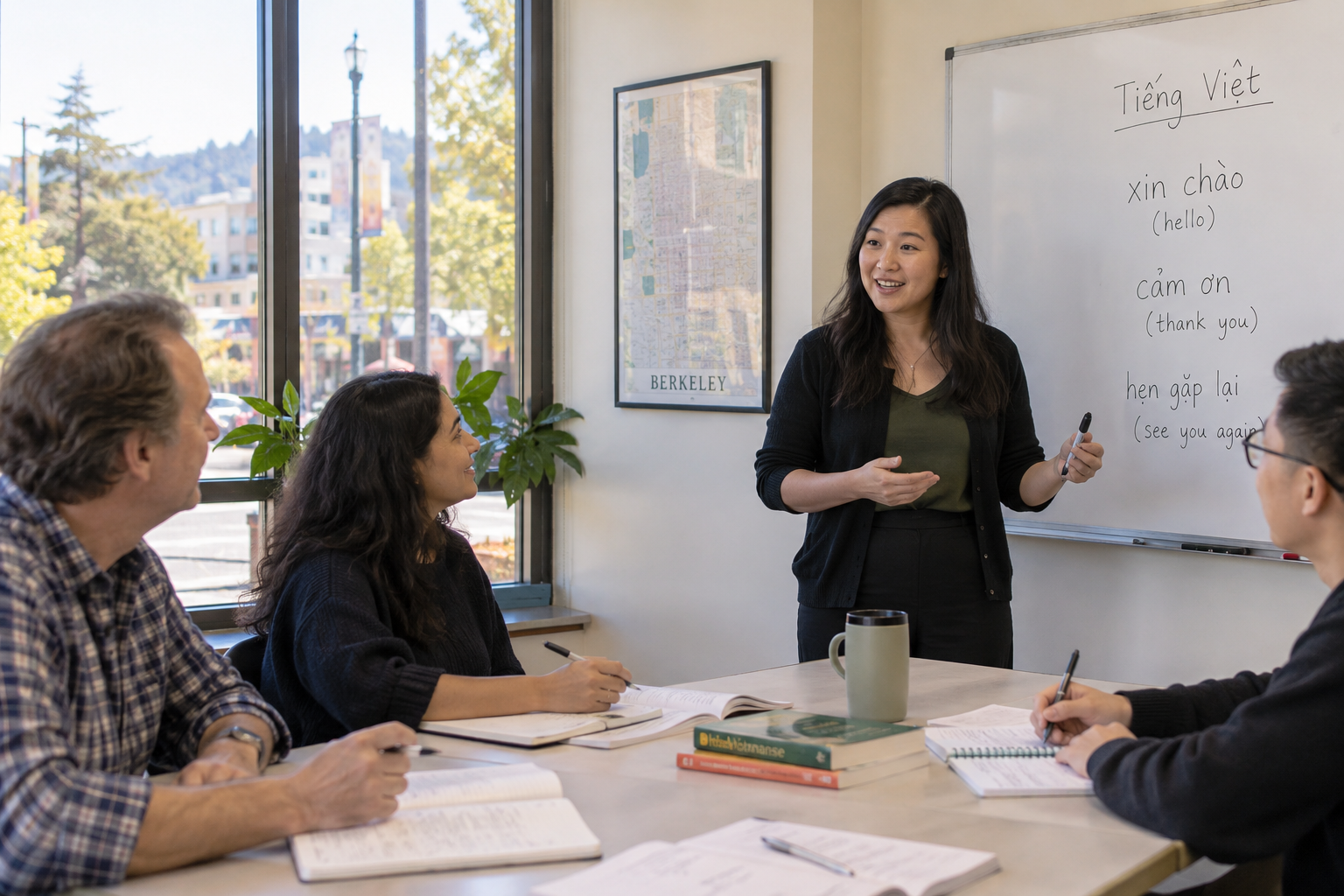
If you search for Vietnamese classes in Berkeley, one of the first things you discover is that “a Vietnamese class” can mean several very different things. A university course may meet five hours a week and come with homework, exams, and a full academic sequence. A private adult class may meet once a week after work. A heritage learner who grew up hearing Vietnamese at home may need something different from both.
That distinction matters more in Vietnamese than many beginners expect. A student can memorize a surprising amount of vocabulary and still struggle to be understood if the tones and vowel sounds are not being corrected. Another student may understand family conversations quite well but hesitate to speak because the Vietnamese they know is tied to home, older relatives, or one regional variety. Choosing the right class is therefore less about finding the most impressive institution and more about finding the kind of instruction that matches how you actually need to learn.
Berkeley has a real academic option, but it is a serious commitment
UC Berkeley currently offers Vietnamese through its Department of South and Southeast Asian Studies. The university’s introductory sequence emphasizes modern spoken and written Vietnamese, phonology, tones, basic grammar, conversation, reading, and writing. In Fall 2026, UC Berkeley lists introductory, intermediate, and advanced Vietnamese courses, so this is not a one-semester curiosity but a developed academic sequence.
For someone enrolled at the university, or for an adult who wants substantial weekly contact with the language and can access the course, that kind of program can be excellent. The advantage is intensity. Several meetings each week force Vietnamese to become part of your routine rather than something you revisit on Sunday evening after forgetting what happened in class six days earlier.
The same intensity can also make a university course impractical for a working adult. A five-unit language course is built around an academic calendar, not around the schedule of someone who has a full-time job, children, or a long commute. If you are looking for a one-hour evening class, you are really looking for a different product, even if both options are called “beginner Vietnamese.”
For most adults, schedule is not a minor detail
Bay Area learners often underestimate how much logistics affect language study. A class that looks perfect on paper may stop being perfect when it requires crossing the Bay Bridge at 5:30 p.m. or adding two BART transfers to the end of a long workday. In-person study has real advantages, especially for pronunciation work and spontaneous conversation, but consistency matters more than an ideal format you cannot sustain.
For a Berkeley resident, an in-person class near Downtown Berkeley or North Berkeley may be easy to attend weekly. Someone coming from San Francisco, Oakland, Alameda, or farther south may find that a live online class gives them more actual speaking time simply because they are less likely to miss sessions. The useful question is not “Is online as good as in person?” in the abstract. It is “Which format will I attend regularly, speak in, and receive correction in?”
## Vietnamese pronunciation should shape your choice of class
Vietnamese uses the Latin alphabet, which can make the language look deceptively accessible to English speakers. The writing system is familiar enough that beginners may feel they can read a word before they can actually pronounce it.
That is where a good teacher becomes important. Vietnamese is tonal, and the tone is part of the word. Vowels also contain distinctions that English speakers may not hear clearly at first. A learner can reproduce the consonants reasonably well and still say something that a native speaker has trouble recognizing because the vowel quality or tone is off.
Teachers often notice that beginners try to solve this by speaking more loudly or more slowly. That rarely fixes the real problem. What helps is hearing a model, producing the sound, receiving immediate correction, and repeating it before the wrong version becomes automatic. When comparing classes, ask how much actual speaking occurs and whether the instructor corrects pronunciation individually.
A class in which students mostly watch slides may cover a great deal of material without giving a beginner enough time to develop the sound system.
Northern, Central, or Southern Vietnamese?
Adult learners sometimes become anxious about dialect before they have learned their first dozen sentences. The question matters, but it should be tied to your reason for studying.
Vietnamese is commonly described in broad Northern, Central, and Southern varieties, with noticeable differences in pronunciation and some vocabulary. If you are learning because your spouse’s family is from Ho Chi Minh City, a Southern-oriented model may be especially useful. If your relatives are from Hanoi, Northern pronunciation may make more sense. A traveler planning to spend months in one region may have a similar preference.
For a beginner without a family or regional connection, the most important thing is usually to learn one coherent pronunciation system first and gradually become familiar with variation. Trying to imitate several regional models from the beginning can create more confusion than flexibility.
A good teacher should be able to tell you which variety is being used in class and explain major differences without turning every lesson into a dialectology seminar.
Heritage learners often need placement, not a “beginner” label
Some of the most difficult Vietnamese students to place are the ones who say, “I’m basically a beginner, but my family speaks Vietnamese.” That sentence can describe many different profiles.
One heritage learner may understand a grandparent almost perfectly but answer in English. Another may speak fluidly about food, relatives, and household routines but be unable to read. Someone else may read Vietnamese slowly yet struggle with spontaneous conversation. A learner may also speak a regional or family variety that does not match the textbook used in class.
Putting all of these students into a complete-beginner class can be frustrating. They may find the first lessons too easy while still having important gaps in grammar, literacy, vocabulary, or confidence.
If that sounds familiar, look for a program willing to discuss placement rather than assigning a level based only on how many years you have studied formally. Heritage knowledge is often uneven, and the unevenness is the important part.
Small groups and private lessons solve different problems
A small group can be especially useful for adults because it creates a reason to speak to more than one person. You hear different voices, ask and answer questions, and learn to keep a conversation moving even when the exchange is not scripted. The social pressure is mild but helpful: you know you will have to use the language, not simply recognize it.
Private lessons are more efficient when your goals are highly specific. A heritage learner working on literacy, a traveler preparing for a particular trip, or a professional who needs Vietnamese for a narrow context may benefit from individual instruction. Private study also makes it easier to spend twenty minutes on one stubborn pronunciation problem without worrying about holding up a group.
The tradeoff is that private instruction gives you only one conversational partner. For many beginners, a combination works well: structured group study for progression and interaction, with occasional individual help if pronunciation or placement needs extra attention.
What should a beginner Vietnamese class actually cover?
A complete beginner does not need hundreds of isolated words. The first stage should create a usable sound system and a small set of sentence patterns that can be recombined.
You should expect careful work on pronunciation and tones, greetings, introductions, numbers, basic questions, common verbs, family and everyday vocabulary, and the forms of address that Vietnamese uses much more extensively than English. Pronouns and kinship terms deserve attention early because choosing how to address another person is part of ordinary conversation, not an advanced cultural topic.
This is one of the places where textbook Vietnamese can feel very different from real interaction. English speakers are used to a nearly universal “you.” Vietnamese speakers make choices that reflect age, relationship, familiarity, and social context. Beginners do not need to master every possibility at once, but they do need to understand why the language keeps asking them to make a choice English does not require.
Apps are useful, but they cannot hear you well enough
Apps can be very good for maintaining a daily habit, drilling vocabulary, reviewing spelling, or giving a beginner low-pressure repetition. They are much less reliable as the only source of pronunciation training.
The problem is not that technology is useless. It is that Vietnamese pronunciation depends on distinctions a learner may not yet know how to hear. If you repeatedly produce a tone or vowel incorrectly while an app accepts it, you can end up practicing the mistake.
Use an app as a supplement. Let a teacher or skilled speaker help establish the sound system, then use independent study to reinforce what you already know how to produce.
A practical way to choose among Berkeley-area options
Before registering, ask yourself four questions. How many hours per week can I realistically give this? Do I want an academic course or an adult continuing-education pace? Do I need help with placement because I already understand some Vietnamese? And will I have enough time in class to speak and receive correction?
Those questions usually narrow the field quickly.
Polyglottist Language Academy is based in Downtown Berkeley and offers live Vietnamese instruction for adults, including small-group online classes and individual lessons depending on the current schedule. For adults who want a structured course without the time commitment of a university language sequence, that format can be a practical middle ground.
The right class should make Vietnamese less mysterious after a few weeks, not simply give you more material to memorize. If you are beginning to hear the tones more clearly, form simple sentences without translating every word, and respond to another person rather than reciting from a page, the course is doing useful work.