
Best Vietnamese Classes for Adults in San Jose and the Bay Area
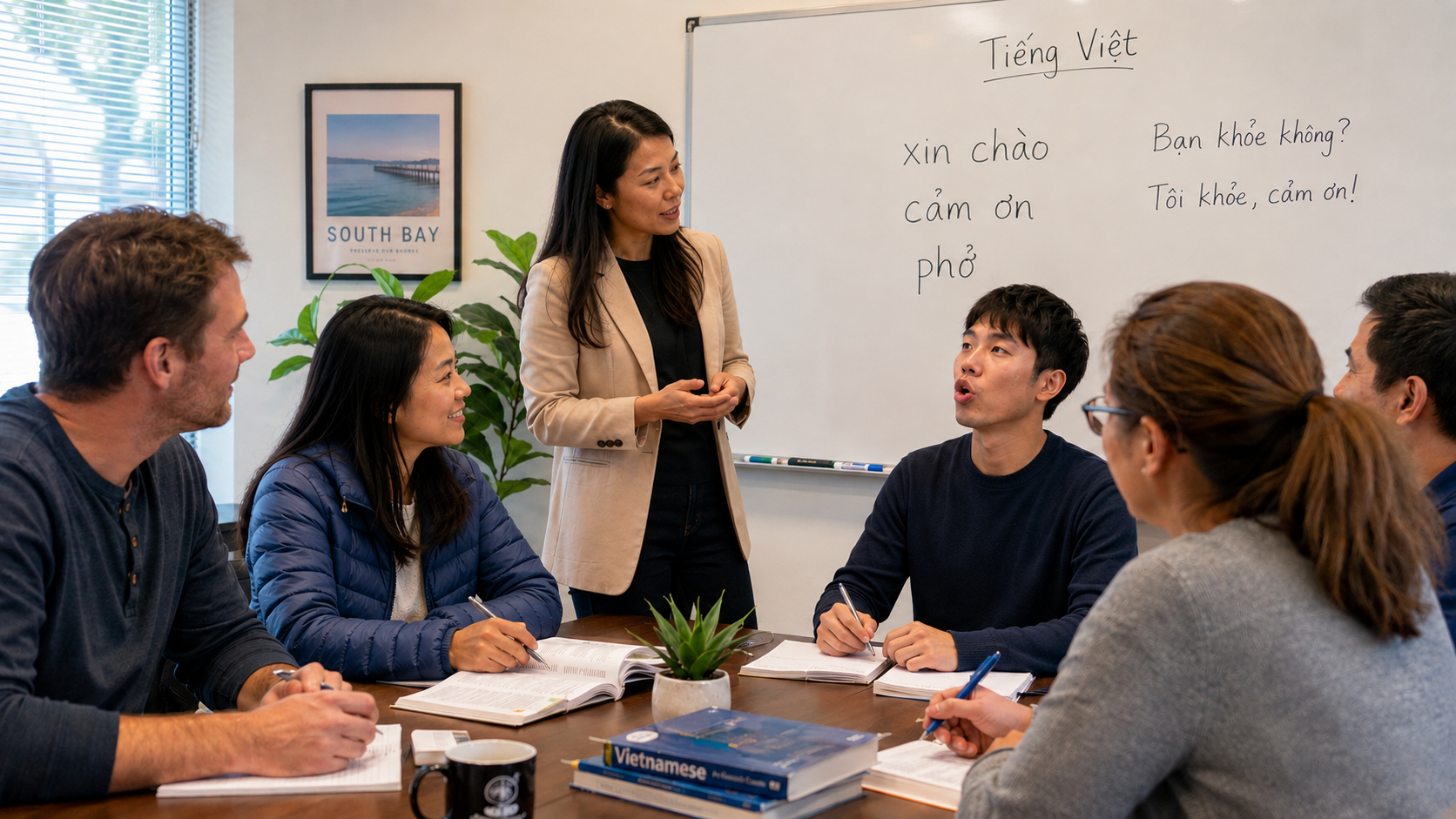
An adult in San Jose decides to learn Vietnamese because his partner’s parents speak it at home. He downloads an app, learns a few greetings, memorizes some food vocabulary, and becomes reasonably confident about saying cảm ơn and ordering phở.
Then he tries a new sentence with the family.
Nobody understands him.
He repeats it. Someone eventually figures out what he means and says the word back to him. To his ears, it sounds almost exactly like what he just said.
This is the point when many beginners discover that choosing a Vietnamese class is not simply about finding somewhere that teaches vocabulary and grammar. Pronunciation, tones, vowel distinctions, listening, and forms of address matter from the beginning, and these are precisely the parts of Vietnamese that can be difficult to correct when you study entirely on your own.
San Jose is also an especially relevant place to learn the language. The city has a long-established Vietnamese community, and Vietnamese is part of everyday life in neighborhoods such as Little Saigon and East San Jose. For some adults in the South Bay, learning the language is connected to family or heritage. Others want it for work, travel, relationships, or simply because they hear Vietnamese around them and want to understand more of what is being said.
So when someone searches for the “best Vietnamese classes in San Jose,” the answer depends heavily on the learner.
A complete beginner, a heritage speaker, and someone preparing to communicate with a Vietnamese spouse’s family may all need different things. Instead of looking only for the most recognizable school name, it is more useful to ask which class will actually give you the pronunciation feedback, speaking time, level, regional exposure, and schedule you need.
What Makes a Vietnamese Class Good for an Adult Learner?
Price and location matter, of course, but I would look at a few other things first.
How much will you actually speak during class? Does the teacher correct pronunciation individually? Is the course genuinely designed for adults? Is “beginner” being used to mean complete beginner, or are students expected to arrive with some prior knowledge? And is there a clear progression after the first term?
The schedule matters too.
Bay Area learners often underestimate how important convenience is. A class may be excellent on paper, but if attending it means fighting traffic across the region after work, missing lessons eventually becomes very easy.
Vietnamese also makes live feedback unusually valuable. Because the language uses the Latin alphabet, beginners can sometimes feel more confident than they really are. A word looks readable on the page, yet the tone, vowel, or ending may sound quite different when the learner says it aloud.
That is why pronunciation should be one of the first things you investigate when comparing classes.
Pronunciation Should Not Be Treated as a Beginner Unit You Finish and Forget
A good Vietnamese instructor should do more than explain that the language has tones.
Students need to hear differences, try to reproduce them, be corrected, and try again. They also need help with vowel quality, final consonants, and the way pronunciation changes once individual words become part of a normal phrase.
Ask what actually happens in class.
Does the instructor hear students one by one? Are learners asked to distinguish similar sounds? Does the teacher stop and correct a tone when necessary, or does the lesson simply move on because the sentence was understandable from context?
These details make a difference.
A beginner may know exactly which word they intend to say and still produce something a native speaker hears differently. Without feedback, the learner may repeat the same mistake for weeks and never realize it.
This is one reason live instruction can be particularly useful in Vietnamese. An app can tell you which word comes next in a lesson. A teacher can hear what you are actually doing with it.
Southern or Northern Vietnamese? For San Jose Learners, It Is Worth Asking
Vietnamese varies regionally, and one of the first distinctions learners encounter is between Northern and Southern pronunciation.
Neither is the “wrong” Vietnamese.
For learners in San Jose, however, Southern Vietnamese may be especially relevant because many local Vietnamese families have roots in southern Vietnam. If you are learning because your spouse, parents, grandparents, or in-laws speak Vietnamese at home, the variety you hear from them may matter more than the pronunciation model used in a textbook.
That does not mean you should reject a teacher who speaks Northern Vietnamese. A strong instructor can explain important regional differences and help students become accustomed to hearing more than one variety.
Before registering, I would simply ask which pronunciation the instructor primarily uses and whether regional differences are discussed.
If family is your main reason for studying, ask the family too. Their answer may be more useful than anything written in the course description.
A More Academic Option: San José City College
For adults who want a substantial, semester-style course, San José City College is one of the local options worth investigating.
Its Vietnamese curriculum includes elementary Vietnamese study with pronunciation, vocabulary, grammar, listening, speaking, reading, writing, and cultural material. A college course can offer something that short language-school terms often cannot: a long, structured sequence with considerable contact time.
That can be ideal for someone who wants to study the language seriously and does not mind a traditional academic format.
The commitment is also much greater.
A five-unit college language course is not the same thing as attending a one-hour evening lesson once a week. There may be homework, assessments, a semester calendar, and registration procedures that make perfect sense for a college student but may feel cumbersome to someone simply looking for conversational Vietnamese after work.
Course availability can also change from term to term, so it is worth checking the current schedule rather than assuming a catalog listing means the class is running at the moment you want it.
For the right learner, though, an academic course can provide an excellent foundation.
A Shorter Adult-Class Format: San Jose Learning Center
Some adults want structure but are not looking for an entire college semester.
San Jose Learning Center has offered adult Vietnamese classes in the South Bay, including beginner-level study in Santa Clara. A shorter language-school format can be attractive if you want to try Vietnamese, work around a professional schedule, or avoid the workload of an academic course.
Here I would pay particular attention to class size and speaking time.
A course labeled “Vietnamese Level 1” tells you the starting point, but not how interactive the class is. Two beginner programs can cover similar vocabulary and grammar while giving students very different amounts of actual practice.
For Vietnamese, that matters.
If each student gets regular opportunities to speak and receives correction, a short adult group course can be a very practical introduction. If most of the class consists of listening to explanations, it becomes much harder to develop comfortable pronunciation.
Schedules change, so current offerings should always be checked directly before planning around them.
Community Programs Can Offer Something a Language School Cannot
The Bay Area also has Vietnamese cultural and community organizations that teach the language.
These programs can be appealing because language is often taught alongside cultural knowledge and community connection. For a heritage learner in particular, that can be meaningful in a way that a purely commercial course may not reproduce.
The main thing adults need to check is whom the program was designed for.
Many Vietnamese community schools were established primarily for children growing up in Vietnamese-speaking families. They may provide excellent instruction for those students and still be a poor fit for an English-speaking adult beginner.
Some organizations do have adult offerings. Au Co Vietnamese Cultural Center in San Francisco, for example, has offered adult Vietnamese study alongside its youth and cultural programs.
For someone in San Jose, the drawback is obvious: San Francisco is not exactly around the corner.
If community connection matters enough to justify the trip, it may still be worthwhile. Otherwise, a South Bay or online class may be much easier to sustain.
Not Every Local Vietnamese Program Is a Beginner Program
This is another reason to read course descriptions carefully.
Evergreen Valley College in San Jose has Vietnamese programming, but its Vietnamese Translation and Interpreting program serves a much more specialized audience. It is aimed at people developing professional translation and interpreting skills, including work in settings such as healthcare or the courts.
That can be extremely valuable for someone who is already bilingual or advanced.
It is not the obvious place for a complete beginner who is learning how to introduce themselves.
Search results often flatten these differences. A program appears under “Vietnamese classes,” but the level, purpose, and intended student may be completely different from what you are looking for.
Live Online Classes Make More Sense in the Bay Area Than They May Seem To
An online Vietnamese class may sound less local than an in-person class, but for someone living in the Bay Area it can solve a very local problem: commuting.
A learner in San Jose, Santa Clara, Sunnyvale, Cupertino, Milpitas, Fremont, or Mountain View can join the same class without needing to cross the South Bay in evening traffic.
The important distinction is between live online instruction and self-paced online study.
A live instructor can hear your pronunciation, interrupt when a tone is unclear, ask you to repeat something, and put you into a short conversation. You still have classmates, a schedule, and the expectation that you will actually speak.
For many adults, that combination works well. They get the structure and feedback of a real class without adding another commute to the week.
Polyglottist Language Academy offers live online Vietnamese instruction for adult learners, including beginners and heritage learners, so students in San Jose and elsewhere in the Bay Area can attend without traveling to another city. The emphasis is on structured learning, speaking practice, and live teacher feedback.
For someone with a demanding schedule, that can matter more than whether the teacher is physically in the same ZIP code.
Heritage Learners Need More Careful Placement
The word “beginner” causes a lot of problems in Vietnamese.
Imagine two students.
One has never studied the language and is still learning to hear the tones.
The other grew up listening to Vietnamese at home. She understands much of what her parents say, may pronounce many words naturally, and knows a surprising amount of family vocabulary. But she struggles to answer in complete sentences and may not read Vietnamese comfortably.
Both might say, “I’m a beginner.”
They clearly do not need the same class.
Heritage learners often have uneven skills. Someone may understand familiar relatives but have difficulty following strangers. Another learner may speak comfortably but lack literacy. Someone else may know a Southern family variety and find textbook Vietnamese unexpectedly unfamiliar.
A complete-beginner course can therefore be painfully slow in some areas while failing to address the gaps the learner actually has.
If you are a heritage speaker, I would look for a school or instructor willing to discuss placement rather than assuming that everyone who cannot read or speak fluently belongs at Level 1.
Sometimes a regular group is appropriate. Sometimes a few private lessons are a much better starting point.
When Private Vietnamese Lessons Make Sense
Private instruction is especially useful when the learner’s needs are difficult to fit into a standard syllabus.
A heritage speaker with strong listening and weak speaking is one example. Someone with an unpredictable work schedule is another. Private lessons can also be useful when you are preparing for a specific trip, want intensive pronunciation work, or mainly want to communicate with one particular family.
Suppose your spouse’s parents speak Southern Vietnamese and your goal is to participate more comfortably in family conversations. You may care more about their pronunciation, family vocabulary, and forms of address than about covering every beginner textbook unit in the usual order.
A private instructor can build around that.
For a typical complete beginner, though, private lessons are not automatically necessary.
A well-run small group can provide plenty of correction and speaking time while also letting students learn from one another. Hearing another beginner struggle with the same tone distinction can sometimes be surprisingly useful.
The real question is whether the class gives you enough individual attention.
Small Groups Give Pronunciation Somewhere to Go
Course descriptions often promise conversation, immersion, cultural learning, and interactive instruction.
There is a much simpler question worth asking:
How much will I actually speak?
In a large class, even a very good teacher has limited time to hear every student. For a language where pronunciation needs early correction, that can become a problem.
A smaller group makes it easier for the teacher to notice recurring mistakes, hear individual tones, run short dialogues, and make sure quieter students are participating.
There is no perfect number of students that guarantees a good class. Teaching quality matters, and so does how the class is organized.
Still, for Vietnamese I would rather be in a group where the instructor regularly hears my voice than in one where I can disappear for most of the lesson.
Apps Are Useful When You Give Them the Right Job
There is no reason to stop using apps once you start taking a class.
They can be very helpful for vocabulary review, spelling, repetition, and maintaining a daily routine. Flashcards help. Videos help. Listening resources become increasingly valuable as your vocabulary grows.
The problem comes when self-study is expected to replace every other form of learning.
A learner can become very good at recognizing a word on a screen and still hesitate completely when someone asks a simple question in conversation. More importantly, they may repeat the same pronunciation mistake without realizing it.
Use apps between lessons.
Let a teacher handle the things that require another human being to hear you.
Vietnamese is a language where the difference between “I know that word” and “another person understood me when I said it” becomes obvious quite early.
One Class a Week Can Work
Adults often ask whether one class per week is enough.
It can be, provided Vietnamese does not disappear completely between lessons.
Ten or fifteen minutes of review on several days is more useful than doing nothing all week and trying to reconstruct the previous class right before the next one begins.
Repeat pronunciation aloud. Listen again to short recordings. Review a handful of sentences. If you have Vietnamese-speaking relatives or friends, try using something small rather than waiting until you feel ready to hold a flawless conversation.
Different learners will progress at very different speeds.
Someone hearing Vietnamese at home every day has an advantage that cannot be reproduced by adding another worksheet. A complete beginner with no exposure outside class may need more deliberate listening practice.
There is little value in comparing those two students. What matters is whether your own Vietnamese is becoming easier to understand and easier to use.
What I Would Ask Before Registering
Before paying for a Vietnamese class, I would want clear answers to a few practical questions:
Is this genuinely for complete beginners, or is previous exposure expected?
Which regional pronunciation does the instructor primarily use?
Will the teacher correct individual tones and pronunciation?
How much speaking do students do during a normal lesson?
How large is the group?
Is the class specifically designed for adults?
Can someone help with placement if I already understand some Vietnamese?
Is there another level after this course?
Is the class live or self-paced?
You do not need every course to be perfect.
You simply want to know what you are buying before the first lesson.
A conversation course that turns out to be mostly lecture is disappointing. So is discovering that a “beginner” class assumes everyone grew up hearing Vietnamese at home.
Choosing Among the Bay Area Options
For someone who wants a traditional, substantial academic course, San José City College is worth investigating.
If you prefer a shorter adult language-school term, San Jose Learning Center may fit better when Vietnamese is on the current schedule.
Community organizations can be attractive for learners who value cultural connection, although you should check carefully that an adult class actually exists and that commuting to it is realistic.
Someone already fluent enough to pursue professional interpreting has very different needs, and a specialized program such as the one at Evergreen Valley College may be more appropriate.
Heritage speakers with highly uneven abilities and learners with very specific family or travel goals may benefit most from private instruction.
And for adults who want live teaching but do not want to build their week around another Bay Area commute, a small online group can be one of the most practical choices.
Polyglottist Language Academy offers live online Vietnamese classes for adult learners in San Jose and throughout the Bay Area, with structured instruction, speaking practice, and teacher feedback.
POLYGLOTTIST VIETNAMESE CLASSES
The learner from the beginning who could not make himself understood did not necessarily need a famous university, a more expensive course, or another language app.
He needed someone who could hear what he was actually saying.
That is a useful standard when comparing Vietnamese classes in San Jose and the wider Bay Area. Look beyond the word “beginner” and the name of the institution. Find a class where you will speak often enough to be corrected, where your level makes sense, and where the schedule is realistic enough that you will keep showing up.
For Vietnamese, those practical details are often what turn studying the language into actually being able to use it.