
I Understand Russian but Can't Read It: Classes for Heritage Speakers in New York
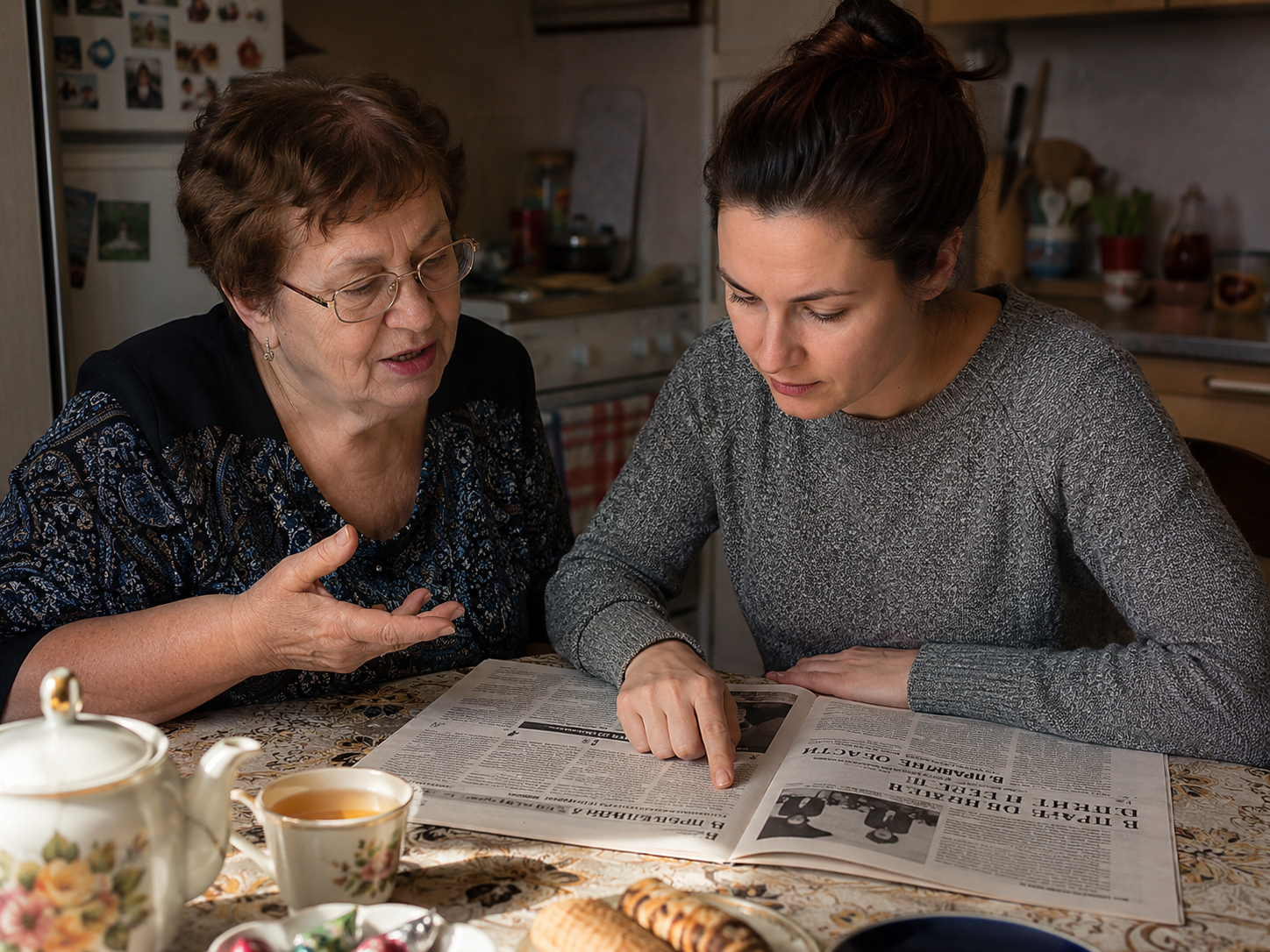
You can understand almost everything your mother says in Russian. You know when your grandmother is asking whether you have eaten, whether you are cold, and why you have not called. At a family dinner, you may follow an entire conversation without consciously translating anything into English.
Then someone hands you a page written in Russian.
Suddenly, a language you have understood for most of your life becomes slow and awkward. You recognize the letters, sound out a word, realize that you have known that word since childhood, and move on to the next one. Writing can feel even stranger. You may be able to say a complicated sentence naturally but have no idea how to spell half of it.
This is a familiar experience for many Russian heritage speakers in New York. It also explains why ordinary labels such as beginner, intermediate, and advanced do not always work very well for them.
A person can have excellent listening comprehension, natural pronunciation, reasonably fluent speech, elementary reading, weak spelling, and almost no formal knowledge of Russian grammar—all at the same time. That learner does not need to “start Russian from the beginning.” They need to develop the parts of the language that were never formally taught.
You may already know far more Russian than you can read
People who learn Russian in a classroom usually encounter the language in a fairly orderly way. They learn Cyrillic, begin reading short sentences, study vocabulary and grammar, and gradually work toward conversation.
Heritage speakers often acquire Russian in almost the opposite order.
A child hears Russian at breakfast, in the car, while visiting grandparents, during family arguments, while watching television, or when somebody tells them to put on a jacket. Nobody needs to explain that тарелка means plate or that ложка means spoon. The meaning becomes obvious because those words are heard again and again in situations where their meaning is clear.
The same happens with whole expressions:
Иди сюда.
Come here.
Ты поел? / Ты поела?
Did you eat?
Надень куртку.
Put on your jacket.
A person can absorb thousands of words and grammatical patterns this way without ever having a Russian lesson.
Reading requires something different. The brain has to connect the sounds and words it already recognizes with a written system. If nobody taught Cyrillic systematically or encouraged regular reading and writing, literacy may simply never have developed alongside spoken Russian.
This produces a strange but very understandable experience. A learner sees:
Здравствуйте
and struggles through the letters, only to realize that the word they have just decoded is one they have heard thousands of times.
For a complete beginner, здравствуйте is new in almost every respect: pronunciation, meaning, spelling, and usage. For a heritage speaker, most of the word may already exist in memory. Reading involves attaching a visual form to something familiar.
That can make progress surprisingly quick once systematic literacy work begins, although fluent reading still requires practice. At first, a heritage learner may decode letter by letter. Later, familiar words begin to appear as whole units rather than collections of symbols.
Spelling is often harder than expected. Spoken Russian does not always reveal exactly how a word should be written, particularly because unstressed vowels may sound different from their written form. Someone whose Russian has always been based on listening may therefore pronounce a word perfectly and still hesitate when trying to write it.
Russian cursive can add another complication. A person who taught themselves printed Cyrillic may discover that handwritten Russian looks unexpectedly unfamiliar. Some heritage-language courses address cursive and handwriting for this reason, although an adult learner who mainly wants to read books, news, messages, and websites does not need to turn handwriting into an exercise in calligraphy.
Family Russian has its own strengths—and gaps
Heritage speakers sometimes discover that their Russian vocabulary is much larger than they thought, but also concentrated in particular parts of life.
Someone who grew up hearing Russian at home may know the language of food, clothes, relatives, household chores, childhood illnesses, family stories, affection, complaints, and arguments extremely well. None of this necessarily feels like “vocabulary” because the words were never memorized from a list.
Then the same person tries to explain what they do professionally.
Words suddenly disappear.
A heritage speaker may be able to discuss dinner effortlessly but struggle with a work presentation, banking, university, politics, healthcare, or a formal email. There is a simple reason for this: those parts of adult life probably happened in English.
If school was in English, university was in English, work is in English, and most reading is in English, then English naturally becomes the language for subjects that never came up during family conversations.
Grammar can be uneven in a similar way.
A heritage speaker might naturally say:
Я говорю с мамой.
I'm talking with Mom.
The form с мамой may sound completely obvious. Ask why мама changed to мамой, though, and the answer may be a shrug.
Someone who learned Russian formally might explain that мамой is the instrumental case after с meaning with. The heritage speaker may never have heard the phrase “instrumental case” but still use the form correctly because it sounds familiar.
The difficulty appears when the learner has to create a new sentence rather than repeat a pattern heard throughout childhood. A familiar form may come naturally, while an unfamiliar noun suddenly produces uncertainty.
Formal grammar can be extremely useful here because it gives structure to knowledge that is already partly present. Instead of memorizing an entire system from nothing, the learner begins to see why familiar expressions take the forms they do and how the same patterns apply elsewhere.
A heritage speaker can therefore sound much more advanced than their formal level suggests. Good pronunciation and natural rhythm may hide gaps in grammar, vocabulary, or literacy that become obvious only when the conversation moves beyond familiar territory.
Why a regular beginner course can be frustrating
Suppose you immediately understand:
Как тебя зовут?
What's your name?
Где ты живёшь?
Where do you live?
Что ты делала вчера?
What did you do yesterday?
Now imagine spending several weeks in a complete beginner class learning greetings, numbers, basic questions, and elementary listening exercises.
You might genuinely need help reading those same sentences. You might not know how to explain the grammar in them. But listening to a teacher slowly introduce spoken expressions you have understood since childhood is unlikely to be an efficient use of your time.
Moving straight into an ordinary intermediate class can create the opposite problem. That teacher may assume everyone reads fluently, knows basic grammatical terminology, can write homework without difficulty, and has systematically studied the case system.
A heritage learner can therefore be too advanced for one class and insufficiently prepared for the next, depending on which skill is being measured.
Brooklyn College, for example, explicitly recognizes heritage speakers as a separate learner group. Its current language guidance describes heritage speakers as people who grew up speaking a language with little or no formal education in it and notes that they are often not fully literate. The college offers heritage courses numbered 1038 and 2018 in languages where they are available, including Russian, with the first level focusing on areas such as grammar and the writing system and the second moving toward more complex texts and formal registers. It also offers heritage-language placement guidance rather than assuming everyone with family Russian belongs at the same level.
Even outside a university setting, the same principle is useful: listening, speaking, reading, and writing should be assessed separately instead of collapsing everything into one overall label.
What should a heritage Russian class actually do?
If reading is the main weakness, literacy obviously deserves substantial attention, but simply dropping a heritage speaker into alphabet drills designed for complete beginners misses an important advantage: much of the spoken language is already familiar.
A good course should connect written Russian to that existing knowledge.
Reading practice can begin with familiar vocabulary and gradually move toward longer, less predictable texts. Spelling gives the learner a chance to connect sounds with standard written forms. Short writing assignments expose gaps that conversation can easily hide: endings, punctuation, word choice, and the difference between casual family Russian and more neutral written language.
Grammar should explain patterns without pretending that the learner has never encountered them. If a student already uses certain case forms naturally, the teacher can begin there and show how the pattern extends to less familiar words.
Vocabulary also needs to move beyond the home. Articles, short essays, contemporary nonfiction, interviews, and other authentic materials can introduce the adult language that may be missing from a learner's Russian.
Speaking should remain part of the course even when literacy is the primary goal. Oral Russian is one of the learner's strongest resources and should be used throughout the course rather than pushed aside while they work on reading and writing.
The same principle applies to students who understand Russian but usually answer in English. Their first goal may be less about literacy and more about activating a language that has largely remained passive. They need opportunities to produce sentences, search for words, make mistakes, and become accustomed to carrying a conversation without immediately switching languages.
Heritage Russian classes in New York
New York has a few unusually relevant academic options for heritage speakers, although the schedules and enrollment structures will not work for everyone.
At Brooklyn College, students with a community connection to Russian can seek heritage-language placement, and the college's program specifically recognizes the difference between ordinary foreign-language learners and students who grew up with Russian but had little formal instruction.
For someone whose primary gaps are reading, writing, and formal grammar, that kind of curriculum can be much more appropriate than a standard Russian I course. Adults interested in university study should check the current semester schedule and enrollment rules rather than assuming every catalog course runs every term.
Columbia University also has a dedicated Russian heritage sequence. Its current course description is unusually specific: the program is designed for students who speak Russian at home but have limited reading and writing skills. For Fall 2026, Columbia lists RUSS UN3430, Russian for Heritage Speakers, as an in-person course taught in Russian. The current section meets Mondays and Wednesdays and has a maximum enrollment of 15 students.
It is a good example of what heritage-specific instruction can look like, but the practical limitations are obvious for many adults. A university course held during the day may fit one person's schedule perfectly and be impossible for another. Enrollment access can also depend on university status or visiting-student rules.
Private instruction is often worth considering for exactly this reason. A teacher may discover within one assessment that a student has advanced listening, intermediate speaking, elementary reading, weak writing, and almost no explicit knowledge of grammar. A one-to-one course can be built around that exact combination.
A well-designed heritage group has its own advantages. It can be a relief to study alongside adults who also read more slowly than they speak, know words they cannot spell, or understand grammatical forms without knowing their names. The class can move quickly through material everyone already understands orally while spending more time on literacy and formal language.
For many working adults in New York, the best-matched heritage instructor may also be online. That can make more sense than choosing a nearby general Russian class simply because it is close. With heritage learners, the teacher's experience with this particular language profile often matters more than the physical location of the classroom.
Before registering, stop asking yourself whether you are “a beginner”
That question is often too broad to be useful.
Instead, take a short text in Russian and read it aloud. Are you recognizing words, or still decoding most of them letter by letter?
Think about a conversation between relatives. Do you understand almost everything when they speak naturally, or mostly the general subject?
Try talking for several minutes about something outside family life—your job, a book, an opinion, a recent trip. How quickly does English begin to take over?
Then write a short paragraph without translation software. Can you express what you want to say? Are you guessing at spelling and endings?
Finally, consider what happens with grammar. Do you know why a particular word changes its form, or do you rely almost entirely on what sounds familiar?
You may discover that calling yourself “beginner” obscures more than it explains.
Someone can be an advanced listener and a beginning reader. Another person may read quite well but have trouble speaking. Someone else may have beautiful pronunciation, limited vocabulary, and surprisingly weak grammar outside familiar expressions. Those combinations are common, which is why placement based on a single overall level often works poorly.
Learning Russian online from New York
For New York adults who need an option outside the university system, Polyglottist Language Academy offers live online Russian instruction for adults at different levels, depending on the current term. Current course listings include small-group online instruction with groups of 3–6 students.
A heritage speaker should discuss previous experience before choosing a level rather than registering automatically for a complete beginner course because reading feels difficult. Someone who understands substantial spoken Russian may need a very different starting point.
View current Russian classes at Polyglottist Language Academy
For many heritage learners, learning to read Russian is not a matter of beginning the language again. The language may already be present in family jokes, instructions from grandparents, arguments, holiday meals, childhood television, and thousands of expressions that were never consciously studied.
Literacy gradually connects those familiar sounds to the page. Grammar gives names and patterns to forms that may already feel right. Learning a broader range of vocabulary also makes it easier to use Russian for subjects that were never part of childhood family conversations.
And eventually a word that once had to be sounded out letter by letter becomes simply the word you have been hearing all along.