
Where to Learn Russian in Brooklyn: A Guide for Adult Learners
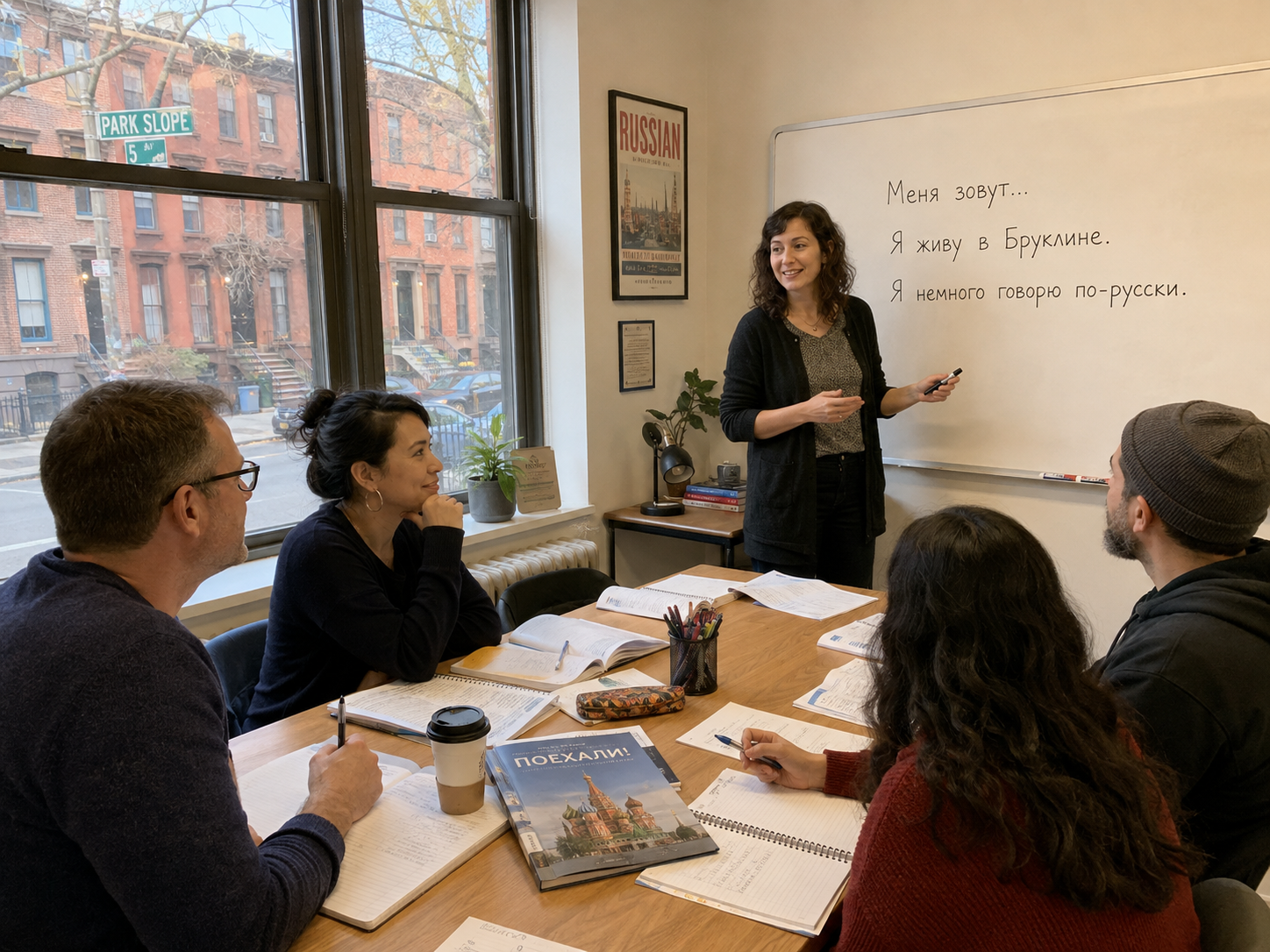
Brooklyn is an unusual place to start learning Russian. In many American cities, a student can go for weeks without hearing the language outside class. In parts of Brooklyn, particularly around Brighton Beach and Sheepshead Bay, Russian is part of ordinary neighborhood life. You hear it in grocery stores and cafés, see Cyrillic on storefronts and food labels, and encounter people using it for completely everyday conversations.
That sounds ideal for a language learner, and in some ways it is. The complication is that Brooklyn's large Russian-speaking community does not necessarily translate into a large selection of Russian classes designed for English-speaking adults.
Search for a “Russian school in Brooklyn,” and many of the programs you find are intended for children growing up in Russian-speaking families. Others assume that students already understand Russian. For an adult beginning from zero—or returning to the language after studying it years ago—the challenge is figuring out which programs actually teach Russian as a foreign language and which simply operate within a Russian-speaking community.
Fortunately, Brooklyn learners have several realistic possibilities, from private instruction and college courses to adult group classes elsewhere in New York and live online programs. The right choice depends less on finding the nearest place with the word Russian in its name and more on finding instruction that matches your actual level and the way you want to learn.
Brooklyn gives Russian learners something most cities cannot
The biggest local advantage is not necessarily the number of schools. It is the amount of Russian you can encounter once you leave the classroom.
At the beginning, this exposure may not seem very useful. Russian conversation moves quickly, and even a student who has learned the alphabet may hear little more than a stream of unfamiliar sounds. After several weeks of study, though, things begin to separate. You recognize a greeting. You hear a number you know. A word on a shop window suddenly makes sense.
If you spend time around Brighton Beach, you may begin recognizing basic words such as хлеб (bread) or аптека (pharmacy). A phrase that once sounded completely opaque may contain two or three words you understand.
That matters because real spoken Russian does not arrive at textbook speed. Learners need opportunities to hear different voices, speech rhythms, and sentence patterns, even when they cannot yet understand everything.
Brooklyn's Russian-speaking neighborhoods can provide that kind of background exposure unusually well. They cannot explain why a Russian noun suddenly changes its ending, correct your pronunciation, or tell you why a sentence that seems perfectly logical in English sounds strange in Russian. Those are the kinds of things beginners usually need systematic instruction for.
In practice, the two work well together: class gives you a framework, while everyday exposure makes that framework gradually feel less abstract.
Where can an adult actually study Russian in Brooklyn?
The options vary considerably depending on whether you want private lessons, a college environment, or a conventional adult group class.
Private Russian lessons in Brooklyn
For students who specifically want face-to-face instruction without leaving the borough, private lessons may be the easiest option to find.
Private instruction can be particularly useful when a student's background does not fit neatly into a standard class.
Someone may have taken Russian for two years in college fifteen years ago and still read Cyrillic fairly comfortably while remembering very little grammar. Another person may know a considerable amount of Russian from family but have almost no formal understanding of the language. Starting either student in an ordinary complete beginner class could mean spending weeks covering material they already know.
With individual lessons, an instructor can spend less time on familiar material and concentrate on the gaps.
Brooklyn College
Adults interested in a more academic approach should also look at Brooklyn College.
Its Russian curriculum includes elementary and intermediate Russian as well as more advanced study. Particularly interesting in a borough with a substantial heritage-speaking population is its separate course in basic reading and writing skills for heritage speakers.
Consider two people who both describe their Russian as “basic.” One has never studied the language and cannot read Cyrillic. The other grew up hearing Russian from parents or grandparents, understands much of what relatives say, and may even speak with convincing pronunciation, but has difficulty reading and writing.
They clearly do not need the same class.
A university program is also different from a casual evening language course. Students should expect a more academic structure and a semester-based commitment. Nondegree study may be possible for adults taking courses for personal enrichment, but individual courses depend on the semester and available space, so checking the current schedule is essential.
For someone who wants systematic study and likes a university environment, however, Brooklyn College is one of the more substantial Russian-learning options within the borough itself.
Adult group classes may be easier to find outside Brooklyn
A somewhat surprising part of looking for Russian classes in Brooklyn is that conventional adult Russian-as-a-foreign-language group courses can sometimes be easier to find in Manhattan than in the Russian-speaking neighborhoods of southern Brooklyn.
Depending on where you live, that may not be inconvenient at all.
Someone in Brooklyn Heights or Downtown Brooklyn may reach Lower Manhattan much faster than Brighton Beach. Even from other parts of the borough, the relevant question is usually not which class has a Brooklyn address but which one fits realistically into your week.
A course can look perfect on paper and still be a poor choice if getting there is such a production that you begin skipping classes after the first few weeks.
Group classes, private instruction, or online?
For a complete beginner with a predictable schedule, a small group class is often a very good place to start. There is structure, a regular meeting time, teacher correction, and other students to speak with. You also get used to understanding people other than your instructor.
Russian requires both explanation and practice. Students have to learn why words change and how sentences are built, but eventually they must produce those forms quickly enough to hold a conversation.
The Cyrillic alphabet tends to receive a disproportionate amount of attention before people start learning. It certainly looks intimidating at first, especially because letters such as Р, Н, and В resemble familiar English letters but represent different sounds. Most students, however, become comfortable decoding Cyrillic sooner than they expect.
The longer-term challenge is usually using Russian grammar while speaking. A learner may understand a rule perfectly on paper and still hesitate over an ending in the middle of a sentence. Regular interaction and correction are what gradually make those forms more automatic.
Private lessons make more sense when a student's needs are unusually specific. They are particularly useful for returning learners, heritage speakers, people with irregular schedules, or students preparing for a particular trip or professional situation.
Online classes are also worth considering seriously rather than treating them as a fallback. Brooklyn is enormous. A student can live in a borough famous for its Russian-speaking population and still be an hour away from an appropriate class.
For many working adults, live online instruction simply fits life better. They can still use Brooklyn's Russian-speaking environment for the part no online classroom can reproduce: hearing the language unexpectedly in normal daily situations.
Apps and independent study can help as well, especially for learning Cyrillic, reviewing vocabulary, or maintaining daily contact with the language. What they usually cannot provide is immediate correction. A teacher can hear that your stress is falling on the wrong syllable, notice that you keep using an English sentence pattern, or recognize that a grammatical mistake has become a habit.
Heritage Russian learners need a different kind of placement
Brooklyn has many people whose relationship with Russian does not resemble that of a typical foreign-language student.
A heritage learner may understand parents or grandparents very well but hesitate when answering. Another may speak fluidly at home but read slowly. Someone can have nearly native pronunciation and still make grammatical errors that a classroom learner would recognize immediately.
Vocabulary is often uneven too.
A person who grew up hearing Russian at home may know тарелка (plate), куртка (jacket), and убери комнату (clean your room) without thinking about them. The same person may struggle to discuss a work project, explain a political opinion, or write a formal email in Russian simply because those subjects were never part of family conversation.
This is why heritage learners should be cautious about automatically registering for a complete beginner course.
They may become bored with greetings, numbers, and basic pronunciation while still having significant gaps elsewhere. At the same time, an advanced class aimed at highly literate speakers may be far too difficult.
A useful placement process should look separately at listening, speaking, reading, writing, vocabulary, and previous formal study. Brooklyn College's separate heritage-language offering is one local example of recognizing that these students have different needs. Individual instruction can also work particularly well when someone's abilities are spread across several conventional levels.
This is also worth remembering when looking at schools in Brighton Beach or Sheepshead Bay. A program serving Russian-speaking families may be excellent at what it does while still being completely unsuitable for an English-speaking adult beginner.
One useful question to ask before registering is simply: Is this course designed to teach Russian as a foreign language to adults?
The answer often tells you immediately whether the program is worth investigating further.
Using Brighton Beach to practice without making it awkward
Once students realize how much Russian is spoken in parts of Brooklyn, they sometimes imagine that they should immediately start approaching native speakers for conversation practice.
There is no need to turn every trip to the grocery store into an oral examination.
For beginners, simply noticing the language is useful. Read signs and labels. Look for words you know. Listen for numbers, greetings, and familiar expressions. See whether you can understand the general subject of a short exchange without trying to translate every word.
When you become more comfortable, small interactions can happen naturally. You might use a greeting, ask a simple question, understand part of an answer, or complete a brief transaction in Russian. Even a very short exchange can be satisfying because it connects something learned deliberately in class with a real situation.
Hearing a grammatical form you have just studied used spontaneously by another person can also make it much easier to remember.
Cultural and community events provide another type of exposure. Russian-language events, library programming, conversation groups, and cultural organizations around New York change over time, so checking current schedules is worthwhile. These activities become especially useful once you can understand enough Russian to follow at least part of what is happening.
What should you ask before registering for a Russian class?
The word beginner is not standardized.
At one school it may mean a student who has never seen Cyrillic. Somewhere else it may describe the second or third course in a sequence. A heritage speaker can sometimes be called a beginner because they have never formally studied grammar even though they understand far more spoken Russian than the rest of the class.
Ask what students are expected to know before the first lesson.
It is also worth asking how much students actually speak during class. A course can describe itself as conversational while giving students surprisingly little opportunity to produce their own sentences. Find out whether the instructor corrects pronunciation and grammar, whether Cyrillic is introduced immediately, how large the group is, and whether there is a continuation course after the first term.
Class size matters because speaking time is finite. In a small group, each student can answer questions, make mistakes, receive corrections, and interact with classmates. In a much larger class, an individual learner may spend most of the hour listening.
For returning and heritage learners, it is better to ask how placement is determined than to guess from course names.
Learning Russian online from Brooklyn
For Brooklyn residents who prefer live online instruction, Polyglottist Language Academy offers Russian classes for adult learners at different levels, depending on the current schedule. The classes are taught live, with structured progression and opportunities to practice speaking rather than working only through prerecorded material.
Students who already know some Russian can also be placed according to their previous experience rather than automatically beginning from the first course.
View current Russian classes at Polyglottist Language Academy
For many Brooklyn learners, online instruction and local exposure fit together naturally. The class provides explanation, progression, correction, and regular speaking practice. Outside class, Brooklyn offers the less structured experience of simply hearing Russian as part of daily life.
After studying for a while, a walk through Brighton Beach begins to feel different. Cyrillic that once registered simply as unfamiliar lettering starts to contain recognizable words. A conversation passing beside you is no longer completely opaque. Perhaps you understand only a sentence fragment, but you know what you heard.
Living in Brooklyn will not teach someone Russian by itself. Once you begin studying seriously, though, it is difficult to think of many places in the United States where the language is quite so easy to keep encountering after class is over.