
Japanese Classes Near El Cerrito: Options for Adults in the East Bay
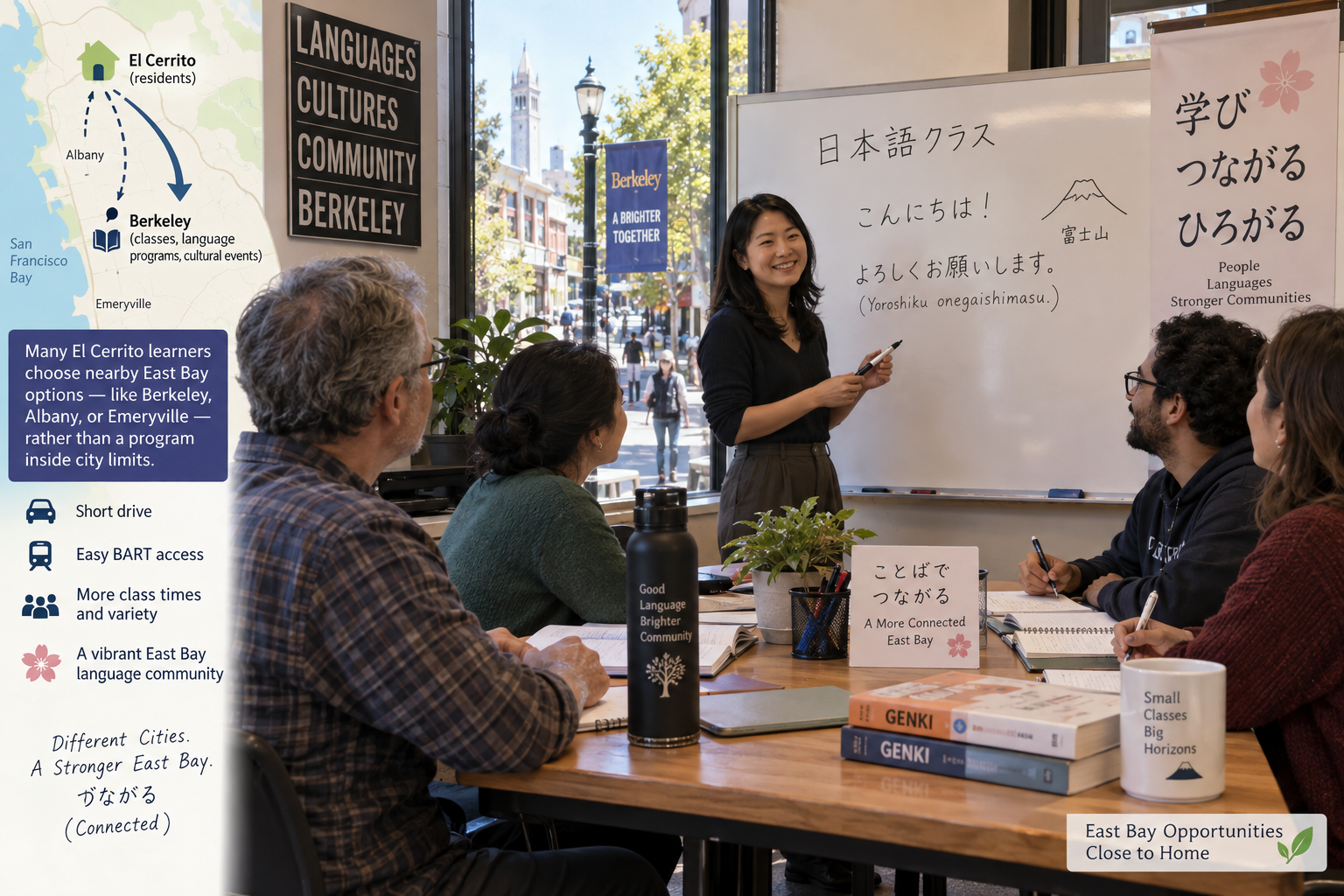
El Cerrito is a good example of a Bay Area city where the best Japanese class may not have “El Cerrito” in its address. The city is small, but it sits between Richmond, Albany, and Berkeley and has direct BART access. For an adult learner, that makes the realistic search area much larger than the city limits.
The useful question is therefore not “Is there a Japanese school in El Cerrito?” but “Which nearby option matches my level and schedule?”
A local resource people often miss: Sakura Kai
El Cerrito's own resource pages point residents to Sakura Kai, which currently meets at the Alvarado Adult School campus in Richmond. The program serves older adults and includes Japanese cultural activities as well as beginning Japanese.
This can be a meaningful local option for learners who fit the program's age and community focus. It is not, however, a general evening Japanese school for every adult. That distinction matters because search results sometimes list community programs without explaining who they are designed to serve.
Berkeley is often the most practical classroom option
For many El Cerrito residents, downtown Berkeley is easier to reach than programs elsewhere in Contra Costa County. BART makes the trip especially straightforward, and the distance is short enough that a weekly evening class does not necessarily become a major commute.
Polyglottist Language Academy offers small-group Japanese classes for adults in downtown Berkeley, including beginner levels, as well as online instruction. For someone in El Cerrito who wants a traditional adult classroom rather than a university course, that proximity can be more important than having an El Cerrito mailing address on the program.
UC Berkeley also has a substantial Japanese language program. Its courses are rigorous academic classes and can be excellent for eligible students, but they meet far more frequently and involve more work than a typical once-a-week adult course. That format suits some learners and overwhelms others.
Do not confuse heritage programs with beginner Japanese for adults
The East Bay has several Japanese schools connected to Japanese American communities. Some are designed primarily for children who are maintaining or developing Japanese as a heritage language. Others offer classes for teens and adults or for Japanese learners as a second language.
The names can look similar online. Before registering, check the age group, teaching language, assumed literacy, and whether the curriculum is designed for native/heritage speakers or adult second-language learners.
What should a beginner class actually cover?
A complete beginner needs more than memorized greetings. In the first term, students should begin using basic patterns such as:
これは何ですか。 — What is this?
コーヒーが好きです。 — I like coffee.
どこに行きますか。 — Where are you going?
At the same time, they should learn hiragana and start reading short, controlled material. A course that delays all reading can make later progress unnecessarily difficult; a course that focuses only on writing can leave students unable to have a basic exchange.
Conversation groups are useful later, not always first
Adult beginners are often drawn to conversation meetups because they sound less formal. The problem is that free conversation is difficult when you do not yet have enough grammar or vocabulary to sustain it.
Once you can make basic sentences, however, conversation practice becomes extremely valuable. A structured class can provide the foundation, while community events or informal groups provide the repetition and unpredictability that help Japanese become usable.
What about private lessons?
Private instruction makes sense when your schedule is unusual, you are preparing for a specific trip or exam, or your skills are uneven. It can also help heritage learners who do not fit standard beginner levels.
Group classes have a different advantage: you hear multiple people speak, learn from other students' questions, and practice communicating with more than one partner.
Choosing by transit, not by map distance
In the East Bay, five miles can be easier than two depending on traffic and transit. For an El Cerrito learner, a class near Downtown Berkeley BART may be more sustainable than one that requires a car trip at the wrong time of day.
That practical reality should influence your decision. Language learning rewards consistency, and a class you regularly miss because the commute is unpleasant is not actually convenient.
El Cerrito adults have more Japanese-learning choices than a city-only search suggests. The strongest route is usually to combine the city's proximity to Berkeley and Richmond with the broader Bay Area's online options, then choose the class that truly matches your level. Geography matters, but the right level and a schedule you can maintain matter more.
Explore In-person Japanese Classes in Berkeley and Online Classes at Polyglottist Language Academy