
Traveling to Vietnam? Learn These Vietnamese Phrases Before You Go
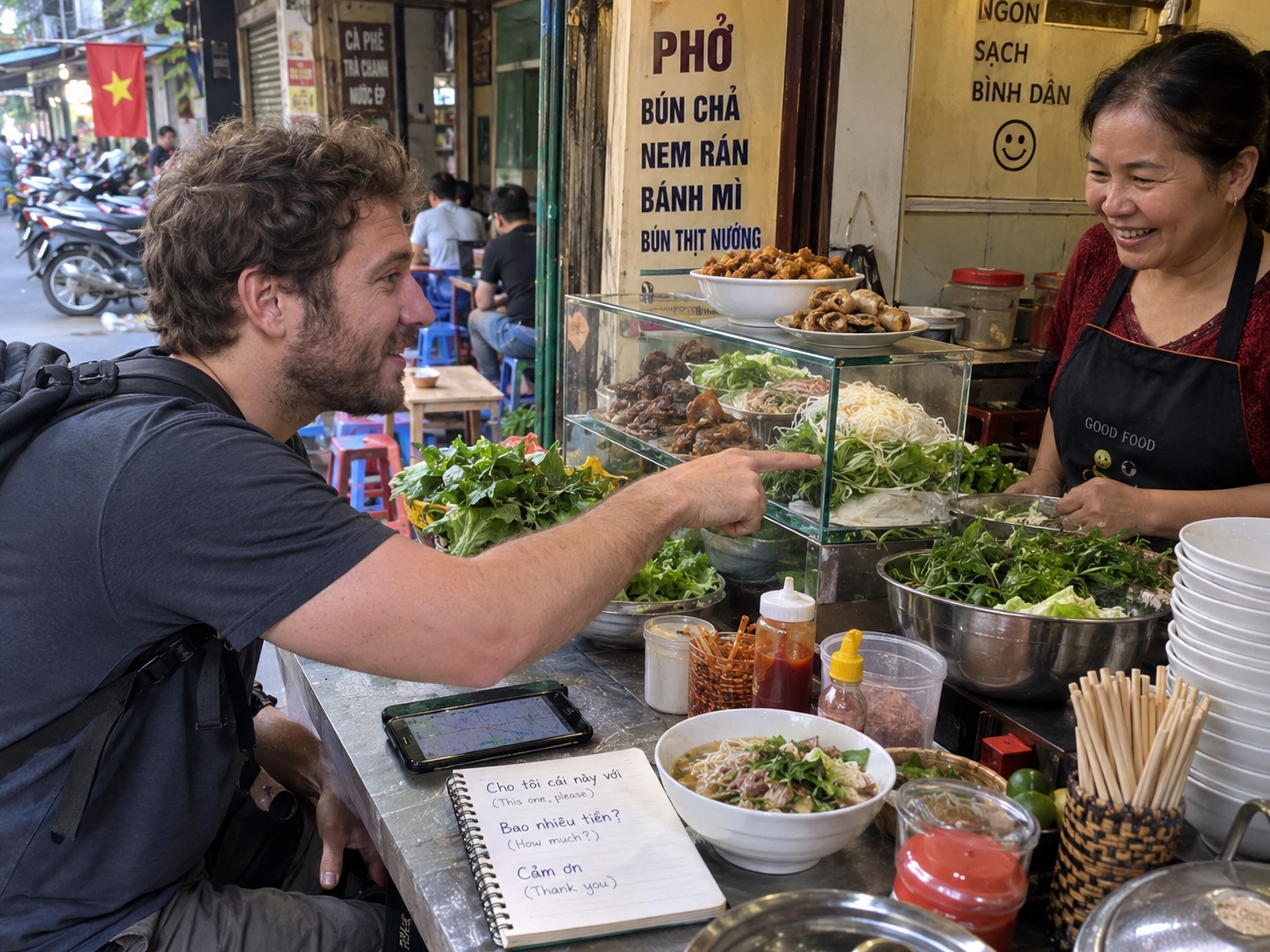
Imagine sitting down at a small restaurant in Vietnam where the menu has photographs but very little English. You do not really need to explain where you are from, recite a formal greeting, or produce the introduction you practiced before the trip. What you need is much simpler.
You point to a dish and say:
Cho tôi cái này với.
I'll have this one, please.
Later, when the server says something you cannot follow, another phrase becomes considerably more useful:
Tôi không hiểu.
I don't understand.
And at a market the next morning:
Cái này bao nhiêu tiền?
How much is this?
That is the kind of Vietnamese worth learning before a trip. You do not need fifty elaborate sentences memorized from a phrasebook. A small group of expressions that you can actually remember, combined with a few flexible words, numbers, and gestures, will probably get much more use.
Vietnam's official tourism materials make a similar choice in their basic phrase guidance, emphasizing expressions such as xin chào, cảm ơn, tôi không hiểu, and bao nhiêu tiền? rather than complicated tourist dialogues.
There is one thing worth knowing before you start memorizing anything: Vietnamese pronunciation matters.
Learn Fewer Phrases, but Learn How They Sound
Vietnamese is tonal, which means pitch is part of the word rather than something added for emphasis. A different tone can change the meaning of a syllable, and Vietnamese also contains vowel and final-consonant distinctions that English speakers may not hear easily at first.
This does not mean you need perfect pronunciation before ordering lunch. It does mean that learning twenty-five phrases from an English-looking phonetic transcription the night before your flight is not necessarily the best use of your time.
Five or ten phrases practiced repeatedly with native audio are likely to serve you better. Listen to the entire sound of the phrase rather than reading Vietnamese letters as though they followed English pronunciation. Your tones will probably still be imperfect, particularly if you have only studied for a few days, but context helps a great deal.
If you are holding up an item at a market while asking Bao nhiêu tiền?, the seller already has a good idea of what you mean.
You will also hear regional differences. Vietnamese spoken in Hanoi does not sound exactly like Vietnamese spoken in Ho Chi Minh City, and Central varieties bring additional differences. A short-term traveler does not need to learn several pronunciation systems. Choose one reliable pronunciation model, practice it consistently, and expect real Vietnamese to sound more varied once you arrive.
Learn How to Get Unstuck
Travel phrasebooks devote plenty of space to sentences such as “I am from the United States” or “I am traveling with my family.” Those can be pleasant to know, but they do not solve one of the most common beginner problems: someone answers you in Vietnamese.
A few phrases for repairing the conversation are much more useful.
Tôi không hiểu.
I don't understand.
If the problem is speed:
Xin nói chậm lại.
Please speak more slowly.
A slightly fuller version is:
Nói chậm lại một chút được không?
Could you speak a little more slowly?
And if you simply need another attempt:
Nói lại được không?
Could you say that again?
These phrases matter because asking a question is only half of travel communication. You may memorize “Where is the station?” perfectly, but the phrase is not very useful if the answer immediately becomes incomprehensible.
Another good one is:
Cái này là gì?
What is this?
You can use it with food, an unfamiliar object, something on a menu, or almost anything you can point to.
If you need to ask whether someone speaks English, you may hear a number of versions. A compact form is:
Biết nói tiếng Anh không?
Do you speak English?
You may also hear a form of address included, such as Anh có nói tiếng Anh không? or Chị có nói tiếng Anh không?, depending on whom you are speaking to.
That introduces a part of Vietnamese that is worth understanding even if you are visiting for only a week.
“You” Depends on Who You Are Talking To
English makes this part easy. Almost everyone is you.
Vietnamese frequently uses kinship and relationship terms instead. The word chosen can reflect age, gender, familiarity, and the relationship between the people speaking.
You will commonly hear:
anh — literally “older brother,” also used for a somewhat older man
chị — “older sister,” also used for a somewhat older woman
em — often used for someone younger
cô — an aunt-like form of address for an older woman
chú — an uncle-like form for an older man
You may also hear ơi added when someone is calling for another person's attention:
chị ơi
anh ơi
em ơi
For example, chị ơi may be a natural way to get the attention of a female server who is somewhat older than you.
You do not need to memorize the whole Vietnamese kinship system before your trip. It is extensive, and trying to master it quickly can create more anxiety than usefulness. Just understand that tôi = I and bạn = you is a useful beginner simplification, not a complete description of everyday Vietnamese.
Listen to how people address one another. After several days, you may begin noticing these words everywhere.
At Restaurants, Small Words Do a Lot of Work
Food is one of the easiest places to use a little Vietnamese because the situation provides so much context.
If you can point to what you want:
Cho tôi cái này với.
I'll have this one, please.
You can also say:
Cho tôi một...
Please give me one... / I'd like one...
Another useful structure is:
Tôi muốn...
I want / I'd like...
Do not worry too much about finding an exact English equivalent for every Vietnamese expression. A phrase translated literally as “I want” does not necessarily carry exactly the same social tone as the English words.
A handful of modifiers will probably help you more than memorizing a complete restaurant dialogue:
không cay — not spicy
ít cay — less spicy / mildly spicy
không đường — no sugar
ít đường — less sugar
không đá — no ice
thêm... — more / add...
If you do not want spicy food, không cay is worth remembering. You may also hear it softened in conversation, for example Không cay nhé.
And when something is genuinely good:
Ngon quá!
So delicious! / Really good!
It is short, easy to remember, and far more likely to come in handy than most elaborate textbook restaurant dialogues.
There is one situation where improvising with a few words is not enough. If you have a serious food allergy, carry a clearly written Vietnamese allergy card that identifies the specific allergen and explains the severity. Do not rely only on your pronunciation or a two-word phrase when a misunderstanding could have medical consequences.
Vietnamese cafés offer another easy place to practice. A few useful terms are:
cà phê — coffee
cà phê đen — black coffee
cà phê sữa — coffee with milk, commonly condensed milk in Vietnamese coffee contexts
cà phê sữa đá — iced coffee with condensed milk
nóng — hot
đá — ice
ít đường — less sugar
không đường — no sugar
Coffee vocabulary varies somewhat by region and café, so you may hear names that do not match exactly what you studied. Pointing at a menu and using Cho tôi cái này với still works surprisingly well.
At Markets, Learn “How Much?” and the Numbers
If you learn only one shopping phrase, make it:
Bao nhiêu tiền?
How much is it?
If you are pointing to something specific:
Cái này bao nhiêu tiền?
How much is this?
You may also hear the shorter:
Bao nhiêu?
How much?
Another phrase you may find useful is:
Đắt quá.
Too expensive.
And in a market or informal setting where bargaining is actually appropriate:
Bớt được không?
Can you lower the price?
Bargaining is not appropriate everywhere. A traditional market or souvenir stall may be negotiable; a convenience store, supermarket, restaurant with printed prices, or other fixed-price business generally is not. You do not need to haggle over every purchase just because you are traveling.
Numbers are probably worth learning before another ten specialized phrases:
một — one
hai — two
ba — three
bốn — four
năm — five
sáu — six
bảy — seven
tám — eight
chín — nine
mười — ten
Because prices in Vietnamese đồng can quickly move into the tens or hundreds of thousands, you will also encounter the word for “thousand.” Nghìn is especially associated with Northern speech, while ngàn is common in the South.
You do not need to become fast at Vietnamese arithmetic. Prices are often visible, and showing a number on a phone or calculator is perfectly normal. But recognizing a few spoken numbers makes a surprising difference when buying food, paying for something, or confirming a quantity.
Getting Around, Checking In, and Finding What You Need
Phones have changed how much direction vocabulary travelers really need. You can show a driver a map pin or hotel address instead of attempting to describe a complicated route in Vietnamese.
A few phrases remain useful:
Ở đâu?
Where? / Where is it?
Ở đây.
Here.
Dừng ở đây.
Stop here.
Đi thẳng.
Go straight.
Bên trái.
On the left.
Bên phải.
On the right.
Dừng ở đây is particularly useful when you are already close to your destination and simply need a driver to stop.
It is still wise to keep destinations written on your phone. Vietnamese place names are tonal too, and a name that appears straightforward in Latin letters may sound quite different when pronounced according to English habits.
At hotels, you may end up using English much of the time, especially in places accustomed to international visitors. There is little benefit in memorizing a long check-in conversation simply for the sake of having one.
A couple of phrases can still help:
Tôi đã đặt phòng.
I have booked a room / I have a reservation.
Mật khẩu Wi-Fi là gì?
What is the Wi-Fi password?
For an unusual problem, showing the issue or using a translation app will often work better than trying to remember a highly specific sentence you practiced weeks earlier.
The same principle applies elsewhere. Learn phrases you are likely to reuse. Let your phone help with the odd situations.
One question almost every traveler eventually needs is:
Nhà vệ sinh ở đâu?
Where is the restroom?
It may not be glamorous Vietnamese, but it is considerably more useful than being able to explain your hobbies.
The same ở đâu? structure gives you:
Nhà thuốc ở đâu?
Where is the pharmacy?
Bệnh viện ở đâu?
Where is the hospital?
And if you need assistance:
Giúp tôi với.
Please help me.
In a serious medical or safety situation, do not depend on memorized travel Vietnamese. Use translation tools, hotel staff, guides, emergency assistance, or someone who can interpret accurately.
Your Translation App Is Part of the Toolkit
There is no particular virtue in going through Vietnam without opening a translation app.
Use one when it makes things easier.
Translation tools are especially helpful for addresses, uncommon ingredients, complicated requests, written messages, or anything too important to trust to beginner pronunciation.
Knowing some Vietnamese still changes the interaction in small ways. You can begin without immediately holding up a phone. You may understand the number someone says. You can ask for repetition. You might recognize enough of an answer to work out what is happening before you need translation.
For ordinary travel, that combination tends to work better than expecting either technology or memorized phrases to do everything.
Ten Phrases Worth Learning First
If your flight leaves soon and you only have time for a small set, I would start with these:
1. Cảm ơn.
Thank you.
2. Xin lỗi.
Sorry / excuse me.
3. Tôi không hiểu.
I don't understand.
4. Xin nói chậm lại.
Please speak more slowly.
5. Nói lại được không?
Could you say that again?
6. Cái này là gì?
What is this?
7. Cho tôi cái này với.
I'll have this one, please.
8. Bao nhiêu tiền?
How much is it?
9. Nhà vệ sinh ở đâu?
Where is the restroom?
10. Dừng ở đây.
Stop here.
I would also learn Giúp tôi với (“Please help me”), even if you never need to use it.
What is missing from this list is intentional. There is no elaborate introduction, no vocabulary for fifteen professions, and no memorized restaurant conversation. These phrases are useful because you can reuse them in many different situations.
About “Xin Chào”
Almost every beginner learns:
Xin chào.
Hello.
It is correct, understandable, and useful.
Once you arrive, though, you may notice that people do not necessarily say xin chào every time they greet someone. Vietnamese forms of address are woven deeply into ordinary conversation, so you may hear anh, chị, or em, and combinations involving those words, much more often than your first phrasebook suggested.
There is no reason to stop using xin chào because you are worried about sounding like a beginner. You are a beginner, and the phrase works.
What is useful is noticing what other people say. Travel gives you a chance to hear the difference between the language presented in an introductory lesson and the language that appears naturally around you.
What I Would Not Spend Much Time Memorizing
If you only have a week or two before departure, I would not spend much of it on long prepared dialogues.
You probably do not need a paragraph describing your family, a list of occupations, every imaginable hotel complaint, or a sentence as specific as “Could you tell me which platform the 7:35 train leaves from?”
Long, highly specific phrases are difficult to retrieve when the real situation turns out to be slightly different from the one you memorized.
A few flexible words are more useful:
không — no / not
ít — little / less
thêm — more / add
này — this
đây — here
đâu — where
gì — what
một — one
Once you start recognizing these, Vietnamese around you becomes a little easier to break apart.
Cái này là gì? gives you này and gì.
Nhà vệ sinh ở đâu? gives you đâu.
Tôi không hiểu gives you không.
They stop being isolated travel sentences and become pieces you notice again elsewhere.
If Vietnam is still a few months away, it is worth going beyond survival phrases and spending some time on pronunciation, listening, and basic conversation. Polyglottist Language Academy offers Vietnamese instruction for adults, including live study that allows learners to practice hearing and responding rather than simply memorizing lines before a trip. POLYGLOTTIST VIETNAMESE CLASSES