Vietnamese Grammar for Beginners: What Makes It Different from English
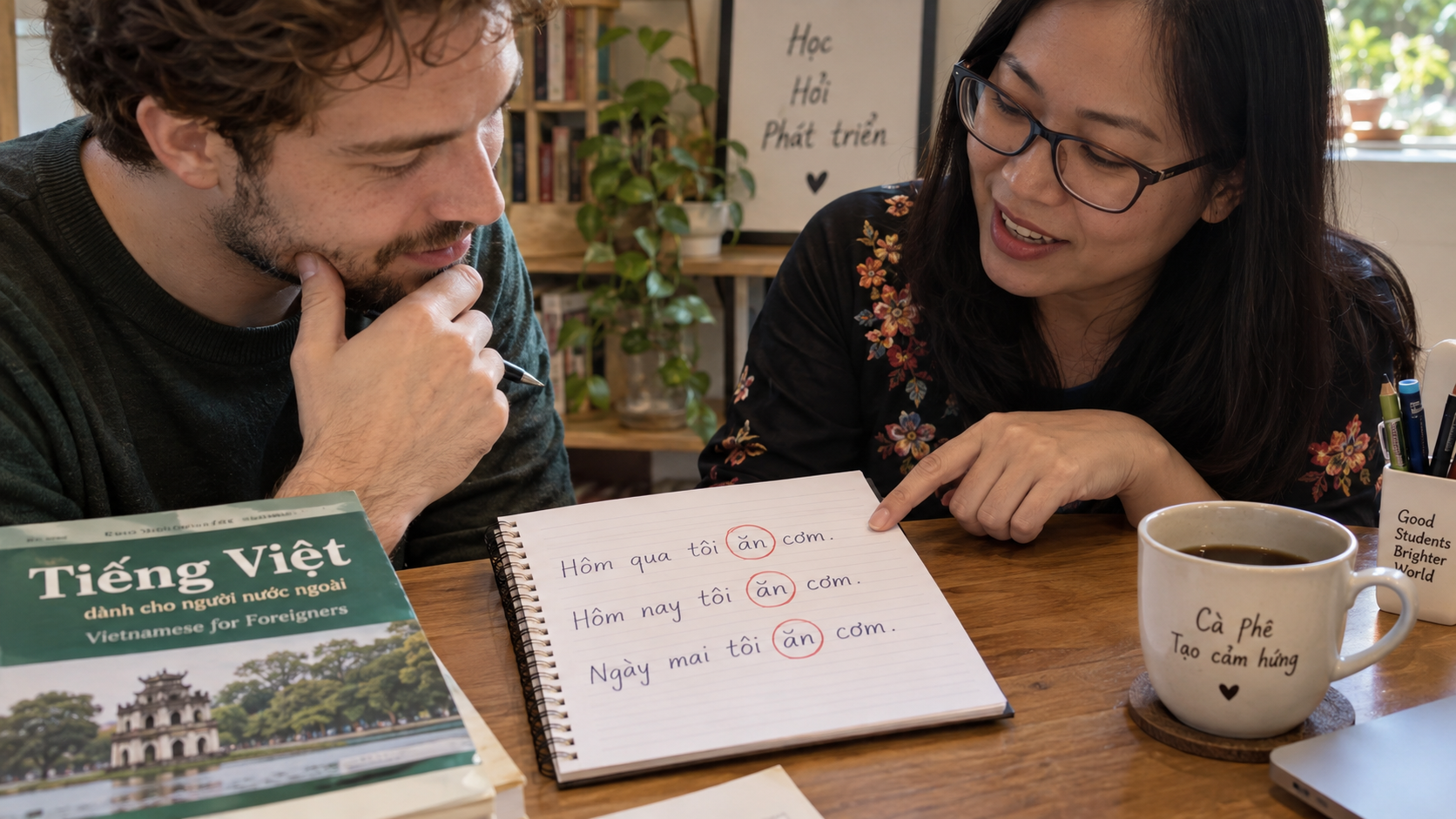
Consider three very simple sentences:
Hôm qua tôi ăn cơm.
Yesterday I ate rice.
Hôm nay tôi ăn cơm.
Today I eat rice / I am eating rice.
Ngày mai tôi ăn cơm.
Tomorrow I will eat rice.
The Vietnamese verb ăn, “to eat,” has not changed at all. English moves from eat to ate and then adds will for the future. Vietnamese can leave the verb alone and let expressions such as hôm qua (yesterday), hôm nay (today), and ngày mai(tomorrow), together with context, tell us when something happens.
For an English-speaking beginner, this can feel almost suspiciously easy. Where are the conjugation tables? What happens to irregular verbs? When do you learn the Vietnamese equivalent of I went, she goes, they have gone?
There is good news: Vietnamese really does spare learners many of the verb changes that occupy so much time in languages such as French, Spanish, or Russian. But that does not mean Vietnamese has very little grammar. Much of the information English expresses by changing the shape of a word is handled in Vietnamese through word order, context, separate grammatical words, classifiers, and forms of address.
That difference becomes much easier to understand once you stop looking for Vietnamese versions of English grammar and start paying attention to how Vietnamese builds meaning on its own terms.
Vietnamese Verbs Give Beginners a Break
One of the genuinely pleasant things about Vietnamese grammar is that verbs do not change according to the subject.
Take ăn:
tôi ăn — I eat
bạn ăn — you eat
anh ấy ăn — he eats
chúng tôi ăn — we eat
English has the small but annoying he eats distinction. Other languages may change the verb for almost every person. Vietnamese leaves ăn alone.
The verb itself also does not acquire a special past-tense form comparable to English ate. There is nothing like go/went or buy/bought to memorize.
Vietnamese still needs to communicate whether an action happened previously, is happening now, has been completed, or is expected in the future. It simply does so differently.
Beginners soon encounter words such as đã, đang, and sẽ:
Tôi đã ăn.
I ate / I have eaten.
Tôi đang ăn.
I am eating.
Tôi sẽ ăn.
I will eat.
It is tempting to memorize these as:
đã = past
đang = present continuous
sẽ = future
That is useful as an initial shortcut, but it is not the whole story. These words do not line up perfectly with English tense forms, and Vietnamese often leaves them out when time is already obvious.
If someone says Hôm qua tôi ăn phở, the phrase hôm qua already establishes that the action took place yesterday. Vietnamese does not always need additional grammatical marking simply because English would change the verb.
This is one of the first habits English speakers have to develop: if the information is already clear, Vietnamese may not repeat it grammatically.
Simple Vietnamese Sentences Can Feel Familiar
Basic Vietnamese word order is often reassuringly recognizable to an English speaker.
Tôi học tiếng Việt.
I study Vietnamese.
The structure is subject + verb + object, just as it is in English.
Tôi uống cà phê.
I drink coffee.
Cô ấy đọc sách.
She reads books.
That familiarity helps beginners begin making useful sentences quite early. The differences become more noticeable once you start adding descriptions, questions, possession, time, and other information.
One of the first small adjustments is adjective placement.
English says:
a beautiful house
a red car
Vietnamese commonly puts the noun first:
nhà đẹp
beautiful house
xe đỏ
red car
Students often understand this rule immediately and then continue putting adjectives first when speaking because the English pattern is so automatic. That is typical of beginner grammar problems: the rule itself is not necessarily difficult, but using it without stopping to translate requires repetition.
The same issue appears again and again in Vietnamese. Much of the grammar is not complicated in the sense of requiring enormous charts. The challenge is persuading your brain to stop constructing an English sentence first.
Then You Meet Classifiers
Sooner or later, a Vietnamese beginner encounters a phrase such as:
một con chó
one dog
Why is con there?
Or:
một cái bàn
one table
Why not simply một bàn?
Vietnamese uses classifiers extensively with nouns, particularly when counting or identifying them. Different kinds of nouns commonly appear with different classifiers.
For example:
một con chó — one dog
hai con mèo — two cats
một cái bàn — one table
một quyển sách — one book
Con is frequently associated with animals, cái is widely used with objects, and quyển or cuốn commonly appears with books and bound items.
For an English speaker, classifiers can initially seem like mysterious extra words. English does have somewhat similar constructions: a piece of paper, a cup of coffee, a pair of shoes. We do not normally say “two papers” when we mean two sheets of paper.
Vietnamese takes this kind of categorization much further.
The mistake beginners sometimes make is trying to memorize a giant classifier list before they can say anything. That is rarely necessary. A handful of frequent classifiers goes a long way initially, and repeated encounters with noun-classifier combinations gradually make them more familiar.
There are also nuances and exceptions that become important later. At beginner level, it is enough to understand that classifiers are a normal part of Vietnamese noun phrases and not decorative words that can always be ignored.
Pronouns Are Where Grammar Becomes Social
If Vietnamese verbs seem easier than English verbs, pronouns tend to produce the opposite reaction.
An English speaker expects a vocabulary list to tell them:
I = ___
you = ___
he = ___
she = ___
Vietnamese does have words such as tôi and bạn, and beginner courses understandably introduce them early. But real forms of address are much more closely connected to the relationship between the people speaking.
Words that are also family terms can function as pronouns and forms of address:
anh — older brother; also commonly used for a somewhat older male
chị — older sister; also commonly used for a somewhat older female
em — younger sibling/person in relation to an older speaker
cô — aunt-like term and form of address in certain age relationships
chú — uncle-like term and form of address in certain age relationships
This is one area where grammar cannot be separated neatly from social interaction.
Suppose two adults meet. Their choice of how to refer to themselves and one another can depend on perceived age, gender, familiarity, and relationship. The English words I and you reveal almost none of this.
That is why memorizing tôi = I and bạn = you does not fully prepare someone for an actual Vietnamese conversation. Both words are useful, but repeatedly using them in situations where Vietnamese speakers would naturally choose relationship terms can sound distant or unusual.
Beginners do not need to master the entire Vietnamese kinship system before opening their mouths. They should, however, learn early that pronoun choice is flexible and relational. It is normal to need context before deciding what “I” and “you” should be.
This is also one reason Vietnamese can feel very different outside an app. An exercise can tell you which answer is grammatically correct. A real conversation requires you to decide how you stand in relation to the person in front of you.
Questions Do Not Need English-Style “Do”
English has a peculiar habit that native speakers rarely think about.
We say:
You like coffee.
But to make that into a question, we usually need:
Do you like coffee?
The auxiliary do suddenly appears.
Vietnamese does not need to reconstruct the sentence in the same way.
A beginner may learn:
Bạn thích cà phê không?
Do you like coffee?
Here không helps turn the statement into a yes/no question.
You may also encounter:
Bạn có thích cà phê không?
Again, the underlying sentence remains quite recognizable.
Question words also behave differently from English in many constructions. Useful beginner words include:
ai — who
gì — what
ở đâu — where
khi nào — when
tại sao / vì sao — why
English frequently moves its question word toward the front:
What are you eating?
Vietnamese often leaves the question word in the position occupied by the unknown information:
Bạn ăn gì?
What are you eating?
Literally, the order is closer to “You eat what?”
To an English-speaking beginner, that may sound backwards for about five minutes. Then it begins to seem rather logical.
Saying “No” Is Often Simpler Too
Negation offers another structure many beginners appreciate.
Tôi hiểu.
I understand.
Add không:
Tôi không hiểu.
I don't understand.
Or:
Tôi không biết.
I don't know.
English requires do not because of how English verbs work. Vietnamese can place không before the verb or predicate.
This does not mean không explains every possible kind of Vietnamese negation, but for a beginner it covers a great deal of useful territory.
Notice how quickly this becomes practical language. Tôi không hiểu is not an abstract grammar example invented for a textbook. It is one of the most useful sentences a beginning Vietnamese learner can know.
English “To Be” Creates Some Very Predictable Mistakes
English uses forms of to be everywhere:
She is a teacher.
She is beautiful.
She is at home.
It is easy to assume another language will need one equivalent verb in all three sentences.
Vietnamese does not.
When identifying or classifying someone, là is commonly used:
Cô ấy là giáo viên.
She is a teacher.
A beginner sees this and may understandably conclude:
là = am/is/are
Then comes:
Cô ấy đẹp.
She is beautiful.
No là.
Putting là before an ordinary adjective because English requires is is a classic transfer from English grammar.
The difficulty is not that the Vietnamese construction is complicated. In some respects it is simpler. The difficulty is that an English speaker keeps feeling that something must be missing.
Vietnamese simply does not require the same grammatical machinery in that sentence.
Location and existence also use structures that cannot be reduced to one universal Vietnamese equivalent of English to be. This is worth learning as a pattern rather than trying to make là perform every job that is performs in English.
Vietnamese Doesn't Have English-Style “A” and “The”
Articles create a similar situation.
English speakers constantly distinguish:
a book
the book
Vietnamese does not have direct equivalents of English a, an, and the that must be inserted according to the same set of rules.
At first this sounds like another thing you no longer have to worry about.
It is, to some extent. But Vietnamese still has ways of indicating whether a speaker means a particular object, one object among many, or something already known in the conversation. Classifiers, demonstratives, numerals, and context all contribute.
Again, the communicative information has not vanished simply because Vietnamese lacks the English grammatical category.
This is a useful way to think about Vietnamese grammar more generally. Instead of asking, “Where is the Vietnamese word for the?” ask what information the is contributing to the English sentence and how Vietnamese would naturally make that meaning clear.
Sometimes the answer is that no extra word is necessary.
Plurals Work Differently as Well
English marks plurality aggressively:
one book
two books
Vietnamese nouns themselves do not acquire an -s ending.
If a number already makes the quantity obvious, nothing needs to happen to the noun in the English sense of pluralization.
Vietnamese also has words such as những and các that can indicate groups or plurality in appropriate contexts, but treating either one as a Vietnamese version of English -s creates another set of mistakes. They are not obligatory every time a noun refers to more than one thing.
Context does a great deal of work.
This can feel vague to an English speaker at first because English has trained us to mark certain distinctions almost automatically. Vietnamese is often perfectly comfortable leaving information unmarked when everyone already understands it.
Possession Has Its Own Logic
A beginner can express possession with của:
sách của tôi
my book / book of mine
nhà của anh ấy
his house
The order may remind English speakers of expressions such as the book of mine rather than the more compact my book.
As learners hear more Vietnamese, they also discover that của does not need to appear mechanically in every relationship where English uses a possessive. Context and the closeness of certain relationships can make possession sufficiently obvious.
This is another case where a beginner rule is useful without being the final rule.
You can begin with của, make perfectly understandable sentences, and gradually learn when Vietnamese speakers naturally omit it.
So Is Vietnamese Grammar Actually Easy?
In certain respects, yes.
An English-speaking beginner does not have to memorize person-based conjugations. There is no eat/eats/ate paradigm attached to every new verb. Nouns do not take an English-style plural ending. Vietnamese also does not burden learners with a grammatical gender system comparable to the masculine/feminine noun systems found in many European languages.
These are meaningful advantages.
But a short grammar rule can still take time to use naturally.
It takes almost no time to understand that Vietnamese adjectives commonly follow nouns. It takes longer to stop saying the equivalent of “beautiful house” in English order when speaking quickly.
It is easy to memorize that không can make a negative sentence. It takes more exposure to understand all the situations in which Vietnamese speakers use or omit different grammatical markers.
Classifiers are straightforward in principle but require experience. Pronouns are easy to explain badly and much harder to use well because the correct choice depends on people rather than simply vocabulary.
In fact, forms of address may be one of the best examples of why Vietnamese grammar should not be judged by the length of its conjugation tables. There may be less morphology to memorize, but using the language naturally requires sensitivity to context.
The Biggest Beginner Mistake Is Translating Too Literally
A great many early Vietnamese mistakes begin with a perfectly grammatical English sentence.
The learner constructs the English thought and then searches for a Vietnamese replacement for every piece.
That approach produces predictable problems: adjectives end up in the wrong place, là appears where Vietnamese does not need it, English pronouns are mapped too rigidly onto tôi and bạn, and grammatical markers get added simply because English requires something in the equivalent sentence.
You can see the difference in a simple phrase such as:
Cà phê này ngon.
This coffee is good.
An English speaker may instinctively look for the missing is. Vietnamese does not need it.
Likewise:
Tôi đang học tiếng Việt.
I'm learning Vietnamese.
The Vietnamese sentence communicates an ongoing activity with đang, not by changing học into some equivalent of English learning.
Or:
Bạn có nói tiếng Việt không?
Do you speak Vietnamese?
There is no need to find a Vietnamese version of English auxiliary do.
Once beginners begin learning whole Vietnamese patterns instead of converting English grammar one component at a time, sentence building becomes much easier.
Grammar on Paper and Grammar in Conversation Are Different Skills
An app can teach that đang is associated with an ongoing action. A textbook can explain that không forms common negative constructions. A learner can memorize that adjectives often follow nouns.
All of that is useful.
The harder part comes when another person speaks to you and you have a second or two to respond.
Teachers often see students who understand a Vietnamese grammar rule perfectly when completing an exercise and then revert to English word order as soon as conversation speeds up. That is not evidence that the explanation failed. Intellectual understanding usually develops faster than automatic use.
This is why speaking practice matters even for learners who enjoy grammar. A pattern becomes useful when you can retrieve it without rebuilding the rule every time.
Teacher feedback can also help with distinctions that are difficult to learn from a simple right-or-wrong answer. A Vietnamese sentence may be understandable and even grammatically possible but still not be the way people would normally express that thought in a particular situation.
Pronouns are an obvious example. A vocabulary exercise can teach you tôi and bạn. A teacher can explain why a particular relationship might call for chị, anh, or em instead.
The difference between those two kinds of knowledge becomes increasingly important as your Vietnamese improves.
Heritage Speakers Often Encounter the Same Grammar Backwards
Someone who grew up hearing Vietnamese may experience all of this very differently.
A heritage learner may already choose classifiers, pronouns, word order, and particles instinctively but have no idea what any of those grammatical categories are called. Ask why one sentence sounds right and another sounds strange, and the answer may be little more than “I would never say it like that.”
That intuition is valuable.
Formal grammar can give names and patterns to knowledge that already exists rather than replacing it. A heritage learner may therefore need a very different emphasis from a complete beginner, particularly if listening and pronunciation are strong while reading, writing, or formal vocabulary developed less fully.
For both groups, though, the goal eventually becomes similar: moving from recognizing a pattern to being able to use it deliberately in new situations.
Learning to Think in Vietnamese Patterns
Vietnamese grammar becomes much less mysterious once you notice where the language puts information.
English changes verbs frequently. Vietnamese often leaves the verb unchanged and uses context or separate words. English depends heavily on fixed pronouns such as I and you. Vietnamese forms of address can change with the relationship between speakers. English marks plurals on nouns and relies on articles constantly; Vietnamese handles quantity and reference differently. English puts adjectives before nouns, while Vietnamese commonly puts them afterward.
None of this means Vietnamese has “less grammar.” It means the two languages distribute grammatical information differently.
If you'd like structured practice with these patterns, Polyglottist Language Academy offers language instruction for adult learners, including opportunities to work with an instructor rather than studying grammar only through isolated exercises. POLYGLOTTIST VIETNAMESE CLASSES