
Russian Classes in Washington, DC: A Guide for Adult Learners
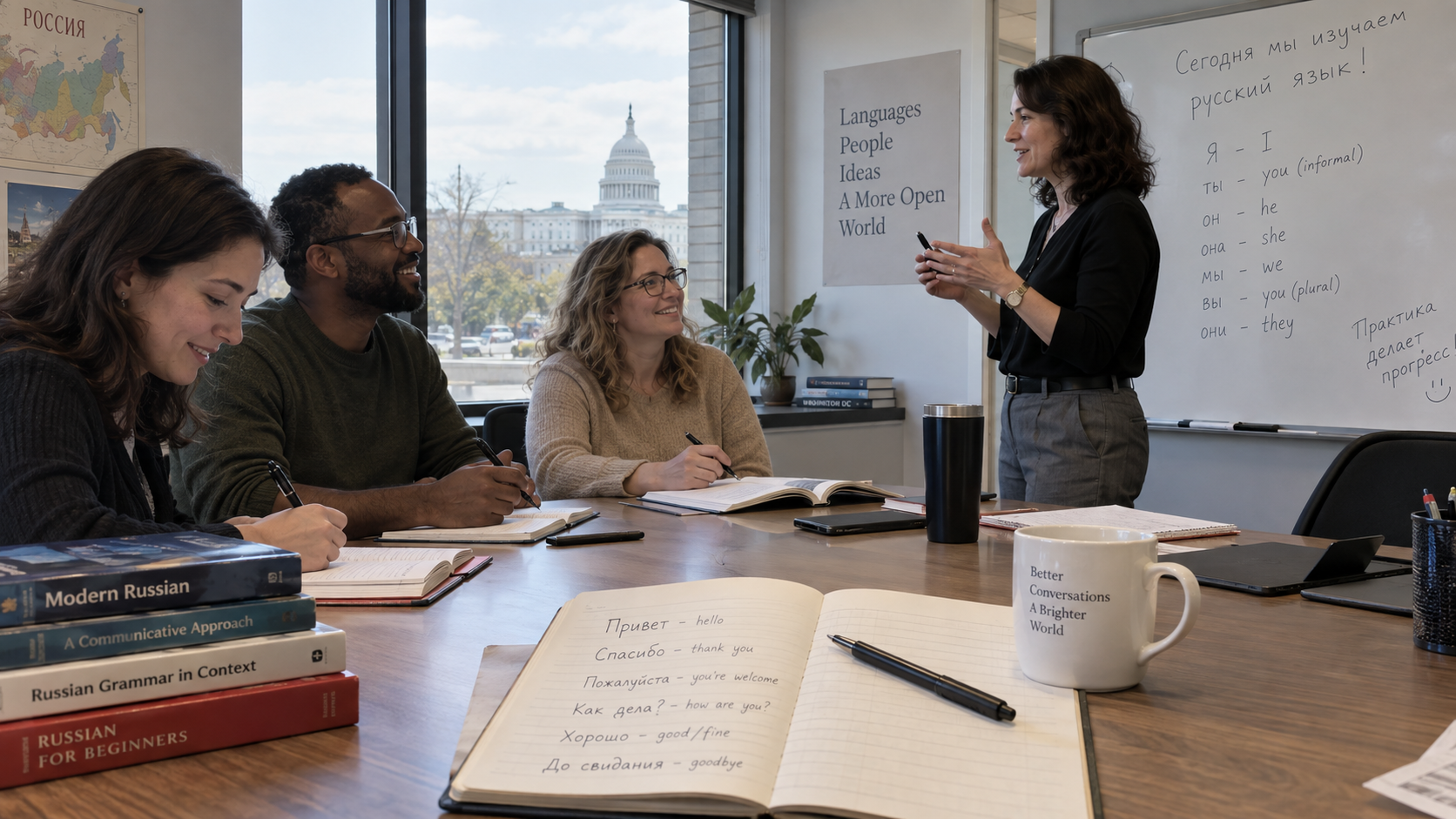
One of the first things that surprises many adults beginning Russian is that the Cyrillic alphabet is rarely the obstacle they imagined it would be. Before the first lesson, Russian can look almost impenetrable: some letters are completely unfamiliar, while others seem familiar but represent the “wrong” sounds. Yet after a little regular practice, most students begin recognizing and decoding Cyrillic fairly quickly. The more substantial challenge comes later, when reading individual letters is no longer the main task and learners have to understand why words keep changing their endings, where the stress belongs, and how to form a sentence quickly enough to use it in conversation.
For adults looking for Russian classes in Washington, DC, that distinction matters. A useful course should do more than teach the alphabet and explain grammar rules. It should help students move from recognizing Russian to actually using it. It also has to fit into adult life, which can be especially relevant in the Washington metropolitan area, where a one-hour evening class may require considerably more time once commuting from another part of DC, Maryland, or Northern Virginia is taken into account.
What Beginning Russian Actually Feels Like
Russian introduces several unfamiliar systems at once. A new learner is dealing with a different alphabet, unfamiliar sounds, grammatical gender, verb conjugation, and words whose endings change depending on how they function in a sentence. Even simple phrases can therefore feel unusually dense at first.
The alphabet is the most visible difference, but it often becomes familiar sooner than expected. Some letters are genuinely new, while others are confusing because they resemble Latin letters but represent different sounds. The Russian В, for example, corresponds to the English v, while Н represents n and Р represents r. At first, students often have to stop themselves from reading these letters as though they were English. With enough repetition, that habit fades.
There is also an important difference between knowing the alphabet and reading Russian comfortably. A learner may be able to identify every letter in Здравствуйте while still taking several seconds to work through the word. Later, the same word is recognized as a whole. At that point, attention can finally shift from decoding letters to understanding meaning.
The more complicated part of Russian becomes obvious once learners begin building sentences of their own. English speakers are accustomed to words remaining relatively stable. The word mother, for example, stays mother whether she is doing something, receiving something, or being spoken about. Russian uses endings to communicate much of this grammatical information.
A beginner may first learn:
мама — mother
and soon encounter:
маму
маме
мамой
These are not separate vocabulary words. They are forms of the same word, changed according to its role in the sentence.
This is one reason Russian grammar can feel confusing even when the individual rules make sense. A student may understand perfectly well that a noun requires the accusative case in a written exercise, yet hesitate when trying to use that same form in conversation. In real speech, there is no time to stop and reconstruct the grammar step by step. The learner has to understand what was said, retrieve vocabulary, choose the correct structure, pronounce it, and continue listening.
Teachers often notice that students perform better on written grammar exercises than they do when asked to use exactly the same material spontaneously. That does not mean the grammar exercises are ineffective. It simply shows that recognizing the right answer and producing it automatically are different stages of learning.
Russian Is Difficult, but Not Always in the Ways Beginners Expect
Russian has a reputation for being a difficult language, but that description becomes less useful once you actually start studying it. Some features that look intimidating become manageable fairly quickly, while others that seem minor at first continue causing problems much later.
Cyrillic is the clearest example. It makes Russian look dramatically different from English, but the basic writing system can be learned relatively quickly. Word stress, by contrast, appears much less intimidating at first and often causes more persistent trouble.
Russian stress is not reliably indicated in ordinary writing, and it can move when a word changes form. This means that learning vocabulary only from written lists has limitations. A student may recognize a word instantly on a flashcard yet fail to recognize it when a native speaker says it because the learner never stored its sound accurately.
Listening creates a similar problem. Beginner audio is normally pronounced carefully and designed to be understood. Ordinary speech between native speakers is not. Familiar words can sound different when spoken at normal speed, and learners have very little time to process each phrase before the conversation continues.
It is also common for students to understand their own instructor much more easily than an unfamiliar Russian speaker. They become accustomed to the teacher’s voice, pace, vocabulary, and recurring classroom expressions. That is a normal stage of development. Listening comprehension expands gradually as students hear more voices, more vocabulary, and less predictable speech.
Grammar presents another kind of difficulty because Russian does not map neatly onto English. The case system is one example, but verb aspect becomes increasingly important as students progress. Choosing a verb is not simply a matter of deciding whether something happened in the past, present, or future. Russian also often distinguishes between an action seen as a process, repeated activity, completed event, or result.
A complete beginner does not need to master every aspectual distinction immediately. The point is that Russian eventually requires learners to stop translating English structures word for word and begin recognizing patterns that belong to Russian itself.
Knowing the Rules and Speaking Are Two Different Skills
Adult learners are often quite good at understanding explanations. They may enjoy grammar, recognize patterns quickly, and complete exercises accurately. The difficulty comes when that knowledge has to be used under conversational pressure.
Consider a simple question:
Куда вы идёте? — Where are you going?
Answering it requires more than knowing what the words mean. The learner has to understand the question immediately, decide what to say, select the correct verb and destination, produce the appropriate grammatical forms, and pronounce the answer while another person is waiting.
Someone can therefore know a surprising amount of Russian and still feel unable to speak. The problem is often not a complete lack of knowledge but lack of automaticity.
This is why Russian classes work best when grammar explanation and communication are not treated as opposing methods. A course focused almost entirely on grammar can produce students who understand the language analytically but hesitate whenever they have to say something. A purely conversational approach can create a different kind of frustration, particularly for beginners who keep hearing changing endings without understanding why they are changing.
Most adults benefit from a balance. They want to know why мама becomes маму, but they also need to use the pattern enough times that they eventually stop consciously thinking about it every time they speak.
Where Apps Fit Into Russian Study
Many adults searching for Russian classes in Washington, DC have already studied on their own. They may have used Duolingo, flashcards, YouTube lessons, podcasts, or an online course before deciding that they want something more structured.
That work can be genuinely useful. Apps are good at encouraging regular exposure, reinforcing Cyrillic, reviewing vocabulary, and helping students notice familiar patterns. Someone who has been studying independently for several months may already understand much more Russian than they realize.
The limitation usually becomes apparent when passive recognition has to turn into conversation.
An app often presents vocabulary and structures in a predictable context. Another person does not. A teacher or classmate may ask a question the learner was not expecting, phrase something differently, or respond in a way that requires the conversation to change direction.
Live instruction also allows someone to notice patterns in a learner’s mistakes. A student might repeatedly put stress on the wrong syllable, use the same incorrect case ending, translate a particular English structure too literally, or produce a sentence that is understandable but unnatural. These are the kinds of issues that become much easier to correct when another person is listening closely.
For many adult learners, apps and classes work well together. Independent study provides extra repetition between lessons, while live instruction provides interaction, correction, and the experience of having to produce Russian without knowing exactly what sentence will come next.
“Beginner” Can Mean Several Very Different Things
Choosing the right Russian level is not always straightforward. Time spent studying tells only part of the story.
Someone who studied Russian for a year in college fifteen years ago may remember very little at first but recover familiar structures surprisingly quickly. Someone who has completed months of app lessons may know a large amount of vocabulary but have almost no experience speaking. Another learner may read Cyrillic comfortably while knowing very little grammar.
A true complete beginner usually benefits from starting systematically with pronunciation, the alphabet, basic sentence structures, common vocabulary, and fundamental grammar. Returning learners may not need to begin again from the first letter of Cyrillic, even if they feel rusty.
Heritage learners can be even harder to place because their skills often develop in a completely different order from those of classroom students. A person raised around Russian-speaking relatives may understand everyday conversation and have natural pronunciation but struggle to read. Another may answer family members mostly in English despite understanding almost everything they hear. Some know household and family vocabulary extremely well but lack words for work, education, current events, or other adult subjects.
Grammar can also be uneven. A heritage learner may use certain forms correctly because they sound right, without knowing the name of the grammatical case involved. Other structures may be much weaker.
For this reason, neither family background nor the number of years spent “studying Russian” is enough to determine placement. A more useful question is what the learner can currently understand, read, and produce.
What a Good Adult Russian Class Should Actually Do
“Find an experienced teacher” is reasonable advice, but it does not tell a prospective student much about what should happen during class.
Russian instruction for adults should normally combine pronunciation, listening, vocabulary, grammar, and speaking. Students need clear explanations, but they also need repeated opportunities to use the same structures independently. Vocabulary should appear in speech as well as on the page, and students should hear words often enough to learn their pronunciation and stress rather than memorizing spelling alone.
Repetition matters more than learners sometimes expect. Being introduced to a case ending once does not mean it has been acquired. The same pattern needs to return in new vocabulary, questions, conversations, and later lessons until the form begins to feel familiar rather than newly calculated every time.
A useful instructor also pays attention to the difference between mistakes that merely show the student is still learning and mistakes that interfere with communication or become persistent habits. Not every error needs to interrupt a conversation, but recurring problems with stress, endings, or sentence structure should not simply be ignored either.
Adults also tend to want explanations that respect the fact that they are adults. They do not necessarily want a university-style grammar lecture, but many appreciate understanding why a form changes rather than being told simply to memorize it.
In-Person and Online Russian Classes in the Washington Area
For someone specifically searching for Russian language classes in Washington, an in-person classroom may initially seem like the obvious choice. For some students, it is. Attending class physically can create a useful weekly routine, and many adults enjoy having a place where they meet classmates and step away from work and home responsibilities.
The practical calculation becomes different when the broader Washington metropolitan area is considered. A student may live in Arlington or Alexandria, work in DC, or travel from Bethesda, Silver Spring, Fairfax, or another part of Maryland or Northern Virginia. A one-hour class can easily require a much larger block of time once transportation is included.
That does not automatically make online learning better. It simply means that location is one factor among several.
A live online class is also quite different from a self-paced online course. Students can still ask questions, speak with an instructor, receive pronunciation and grammar corrections, interact with classmates, and follow a structured sequence of levels. For someone who wants live instruction but does not want to spend an evening crossing the metropolitan area, that can be a practical compromise.
Someone searching for “Russian classes in Washington DC” may therefore want to compare not only physical distance, but also class size, teaching style, opportunities to speak, level placement, and whether the schedule is realistic enough to maintain consistently.
What Early Progress in Russian Actually Looks Like
Adults sometimes measure progress according to whether they can “speak Russian,” which is such a broad standard that it can obscure what has actually changed.
Early progress is often much less dramatic. Cyrillic stops requiring conscious decoding. A familiar question is understood immediately instead of being translated word by word. Basic introductions become automatic. Case endings that originally looked random begin to form recognizable patterns.
Later, learners start producing sentences that they did not memorize in advance. The sentences may contain mistakes, and choosing the correct form may still require hesitation, but the student is beginning to create rather than repeat.
Different abilities rarely improve at exactly the same speed. One learner may read well but struggle with spoken Russian. Another may speak confidently while making frequent grammatical errors. A heritage learner may understand almost everything but have difficulty responding.
These uneven profiles are normal because “knowing Russian” is not one skill. Reading, speaking, listening, pronunciation, grammar, and vocabulary interact with one another but do not develop in perfect synchronization.
The Washington area also attracts adults with very different reasons for studying the language. Some encounter Russian through history, literature, international affairs, or regional studies. Others have Russian-speaking relatives or partners, want to travel, or simply become interested in the language itself. Russian is broader than any single professional or political context, and students often discover that the more they learn, the more ordinary and varied the language becomes: family conversations, humor, films, books, music, everyday expressions, and all the small choices native speakers make without thinking about them.
Finding a Russian Class That Can Take You Beyond the Beginning
For adults who want more structure than independent study provides, Polyglottist Language Academy offers live online Russian classes for adults, which can be attended from Washington, DC, Maryland, Northern Virginia, and elsewhere. Classes are designed around structured progression, teacher interaction, grammar, listening, and opportunities to use Russian in conversation rather than studying entirely through prerecorded lessons or exercises.
Related Articles
Is Russian Worth Learning? An Honest Look For English Speakers
Why Russian Feels Hard At First (And Why It Gets Easier After 6 Months)
Can You Learn Russian In A Year? What's Actually Possible And How To Do It
Why Russian Is A Critical Language — And What That Means For Your Career
Russian For Heritage Speakers: How To Reconnect With Your Roots Through Language