
Why Russian Feels Hard at First (And Why It Gets Easier After 6 Months)
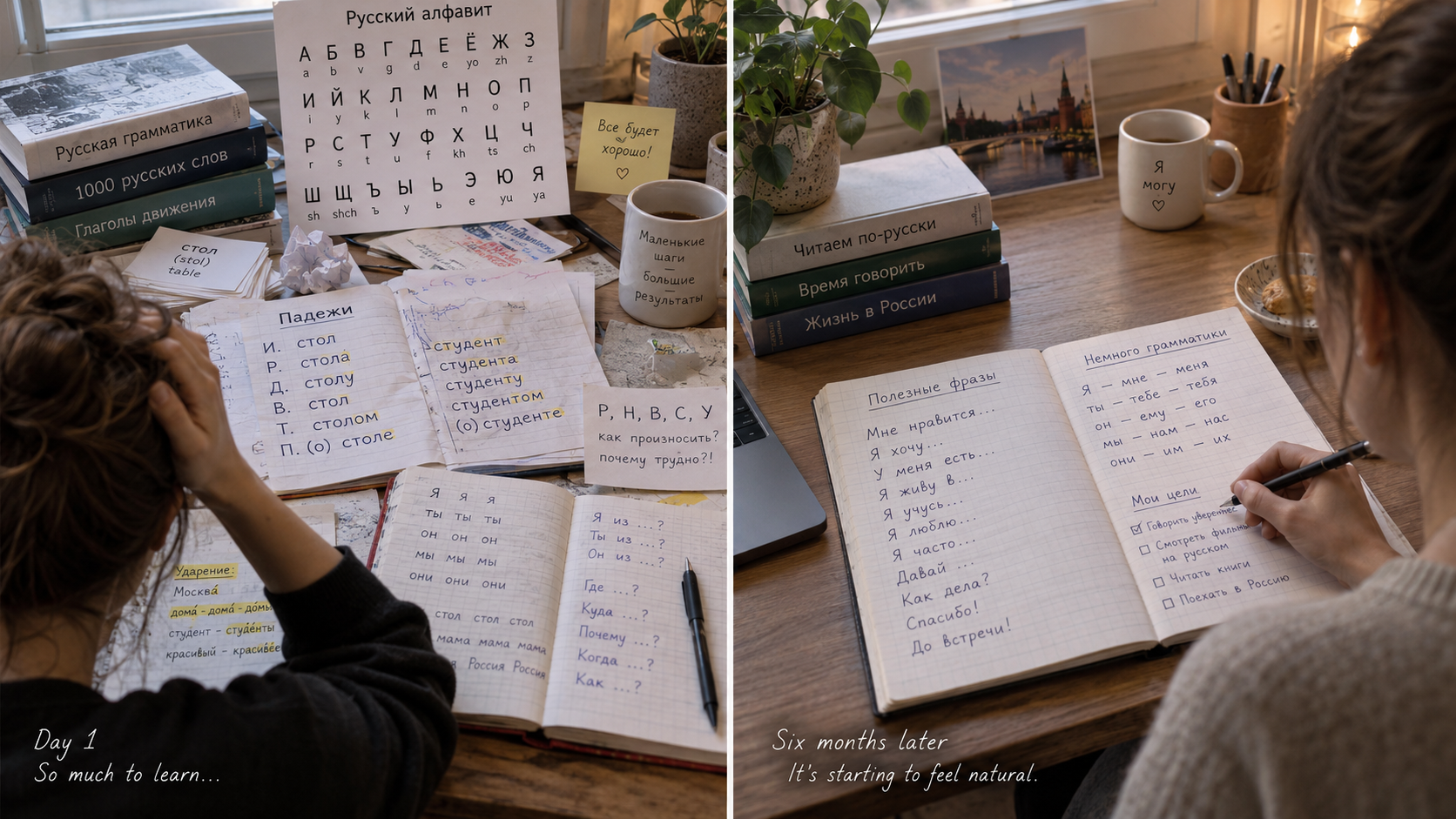
During the first few Russian lessons, even a very simple sentence can feel like a small engineering project. You are trying to remember that В sounds like v, that Р is r, that the stress may not fall where you expect it, that a noun ending has changed for some grammatical reason, and that the verb you just learned may not be the right verb for this particular situation.
Then the teacher asks an easy question. You know what you want to say in English, and you may even know all the Russian words individually, but assembling them into a sentence can take long enough that the conversation seems to move on while you are still putting the pieces together.
For many adult learners, this is the stage when Russian begins to feel unusually difficult. The problem is not simply that Russian has cases, unfamiliar verbs, or a different alphabet. It is that almost nothing is automatic yet, so every part of the language is competing for conscious attention.
After several months of regular study, that begins to change. Not suddenly, and certainly not on the exact day you reach six months, but often enough that learners notice a real difference somewhere around this stage. Russian has not become simple. You have simply stopped having to solve every piece of it from the beginning.
The alphabet feels like the first big obstacle
Before starting Russian, many people are most intimidated by Cyrillic. At first, that concern makes sense. Some letters are completely unfamiliar, while others are almost more confusing because they look familiar but represent different sounds.
Р is r. Н is n. В is v. С is s. У is u.
A new learner may read спасибо letter by letter, checking the alphabet mentally along the way. Even a short sentence takes effort because reading itself is still a separate task.
After a while, though, familiar words stop requiring that kind of decoding. Спасибо no longer looks like a sequence of symbols that has to be converted into sounds. You simply recognize it.
Students often overlook how significant this is because the alphabet stops feeling like an achievement once it becomes ordinary. Something that once consumed most of their attention quietly moves into the background, leaving more mental space for everything else Russian is about to introduce.
Once Cyrillic gets easier, the grammar becomes harder to ignore
Learning to read Russian is satisfying partly because the progress is visible. You go from not recognizing letters to reading words. Grammar develops less dramatically.
Very soon, beginners encounter the Russian case system. A noun learned in one form suddenly appears with another ending. Then adjectives change with it. Pronouns change too. Certain prepositions seem to require particular forms.
You learn стол, “table,” and then meet стола, столу, столом. To a beginner, this can feel as though a perfectly good vocabulary word keeps being replaced by slightly different versions of itself.
Several other systems arrive around the same time. Russian has grammatical gender. Verbs change according to tense and person. Past-tense verbs reflect gender in the singular. Verb aspect asks learners to distinguish between completed actions and processes in a way that English does not always make explicit. Later, verbs of motion introduce distinctions that can make the apparently simple idea of “going somewhere” surprisingly elaborate.
Stress adds another layer because ordinary Russian writing usually does not tell you where it falls. A student can read every letter correctly and still pronounce the word in a way that sounds wrong.
Individually, most of these concepts can be explained clearly enough. What makes the beginning exhausting is that several of them are operating in the same sentence before the learner has become comfortable with any of them.
Cases make vocabulary feel unstable
Cases are a particularly good example of how Russian feels different during the first months.
An English speaker is accustomed to learning a noun and expecting it to remain recognizable in most sentences. Russian asks the learner to become comfortable with endings changing according to the noun's grammatical role.
At first, this can create the impression that learning one Russian word really means learning five or six versions of it. Students may approach a sentence by mentally asking which case is required, remembering which ending belongs to the noun's gender and declension pattern, changing the adjective to match, and then checking whether a preposition changes the situation again.
That is a perfectly normal way to work when the material is new. The student is applying rules consciously because there is no faster route available yet.
After several months, familiar endings start looking familiar as endings, rather than as random changes attached to individual vocabulary words. A learner may see a common genitive or instrumental form and recognize the pattern before consciously thinking, “This is the genitive case.”
Mistakes do not disappear. Russian cases remain difficult long after the beginner stage. What becomes easier is that not every ending has to be treated as an entirely new grammatical event.
Speaking Russian can feel like doing grammar in real time
This difference becomes most obvious in conversation.
Imagine that you want to say something as simple as:
I went to the store yesterday.
In English, you say it without thinking about the grammar. A beginner in Russian may have several decisions competing for attention at once. Which verb of motion is appropriate? Which past-tense form do I need? Does the speaker's gender affect the ending? Which preposition goes with the destination? What case follows it? What is the word for “store” again? Where is the stress?
By the time all of that has been considered, the idea itself seems absurdly simple compared with the work required to express it.
This is one of the clearest differences between understanding Russian grammar and being able to use Russian. A student can explain perfectly well why a noun belongs in a particular case and still fail to produce the form quickly when someone is waiting for an answer.
Teachers see this constantly. Students often say they “don't know” a form when what they really mean is that they cannot retrieve it fast enough. Give them ten seconds and they may produce it correctly. Conversation rarely feels generous enough to provide those ten seconds.
Over time, that delay begins to shrink. The rule may still be there somewhere in the learner's mind, but it is no longer consulted quite so formally every time.
Russian vocabulary can feel unusually arbitrary at first
English speakers learning Spanish or French often receive some help from cognates. Even at a beginner level, many words look vaguely familiar.
Russian can feel less cooperative. Words such as магазин (store), работать (to work), понимать (to understand), and сегодня (today) may initially give an English-speaking learner very little to work with. They simply have to be learned.
During the first months, vocabulary can therefore feel like a long list of unrelated items. You memorize a word, forget it, relearn it, and then fail to recognize it when someone says it quickly.
With more exposure, the words stop feeling quite so isolated. Learners begin noticing roots, prefixes, suffixes, and families of related forms. A new word may contain something already familiar, and a verb that looked completely new at first may resemble another one encountered several weeks earlier.
You still have to learn vocabulary, but Russian begins giving you more clues than it did at the start. That makes guessing possible, and guessing is something absolute beginners rarely have enough information to do.
Stress gradually moves from memory into intuition
Russian stress can be frustrating because it often has to be learned with the word and may shift between related forms. Beginners frequently rely on dictionary marks, textbook accents, or deliberate memorization.
Later, high-frequency words develop a familiar sound shape. A learner may hear an incorrectly stressed version and feel that something sounds odd before they can explain exactly what is wrong.
That small reaction is worth noticing. The student is beginning to build an internal sense of Russian sound rather than following pronunciation instructions one word at a time.
Grammar develops in a similar way. Some forms eventually start sounding wrong before the learner has consciously reconstructed the rule. That kind of intuition only appears after the correct patterns have been heard and used many times.
Why the first three months can feel disappointingly slow
Adults often imagine language progress in a fairly orderly sequence. First basic vocabulary, then simple conversation, followed by gradually increasing fluency.
Russian rarely feels that tidy.
During the early months, a large amount of effort is going into building infrastructure. Cyrillic is becoming automatic. The ear is learning to separate Russian speech into recognizable pieces. Common endings are appearing repeatedly. Basic verbs are being stored. Pronunciation is becoming less foreign, and the learner is discovering that some English sentence patterns cannot simply be transferred into Russian.
A great deal can change without producing an impressive conversation.
Someone may study for three months and still understand very little when two Russian speakers talk naturally to each other. The same student may pause over simple sentences and continue making case mistakes in material that was covered weeks earlier.
If the comparison is with fluent Russian, progress looks painfully small. If the comparison is with the first lesson, a different picture appears. The learner who once spent ten seconds decoding спасибо now reads it instantly. A question that once sounded like noise now contains several recognizable words. Familiar endings are beginning to register as patterns, and a handful of responses can be produced without assembling every word separately.
Because many of these improvements involve less effort rather than impressive new abilities, they are easy to miss.
What often changes around months four to six
Six months is not a linguistic deadline. Someone studying intensively will progress differently from someone who attends a lesson once a week and rarely touches Russian between classes.
Still, after several months of regular contact with the language, a number of things often begin to improve at roughly the same time.
Cyrillic has usually stopped feeling like a separate task. Students are no longer thinking, “I am reading another alphabet.” They are simply reading Russian, even if they still read slowly.
Common grammatical endings also begin looking familiar. The learner may not always produce the correct case, but familiar forms no longer create the same sense of surprise.
High-frequency verbs become easier to retrieve, and basic sentence structures start coming out as complete units instead of being assembled from individual rules.
A phrase such as Мне нравится… (“I like…”) may require considerable explanation when first introduced because Russian expresses the idea differently from English. After enough repetition, the student stops rebuilding the grammar every time. Мне нравится becomes an available expression rather than a small puzzle.
The same thing happens with Я хочу… (“I want…”), Мне нужно… (“I need…”), Я думаю, что… (“I think that…”), and У меня есть… (“I have…”). Once enough of these patterns are familiar, a learner can change one piece of a sentence instead of constructing the entire thing again.
Conversation starts to feel different even though the vocabulary and grammar are still limited.
Listening becomes less like a continuous stream
Natural Russian can be particularly discouraging for beginners because spoken language does not arrive with spaces between the words.
During the first weeks, a sentence containing several known words may still sound like one long stream. Later, pieces begin separating themselves. Perhaps the learner catches a verb, then a pronoun, then an ending that makes the structure a little clearer.
They may still miss half the sentence, but comprehension is no longer completely random.
There is also a stage when students begin understanding things they cannot translate word for word. They hear a familiar construction and know roughly what it means without consciously converting every element into English.
That can feel uncertain at first because adult learners often trust an explanation more than an intuition. Yet everyday comprehension eventually has to work faster than deliberate translation.
You begin making better guesses
One of the clearest signs that a learner has moved beyond the absolute beginner stage is the ability to make reasonable guesses.
You encounter a word you have never formally studied and recognize part of the root. You see an ending and suspect that a noun is plural. A prefix resembles one used on several other verbs. The structure of a sentence gives you enough information to infer approximately what kind of word belongs there.
Sometimes the guess is wrong, but the important difference is that there is now enough Russian in your head to make one.
During the first month, nearly every unfamiliar form has to be treated as new information. Several months later, new material often attaches itself to something already known. Learning becomes less like adding isolated facts and more like extending a system that has already started taking shape.
Speaking may speed up before the grammar becomes accurate
Adults can find this stage frustrating because progress does not always look like fewer mistakes.
A student who spent the first months carefully constructing grammatically correct sentences may begin speaking more quickly and making more visible errors. A case ending is wrong. The wrong aspect appears. An adjective does not agree perfectly.
From the learner's perspective, that can look like regression. In practice, it may mean that the student is finally trying to process Russian quickly enough for an actual conversation.
There is a large difference between producing a perfect sentence after thirty seconds of preparation and keeping a conversation moving while occasionally choosing the wrong ending. Eventually, learners need both speed and accuracy, but those abilities do not always improve at exactly the same pace.
A teacher still needs to correct important patterns, especially errors that are becoming habitual. At the same time, stopping every sentence before the student has finished can create a different problem: someone who knows how to avoid errors but never develops the confidence or speed to speak.
Russian is still difficult after six months
This is where the six-month idea needs some realism.
Russian still has cases. Verb aspect may still be confusing. Verbs of motion are often only beginning to reveal how complicated they can become. Stress continues to surprise learners, and fast native conversation may remain extremely difficult.
Someone at this stage is usually still a beginner or continuing beginner in many respects.
What has changed is the amount of context available for new material. At the beginning, a new case rule may feel like an entirely separate problem. Several months later, the student has already seen many of the endings and encountered the construction repeatedly.
A new verb is no longer always an isolated vocabulary item either. The learner may recognize its prefix, its root, or another member of the same family.
New Russian now has somewhere to attach.
Why some learners stop before this stage becomes obvious
The first months can have an unpleasant ratio of effort to visible reward.
Students study cases and continue making case mistakes. They memorize vocabulary and then fail to recognize those same words in conversation. They complete exercises successfully but freeze when asked an unscripted question.
It is understandable to wonder whether the language simply does not suit you.
What often changes with continued study is not the learner's ability to tolerate difficulty, but the nature of the difficulty itself. Once the most common structures are familiar, students stop approaching every sentence as absolute beginners.
The second six months can therefore feel quite different from the first. There is still plenty of difficult Russian ahead, but fewer things feel completely new at the same time.
Six months only helps if Russian keeps appearing
Six calendar months by themselves do very little.
A student who attends one class each week and otherwise never encounters Russian will have a different experience from someone who has brief contact with the language several times during the week.
Consistency does not have to mean studying for hours every day. Short vocabulary reviews, reading a few sentences, listening to familiar material, completing homework, or speaking for a few minutes can keep patterns active between lessons.
For many adults, twenty minutes several times a week is more useful than one exhausting three-hour study session followed by six days without Russian.
Repetition matters because understanding a rule once is not the same as being able to retrieve it automatically. Adults sometimes become impatient when a teacher returns to grammar they already “know,” but the goal is usually not to explain the same definition again. It is to make the form familiar enough that it requires less thought when it turns up in conversation.
A case ending encountered for the twentieth time is not being learned in quite the same way as it was the first time.
Apps help with repetition, but recognition is not the same as production
Language apps can be useful during this stage because they make frequent contact easier. They can reinforce vocabulary, Cyrillic, basic listening, and familiar grammar patterns without requiring a large block of study time.
Their limitation is that many exercises train recognition. Choosing the correct answer from four possibilities is easier than producing the Russian word with no prompt. Reading a sentence on a screen is easier than understanding the same sentence when someone says it naturally.
The difference often becomes obvious in conversation. A word you have selected correctly in exercises dozens of times may be surprisingly difficult to retrieve when someone asks you a question and there are no options on the screen.
That does not make the app useless. It simply shows that recognition and production need different kinds of practice.
What an instructor can change during the difficult stage
A Russian instructor cannot make the case system disappear, but a good one can make the first months considerably less chaotic.
Experienced teachers learn which mistakes deserve immediate correction and which can wait. They know when a student needs another grammatical explanation and when another explanation would only add terminology to something that really needs repetition.
Old grammar can also return in new contexts. A case introduced several weeks earlier appears again in conversation. A familiar verb is reused with new vocabulary. Stress that was corrected once is heard again before the wrong version becomes too comfortable.
Teachers sometimes notice progress earlier than students do because they are comparing today's answer with one from several months ago. The learner notices the incorrect ending; the instructor may notice that the same student once needed thirty seconds to answer and now needs five.
Both observations can be true at the same time.
What six months of progress can actually look like
It usually does not look like fluency.
It may look like reading Cyrillic without thinking about the alphabet, recognizing common case endings without consciously naming them, understanding familiar classroom questions immediately, or telling a short story in the past tense with several imperfect endings.
You may find yourself asking a follow-up question instead of simply answering. A Russian word overheard somewhere may register before you consciously translate it. A familiar phrase may come out as one complete unit rather than a sequence assembled from vocabulary and grammar rules.
Occasionally, you may choose the correct form because it sounds right and remember the rule only afterward.
Heritage learners may notice a different set of changes. Someone who already understands spoken Russian might spend these months learning to read confidently, organizing grammar previously known only by intuition, expanding vocabulary beyond family conversations, or becoming more comfortable speaking Russian outside the home.
In both cases, progress often becomes visible when previously separate skills begin working together.
When Russian starts requiring less conscious effort
For adults who want structured practice through this stage, Polyglottist Language Academy offers small-group Russian classes in which learners work with grammar repeatedly through speaking, listening, and conversation. The aim is not to rush through rules but to give familiar structures enough use that they gradually become easier to retrieve.
In the beginning, a simple Russian sentence may require conscious attention to the alphabet, vocabulary, stress, verb form, case, and word order all at once. Several months later, the same sentence may come out with much less effort. It may still contain a mistake, and the learner may still pause to find a word, but much of the machinery that once consumed all their attention has begun moving quietly into the background.
Related Articles
Why Russian Is A Critical Language — And What That Means For Your Career
Can You Learn Russian In A Year? What's Actually Possible And How To Do It
Is Russian Worth Learning? An Honest Look For English Speakers
Why Learn Russian? 7 Surprisingly Good Reasons Americans Are Studying It In 2026
The Russian Alphabet In 2 Hours: A Complete Beginner's Guide To Cyrillic