
Can Heritage Speakers Join Beginner Tagalog Classes?
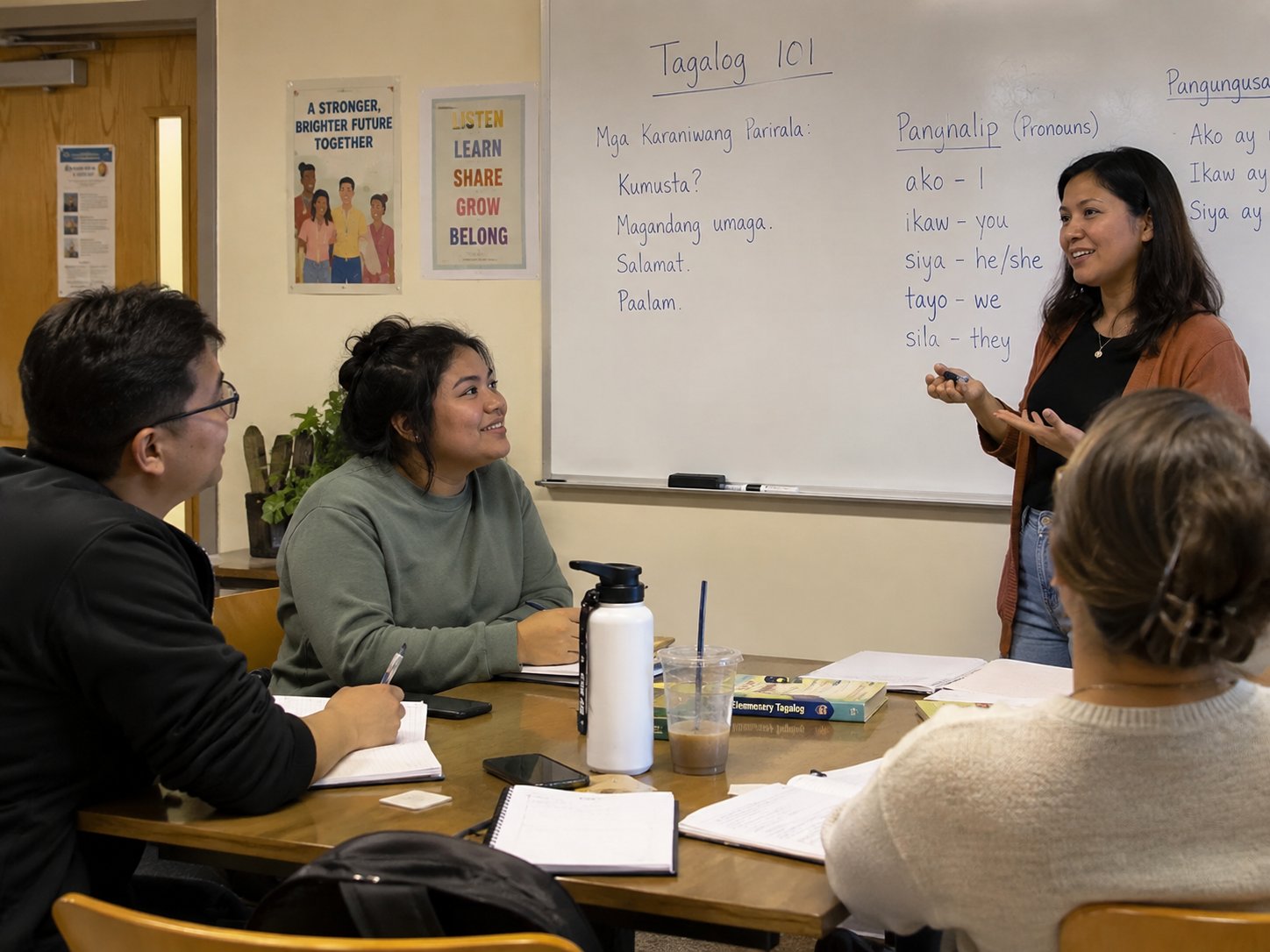
A new Tagalog student may say something that sounds contradictory at first:
“I’m a beginner, but I understand almost everything my parents say.”
Then the teacher asks a simple question in Tagalog, and the student hesitates. They understand the question immediately, but answering in a complete sentence is much harder. Another heritage learner may speak familiar phrases with very natural pronunciation but struggle to read a short paragraph. Someone else may read Tagalog reasonably well yet switch back to English as soon as a conversation becomes spontaneous.
These are all common heritage-language profiles, and they explain why the question “Should I join a beginner Tagalog class?” does not have a simple yes-or-no answer.
Some heritage learners absolutely belong in Complete Beginner classes. Others would be bored there within ten minutes. Many fall somewhere in between.
The important question is not whether someone “counts” as a heritage speaker. It is what they can actually understand and use.
Heritage Tagalog ability is often uneven
A heritage speaker is generally someone who grew up with some meaningful exposure to a language through family or community, even if they did not become fully proficient in it.
For Tagalog learners, that experience can vary enormously.
One person may have heard Tagalog every day from parents and grandparents. Another may have heard it mostly at family gatherings. Some families switch constantly between English and Tagalog. Others use mostly English with children while speaking Tagalog between adults.
There are also Filipino-American learners who had very little Tagalog exposure at all. Filipino family background by itself does not tell us someone's language level.
The same is true in the other direction. A person can have strong Tagalog comprehension without ever having taken a formal class.
Heritage learners often develop whichever skills their childhood environment required. If parents spoke Tagalog and children answered in English, listening had years of practice while speaking did not. If Tagalog was mainly used around food and family life, the learner may have excellent vocabulary in those areas and much less language available for work, travel, opinions, or unfamiliar social situations.
This can produce a language profile that does not fit neatly into any traditional level.
“I understand Tagalog, but I can’t speak it”
This is probably one of the most common things heritage learners say.
Imagine a child growing up in a household where a parent asks:
Kumain ka na ba?
Have you eaten?
The child understands immediately and replies:
“Yeah, I already ate.”
There is no communication problem. The parent understands English, so the conversation continues.
Repeat that pattern thousands of times over many years and something interesting happens. The child develops very strong receptive Tagalog without getting the same amount of practice producing it.
As an adult, that person may follow a family conversation surprisingly well. They may understand jokes, complaints, instructions, familiar expressions, and the general flow of what relatives are saying.
Then somebody turns to them and expects an answer in Tagalog.
Suddenly a much shorter sentence becomes difficult.
The vocabulary may be somewhere in memory, but retrieving it quickly is another matter. The learner may know exactly what another person means while having trouble constructing a response without falling back into English.
That does not mean the person has no Tagalog. Their listening ability may be considerably stronger than that of a conventional beginner. Their active speaking ability simply developed along a different path.
Pronunciation can make someone sound more advanced than they are
Heritage learners can also be difficult to place because pronunciation is sometimes one of their strongest skills.
Someone who heard Tagalog frequently as a child may have absorbed its rhythm, vowels, and intonation long before they understood any grammar consciously. Familiar words and expressions can sound very natural.
That first impression can be misleading.
A learner might say several common phrases beautifully, then struggle when asked to describe what they did last weekend. They may understand ordinary family conversation but lack the vocabulary needed to discuss work or explain an opinion.
There is an important difference between sounding natural in familiar language and having enough active grammar and vocabulary to sustain an unfamiliar conversation.
The opposite can also happen. A heritage learner may know quite a lot of Tagalog but speak with noticeable English influence because they rarely used the language actively while growing up.
Accent is therefore useful information, but it is not a language level.
Family Tagalog can be surprisingly specialized
A heritage learner's vocabulary often reflects exactly where they heard the language.
Someone may know a large number of words related to food, relatives, household objects, childhood routines, and being told what to do. They may recognize familiar questions instantly and understand expressions that would never appear in the first chapter of a textbook.
Then the topic changes.
Describe your job.
Explain why you chose a particular university.
Talk about a trip you took.
Describe what you want to do next year.
Give an opinion about a film.
The learner who seemed almost fluent ten minutes earlier may suddenly have very little to say.
There is nothing unusual about this. People learn the language they need.
If Tagalog was primarily the language of family life, then family life is where the learner's vocabulary will be deepest. English may have become the language of school, work, friends, technology, and adult life.
Formal classes can be useful precisely because they expand the range of situations in which Tagalog can be used.
Reading and speaking do not necessarily develop together
Tagalog uses the Latin alphabet, which can make literacy seem less complicated than it is.
An English-speaking heritage learner may be able to pronounce many written words without difficulty simply because the letters are familiar. That does not necessarily mean they read Tagalog comfortably.
A learner who heard Tagalog throughout childhood but rarely saw it written may read slowly, have trouble with unfamiliar vocabulary, or discover that words they have known by ear for years look strangely unfamiliar on the page.
Writing can be even less developed.
Someone may speak conversationally but rarely have written more than a short text message in Tagalog. Spelling, grammatical choices, and constructing longer written sentences may all require conscious attention.
Other heritage learners grew up reading Filipino social media, messages from relatives, religious materials, books, or community publications and have much stronger literacy.
A placement decision therefore should not assume that speaking ability predicts reading ability or vice versa.
Grammar can feel familiar without being understood
Heritage learners often know more grammar than they think they do.
Someone may consistently use a familiar construction correctly simply because they have heard it hundreds of times. Ask why that verb form is used, however, and they may have no idea.
This becomes especially noticeable with Tagalog grammar because the language contains structures that do not map neatly onto English.
A heritage learner might use common pronouns correctly, recognize familiar ang/ng/sa patterns, or produce certain verb forms naturally without knowing the terminology behind any of them.
That intuitive knowledge is valuable.
The gaps usually appear when the learner tries to move beyond familiar constructions. If they have never had to create a particular kind of sentence before, intuition may not provide enough guidance. Verb forms become inconsistent, grammatical markers become uncertain, or an English structure gets transferred into Tagalog.
Formal grammar instruction can sometimes produce an interesting reaction in heritage learners: the rule is new, but the examples are not. The learner suddenly gets an explanation for something that has sounded familiar for years.
So, can a heritage learner join Complete Beginner Tagalog?
Yes. Having Filipino family background does not automatically make someone too advanced for a Complete Beginner class.
A heritage learner may be well suited to that level if they understand only a limited collection of familiar words and expressions, cannot comfortably create basic sentences, have very little active vocabulary, and need a systematic introduction to Tagalog grammar.
Some people describe themselves as heritage learners because Tagalog was present somewhere in their childhood, but their actual exposure was relatively limited. They may recognize the sound of the language or know a handful of household phrases without having developed functional comprehension.
For that person, starting from the beginning can make perfect sense.
A Complete Beginner class becomes less appropriate when the learner already understands ordinary family conversation, follows simple questions easily, knows common verbs and pronouns, and can produce basic sentences even if their grammar is inconsistent.
If the instructor spends twenty minutes teaching expressions the heritage learner has understood since preschool, the class is probably too low.
A continuing beginner class may be a better fit
Many heritage learners fit more naturally into Low Beginner or High Beginner levels.
A Low Beginner heritage learner might understand common questions immediately and answer them with short sentences. They may recognize a lot of familiar vocabulary and follow slow conversation while still struggling to build new sentences independently.
Grammar may be one of the biggest gaps. A learner may know what sounds familiar but not understand how to adapt a construction to a new situation.
At a somewhat higher beginner level, a heritage learner may be able to participate in conversation about familiar topics and understand a good amount of slower natural speech, while still lacking confidence with longer answers or unfamiliar subjects.
These categories are necessarily approximate. The point is not to find the perfect label but to avoid assuming that “heritage” itself is a level.
Being placed too low can be surprisingly frustrating
It may seem harmless to tell a heritage learner to start from the beginning “just to make sure there are no gaps.”
Sometimes that is useful. Sometimes it creates six weeks of material the student already understands.
A heritage learner may sit through lessons on basic family vocabulary, familiar greetings, or questions they have heard thousands of times. Listening exercises may require almost no effort.
The learner can then reach the wrong conclusion: formal Tagalog classes have nothing to offer them.
The real problem may simply be placement.
Many heritage learners do need gaps filled, but filling gaps is different from reteaching every part of the language from zero.
A learner who already understands Kumain ka na? does not necessarily need a lesson introducing the phrase. They may instead need practice answering it naturally, expanding the answer, changing the tense or aspect, or using similar constructions in new situations.
That is a different kind of learning.
Being placed too high can be just as uncomfortable
Natural pronunciation and strong comprehension can create the opposite problem.
A heritage learner speaks for a few minutes and sounds comfortable, so they are placed into an intermediate conversation class. Then the group begins discussing travel, work, or a current event, and the gaps become obvious.
The learner may understand much of what everyone says but lack enough active vocabulary to participate. They may have never learned the grammar explicitly and struggle to create unfamiliar sentence patterns.
This can be especially uncomfortable because heritage learners sometimes carry an expectation that they should already know the language.
A conventional second-language learner can say, “I haven't learned that yet.”
A heritage learner may instead think, “Why don't I know this? My family speaks Tagalog.”
That pressure does not help anyone learn.
A class level is simply a description of the language skills currently needed for that class. It is not a judgment about someone's family background, cultural connection, or authenticity.
Being in a beginner class does not make someone “less Filipino”
This point matters because language and identity can become tangled together very quickly.
Someone may feel strange enrolling in Beginner Tagalog while having Filipino parents or grandparents. They may imagine that classmates will wonder why they are there or that relatives would expect them to know more.
But language ability is not an identity test.
Someone can be deeply connected to Filipino family and culture without speaking much Tagalog. Another person with no Filipino background at all can study for years and become highly proficient.
The Philippines itself is multilingual, and not every Filipino family uses Tagalog at home. A Filipino-American learner's family language may be Cebuano, Ilocano, Hiligaynon, Kapampangan, or another Philippine language. Others may have grown up primarily in English.
The useful question in a language class is much narrower: What can you understand and produce right now?
That is what placement is trying to measure.
Heritage learners may progress quickly in some areas and slowly in others
Once heritage learners begin structured classes, their earlier exposure can become very noticeable.
Pronunciation may need relatively little attention. Vocabulary that seemed forgotten may return quickly once it appears in context. Grammar explanations can organize patterns that already feel familiar.
Listening may also be considerably easier than it is for classmates encountering Tagalog for the first time.
Other skills may take much longer.
A learner who rarely spoke Tagalog growing up still has to develop active speaking. Someone who never read much Tagalog has to build literacy. Vocabulary outside the family environment has to be learned like any other new vocabulary.
Heritage exposure is therefore not a universal shortcut. It gives the learner a particular collection of strengths, and those strengths differ from person to person.
Can a heritage learner fit into a mixed beginner class?
Often, yes. Suppose a heritage learner in a Low Beginner group understands the instructor more easily than the other students but has roughly the same difficulty creating original sentences.
That student can still benefit from the course.
The teacher may ask them for a longer response, introduce additional vocabulary, push them to explain rather than simply answer, or give them more challenging reading. Meanwhile, the grammar being practiced may be exactly what they need.
They might occasionally recognize an expression before their classmates do. That does not make the class inappropriate.
It is also important that the heritage learner not become an unofficial teaching assistant. Knowing how something sounds at home does not make a student responsible for explaining the language to everyone else.
They are in the classroom because they have something to learn too.
A simple way to think about your own level
Instead of asking yourself, “Do I speak Tagalog?”, it can be more useful to ask what happens in specific situations.
Can you answer ordinary questions in complete Tagalog sentences rather than just understanding them?
Can you describe what you did yesterday?
Can you explain what you are planning to do tomorrow?
Could you have a five-minute conversation with someone who is not a relative without relying mostly on English?
Can you understand Tagalog spoken by unfamiliar people, or do you mainly understand the voices and expressions used in your family?
Can you read a short paragraph comfortably?
Could you write a simple message?
Can you discuss something outside home and family life?
The pattern of answers is more informative than any single score.
Someone who answers yes to nearly every listening question and no to most speaking questions has a very different learning profile from someone who speaks comfortably but struggles to read.
Both may be called heritage learners, but they probably do not need exactly the same class.
A short placement conversation is often more useful than a test
Heritage learners are one group for whom self-placement can be especially difficult.
They may underestimate themselves because they cannot explain grammar. They may overestimate themselves because familiar conversation feels easy.
A short conversation with an instructor can reveal a great deal. How quickly does the learner understand questions? How long are their answers? What happens when the topic changes? How much English enters the conversation? How stable is the grammar outside familiar expressions?
Reading and writing can be considered separately if those skills matter for the course.
This does not need to become an intimidating examination. Sometimes ten minutes of conversation and an honest description of the learner's language background provide enough information to make a much better placement decision than the word “beginner.”
And placement does not have to be permanent. A student may try Complete Beginner and quickly discover that the pace is too slow, or join Low Beginner and realize that important foundations are missing. Adjusting the level is simply part of finding the right fit.
What a Tagalog class can offer a heritage learner
For many heritage learners, the goal is not really to “learn Tagalog from scratch.” It is to make existing knowledge more complete and easier to use.
That might mean turning strong comprehension into active speaking, expanding vocabulary beyond family conversations, understanding grammar that was previously intuitive, or becoming more comfortable reading and writing.
A learner who has spent years answering relatives in English may need something very different from a complete beginner hearing Tagalog for the first time, even if both hesitate when asked to speak.
Polyglottist Language Academy offers Tagalog classes for adults at different levels, including options for learners whose experience does not fit neatly into a standard beginner profile. Heritage learners who are uncertain where to start can consider what they already understand, what they can actively produce, and where the largest gaps remain when choosing a level.