
Why Second-Generation Filipino Americans Are Learning Tagalog
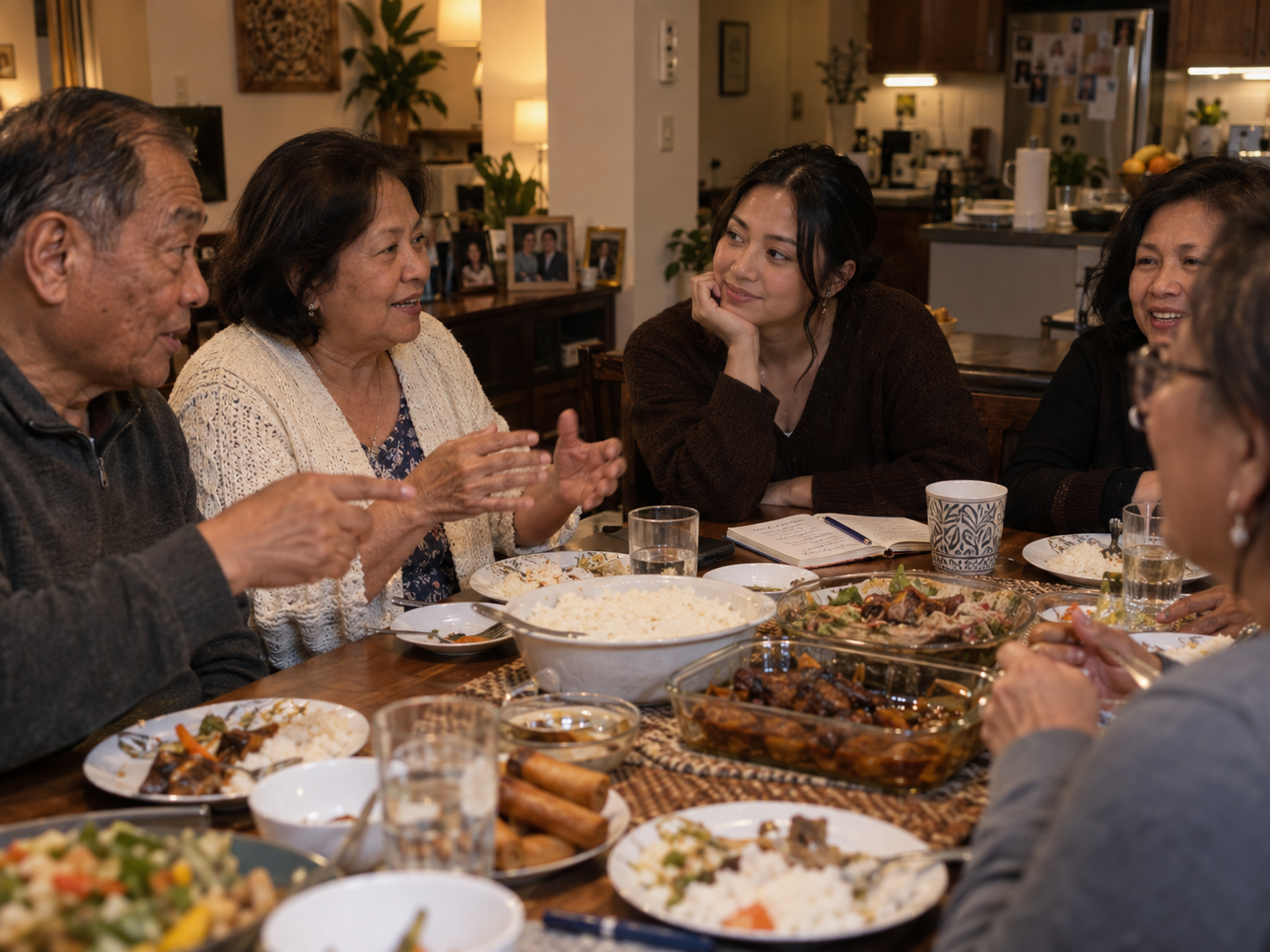
A second-generation Filipino American may spend years saying the same thing: “I understand Tagalog, but I always answer in English.”At home, this may not have caused any problem at all. A parent speaks in Tagalog, the child answers in English, and everyone understands one another. The conversation works, so there is little reason to change it. Years later, however, the same person may notice that understanding is not quite the same as participating. They can follow what relatives are saying, laugh at a familiar joke, or understand a parent telling a story, but when they try to respond in Tagalog, the words do not come as easily.
For some second-generation Filipino Americans, this is the point when Tagalog starts to feel different. The language may have been present in the background for years, but adulthood creates new reasons to use it actively rather than simply understand it. Those reasons are not always dramatic. They may involve family conversations, travel, friendships, media, parenthood, or simply the desire to turn passive knowledge into something more usable.
Understanding Tagalog without speaking it is extremely common
One of the clearest patterns among heritage learners is strong comprehension combined with much weaker speaking.
Imagine a child growing up hearing:
Kumain ka na ba?
Have you eaten?
The child understands immediately and answers:
“Yeah, I already ate.”
The parent understands the English response, so the conversation continues. From the family's perspective, communication has succeeded.Repeat that interaction for years and the child receives enormous amounts of listening practice without being required to produce much Tagalog. The result can be surprisingly strong comprehension. As an adult, the person may understand familiar family conversations almost automatically. They may recognize expressions, tone, jokes, and even grammatical patterns without ever having studied them.
Speaking is another skill. When someone turns to them and expects a full answer in Tagalog, vocabulary has to be retrieved, verb forms have to be chosen, and a sentence has to be created rather than merely understood. That can be much harder. This is why “I understand Tagalog but can't really speak it” is not contradictory. Listening and speaking do not have to develop at the same speed.
Tagalog may not have seemed especially necessary in childhood
Children usually use the language that works most efficiently in the world around them. For second-generation Filipino Americans growing up in the United States, English often dominates school, friendships, entertainment, sports, higher education, and eventually work. If parents also understand English, there may be very little practical pressure to speak Tagalog.
This does not necessarily mean a child consciously rejected the language. Often nothing that dramatic happened. English was simply easier and faster. A child who knows that a parent will understand an English answer has little reason to struggle for thirty seconds trying to produce the same thought in Tagalog. The family conversation keeps moving, and over time English becomes the child's dominant speaking language even while Tagalog remains familiar to the ear.
Some parents may have encouraged their children to speak Tagalog. Others may have emphasized English because they believed it would help with school or social integration. In some households, parents themselves used a mixture of Tagalog and English. In others, the parents spoke different Philippine languages and English became the shared language of the family.
There is no single Filipino-American language story.
Adulthood can make the language useful in completely new ways
The reasons for learning Tagalog often change once someone is no longer a child. A twelve-year-old may see little advantage in struggling through a Tagalog sentence when everyone around them understands English. A thirty-year-old may suddenly have much more to talk about with parents, grandparents, relatives, or friends.
Family conversations themselves change. Adults may want to discuss work, health, relationships, family history, migration, decisions, finances, or what life was like before the family moved to the United States. These are not necessarily the subjects a child heard discussed directly with them.
Someone who understands everyday family Tagalog may discover that they do not have the vocabulary to ask a grandparent a detailed question about childhood or listen comfortably to a story full of unfamiliar words.
At that point, Tagalog is no longer just the language of childhood instructions and dinner-table conversation. It becomes a way to participate in adult relationships differently.
Family vocabulary can take you only so far
Heritage learners often know a surprisingly specific kind of Tagalog. They may understand words related to food, family members, household objects, familiar commands, greetings, and childhood routines. They may know expressions that would never appear in the first unit of a language textbook.
Then someone asks them to explain what they do for work. Or discuss a film. Or describe a trip. Or explain why they made a particular decision. Suddenly the vocabulary disappears.
This can be confusing because the learner may have spent years thinking of themselves as someone who “understands Tagalog.” That description is still true, but it may be true mainly in the situations where they heard the language repeatedly.
Adult study can expand the language beyond those familiar domains. A heritage learner does not necessarily need to relearn what kain means, but they may need vocabulary for opinions, plans, work, travel, education, or abstract conversation.
That is one of the biggest differences between heritage learning and conventional beginner learning.
Travel can expose the gap between understanding and participating
English is widely used in the Philippines, so learning Tagalog is not a requirement for visiting. A second-generation Filipino American can travel through much of the country using English successfully. Yet travel can still change how someone thinks about the language.
A person may visit relatives and realize that they can follow much of what is being said around them but cannot contribute naturally. They may understand when everyone switches into Tagalog at dinner but answer in English. They may know what a joke means while feeling that their own response comes too slowly.
The practical problem is rarely “I cannot survive without Tagalog.” It is usually subtler. English lets you function. Tagalog may allow you to catch more of what is happening socially. That difference can matter more to an adult than it did during childhood visits.
Culture also feels different when you do not have to translate everything
Language becomes interesting for reasons that have nothing to do with family obligation. Someone may begin following Filipino creators online, watching films, listening to music, or paying more attention to interviews and conversations where Tagalog appears naturally.
Translation can communicate the basic idea, but it does not always preserve tone. A joke may depend on word choice. An expression may sound much funnier or sharper in Tagalog than in English. The way someone addresses an older relative or shifts between Tagalog and English may communicate something about the relationship that subtitles flatten.
This does not mean Tagalog is required to understand Filipino culture. Filipino-American culture itself exists across multiple languages, and millions of culturally connected people do not speak Tagalog fluently.
Still, knowing more of the language can provide access to things that previously arrived through translation or explanation. For some learners, that alone is reason enough to study.
Adult social life can create reasons to speak that did not exist before
A person's social environment can also change. Someone who rarely used Tagalog growing up may later have Filipino coworkers, new friends, a partner, or relatives they see more often. They may join a Filipino organization or begin spending time with people who naturally move between English and Tagalog. Suddenly the language has a social use that was absent during childhood. Even small changes matter. A learner may start wanting to answer an aunt in Tagalog instead of automatically replying in English. They may want to participate when a group switches languages rather than waiting for the conversation to come back. The motivation is not necessarily about identity in a grand sense. Sometimes it is simply about wanting to communicate differently with people who are already part of your life.
Parenthood can make language decisions feel more concrete
For some second-generation Filipino Americans, having children changes the question again. Someone who was perfectly comfortable saying “I understand Tagalog, but I don't speak it much” may begin wondering what their own child will hear.
Will the grandparents speak Tagalog to the child? Will the child understand them? Will there be Filipino words used at home? Does the parent want Tagalog to be part of family life at all?
There is no correct answer. Some parents want to raise bilingual children. Others want their children to understand a few family expressions. Some have no particular goal related to Tagalog. What changes is that language transmission becomes less abstract. The learner is no longer thinking only about what they received from their own parents. They are deciding what, if anything, they want to pass on themselves. That can be a powerful reason to study more seriously, but it does not need to become an obligation.
Learning Tagalog as an adult can feel very different from being told to speak it as a child
Agency matters. A child may experience Tagalog as something a parent keeps asking them to use when English is easier. An adult can choose to study it. That change in context can completely alter the experience.
Someone who resisted language lessons at ten years old may willingly spend an evening learning verb forms at thirty. The difference is not that the adult has suddenly become more disciplined or culturally aware. The language now serves a purpose they chose for themselves.
Adult learners also tend to ask different questions. They want to know why a familiar expression works grammatically. They notice patterns they heard all through childhood but never analyzed. They may suddenly understand what ang, ng, or a particular verb form is doing in sentences they have known for years.
Formal study can give structure to knowledge that previously existed only by ear.
Heritage learners usually are not starting from zero
This is one of the most important things to understand about second-generation Tagalog learners. Their abilities may be very uneven. A learner might have strong listening comprehension and natural pronunciation but weak speaking. Another may understand family conversation while reading slowly. Someone else may have almost no Tagalog despite having Filipino parents because English or another Philippine language was used at home.
Second-generation status is not a language level. A heritage learner who understands ordinary Tagalog conversation may become bored in a Complete Beginner class that spends weeks introducing words and expressions they already know. Another learner with very little previous exposure may genuinely need to start from the beginning. Even within one person, skills may sit at different levels. Listening might be intermediate. Speaking might be beginner. Reading may be almost completely new. Pronunciation may sound much stronger than the learner's grammar.
This is why heritage learners often benefit from placement based on actual ability rather than background.
Pronunciation can hide the gaps
Early exposure sometimes gives heritage learners a strong ear for Tagalog. A person may reproduce familiar vowels, rhythm, and intonation naturally because those sounds were part of childhood long before they began studying the language formally. That can make them sound surprisingly advanced. Then the conversation moves to an unfamiliar topic and they run out of vocabulary. A learner can sound very natural saying phrases heard at home and still struggle to build a completely new sentence. Pronunciation is only one skill. The reverse is also possible. Someone may understand quite a lot but speak with noticeable English influence because they rarely produced Tagalog growing up.
Heritage learners do not all receive the same linguistic advantages from early exposure.
Grammar lessons can explain something you have known for years
Formal grammar can be particularly interesting for heritage speakers because the explanation may be new even when the sentence sounds completely familiar. A teacher introduces a pronoun pattern or explains why a verb changes. The heritage learner may realize they have heard that structure thousands of times. They already knew which version sounded right. They simply did not know why. This can happen with Tagalog verb forms, grammatical markers such as ang, ng, and sa, pronouns, linkers, and sentence patterns.
Understanding the system gives the learner more freedom. Instead of relying only on phrases memorized through childhood exposure, they can begin adapting those patterns to situations they have never discussed in Tagalog before.
That is often where passive heritage knowledge starts becoming more flexible.
Learning Tagalog does not have to prove anything about identity
Heritage-language conversations can become unnecessarily heavy when language ability is treated as evidence of cultural authenticity.A second-generation Filipino American does not become more Filipino by learning Tagalog, and someone who does not speak Tagalog is not less Filipino-American. The Philippines itself is multilingual. Filipino-American families may use Cebuano, Ilocano, Hiligaynon, Kapampangan, Waray, another Philippine language, English, Tagalog, or some combination of several languages. Even within Tagalog-speaking families, people's relationships with the language are different.
Some adults study because family communication matters to them. Some want to travel. Some enjoy languages. Some want to understand media. Some are thinking about their children. Others simply dislike having a skill that is almost there but not quite usable.
None of these motivations needs to become an identity statement.
Why taking a beginner class can still feel awkward
A second-generation learner may feel strange saying: “My parents speak Tagalog, but I'm taking a beginner class.” The discomfort often comes from comparing language ability with family background. But class levels do not measure identity. They describe what a learner can currently do. Someone may already have excellent listening skills while still needing beginner-level help with speaking and grammar. Another person may have natural pronunciation but little active vocabulary. A good class should build on those strengths rather than pretending they do not exist. The problem is not being a beginner. The problem is being placed in a level that does not match the skills you actually have.
What structured Tagalog study can add
Heritage learners often need something different from a conventional beginner program. The goal may be to turn comprehension into speech, fill grammatical gaps, broaden vocabulary beyond the household, become more comfortable reading, or learn to speak with people outside the family. Regular conversation matters because passive understanding can remain passive indefinitely if the learner never has to produce Tagalog.
A teacher can also identify places where pronunciation makes a learner appear more advanced than they are, or where strong listening hides weak grammar.
Apps and independent study can help with vocabulary, spelling, and repetition, but they often assume that all skills develop in a straight line. A heritage learner may find beginner listening exercises extremely easy while struggling with a basic speaking task several lessons later.
That unevenness is easier to address when the learner can work at a level that reflects what they actually know.
Polyglottist Language Academy offers Tagalog classes for adults at different levels, including learners with heritage backgrounds whose listening, speaking, grammar, and reading may not line up neatly. For someone who understands much more than they can say, structured speaking practice can be especially useful because it turns familiar language into something the learner has to retrieve and use actively.
A second-generation Filipino American may spend years saying, “I understand Tagalog, but I always answer in English.” Choosing to change that pattern in adulthood can come from family, travel, friendships, parenthood, curiosity, or simply wanting to do more with a language that has been present for a long time.
For many heritage learners, studying Tagalog is not really about beginning from zero. It is about taking something that has existed in the background and making it more available when they actually want to use it.