
Japanese Classes in San Mateo: Where Bay Area Adults Can Start Learning Japanese
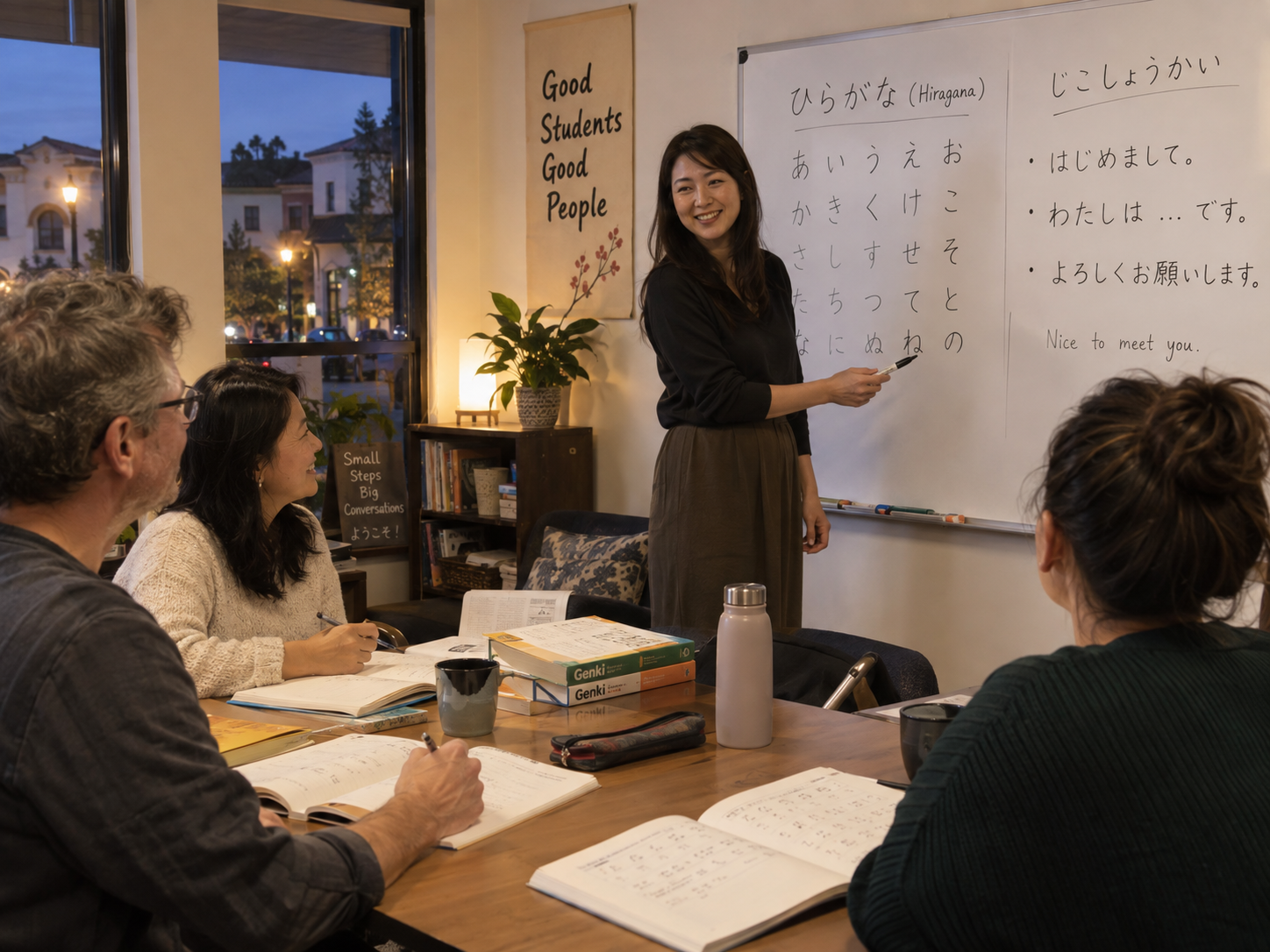
A surprising thing about learning Japanese in San Mateo is that the city has a visible Japanese American community but relatively few obvious, walk-in adult beginner programs. A search can quickly turn up heritage schools, cultural organizations, and children's programs, which can make an adult beginner feel as if there must be a class somewhere nearby — only to discover that the program is designed for K–12 students or for people who already speak some Japanese.
That does not mean adults in San Mateo are short of options. It means the useful options fall into different categories, and choosing well depends on what you actually need: a true beginner course, a conversation group, a credit-bearing college class, or a flexible online class.
The clearest local option: Japan Society of Northern California
For adults who want a structured course without going all the way to San Francisco, the Japan Society of Northern California is one of the most relevant organizations to watch. Its language program runs group classes from beginner through advanced levels, with both in-person and online formats. For Fall 2026, the organization lists several classes in San Mateo at Hero City, including continuing beginner and advanced-level courses, while additional beginning classes are offered online.
The important detail is that the exact level offered in San Mateo changes by term. A complete beginner should not assume that “Japanese classes in San Mateo” automatically means Beginning 1 is available locally every quarter. If the local class starts at Beginning 3 or Beginning 4, taking an online Beginning 1 course first may actually be the cleanest route into the San Mateo sequence later.
This is one of the recurring problems adult learners face. A class can be excellent and still be the wrong class simply because its sequence began months earlier.
San Mateo Japanese-American Community Center: valuable for conversation and culture
The San Mateo Japanese-American Community Center is another useful resource, especially once you know enough Japanese to benefit from regular interaction. The center currently lists a Japanese Conversation Class that alternates between Zoom and in-person meetings. That is different from a formal beginner course: conversation groups usually work best for people who already have some vocabulary and grammar and want more contact with the language.
For a learner at the very beginning, the center is still worth knowing about because language is easier to sustain when it is attached to an actual community. Cultural events, clubs, and conversation practice can eventually give meaning to vocabulary that otherwise exists only in a textbook.
What about San Mateo Nippon Gakuyen?
San Mateo Nippon Gakuyen is an established Japanese language school in the city, but its current program is for students in grades K–12. Adults sometimes find the school while searching and assume it is an adult language program because it offers levels from beginning through advanced. It is important to make the distinction before planning around it.
This is a good example of why local Japanese learning can be confusing in the Bay Area. Heritage-language schools and adult second-language programs may use similar words — “beginner,” “intermediate,” “Japanese language school” — while serving very different students.
Should an adult take Japanese at a college?
A college course can be excellent if your schedule allows it. College Japanese classes generally move quickly, include frequent homework, and expect consistent attendance. That can be exactly what a serious learner wants, but it is not the same experience as a once-a-week evening course.
For working adults, the practical question is not only “Is the course good?” but “Can I attend four days a week and keep up with the assignments?” A slower small-group course often produces better long-term results for someone with a full-time job simply because the pace is sustainable.
What a true beginner should learn first
A complete beginner does not need to spend months memorizing characters before speaking. In a well-designed first term, speaking, listening, and the writing system should develop together. Students can learn greetings and self-introductions while beginning hiragana, then gradually add basic sentence patterns such as:
わたしはアレックスです。 — I am Alex.
アメリカじんです。 — I am American.
コーヒーがすきです。 — I like coffee.
Teachers often notice that adults who study alone postpone speaking because reading feels safer. Then, after several months, they can recognize grammar but hesitate when someone asks a simple question. A class is most useful when it forces those skills to grow together.
In person or online from San Mateo?
San Mateo is unusually well placed for both. If the right level is running locally, an in-person class removes much of the commuting burden that Bay Area students face. If the level is not available, online classes can be a better choice than waiting an entire term or driving to another city after work.
The Peninsula also makes occasional travel to San Francisco or other Bay Area language events realistic, so an effective plan can be hybrid in the broad sense: a regular online course plus occasional in-person workshops, conversation groups, cultural events, or private tutoring.
How to choose the right class
Before registering, ask four questions: Is this class designed for adults learning Japanese as a second language? Is it actually my level? How much homework is expected? And will I get regular speaking practice?
Those questions matter more than whether the class is physically closest to your house. A convenient class that is too advanced can be discouraging, while a well-matched online class can move you forward quickly.
Polyglottist Language Academy also offers small-group Japanese instruction for adults, including online classes for Peninsula learners and in-person classes in Berkeley for students who prefer a classroom setting. For a complete beginner, the strongest starting point is usually the class that gives you a structured sequence, frequent speaking, and a realistic schedule — not necessarily the first program that appears in a local search.
The good news for San Mateo learners is that they do not have to choose between studying Japanese seriously and having a normal adult schedule. The local ecosystem is simply less obvious than it first appears, and once you separate youth schools, conversation groups, and adult courses, the options become much easier to navigate.