
The Unwritten Rules of Russian Hospitality.
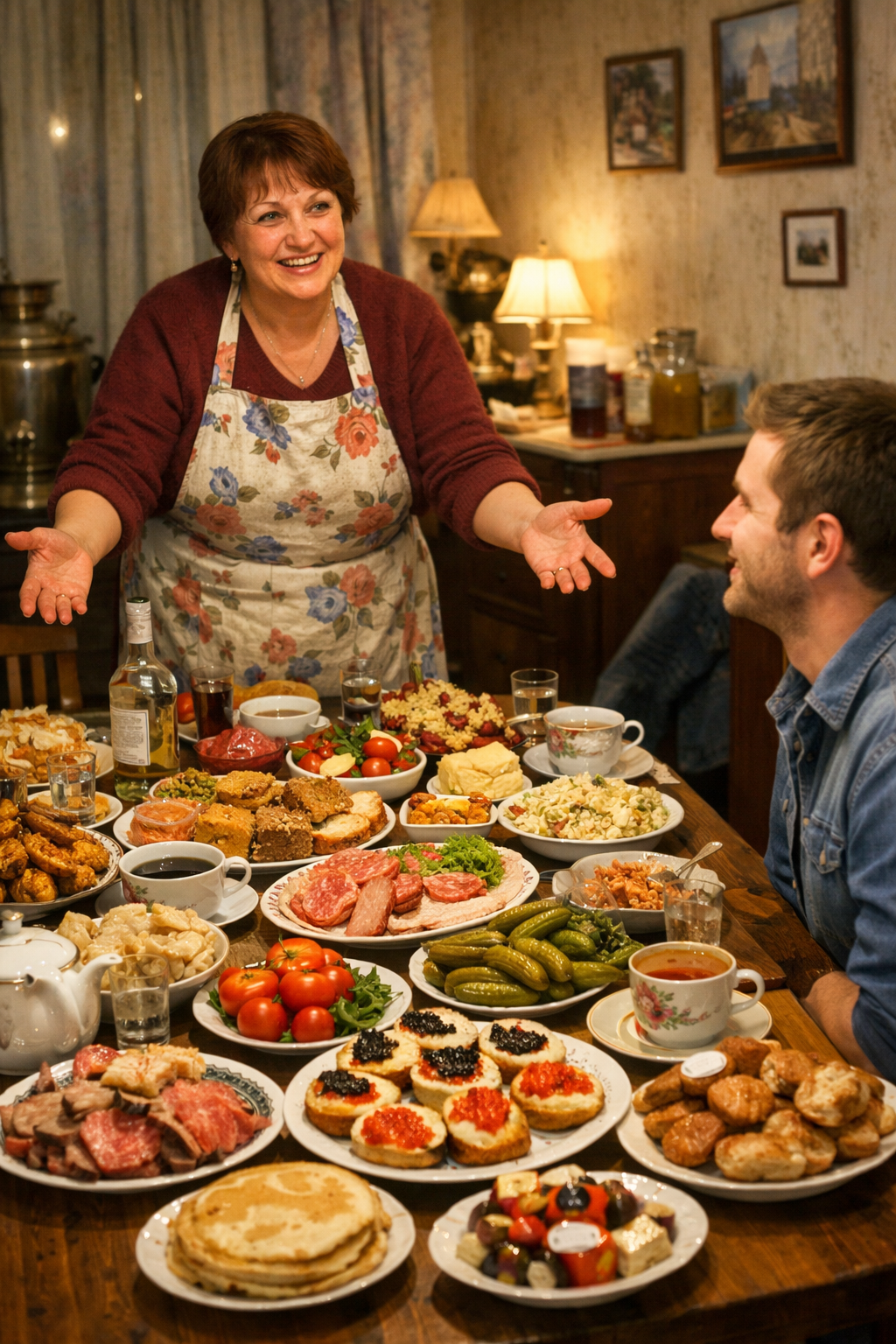
Russian hospitality doesn’t really begin at the front door. It begins days earlier, in the host’s mind, with shopping lists, recipe planning, and a quiet promise: “They will leave my home full, warm, and feeling cared for.” By the time you finally stand in a dim stairwell in front of a heavy apartment door, clutching a slightly crumpled bouquet and a box of chocolates, you are stepping into a whole emotional system—one that many visitors to Russia only gradually learn to read.
This article is your guide to those unwritten rules: why you should never arrive empty‑handed, why your host keeps insisting you eat more, what those long, heartfelt toasts really mean, and why you’ll spend an oddly long time saying goodbye in the hallway. Beneath the etiquette, there is a story about climate, history, scarcity, pride, and the Russian idea of what it means to really take care of another human being.
Crossing the Threshold: First Visit to a Russian Home
Imagine you’ve been invited to dinner at a Russian colleague’s apartment in a typical Soviet‑era block on the outskirts of a big city. You’ve agreed on Saturday at 18:00. You’ve spent 15 minutes at a flower stand worrying about numbers—someone told you flowers must be in odd numbers—and you’re hoping your box of chocolates looks “nice enough.”
You find the right entrance, push open the heavy metal door, and enter the stairwell, where faint cooking smells mingle with laundry detergent and cold air. You ring the doorbell. The door swings open, and you are greeted with a burst of warmth, a rush of voices, and your host’s bright, slightly nervous smile.
The very first thing many Russians will look at is not your face but your feet.
Shoes Off, Slippers On: The Hallway Ritual
In most Russian homes, the hallway (прихожая) is more than a practical space. It’s a border crossing between the “dirty” outside world and the protected inner space of the home. Centuries of harsh winters, muddy streets, and later the grime of industrial Soviet cities have taught people one thing very clearly: outdoor shoes do not belong on clean floors.
This is why, after a quick hug or handshake, your host will often glance down and gesture toward a line of shoes and a rag rug. You instinctively begin to untie your boots or slip off your sneakers. If you move too slowly, someone may gently urge, “Давай, давай, снимай обувь” (“Go on, go on, take your shoes off”). It’s not a suggestion; it’s simply how things are done.
Right beside the shoes, you’ll usually see a basket or pile of slippers (тапочки). They may all be slightly different sizes, slightly mismatched, and a little worn. They are also a subtle gesture of care. Offering you slippers is a way of saying, “You’re not just passing through; you belong here for a while. Get comfortable.”
A few practical notes for visitors:
Always assume you will be taking your shoes off.
Clean socks are a must; you don’t want to be remembered for your holey heels.
If you dislike wearing communal slippers, walking in socks is usually fine; you can simply smile and say, “Я в носках, спасибо” (“I’m fine in socks, thank you”).
In some very modern apartments, especially among younger urban Russians influenced by Western trends, you may occasionally see people keep clean indoor sneakers or stylish slippers. But the shoes‑off norm is still so strong that walking into a home with outdoor shoes would feel almost like walking onto someone’s bed with boots.
Compared to many Western countries, where some households are shoe‑free and others are laissez‑faire, in Russia this is closer to a national reflex. The home is expensive, carefully maintained, and highly valued as a private sanctuary. Dirty shoes feel like a violation of that sanctuary, not a small oversight.
Once you’re in slippers and your coat is hanging among dozens of other coats, you’ve passed the first test. Now the real theater of hospitality begins.
The Gift You Bring Says More Than You Think
In many American or Western European contexts, arriving with a bottle of wine or dessert is “nice, but optional.” In a Russian home, especially on a first visit, bringing a small gift is much closer to an unwritten rule.
It’s not about the money; it’s about acknowledging the effort your host has made and signaling that you understand the seriousness of the invitation. The unspoken message is: “You did a lot for me, and I came prepared.”
Safe, Appreciated Gift Choices
There are three classic categories that almost never fail:
Flowers
Flowers are a deeply coded gesture in Russian culture, especially for female hosts or couples. The florist will automatically arrange them in an odd number—3, 5, 7—because even numbers are reserved for funerals and memorials. It’s one of those details Russians internalize so completely that they don’t even think about it; but if you bring, say, 10 roses for someone’s birthday, you may cause an awkward moment.Yellow flowers traditionally suggest separation, jealousy, or unfaithfulness, so they’re often avoided except when you know someone’s preferences very well. Safer colors include red, pink, white, and mixed bouquets. You hand the flowers to the host as soon as you enter; they’ll immediately look for a vase and water.
Chocolates, Cakes, Sweets
A good box of chocolates, a cake, or pastries are perfect. You’re contributing to the shared table, and at the same time continuing a Soviet‑era tradition where high‑quality sweets were both rare and festive. The host might put them straight onto the dessert table or save them “for later”; either reaction is fine.Alcohol
A bottle of wine, champagne, or vodka is a classic gift for a dinner visit or celebration. It doesn’t have to be expensive, but it should look like something you chose with at least a little thought. It’s not payment; it’s your way of contributing to the abundance and to the toasts.
Souvenirs from your home country also go over very well—local chocolate, cookies, coffee, or small packaged foods often spark long conversations about where you’re from and what life is like there.
What to Avoid
Some items carry subtle taboos or unwanted symbolism:
Sharp objects (knives, scissors) are traditionally said to “cut” relationships.
Very expensive gifts can embarrass your host or make them feel indebted.
Turning up with absolutely nothing, especially for a first invitation, can make you look uncultured or indifferent.
If you really are caught with empty hands—say, you came straight from work—acknowledge it. A simple, “I’m so sorry, I came directly from the office and didn’t have time to buy something,” shows awareness and respect. Your host will wave it off, but they will appreciate the explanation.
The Table as a Stage: Why You’re Overfed
Once you’ve survived the hallway and gift exchange, you are gently ushered into the main room. There it is: the legendary Russian table. At first glance, it might already be covered in dishes—salads, sliced meats, pickles, bread, herring, maybe caviar for a special occasion—yet your host will casually mention that “это только закуски” (“these are just appetizers”).
To understand Russian hospitality, you have to understand the table. It’s not just a place to eat; it’s the centerpiece of the visit, the physical proof of the host’s effort and care. The table says: “Look at all I’ve done for you. Look at how well you will be fed here.”
Historical Roots of Abundance
There are several threads woven together in this obsession with abundance:
For centuries, rural life in Russia was marked by harsh winters and periodic shortages. Having enough food to feed guests generously was not guaranteed; when it was possible, it became a powerful symbol of security and blessing.
During the Soviet period, many foods were difficult to find. People queued for meat, coffee, fruit, good sweets. Producing a rich spread for guests meant planning, saving, and sometimes calling in favors. A loaded table signaled not just wealth, but resourcefulness and dedication.
In a climate where winter can feel endless, hot soups, stews, and layered salads also act as literal warmth: calories as kindness.
All of this history lingers emotionally, even among younger generations who grew up with supermarket shelves full of goods. A “poor” table feels like a failure. A “rich” table feels like dignity.
The Insisting Ritual
This is why, once you sit down, the host does not merely offer you food. They insist.
You may hear variations of:
“Попробуй вот это, я сама (сам) делала.” – “Try this, I made it myself.”
“Ты почти ничего не ел!” – “You’ve hardly eaten anything!”
“Ну ещё ложечку, ради меня.” – “Just one more spoonful, for me.”
They will watch your plate carefully. If it looks too empty, they’ll refill it, sometimes without asking. You may find more salad or potatoes magically appearing in front of you while you’re telling a story. Saying “No, thank you” once won’t be enough. You will likely have to decline politely several times before the host believes you are truly full.
From their perspective, urging you to eat is a kind of moral responsibility. A guest leaving the table slightly hungry is a nightmare scenario. Overfeeding is safer than underfeeding.
How to Say “No” Without Offending
If you aren’t used to this style of hospitality, it can feel overwhelming or intrusive. But there are strategies:
Start with small portions. Take a little of everything at first so you can later accept “just a bit more” without exploding.
Use positive language to refuse. Instead of a blunt “No,” try “Это так вкусно, но я больше не могу” (“It’s so delicious, but I really can’t anymore”).
Praise the food repeatedly. Compliments soften a refusal and reassure the host that their effort was not wasted.
If you have real dietary restrictions, mention them early and calmly; many hosts will make an effort to accommodate you if they know in advance.
In many Western settings, pushing food can be seen as rude or insensitive. In Russia, it’s often interpreted as care. Understanding this emotional logic makes the insistence easier to accept—and even appreciate.
Toasts and Drinking: Why “Just a Sip” Isn’t Just a Sip
If your visit involves any alcohol, it almost certainly involves toasts. These are not quick “cheers” mumbled over clinking glasses. Toasts in Russian culture are small speeches, often emotional, sometimes humorous, and almost always taken seriously.
The First Toast
Typically, the host or the oldest or most respected person at the table makes the first toast. Everyone’s glass is filled—sometimes with vodka, sometimes with wine or champagne. The host may say something like:
“За гостей! Чтобы вам у нас было хорошо.”
“To our guests! May you feel good in our home.”
People listen, maybe chuckle at a joke, and then everyone clinks glasses. There’s an expectation of eye contact during the clink; it’s a tiny moment of connection with each person around the table. Then everyone drinks together. With vodka, finishing the glass is common for the first toast; with wine, a sip is usually enough.
The Emotional Function of Toasts
As the evening continues, toasts often move through a traditional structure:
To the meeting itself
To friendship
To parents and family
To love
To absent friends
To the future
Guests are usually invited to make toasts as well. This can be intimidating if you aren’t used to public speaking, but you don’t need to be poetic. A short, sincere toast is valued far more than a clumsy attempt to imitate grand, flowery speeches.
Toasts serve a deeper purpose: they provide a socially acceptable framework for expressing feelings. In everyday conversation, Russians may seem reserved or ironic. Over the course of a long evening of toasts, however, people might admit how much they value each other, recall old memories, or even apologize for past tensions. The alcohol helps, but the structure of toasts is what allows vulnerability to surface.
What if You Don’t Drink?
Attitudes toward alcohol are changing. Many younger Russians drink less, or choose wine and beer over vodka. Non‑drinkers are increasingly common and usually respected. Still, in more traditional circles or with older hosts, refusing all alcohol can send an unintended message: “I don’t want to participate fully in this shared moment.”
If you don’t drink at all, it’s wise to:
State it calmly and confidently from the start: “Я не пью алкоголь, но с удовольствием выпью сок/чай.” (“I don’t drink alcohol, but I’ll gladly drink juice/tea.”)
Raise your non‑alcoholic glass during toasts, and drink when others do. The shared action matters more than the content of your glass.
Join in verbally. Making your own toast is a bigger signal of participation than what’s in your cup.
Many hosts will accept this without fuss. The key is to show that you’re still engaged in the ritual, even if you’ve opted out of the vodka.
The Host’s Role: Pride, Control, and Care
From the outside, a Russian dinner can look chaotic: multiple dishes, overlapping conversations, kids running around, grandparents telling long stories. Underneath that apparent chaos, the host is quietly orchestrating the entire experience.
Preparation as Performance
For a significant visit, especially with guests who are not close family, hosts often prepare for days:
Cleaning the apartment thoroughly, including spaces guests may never see.
Cooking an impressive variety of dishes, some of which are labor‑intensive (think layered salads, baked meats, pastries).
Planning the order of serving: cold appetizers first, then hot dishes, then tea and sweets.
Even when money is tight, hosts may choose more expensive ingredients “for the guests.” This is not rational budgeting; it’s emotional accounting. A guest’s comfort and impression are worth the extra effort.
Serving, Not Sharing the Labor
In many Western households, guests are encouraged to help themselves and even help the host: “Make yourself at home,” “The kitchen is over there, just grab what you want.” In a traditional Russian home, especially with older hosts, that philosophy can feel almost backwards.
You might try to help clear plates or wash dishes and hear something like:
“Нет, что ты! Ты гость!” – “No, what are you doing! You’re the guest!”
Insisting on helping can make the host feel you don’t trust their ability to care for you, or that you’re trying to end the visit faster. Among younger Russians and close friends, this is changing—many will happily accept help—but it’s wise to offer lightly and accept “no” graciously the first time.
Emotional Temperature of the Room
The host feels responsible not only for your stomach but for the mood of the evening. If someone looks bored, lonely, or physically uncomfortable, the host may feel they’ve failed. This is why they keep offering: more food, more drink, more conversation, more warmth. The underlying question is always, “Are you truly okay here?”
For visitors, understanding how much heart is tied up in this role can help you interpret what might otherwise feel like overbearing fussing. It isn’t about control for its own sake; it’s about proving love and respect through action.
Timing and Punctuality: Before You Knock
The unwritten rules of Russian hospitality actually start with the invitation itself.
Making Plans
When someone invites you to their home, it’s rarely spontaneous, especially in big cities. You’ll typically:
Agree on a specific date and time.
Confirm the visit the day before or the morning of (“Мы в силе на шесть?” – “We’re still on for six?”).
Perhaps receive a friendly reminder not to bring anything “big,” which often really means “Don’t go crazy, but do bring something.”
Dropping in unannounced is more common among close relatives or neighbors in small towns than among colleagues or new friends in Moscow or St. Petersburg.
Being On Time
Punctuality norms vary:
In professional, urban circles, arriving on time or within 10–15 minutes is standard.
Among some older people, a small delay is accepted as normal; traffic, weather, and last‑minute errands are part of life.
Arriving too early can be more awkward than a little late: your host may still be showering, dressing, or in the middle of cooking.
If you know you’ll be significantly late, call or message. Remember that your host may be timing hot dishes and finishing touches around the moment you’re supposed to arrive.
Cancelling: Why It Hurts
Canceling at the last minute can be emotionally loaded. The host may have:
Spent money on extra food.
Spent hours cooking and cleaning.
Emotionally invested in seeing you and making a good impression.
Of course, emergencies happen. But if you treat a home invitation with the same flexibility you might treat a coffee date, you risk hurting feelings. For many Russians, “Come to my home” is at least one notch more serious than “Let’s meet at a café.”
How Long Should You Stay? Understanding the Long Goodbye
In some Western cultures, a dinner invitation might suggest a rough time frame: arrive at seven, leave around nine. In Russia, time is more elastic once you’ve stepped inside.
The Expected Duration
A typical dinner visit can easily last three to five hours:
Arrival and settling in.
Long, multi‑course meal with toasts and conversation.
Transition to tea and sweets, often with a shift to more personal topics.
Slowly winding down, distributing leftovers, and then the farewell ritual.
Leaving after just an hour can feel abrupt, like you popped in to “check the box” rather than truly share time. Unless you’re invited specifically for a quick coffee, assume your host expects a longer stay.
The Art of the Long Goodbye
When you finally say, “Well, I should probably go,” you are not yet close to the actual exit. The Russian goodbye often unfolds in stages:
Announcement
You mention that you need to leave soon—early work tomorrow, long commute, last metro. The host protests lightly: “Уже? Только сели!” (“Already? We just sat down!”)Table Phase
You all continue talking for another 10–20 minutes while still seated. Maybe one last joke, maybe another small toast “на посошок” (a traditional “for the road” drink, which you can politely decline or turn into a sip of tea).Hallway Phase
Coats and shoes go back on. Conversation continues, sometimes becoming unexpectedly serious in this liminal space. The host might press leftovers into your hands: a container of salad, pieces of pie, sweets “for later so you won’t have to cook.”Door and Beyond
The host watches you step out and may accompany you to the stairwell or to the gate. Last bits of life advice, health warnings (“Одевайся теплее” – “Dress warmer”), and affectionate scolding might fly. Only when you’re definitely on your way will they say the final “Напиши, как доберёшься” (“Text me when you get home”).
This extended farewell helps cushion the emotional transition from the intimate, protected world of the home back into the anonymity and cold of the outside. It’s an unspoken acknowledgment that what just happened—hours of eating, drinking, and talking—was significant.
Formal Hospitality vs. “We’re Almost Family”
Russian hospitality isn’t one size fits all. It changes dramatically with the type of relationship you have and the occasion.
Formal or Semi‑Formal Visits
When you are:
A colleague
A new friend
A neighbor they’re getting to know
A guest at a special celebration (birthday, New Year’s, anniversary)
…hospitality tends to be more structured:
The apartment is extra‑clean, sometimes almost unnaturally tidy.
The table is carefully arranged and may feature “holiday” dishes.
The host dresses up a bit more than on a normal day.
You are guided to a specific seat; there is a clear “head of the table.”
Etiquette is stricter: gifts are expected, you wait to sit and eat until the host signals, and toasts are more formal.
Polite small talk at the beginning might cover work, city life, or general topics. Deeper conversations come later, often after the first few toasts.
Close‑Family and Close‑Friend Hospitality
Once you cross into inner‑circle territory, everything relaxes—but doesn’t disappear:
You may be invited into the kitchen while the host finishes cooking. This space, often narrow and crammed with utensils, is the true heart of the home.
The apartment might not be spotless; the presence of everyday mess is a sign of comfort, not disrespect.
You might be told to help yourself: “Возьми в холодильнике, что хочешь” (“Take whatever you want from the fridge”).
Gifts become optional for regular visits, though people often still bring something small out of habit.
Certain norms, however, remain stubbornly in place:
Shoes still come off.
You will still be fed generously.
Hosts will still worry if you leave hungry.
Being treated casually—eating from mismatched plates, borrowing sweatpants, raiding the fridge—is not a lack of hospitality. It’s evidence that you’ve moved from “guest” to “one of us.”
Regional and Generational Flavors
Russia is huge, and its hospitality has regional accents.
In the far North or Siberia, the emphasis on warmth and hot food is magnified by the brutal climate. Feeding and sheltering someone in a blizzard is not metaphorical kindness; it’s survival.
In southern regions and areas influenced by Caucasian traditions, tables can be even more extravagant, with strong, codified rules about guests, honor, and the duty to overfeed.
In big cities like Moscow and St. Petersburg, younger people may prefer meeting in restaurants, cafes, or bars, especially for first encounters. Home invitations still exist, but sometimes appear later in a friendship.
Age matters too:
Older hosts are more likely to cook everything from scratch, insist on alcohol, and resist any offers of help.
Younger hosts might order part of the food, offer vegetarian options, have non‑alcoholic drinks by default, and accept that you really don’t want a fifth helping of salad.
Yet even very modern, globally minded Russians often revert to traditional patterns when guests come: cooking too much, buying “just in case” cakes, and insisting you take leftovers.
Travelers should approach each situation with curiosity rather than rigid expectations. The broad patterns are useful, but individual households will improvise their own variations.
Turning Hospitality into Language Learning: Polyglottist Language Academy
If you’re learning Russian, these hospitality rituals are more than culture; they’re a living classroom. Every “Eat, eat!” and “Just a tiny bit more!” is packed with vocabulary, intonation patterns, and emotional nuance that no textbook can fully capture.
At Polyglottist Language Academy, we encourage students not just to memorize phrases, but to understand the context in which those phrases appear. A sentence like “Ну что ты, это же праздник!” (“Come on, it’s a holiday!”) sounds simple on paper. At a real Russian table, it can be:
A gentle push to eat more.
A justification for breaking a diet.
A way of saying “Let’s forget our problems for tonight.”
In our Russian classes, we often:
Recreate real‑life dialogues from the kitchen and the dining table—offering tea, insisting on seconds, politely refusing the tenth toast.
Practice polite phrases and softening structures (diminutives, “maybe” forms, affectionate scolding) that are essential for navigating hospitality without sounding rude.
Use role‑plays where one student plays the over‑insisting бабушка (grandmother) and another plays a shy foreign guest trying to say “no” while staying respectful.
Analyze authentic video clips of family gatherings to notice how language, tone, and body language work together.
Explore Russian Classes at Polyglottist Language Academy
FAQs About Russian Hospitality
Do I really have to bring flowers in an odd number?
You don’t need to panic about counting petals, but it’s wise to stick to odd numbers when bringing flowers as a gift. Florists in Russia are used to this rule and will usually arrange bouquets accordingly. If you’re unsure, just say you need flowers “для праздника” (“for a celebration”) and let them handle the rest.
What if I have food allergies or dietary restrictions?
Russians are increasingly familiar with allergies and special diets, especially in big cities. The most important thing is to warn your host ahead of time. During the meal, explain briefly and kindly; most hosts will feel relieved to know they’re not being rejected personally.
Is it okay to say no to alcohol?
Yes. Attitudes are changing, and many people don’t drink at all or drink very little. The key is to stay part of the ritual: raise a glass of juice or water during toasts, smile, and maybe make a toast yourself. That way, you’re refusing alcohol, not refusing participation.
Can I bring a very expensive gift to show my appreciation?
Overly expensive gifts can make your host uncomfortable, especially if they feel they can’t reciprocate. It’s better to choose something thoughtful and moderate—a good wine, quality chocolates, a meaningful souvenir from your home country—than something lavish.
Is it rude to leave food on my plate?
Leaving an entire plate untouched can send a negative signal, but leaving a few bites is absolutely normal. In fact, cleaning your plate completely may encourage your host to refill it again and again. The combination of enthusiastic compliments and a little bit left over often works best.
Should I kiss people on the cheek when I arrive?
Among close friends and family, cheek‑kissing is common, but it’s not obligatory for everyone. With colleagues or people you don’t know well, a handshake (for men) or a friendly verbal greeting and smile are enough. Watch how others interact and follow their lead.
What topics are safe to talk about at the dinner table?
People’s preferences vary, but in general: family, travel, food, music, books, and daily life are safe. Politics and history can lead to passionate discussions; join cautiously unless you know your hosts well or feel comfortable with disagreements. When in doubt, asking curious questions about people’s experiences is usually appreciated.
Keep Exploring: Related Articles to Read Next
If you’d like to go deeper into Russian culture, language, and real‑life interactions, these companion articles will help you build a fuller picture: