
What It’s Like to Shop at a Russian Open-Air Market
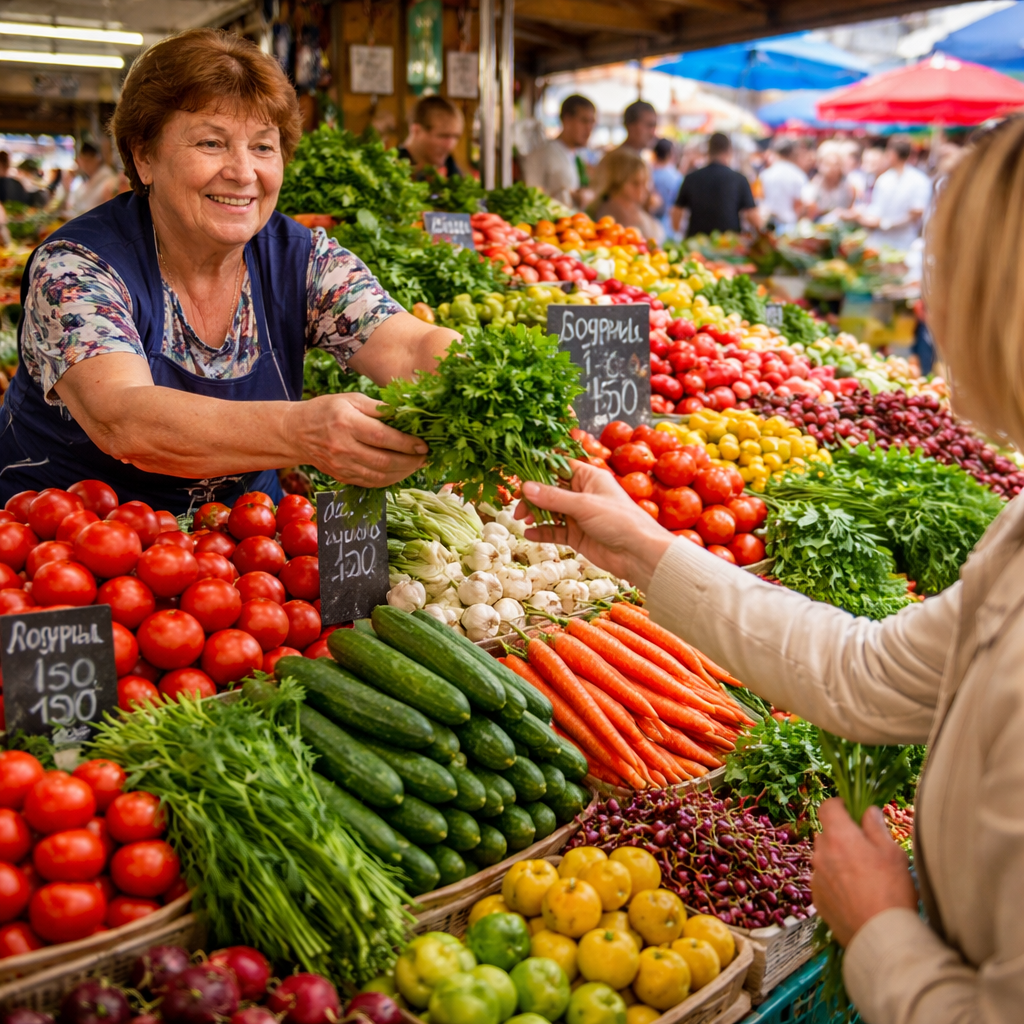
If you want to know what everyday life in Russia really feels like, don’t start with museums or monuments. Go to the рынок.
The Russian open‑air market—рынок, sometimes called a farmers’ market or kolkhoz market—is where city and countryside meet. It is where people still buy tomatoes that taste like sunshine, mushrooms that were in the forest yesterday, and pickles fished out of a wooden barrel with a long-handled ladle. It is also where conversations are loud, prices are negotiable, and nobody is in a hurry to send you to the self‑checkout.
Imagine you are standing in front of one of these markets for the first time. From the outside it might not look like much: a low, sprawling building with a faded sign and a tangle of stalls stretching out into the courtyard, or a big indoor hall with wide steps and heavy, slightly worn doors. Metal frames hold up plastic roofing over the outdoor sections, and around the edges you see vans and small trucks, their back doors open and crates stacked up beside them. The air feels different already—more humid, more alive, a mixture of cool building dust and the faint smell of vegetables.
You push through the entrance and step inside.
First Impressions: The Layout and Atmosphere
At first it feels chaotic, but after a few minutes your eyes adjust and you realize there is an order to everything.
Most traditional Russian markets are organized in zones. Straight ahead you’ll usually find the bright chaos of fruits and vegetables: long rows of wooden or metal tables lined up, each covered in a patchwork of produce. To the side, in their own sections, there are rows where meat and fish are sold, often slightly colder and tiled, with glass displays and stainless-steel counters. Another zone holds dairy: buckets of sour cream, trays of fresh cottage cheese (творог), homemade cheeses, and farm eggs stacked in precarious pyramids. Somewhere nearby, there is often a corner where pickles and sauerkraut live in huge tubs and barrels. Bread and pastries might be at the end of a row or clustered near an exit where the smell can drift out and pull people in from the street.
The building itself shapes the atmosphere. In older Soviet‑era markets, the roof is high and curved, like an old train station. Sunlight filters in through high windows, catching on dust motes and forming bright stripes across the stalls. The floor may be concrete, worn smooth by decades of footsteps. A network of metal pipes and beams hangs overhead, sometimes with hooks, sometimes with electric wires strung like improvised vines, leading to bare bulbs or buzzing fluorescent lights.
In smaller, more modest markets, the infrastructure is simpler: plastic panels, patched roofs, narrow aisles. In summer, the air under the roofing becomes heavy and warm; the smell of fruit and dill grows stronger. In winter, everything feels condensed and sharper: the cold air drifts through the gaps in the doors, and you see more layers of clothing than exposed produce.
Despite these differences, the feeling is the same: the рынок is not just a place to buy food. It is a small world, with its own routines, drama, and relationships. People here talk to each other. They complain about the weather, discuss the price of potatoes, share recipes, ask after grandchildren and gardens. Shopping in a Russian market is as much about these human connections as it is about what ends up in your shopping bag.
The Soundtrack of the Market
What you hear as you walk in is as important as what you see.
There is a constant low roar of voices, layered like a crowded café or a train station. Snatches of conversation float past: a woman asking whether the tomatoes are really from the region or imported, a vendor swearing that his strawberries are the sweetest, two sellers gossiping between customers, a husband and wife arguing over which cabbage is better for borscht.
Then there are the calls. Vendors sing out their prices and their pride, a kind of informal advertisement that has not changed much in decades. “Яблоки по сто!”—apples for a hundred! “Помидоры по сто пятьдесят!”—tomatoes for a hundred and fifty! Some add little phrases for flavor: “Сладкие, как мёд!” (“Sweet as honey!”), “На салат берите!” (“Take these for salad!”), or “На варенье самое то!” (“Perfect for jam!”). The tone is half sales pitch, half neighborly chatter.
Now and then, you hear the slap of a crate being put down, the squeak of a wheeled trolley being pulled along the aisle, the rustle of plastic bags being opened and filled, the beep of an old digital scale. A radio plays somewhere behind the stalls, perhaps a Soviet song or local pop, its melody blending with the market noise. If it’s near a holiday, a vendor might hum along while wrapping up your purchase.
Compared to the controlled, almost silent environment of a Russian supermarket, the рынок feels loud, unscripted, and alive. You hear the city breathing here.
The Smells and Colors: A Sensory Map
As you begin to walk between the stalls, the smells and colours guide you almost more than the signs do.
The vegetable zone hits you first with freshness: the green, slightly sharp smell of dill and parsley, the wet earthiness of potatoes and beets, the crisp scent of cucumbers. Cucumbers and tomatoes are piled high in pyramids or in long lines, their skins shiny from a recent misting of water. Bunches of green onions lie in a row like brush strokes. In summer, everything seems to glow: red tomatoes, yellow peppers, purple eggplants, dark green cucumbers, light green cabbage heads. Price tags on toothpicks or plastic sticks jut out at odd angles, handwritten in thick marker.
Near the fruit sellers, the smell gets sweeter and more complicated. Apples give off their familiar perfume, sometimes mixed with the faint scent of leaves and wooden crates. In berry season, you can actually smell strawberries and raspberries before you see them, a sugary fragrance floating above the stalls. Crates of cherries and apricots add splashes of deep red and ripe orange. Often, one corner of the stall will be devoted to imported favorites—bananas, oranges, mandarins—so their bright yellow and orange sit next to russet apples and red local plums.
Turn a corner and the smell changes abruptly. The pickle and sauerkraut section has a distinctive aroma: vinegar, garlic, dill, and salt. Large plastic tubs and barrels stand in rows, filled with cucumbers, pickled tomatoes, sauerkraut with carrots, pickled cabbage dyed pink with beet juice, shredded carrots in Korean‑style spice blends, and marinated mushrooms. Vendors stand behind these barrels with long-handled spoons or ladles ready to pull out whatever you choose into a waiting container. The air is tangy and briny, and you feel your mouth water just walking past.
A few steps further and the scent becomes smoky and marine near the fish section. Whole smoked fish lie in tight rows, their skin bronzed and gleaming. Dried fish hang from hooks in clusters, tails down like chimes. Fresh fish rest in chilled displays, their silvery sides catching the light. Here, the smell is stronger and saltier, tempered by the cold. Regulars move quickly and confidently, scanning the rows for their usual species and preferred size.
Another pocket of warmth awaits near the bread and pastry stalls. There is something deeply reassuring about this corner: the smell of freshly baked rye loaves, sweet white bread, crusty round loaves with floured tops, and trays of pirozhki—small baked or fried buns filled with potatoes, cabbage, eggs, meat, or jam. Sometimes there are pastries stuffed with cottage cheese or poppy seeds, plump and slightly glossy on their baking trays. This corner feels like the heart of home cooking, with the smell of yeast and butter hanging in the air.
Every corner of the market has its own color palette and scent, and as you walk, your senses adjust and re-adjust. The experience is almost like walking through different rooms of a single living house.
The Food: What Russians Buy at the Market
If you stand next to a popular stall for a few minutes and watch, you start to see patterns in what people buy.
Fresh vegetables and fruit are at the core of market shopping. Potatoes, onions, carrots, beets, and cabbage form the holy quartet of everyday Russian cooking, and they’re stacked in sacks and heaps almost year‑round. These are the ingredients for borscht, stews, salads like vinaigrette, and simple boiled side dishes. In season, tomatoes and cucumbers join them in heroic quantities; people buy several kilos at a time, not just for a salad tonight, but for jars and jars of pickles and preserved salads that will last through the winter.
Berries and mushrooms deserve a chapter of their own. In late summer and early autumn, you see small-scale sellers—often grandmothers—sitting behind a line of enamel bowls or plastic buckets filled with forest berries: bilberries, lingonberries, wild strawberries, sometimes cloudberries in certain regions. The bowls are small but intense, the berries almost too vivid to be real. Next to them, mushrooms appear in shy little mounds: porcini (белые грибы), chanterelles (лисички), and other forest varieties. Some customers arrive with the seriousness of connoisseurs, leaning over to inspect stems and caps, gently turning a mushroom over in their hand before deciding.
Pickled foods are another hallmark. You can find:
Pickled cucumbers in various degrees of crunch and sourness
Pickled tomatoes, from bright red to green and slightly spicy
Sauerkraut with cranberries or carrots
Pickled garlic, whole cloves turned mellow and addictive
Pickled mushrooms in oil with herbs
These are not just snacks; they are insurance against the long winter, and flavors that many Russians associate with childhood and holidays.
Then there is honey and jam. Honey stalls are especially beautiful. Jars or plastic tubs are lined up in grids, each a different shade of yellow, amber, or brown: acacia honey, linden honey, buckwheat honey, wildflower blends, sometimes labeled with a specific region or village. Vendors take small plastic spoons and offer you a taste: one floral and light, one dark and almost molasses‑like, another with a sharp medicinal edge. Next to them, jars of варенье—fruits preserved in sugar syrup—beckon with whole strawberries floating like jewels, sour cherries, blackcurrants, raspberries, or even pine cones in thick golden syrup.
Dried and smoked fish attract a specific crowd. Some people come just for their favorite type to go with beer; others buy fish that will be eaten over several days as a salty accompaniment to everyday meals. The sight of fish hanging or laid out in tight rows can be striking, even for visitors who don’t eat much fish at home.
Fresh bread and pastries, as mentioned, are not only about feeding yourself; they also carry huge emotional weight. A dark, dense rye loaf is part of what many people overseas think of as “Russian bread,” and buying it at the market feels more authentic than picking up a sliced loaf from the supermarket. Pirozhki make convenient snacks—many shoppers don’t resist the temptation to buy one, eat it on the spot, and then continue shopping.
Herbs and spices are another quiet glory of the market. Bunches of dill, parsley, cilantro, and green onions are stacked like green clouds, usually very fragrant and fresher than what you find in plastic bags at a supermarket. Spice stalls might offer paprika, ground chili, black pepper, dried herbs, spice mixes for shashlik (grilled meat), and blends for pickling or fish. Often, tea shares this space: boxes or bags of black tea, green tea, herbal mixes, dried berries and flowers.
Alongside all this, in many markets you also find:
Homemade cheeses and cottage cheese
Sour cream in plastic buckets
Farmer’s sausages and smoked meats
Sunflower seeds and nuts
Ready-made salads and hot dishes like plov
All of this means that a single trip to a market can provide everything for a simple everyday dinner, a weekend feast, or a winter stock‑up session.
Markets vs Supermarkets: Why the Old Ways Survive
You might wonder: in a country where large supermarket chains have multiplied, why do these traditional markets still exist, and in many places, thrive?
One major reason is freshness and flavor. The stereotype is simple: the best-tasting tomatoes, apples, and cucumbers come from someone’s dacha or small farm, not from anonymous supermarket supply chains. At the market, especially during the high season, many sellers bring produce that was in the ground yesterday or picked in the forest this morning. Mushrooms and berries, in particular, have a directness and intensity that supermarket versions rarely match.
Another reason is human connection. In a supermarket, your whole interaction is with shelves and a cashier or machine. At the market, you have favorite vendors. You remember who always has the best strawberries, who gives an extra bunch of dill “as a gift,” whose sour cream tastes closest to what your grandmother used to make. Over time, these interactions build a soft network of familiarity. Vendors might recognize you, ask how your family is doing, or remember that you like apples “not too sweet, with a little sourness.”
Tradition plays a powerful role too. For older generations especially, going to the market is how one “properly” shops for certain things. There is a kind of ritual to choosing cabbages for fermenting, tasting three honeys before deciding which one to buy for the winter, or hunting for the best mushrooms for a festive dish. These activities are tied to memories of parents and grandparents and to a time when the market was the only place to get many foods.
Price and quality also figure into the equation, though not in simple ways. During the peak season, vegetables and fruit from small farmers can be cheaper and better than supermarket produce. At the same time, in big cities some renovated markets have become stylish food halls with higher prices and a focus on atmosphere and niche products. In those spaces, you still get the market feel, but with a more curated, “hipster” twist. Many shoppers happily move between these worlds: a more modest, old‑school market for bulk potatoes and pickles, and a modern market with artisanal bread and coffee on weekends.
Convenience is where supermarkets have the upper hand. They are open later, have everything under one roof from detergent to chocolate, and don’t require conversation if you’re not in the mood. Yet when Russians talk about food that tastes like home, they often describe something that comes not from the chain store, but from the рынок.
Conversations With Vendors: Small Talk and Subtle Negotiations
One of the most memorable parts of visiting a Russian open‑air market is the way people talk to each other.
If you approach a stall and start silently filling a bag with tomatoes without looking at the vendor, you might feel slightly out of place. While it’s perfectly acceptable, the usual rhythm is more interactive. A typical exchange might begin with eye contact, a greeting, and a polite question about price or quality. You might ask, “Сколько стоит?” (“How much is it?”) or the more colloquial “Почём помидоры?” (“What’s the price for tomatoes?”). The vendor will answer and probably watch your face for a reaction.
Then comes the tasting. Many sellers encourage you to try their products, especially if they are homemade or more expensive. They might slice off a piece of apple, spear it with the tip of a knife, and hold it out to you. Or they’ll drizzle a tiny bit of honey into a disposable spoon and hand it over. “Попробуйте, очень вкусно” (“Try it, it’s very tasty”) is a phrase you’ll hear again and again. In the pickle section, you might be offered a small piece of cucumber or a forkful of sauerkraut. You taste, you nod or frown slightly, and then you decide.
Questions about freshness and origin are not only allowed, they are expected. People often ask, “Откуда помидоры?” (“Where are the tomatoes from?”) or “Сегодняшние огурцы?” (“Are the cucumbers from today?”). A proud vendor might answer, “С дачи, свои” (“From my dacha, my own”) or “Из такой-то области” (“From such-and-such region”). These answers matter: “domestic” and, even better, “homegrown” carry more weight than “imported.”
Negotiation at Russian markets is usually gentle rather than dramatic. You might hear someone say, “Если возьму два килограмма, сделаете скидку?” (“If I take two kilos, will you give a discount?”) or simply, “Можно чуть подешевле?” (“Could it be a bit cheaper?”). Sometimes the seller will say yes right away. Other times they’ll sigh theatrically and then agree, or instead they might say, “Ладно, положу вам побольше” (“Fine, I’ll give you a bit more”) and slip an extra apple or cucumber into the bag. Little gestures like rounding the final total down to a nice even number or adding something “as a gift” help maintain a friendly relationship.
There is also plenty of humour and mild teasing. If you poke too many tomatoes, searching for the perfect ones, the vendor might joke, “Не салат, а хирургия” (“This isn’t surgery, it’s a salad”) but with a smile. If you hesitate between two types of apples, they may insist, half-serious, “Берите эти, у меня только хорошие” (“Take these ones, I only have good ones”). The tone is usually warm, but it keeps you engaged.
For a foreign visitor, these conversations can feel intimidating at first, but they are also the quickest way to experience Russian warmth and directness at the same time.
Useful Phrases for Navigating the Market
Even if you don’t speak Russian, learning a few key phrases makes the experience smoother and more fun. Here are some you might actually use while shopping:
To ask the price:
“Сколько стоит?” – How much is it?
“Почём помидоры/яблоки/огурцы?” – What’s the price for tomatoes/apples/cucumbers?
To ask for a quantity:
“Мне, пожалуйста, килограмм яблок.” – I’d like a kilo of apples, please.
“Взвесьте, пожалуйста, полкило сыра.” – Weigh half a kilo of cheese, please.
To point to what you want:
“Покажите, пожалуйста, вон те.” – Please show me those ones over there.
“Можно вот эти?” – Can I have these ones?
To ask about quality:
“Не мягкие? Не зелёные?” – They’re not too soft? Not unripe?
“Это домашнее?” – Is this homemade?
“Когда собирали?” – When were these picked?
To ask for recommendations:
“Что посоветуете?” – What do you recommend?
“Какие сегодня самые сладкие?” – Which are the sweetest today?
“Что лучше для салата/на варенье/для солений?” – What’s better for salad/for jam/for pickling?
To negotiate a little:
“Если возьму два килограмма, сделаете скидку?” – If I take two kilos, will you give a discount?
“Можно чуть подешевле?” – Could it be a bit cheaper?
Add a sincere “Спасибо” (thank you) and “До свидания” (goodbye) at the end, and you’re already participating in the social ritual of market shopping.
Babushki and Small Farmers: The Soul of the Market
No description of a Russian open‑air market is complete without mentioning the grandmothers.
Often, just outside the official bounds of a market, or along the way to the nearest metro station, you’ll see older women sitting on small folding stools or even overturned crates. In front of them there may be a low makeshift table or simply a cloth spread on the ground. On it, a handful of goods: a few jars of pickled cucumbers, a bundle of dill and parsley, a bag of potatoes, some apples, or two jars of honey. Sometimes there are bouquets of garden flowers, homemade woolen socks, or knitted hats.
These women are usually selling the surplus from their own dachas—small country plots where many Russians grow vegetables and fruits in the warmer months. The quantities are tiny compared to the big stalls inside, but the emotional weight is large. Buying from them feels like a personal exchange: you’re helping someone’s grandmother supplement her pension, and in return, you get something that feels deeply “home‑made” and “real.”
Inside the official market, small farmers have their own presence. Their stalls might be less polished: crates instead of decorative displays, handwritten signs on scraps of cardboard, produce that looks more natural and less uniform. The carrots might be crooked, the apples slightly blemished, the cabbage heads larger and looser. But regular customers often make a point of seeking out these stalls, trusting that what they’re buying was grown with care, not shipped across borders.
In conversation, these small sellers may emphasize that their produce comes from “своего огорода” (their own vegetable plot) or “своей пасеки” (their own apiary). They might tell you how they grew it, when they picked it, or how they recommend cooking it. In a world of anonymous food systems, these details matter.
Seasons at the Market: Summer, Autumn, Winter
One of the most beautiful aspects of Russian markets is how clearly they reflect the seasons. You can almost tell the month of the year just by walking through the aisles.
In summer, the market bursts at the seams. The vegetable and fruit rows overflow with color: piles of tomatoes, cucumbers, peppers, eggplants, young potatoes, zucchini, and leafy greens. Berries are everywhere—strawberries, raspberries, currants, cherries, sometimes gooseberries—all demanding to be turned into jam or eaten by the handful. The air is warm and heavy with the smell of herbs and ripe fruit. People buy in bulk, leaving with arms full of bags and boxes. It’s the time for fresh salads, chilled soups, and the first rounds of pickling.
As summer leans into autumn, the mood shifts. Mushroom season begins, and suddenly you see more forest treasures: baskets and bowls of porcini, chanterelles, and other wild varieties. Apples multiply in more types and shades, from small, tart ones perfect for baking to large, rosy varieties for eating fresh. Big heads of cabbage line up like soldiers, ready to become sauerkraut. Beets, carrots, onions, and potatoes are sold in larger quantities, sometimes by the sack, as people prepare their winter stores. There is a sense of purposeful busyness: shoppers planning ahead, sellers proudly displaying the last big harvests.
By winter, the market transforms yet again. The aisles are narrower, partly because fewer stalls are open. Outside, everything is under snow or slush, and the walk to the market involves stamping your boots and adjusting scarves. Inside, the products are more muted in colour but stronger in character: sacks of potatoes and carrots, crates of onions and beets, jars of pickles, tubs of sauerkraut, dried mushrooms, dried and smoked fish. Citrus fruits—especially mandarins—become stars of the season, a bright foreign sunshine in the cold. Many jars on display were actually prepared in late summer and autumn, and now they are opened slowly, one by one, to carry people through the dark months.
The sellers are bundled in layers of sweaters, coats, and shawls, but they are still there, still calling out prices, still slicing bread and packing pickles. Customers move a bit faster in winter, but they still stop to chat, to ask, to taste.
Famous Markets in Moscow and St. Petersburg
If you are visiting Russia and want to experience this world, major cities offer a mix of traditional and modern markets, each with its own character.
In St. Petersburg, Kuznechny Market is one of the classic examples. It sits in a high, bright hall, with rows and rows of stalls selling fresh produce, meat, fish, dairy, and everything in between. The building itself is part of the city’s architectural heritage, and inside you still feel the rhythm of an older, Soviet‑era marketplace: vendors in white coats, neat displays of meat and fish, but also tables overflowing with seasonal fruits and vegetables. It is the kind of place where a local might come for cottage cheese and sour cream from a trusted seller, then pick up some mushrooms from a farmer for a special dinner.
Vasileostrovsky Market, also in St. Petersburg, shows the newer face of Russian markets. It has been renovated into a stylish food space, where traditional stalls coexist with hip eateries, coffee stands, and small restaurants. You can buy cucumbers and honey, but you can also sit down for a bowl of ramen or a fancy dessert. In warm months, the outdoor area becomes a social hub, with people lingering, eating, and sometimes watching films projected on a wall in the evening.
In Moscow, Danilovsky Market has undergone a similar transformation. Once a purely utilitarian Soviet market, it is now a famous gastronomic destination. You can still find farmers’ stalls with garlic, beans, cabbages, and apples, but they sit next to colourful stands selling Georgian khinkali, Vietnamese pho, Uzbek plov, and endless other street foods. The roof soars above a central dome, and the entire place hums with a blend of old and new—it feels both like a market and like a global food court.
Other Moscow markets remain more firmly rooted in the traditional style, with long rows of produce and fewer frills. Going to one of these more “ordinary” markets gives you an even more direct sense of everyday life, far from the glossy central areas. The conversations, the smells, the piles of potatoes and pickles—they are all there, as they have been for decades.
Walking Through the Market for the First Time
So what is it like to actually walk through a Russian open‑air market as a newcomer?
You enter uncertain, maybe a bit overwhelmed by the noise and the crowded aisles. At first you stick to the edges, watching how others behave. You notice that people rarely rush. They take their time, comparing prices at different stalls, chatting with vendors they clearly know, sniffing a melon before choosing it, or gently pressing a tomato to judge its ripeness.
You edge closer to a stall with strikingly red tomatoes and bright green cucumbers. The vendor looks up, meets your eye, and greets you—maybe with a simple “Здравствуйте” or “Привет,” depending on the vibe. You ask, in halting Russian, how much the tomatoes cost. The answer comes, fast but friendly. You repeat the number to make sure you heard correctly, and then, emboldened, you ask whether they are sweet or better for salad. The vendor picks one up, cuts off a slice, and holds it out. You taste. It’s juicy, bursting with flavor in a way supermarket tomatoes rarely are. You nod; you smile. You ask for a kilo.
Next, you’re drawn to the honey stall, where rows of jars glow like stained glass. The seller asks what kind of honey you like—light or strong, floral or with more of a medicinal edge. You shrug, not really knowing, and they offer you a taste of several. Each spoonful is different: one delicate, one rich and dark, one slightly bitter in the back of your throat. You pick one that reminds you of flowers and sun, and as they fill your jar, you feel a small sense of accomplishment. You have navigated a market decision.
As you continue, you notice that the most successful shoppers are not necessarily those who bargain hardest, but those who engage. They ask questions, listen to answers, and treat vendors as individuals with knowledge rather than interchangeable cash registers. In return, they get advice: which apples are better for baking, which mushrooms must be cooked a certain way, which pickles will stay crisp the longest.
By the time you leave, your bags feel heavy. There is a bundle of dill and parsley sticking out of the top of one of them, a clear signal to everyone who sees you on the street that you have been to the market. The smell of herbs follows you home.
And later, when you slice that tomato, fry those mushrooms, or open that jar of honey, the taste you get is not only about the food. It carries with it the echo of the vendor’s voice, the sound of plastic bags rustling, the look of the market hall, the feeling of standing in the middle of a very old, very human ritual.
Learn Russian Before Your Next Market Visit
If you’ve ever stood in a Russian market trying to understand prices, ask about produce, or chat with a vendor, you quickly realize how useful even a little Russian can be.
Simple phrases like:
Сколько стоит? (How much does it cost?)
Дайте, пожалуйста, килограмм яблок (Please give me a kilo of apples)
Можно попробовать? (Can I try it?)
can instantly transform your experience from awkward to enjoyable.
At Polyglottist Language Academy, we offer small-group and private Russian classes in-person and online designed specifically for adults who want to communicate confidently in real-life situations—whether you’re traveling, working with Russian speakers, or simply fascinated by the language and culture.
Our experienced instructors focus on practical conversation, pronunciation, and cultural insight so that you can start using Russian naturally.
More Articles About Russian Culture
If you enjoyed this look inside a Russian market, you might also like these articles exploring other aspects of everyday life in Russia.
Frequently Asked Questions About Russian Open-Air Markets
What is a Russian open-air market called?
A traditional Russian market is called рынок (rynok). These markets often include both indoor halls and outdoor stalls where farmers, small producers, and vendors sell fresh food, homemade products, and seasonal goods.
Are Russian markets cheaper than supermarkets?
Sometimes they are, especially during the summer harvest season when fruits and vegetables are abundant. However, some products—especially artisanal honey, homemade cheese, or wild mushrooms—can be more expensive because they are fresher and often produced in small quantities.
Can you bargain at Russian markets?
Bargaining is possible, but it is usually friendly and subtle. Instead of aggressive negotiation, customers may ask:
“Можно чуть подешевле?”
(Could it be a bit cheaper?)
Often vendors will either reduce the price slightly or add a little extra produce.
Do vendors allow tasting?
Yes—especially for products like honey, berries, cheese, pickles, and fruit. Vendors frequently offer a small sample so you can decide before buying.
Are Russian markets open year-round?
Yes. While the selection changes dramatically with the seasons, most markets stay open all year.
Summer: fresh vegetables, berries, herbs
Autumn: apples, mushrooms, cabbages
Winter: root vegetables, pickles, dried fish
Spring: greenhouse vegetables and early herbs
What should visitors buy at a Russian market?
Some classic items to try include:
fresh dill and cucumbers
wild forest berries
homemade honey
pickled vegetables
rye bread or pirozhki
wild mushrooms (when in season)
These foods are staples of traditional Russian cooking and often taste much better from a market than from a supermarket.