
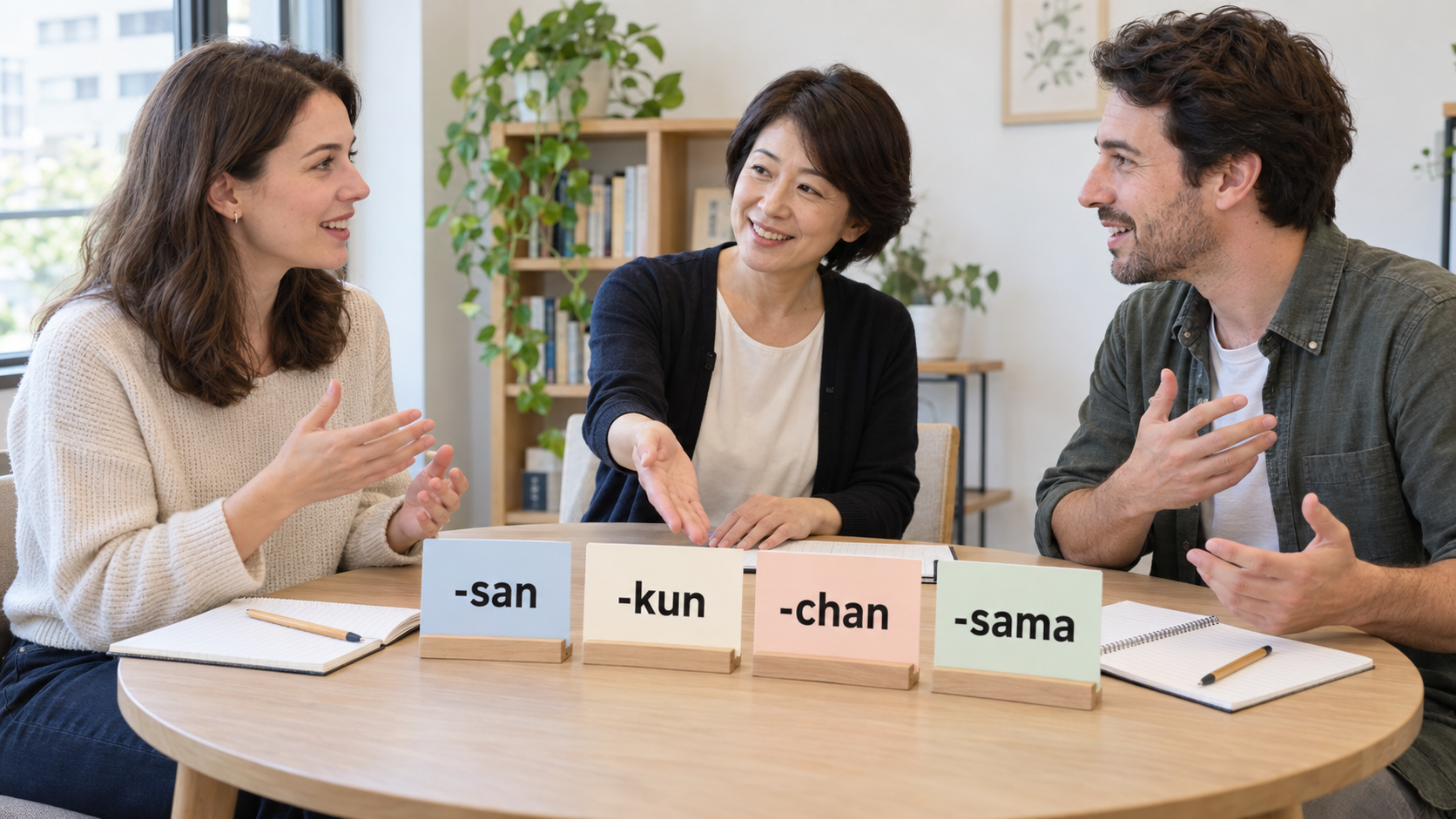
One of the easiest ways to sound slightly wrong in Japanese is to use the right name with the wrong ending.
A learner remembers that -san is polite, so they attach it to everyone. Then they hear a coworker called Tanaka-kun, a child called Yui-chan, and a customer addressed as Satō-sama. Soon another complication appears: Japanese speakers sometimes use no honorific at all.
The words themselves are not difficult.
-san, -kun, -chan, and -sama are short, common, and easy to pronounce. What makes Japanese honorifics challenging is that they describe relationships.
They tell you something about distance, familiarity, hierarchy, affection, and the social situation. Sometimes they tell you almost as much about the speaker as they do about the person being addressed.
That is why a simple translation such as “-san means Mr. or Ms.” is useful for about five minutes and then starts causing problems.
First, what exactly is a Japanese honorific?
Japanese honorific suffixes are attached to names and sometimes titles.
For example:
田中さん
Tanaka-san
ゆきちゃん
Yuki-chan
鈴木先生
Suzuki-sensei
Unlike English titles such as Mr., Mrs., and Dr., Japanese honorifics usually come after the name.
They are also used much more frequently than English titles.
An American office might contain Jennifer, Mike, Dr. Wilson, and Mr. Chen, with first names quickly becoming normal.
In Japanese, the naming system is more sensitive to relationship and context. Two people can know each other for years and still regularly use family name + -san.
This does not necessarily indicate emotional distance. It may simply be the normal relationship between them.
-San: the safest default
If there is one honorific every beginner should learn first, it is -san (さん).
It is polite, neutral, and extraordinarily common.
田中さん
Tanaka-san
could refer to Mr. Tanaka, Ms. Tanaka, Mrs. Tanaka, or simply Tanaka in a respectful neutral way.
That is the first important difference from English: -san is not gendered.
It works for men and women.
It can be attached to family names:
佐藤さん
Satō-san
or given names:
恵美さん
Emi-san
Which name gets used depends on the relationship.
In many professional and less intimate situations, family name + -san is common.
Among friends or in more informal environments, given name + -san may appear.
When should you use -san?
For an adult beginner, the simplest rule is:
Use -san when you are not sure what else to use.
It is appropriate in many everyday situations:
coworkers
neighbors
acquaintances
classmates
people you have just met
someone whose status relative to you is not especially marked
There are exceptions, but -san is rarely an embarrassing choice.
Can you use -san with your own name?
Normally, no.
If you introduce yourself as:
私はオルガさんです。
Watashi wa Olga-san desu.
you are effectively adding an honorific to yourself.
That sounds wrong in normal Japanese.
You would simply say:
オルガです。
Olga desu.
This is a useful early lesson: honorifics are not decorative pieces attached permanently to names. They express how the speaker positions another person.
-Kun: not simply “for boys”
Many beginner explanations say:
-kun is used for boys.
That is not entirely false, but it is much too simple.
-kun (君 / くん) is often used for boys and younger men, especially when the speaker is older or higher in status.
A teacher might address a male student as:
山田くん
Yamada-kun
A senior colleague might use -kun with a junior male employee.
But -kun is also used for women in some professional settings, particularly when a senior person addresses a younger or subordinate employee.
This surprises learners who have memorized “kun = male.”
The more useful way to understand -kun is that it often implies a relationship in which the speaker has some familiarity, seniority, or authority.
That relationship frequently involves boys and young men, but gender is not the whole story.
When does -kun sound natural?
Typical situations include:
Teachers speaking to male students
A teacher may call a student:
健太くん
Kenta-kun
Older people speaking to younger males
For example, an older family friend might use -kun.
Superiors speaking to junior employees
This is especially associated with traditional workplaces.
Friends or acquaintances
In some groups, -kun may be used affectionately or casually among people who know one another well.
The exact feel depends heavily on who is saying it.
That is why learners should be cautious about adopting -kun too quickly.
If a senior Japanese colleague calls someone Suzuki-kun, it does not necessarily mean a foreign learner of the same age should copy them.
The social relationship is different.
-Chan: affection, closeness, and smallness
-chan (ちゃん) is warmer.
It is commonly associated with children, girls, close friends, pets, and affectionate relationships.
A small child named Hana might be:
はなちゃん
Hana-chan
A family pet might also get -chan.
Close female friends sometimes use -chan with each other.
Family members may use it for younger relatives.
And romantic partners may use it depending on personality and relationship.
This is why translating -chan as “little” does not really work. Sometimes it expresses smallness or youth, but often it expresses affection or intimacy.
Can -chan be used for adults?
Absolutely.
The important question is not age. It is relationship.
An adult woman may be called Mika-chan by childhood friends even at forty.
Someone's older relatives may continue using a childhood nickname + -chan forever.
Adult men can also receive -chan, particularly in playful, affectionate, family, entertainment, or nickname contexts.
This does not mean it is safe to call any adult -chan.
Using -chan without the necessary closeness can sound overly familiar, patronizing, flirtatious, childish, or simply odd.
A beginner meeting an adult named Akiko should not assume:
Akiko-chan
is friendlier than:
Akiko-san
It may instead sound as though the speaker has granted themselves an intimacy that does not exist.
Use -san unless the relationship gives you a reason not to.
-Sama: respect turned up considerably
-sama (様 / さま) is more respectful than -san.
Learners encounter it frequently in customer service.
A customer is:
お客様
okyakusama
The word literally combines 客 (kyaku), “guest/customer,” with -sama.
Names on formal correspondence may also take -sama.
For example:
田中様
Tanaka-sama
This is common in letters, business communication, reservations, and customer-facing situations.
If -san is everyday respectful neutrality, -sama creates more distance and deference.
Should you call your boss -sama?
Usually not.
This is another place where “more respectful” does not mean “better.”
Calling an ordinary coworker or boss -sama can sound excessive unless the situation specifically calls for it.
Japanese politeness is not a staircase where adding more respect always improves the sentence.
Appropriate politeness matters more than maximum politeness.
That is a recurring principle in Japanese.
-Sama outside formal politeness
Japanese also uses -sama in contexts that are not ordinary business respect.
One famous example is:
神様
kami-sama
“God” or “a deity,” with elevated respect.
You may also hear ore-sama (俺様) in fiction or exaggerated speech, roughly an arrogant “the great me.”
That usage works because -sama is so elevated that attaching it to oneself sounds comically self-important.
Anime and manga use honorifics creatively, but learners should be careful about treating fictional dialogue as a direct guide to ordinary conversation.
A villain calling himself ore-sama is not offering a useful template for the office.
Why names sometimes have no honorific at all
Eventually, learners encounter a name without -san, -kun, -chan, or another title.
This is called yobisute (呼び捨て): using someone's name without an honorific.
For example:
Yuki
rather than:
Yuki-san
In English, this seems completely normal.
In Japanese, dropping the honorific can communicate closeness, equality, family relationship, roughness, authority, or disrespect depending on context.
Close friends may do it.
Romantic partners may do it.
Family members often do it.
A senior person may use a subordinate's name without an honorific.
Someone angry with another person may suddenly drop the honorific.
That last example reveals how much social information these tiny suffixes carry.
Changing:
田中さん
Tanaka-san
to:
田中
Tanaka
can alter the emotional temperature of the interaction even though the name itself is unchanged.
Do Japanese friends always use honorifics?
No.
Some close friends use first names without suffixes. Others use -chan or -kun. Others continue using family name + -sandespite being genuinely close.
Naming habits often develop early in a relationship and then stick.
This produces a situation that may seem odd to Americans: two close friends can still address one another in a form that sounds quite formal in English translation.
That does not mean the friendship is formal.
Japanese naming conventions cannot be mapped neatly onto American intimacy.
What about -sensei?
Although not part of the familiar -san / -kun / -chan / -sama group, sensei (先生) is too important to leave out.
It is commonly used for teachers, doctors, professors, and certain respected professionals.
A teacher named Suzuki might be:
鈴木先生
Suzuki-sensei
Students should normally not say:
Suzuki-san
if Suzuki is their teacher and Suzuki-sensei is appropriate.
In English, “teacher” describes an occupation.
In Japanese, sensei also functions as a form of address.
You can even say simply:
先生
Sensei
without the person's name.
Doctors are commonly addressed this way as well.
And -senpai?
Senpai (先輩) refers to someone senior to you within a group, institution, school, club, or workplace.
Someone who joined a company or club before you may be your senpai.
The opposite relationship is kōhai (後輩), a junior member.
However, kōhai is usually not used as a name suffix in the same way.
You might hear:
田中先輩
Tanaka-senpai
especially in schools, clubs, sports teams, and fictional dialogue.
The senpai-kōhai relationship receives enormous attention in explanations of Japanese culture, sometimes to the point of exaggeration. It is real, but its importance varies greatly by environment.
A traditional sports club and a modern tech startup may operate very differently.
Family terms can function like honorifics too
Japanese naming becomes even more interesting inside families.
A child may address an older sister as:
お姉ちゃん
onee-chan
or more politely:
お姉さん
onee-san
An older brother might be:
お兄ちゃん
onii-chan
These expressions literally refer to “older sister” and “older brother,” but they also function as forms of address.
Family members are often named according to their relationship to the youngest person present.
For example, after a couple has children, a husband may sometimes refer to his wife as お母さん (okāsan), “Mom,” in the family context because that is her role relative to the children.
English does this too to some extent. Parents sometimes call each other “Mom” and “Dad” around children.
Japanese simply makes relational naming especially visible.
Honorifics change depending on whether someone is inside or outside your group
This is one of the more subtle principles and one of the most important for professional Japanese.
Japanese often distinguishes between uchi (内) and soto (外):
uchi: inside one's group
soto: outside one's group
Suppose you work for Company A and speak directly to your manager, Tanaka.
You might address him as:
田中部長
Tanaka-buchō
“Department Manager Tanaka.”
But if you are speaking to a customer from another company about Tanaka, you generally do not elevate your own colleague in the same way.
This can be startling for English speakers.
The respectful language is not simply attached permanently to whoever outranks you. It changes according to the relationship between speaker, listener, and person being discussed.
Japanese politeness is relational.
That principle matters far beyond honorific suffixes. It also helps explain humble and honorific verb forms in keigo (敬語).
Why Japanese people may call foreigners by first name + -san
English-speaking learners sometimes notice that Japanese acquaintances use:
David-san
rather than:
Smith-san
even though Japanese people frequently use family names with one another.
This can happen for several reasons.
Foreign names may not fit Japanese naming expectations neatly. Japanese speakers may also adapt to the naming conventions they associate with the person's culture.
If someone introduces himself as “David,” the most natural Japanese adaptation may simply be:
David-san
Foreigners sometimes assume that first name + -san means the relationship has become unusually close.
Not necessarily.
It may simply be a culturally convenient way to address that person.
Should you use honorifics when speaking English?
This depends on context.
Among Japanese speakers using English, -san may carry over naturally:
“Tanaka-san sent the documents.”
In international companies, this sometimes becomes part of the organization's English vocabulary.
Outside that environment, adding Japanese honorifics to English sentences can sound affected.
Someone discussing Japan in English does not normally need to say:
“Prime Minister Ishiba-san.”
Likewise, peppering English with -chan and -kun because one has learned them from anime can sound unnatural.
Honorifics belong to a social system, not a collection of Japanese decorations.
How anime can distort a learner's sense of honorifics
Anime is useful for hearing how Japanese sounds.
It is less reliable as a guide to how an ordinary adult should speak.
Fiction deliberately exaggerates relationships.
Characters may use -sama to show extreme devotion, -chan flirtatiously, -kun in stylized ways, or no honorific at all to signal hostility or intimacy.
These choices are meaningful precisely because Japanese viewers understand the social associations behind them.
Learners sometimes copy the surface form without understanding that association.
The safer approach is to ask:
Why is this character using this honorific with this particular person?
That question is much more useful than simply memorizing the suffix.
A practical guide for learners
Most adult beginners do not need a complicated decision tree.
A few rules handle a large percentage of real situations:
When in doubt, use -san
Family name + -san is a safe starting point for most adults you do not know intimately.
Use titles when the title itself is the normal form of address
A teacher can be:
Suzuki-sensei
rather than Suzuki-san.
Do not attach honorifics to your own name
Say:
Olga desu.
not:
Olga-san desu.
Do not imitate someone else's -kun or -chan automatically
Their relationship with the person may be different from yours.
Wait before dropping an honorific
Let closeness develop naturally.
If someone asks you to call them something, use it
A Japanese person might say:
Yuki de ii desu.
“Yuki is fine.”
or:
Yuki tte yonde kudasai.
“Please call me Yuki.”
That instruction is much more useful than any generalized etiquette rule.
The mistake English speakers make: treating politeness as a scale
It is tempting to arrange the major honorifics like this:
-chan → -kun → -san → -sama
casual to respectful.
There is some truth to the visual, but it is misleading.
The honorifics do not simply measure “amount of respect.”
-chan may express enormous affection.
-kun can express hierarchy.
-san can indicate neutral social distance.
-sama can indicate formal deference.
No suffix at all may indicate deep intimacy or open contempt.
The relevant dimension is not just politeness.
It is relationship.
Once that becomes clear, Japanese honorifics stop looking like an etiquette quiz and start looking like something much more interesting: a compact grammatical map of how people see one another.
You do not have to sound Japanese immediately
Adult learners sometimes become so worried about honorifics that introductions feel like negotiations.
Should it be -san? Is first name acceptable? Is this person older? Is -sensei required? Have we reached the point where the suffix should disappear?
Most situations are much more forgiving than that.
Japanese speakers know that learners are learners.
Using -san politely and paying attention to how other people address one another will take you a long way.
More subtle instincts develop with exposure.
Over time, the learner starts noticing that two colleagues always use -san, that an older friend suddenly switches to a first name, or that a teacher calls one student -kun and another -san.
Those observations are where the system starts becoming intuitive.
At Polyglottist Language Academy, our Japanese classes for adults treat forms of address as part of actual communication rather than a vocabulary list. Japanese makes social relationships visible in ways English often does not, and understanding those patterns makes everyday speech considerably easier to interpret. Polyglottist offers live online Japanese classes as well as selected in-person classes in Berkeley, California.
Knowing that -san is polite is useful.
Knowing why someone stopped using it is when things get interesting.
Frequently asked questions about Japanese honorifics
Is -san used for both men and women?
Yes. -san is gender-neutral and is commonly used for adults of any gender.
Is -kun only for boys?
No. It is especially common for boys and younger men, but it can also be used for women in some workplace or hierarchical settings. The relationship between the speakers matters more than a simple gender rule.
Can I call an adult -chan?
Yes, if the relationship supports it. -chan is used with adults among close friends, family members, romantic partners, and in nickname contexts. Using it with an unfamiliar adult can sound overly familiar.
Is -sama more polite than -san?
Yes, but it is also much more formal and deferential. It is commonly used for customers, formal correspondence, and situations requiring elevated respect. It is not a replacement for -san in ordinary conversation.
Do Japanese people use honorifics with family members?
Naming within families follows different patterns. Family terms such as onee-chan, onii-chan, okāsan, and otōsan are frequently used as forms of address.
When can I stop using -san with a Japanese friend?
There is no fixed point. Some friends drop honorifics quickly; others continue using -san for years. Follow the patterns of the relationship, or use the form the person asks you to use.
What should a beginner use if unsure?
For another adult, family name + -san is usually the safest default.