
Can You Learn Japanese in a Year? What's Realistic and How to Maximize Your Progress
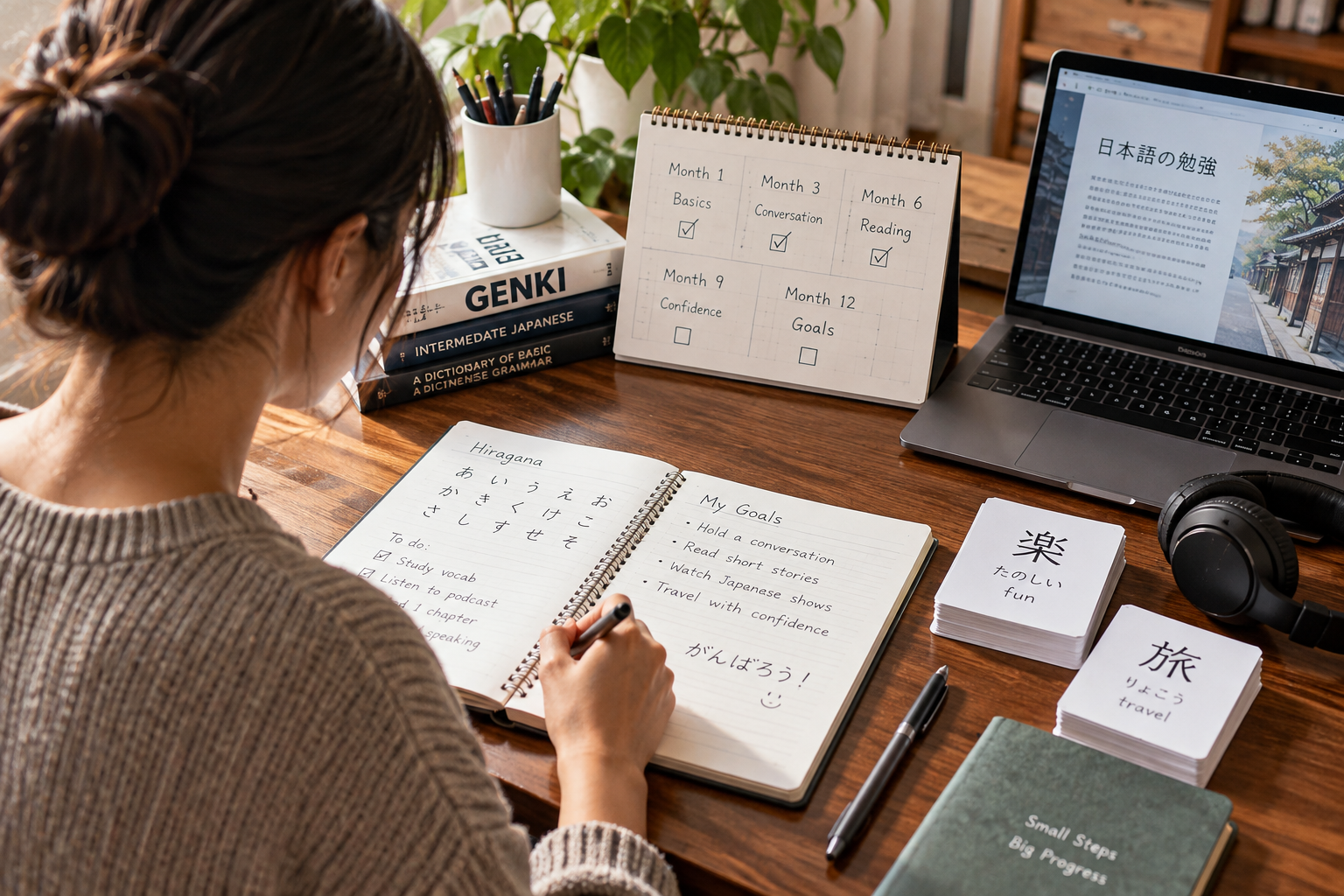
A year is long enough to become recognizably competent in Japanese and far too short to “finish” Japanese.
Both statements are true.
The confusion comes from the word learn. If you mean “Can I study Japanese for twelve months and have real conversations, read basic material, understand familiar speech, and function at a serious beginner or lower-intermediate level?”, yes. If you mean “Can I become effortlessly fluent across work, relationships, news, literature, bureaucracy, and fast native conversation?”, that is a very different target.
The most useful question is not whether Japanese can be learned in a year. It is what a well-used year can realistically produce.
With casual study, expect familiarity rather than independence
If Japanese receives two or three hours of attention per week, you can still achieve something meaningful. You can learn hiragana and katakana, build basic sentence patterns, develop several hundred useful words, recognize common kanji, and handle predictable exchanges.
The limitation is retrieval speed. A language learned only during one weekly lesson tends to feel familiar on the page but slow in real time. You recognize grammar after someone explains it, yet cannot produce it quickly during conversation.
Casual study is not wasted study. It simply produces a different result from daily contact.
With consistent daily study and live practice, a year can transform your ability
An adult who studies most days, attends regular instruction, listens frequently, reads level-appropriate material, and speaks from early on can make substantial progress in twelve months.
By the end of the year, many committed learners can handle routine conversation about themselves, family, work, plans, likes and dislikes, travel, shopping, and everyday experiences. They can read kana automatically and recognize a meaningful body of common kanji. They can understand slower, clear Japanese on familiar topics and begin working with native materials designed for learners.
Some may prepare successfully for N4 or even N3 depending on prior language experience, intensity, and individual strengths. But those exam labels need context.
From December 2025, successful JLPT score reports can include CEFR reference levels. N5 scores map to A1 for the skills measured, N4 to A2, and higher N3 passing scores can show B1. The JLPT itself emphasizes that it tests language knowledge, reading, and listening. It does not test speaking, writing, or interactive conversation.
So “I passed N3” and “I can comfortably conduct a spontaneous B1 conversation” are not automatically the same statement.
Month 1: learn kana quickly and start using Japanese immediately
Do not spend the first two months perfecting hiragana handwriting before learning sentences. Hiragana should become functional quickly, with katakana following soon after.
At the same time, learn basic Japanese word order, particles such as は, が, を, に, and で, the polite verb system, common question forms, and high-frequency vocabulary.
Most importantly, listen from the beginning. Learners who spend months looking at written Japanese can develop strong visual recognition while remaining unable to parse even very basic spoken sentences.
Months 2–3: build a small language you can actually use
Your first conversational system should be narrow but functional. Learn to introduce yourself, describe routines, ask simple questions, order food, talk about time, express likes, make plans, and describe what exists around you.
Practice grammar through substitution rather than isolated explanation. If you learn 〜たいです for “want to,” say ten things you genuinely want to do. If you learn the past tense, talk about yesterday. Grammar becomes usable when it is attached to your own messages.
Kanji should begin early, but through vocabulary. 学 should arrive with 学生 and 学校, not as an abstract symbol accompanied by a list of every possible reading.
Months 4–6: move beyond scripted beginner Japanese
Around this stage, many learners hit a plateau. Textbook dialogues feel manageable, but native conversation still sounds impossibly fast.
The answer is more comprehensible listening, not simply harder grammar.
Use graded podcasts, learner videos, slow interviews, and material with transcripts. Listen once for general meaning, again with the transcript, and once more without it. Short material repeated intelligently is usually more useful than hours of Japanese playing in the background while you understand almost nothing.
Speaking should also become less scripted. Have a teacher or conversation partner ask follow-up questions you did not prepare for. The discomfort of finding language in real time is part of learning to speak.
Months 7–9: start becoming a reader rather than a decoder
By the second half of the year, reading should occupy more of your study. Use graded readers, easy articles, manga chosen for accessibility, simple social-media posts, or learner-friendly news.
Do not look up every word. Learn to distinguish between a word blocking the whole sentence and a word you can ignore temporarily.
This is also a good time to increase kanji systematically. Hundreds of characters become much less frightening once they are encountered through recurring vocabulary and components rather than treated as unrelated drawings.
Months 10–12: specialize around the Japanese you want
A one-year learner preparing for travel needs a different final quarter from someone dating a Japanese speaker, planning graduate school, or aiming for the JLPT.
Choose a domain. If your goal is travel, practice hotel problems, transport, restaurants, directions, and polite requests. If you want family conversation, work on informal speech and relationship vocabulary. If you want N4 or N3, add deliberate test practice while maintaining speaking so exam preparation does not replace the language itself.
The final months should make your Japanese more specific, not simply broader.
What slows adult learners down most
The first problem is inconsistency. Three hours on Sunday is not equivalent to 25 minutes every day, especially for reading and listening automaticity.
The second is overreliance on one tool. Apps are excellent for repetition but cannot provide a complete speaking environment. Textbooks organize grammar but do not automatically build listening speed. Anime provides exposure but is not a structured curriculum.
The third is delaying conversation until you “know enough.” You never reach a point at which speaking suddenly becomes comfortable without having practiced speaking.
A strong weekly structure
For a serious one-year goal, combine several kinds of work: structured lessons or textbook study, daily vocabulary/kanji review, frequent listening, regular reading, and at least one live speaking session each week.
You do not need equal amounts of everything every day. You do need all major skills to appear consistently across the week.
Polyglottist Language Academy’s live Japanese classes can provide the structured progression and speaking feedback that self-study often lacks. The rest of the week can then be used for reading, listening, review, and personal interests.
What a good year feels like at the end
You will still encounter sentences that seem impossibly fast. You will still forget kanji you “knew” last month. You will make particle mistakes and occasionally understand every word in a sentence while missing the point.
But Japanese will no longer be an opaque system. You will know how sentences are built. Kana will be automatic. Hundreds of written forms will be familiar. You will be able to keep some conversations going instead of performing only memorized lines.
That is a substantial achievement for one year, and it is a much more useful goal than a vague promise of fluency.