
Learning Vietnamese to Speak With Family: A Guide for Heritage Learners
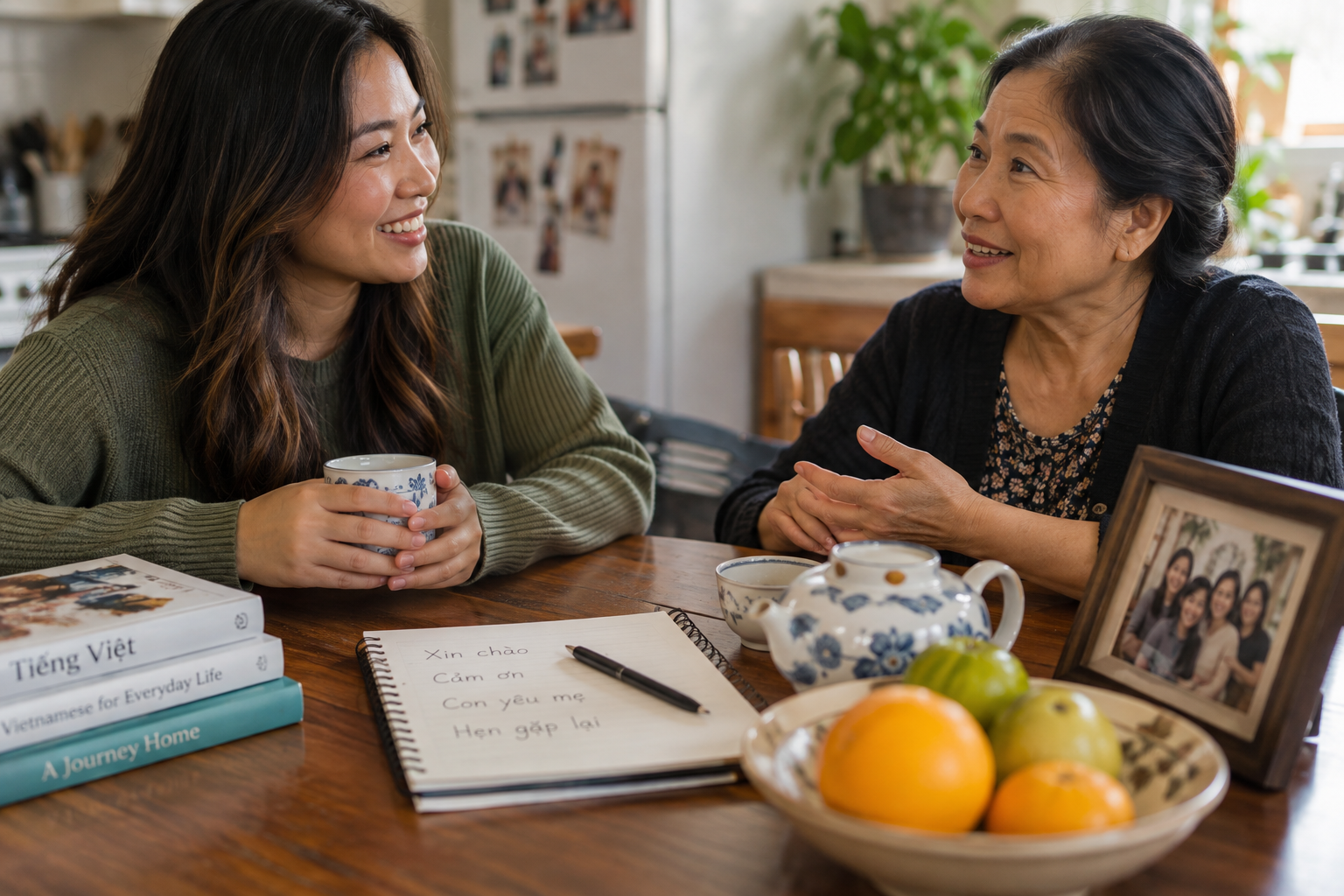
A heritage learner may sit through a family dinner understanding almost everything and still answer every question in English. That combination can be confusing to outsiders. If you understand Vietnamese, why can’t you just speak it?
Because comprehension and production are different skills, and heritage language develops according to the life in which it was used.
If Vietnamese was the language your parents used while you answered in English, your brain had years of listening practice and far less practice building sentences. You may know exactly what Ăn cơm chưa? means because you heard it a thousand times, yet struggle to explain what you did at work that day.
That is not the same starting point as a complete beginner.
Your Vietnamese may be stronger than it looks
Heritage learners often underestimate themselves because formal language learning makes certain weaknesses highly visible. You may not know tone names, grammar terminology, or spelling conventions. A beginner textbook may introduce words you have understood since childhood and then ask you to perform a grammar exercise you have never seen.
At the same time, you may possess things an ordinary beginner needs years to build: an intuitive sense of family address, natural rhythm in familiar expressions, strong listening with particular relatives, and cultural knowledge that tells you when a sentence feels socially wrong even if you cannot explain why.
A good course should identify both sides of that profile.
Start by separating your four skills
Do not ask simply, “What level is my Vietnamese?” Ask four questions instead.
How much do you understand when relatives speak normally? How comfortably can you answer in Vietnamese? Can you read texts or messages? Can you write more than a few familiar words?
The answers may be completely different.
One learner can understand 80 percent of family conversation, speak in short phrases, and barely read. Another can read reasonably well because of later study but struggle with fast southern family speech. A third may speak naturally but lack vocabulary outside home topics.
Placement should reflect that unevenness.
The family vocabulary problem is usually an adult-vocabulary problem
Many heritage speakers know words connected to childhood extremely well: food, chores, relatives, school, bodily needs, scolding, affection. Then adulthood arrives in English.
You learn the language of university, finance, office politics, healthcare, relationships, technology, taxes, and current events in English because those are the environments where you first needed the concepts.
That is why a 30-year-old heritage learner can discuss dinner naturally in Vietnamese but feel like a child when trying to explain a mortgage or a difficult work meeting.
The solution is not more beginner vocabulary. Build thematic adult vocabulary around the conversations you actually want to have with family. If you want to talk with your parents about health, learn appointment, prescription, blood pressure, insurance, side effects, and treatment. If your family discusses news, build political and social vocabulary carefully and in context.
Forms of address deserve deliberate study
Vietnamese does not rely on one neutral word for “you” the way English does. Family relationships and relative age shape how people refer to themselves and one another.
Heritage learners often use these terms correctly inside their own family because they learned them as relationships, not grammar. Confusion appears when meeting unfamiliar people or expanding beyond the family network.
Learning anh, chị, em, cô, chú, bác, dì, ông, and bà is not simply vocabulary work. You are learning how Vietnamese encodes social relationships into ordinary sentences.
This is one area where formal study can make implicit heritage knowledge much more transferable.
Do not erase your family’s regional Vietnamese
A heritage learner may enter a class speaking southern Vietnamese and hear forms associated with Hanoi, or the reverse. There may also be family vocabulary shaped by a particular province, generation, refugee history, or decades of life in the United States.
Learning a broader or more standardized form of Vietnamese is useful. Treating the family variety as incorrect is not.
The goal is range. You want to understand that mẹ and má can both refer to mother in different families and regions, or that pronunciation patterns vary. You can learn to recognize multiple varieties while continuing to speak in the way that feels natural at home.
Literacy can unlock language you already know
Some heritage learners are surprised by how quickly reading improves once the sound system and spelling conventions make sense. The vocabulary is not entirely new; the written form is.
Vietnamese orthography is systematic, but the diacritics carry a great deal of information. Tone marks and vowel marks are not decorative. Learning to read means connecting a familiar spoken word to a precise written shape.
Start with messages, captions, short family stories, menus, and simple articles rather than children’s alphabet drills alone. Familiar content reduces the cognitive load and lets you focus on spelling.
Writing is slower. Typing is often the most useful early goal because it allows you to message relatives and practice complete sentences without the pressure of live conversation.
Speaking requires tolerating a little awkwardness
The most emotionally difficult part of heritage learning is often not grammar. It is using Vietnamese with people who have known you your entire life as “the one who answers in English.”
When you switch languages, relatives may laugh with surprise, correct you immediately, or switch back to English to make things easier. None of those reactions automatically means your Vietnamese is bad.
Set boundaries around practice. Tell a relative that you want ten or fifteen minutes in Vietnamese. Choose one person who is patient rather than trying to transform the entire family dinner into a lesson. Ask for correction when meaning is unclear, but do not invite commentary on every syllable if that makes you stop speaking.
Low-stakes repetition is how the productive gap closes.
A heritage learner probably should not restart from zero
A complete-beginner class can be useful if you truly need foundational literacy and pronunciation work, but it can also be painfully slow if you already understand everyday speech.
A placement conversation is better than a self-label. Speak with the instructor. Read a short passage. Describe your family or your day. Explain what you understand and what feels difficult.
At Polyglottist Language Academy, heritage learners can be placed according to the skills they actually have rather than being treated automatically as either fluent or beginner. A small live class can help build the areas that home exposure often leaves uneven: literacy, grammatical awareness, unfamiliar listening, and adult vocabulary.
A practical weekly plan
Choose one family topic each week. Build 15 to 20 useful words and three or four sentence patterns around it. Listen to Vietnamese connected to the same subject. Write a short message or paragraph. Then have one real conversation with a relative where you deliberately use some of the new language.
Keep a second list called “things my family says.” When you hear an expression you understand but cannot reproduce, write it down afterward. Those phrases are often more valuable than generic vocabulary lists because they belong to the Vietnamese you actually want to speak.
Heritage learning is not a process of replacing the half-language you supposedly have with a proper one. It is a process of making your existing Vietnamese more available to you: turning recognition into speech, family phrases into flexible language, and inherited knowledge into something you can use as an adult.