
Tagalog Food Vocabulary: Words to Know at a Filipino Restaurant
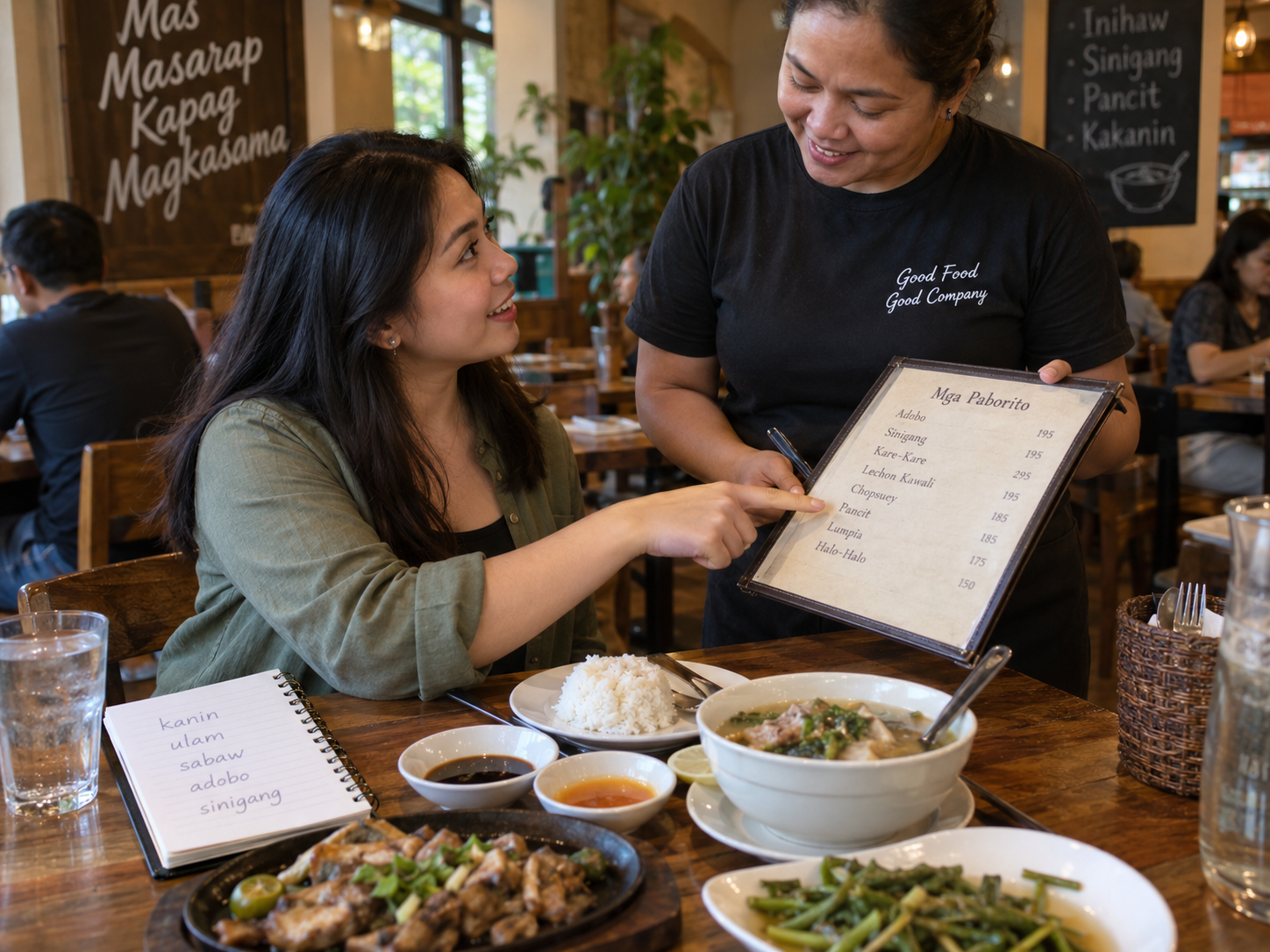
A Filipino menu can be full of words that are technically easy to translate and still confusing if you do not know how they fit together. Ulam, for example, is often translated as “dish” or “viand,” but that does not quite capture how naturally it sits beside kanin, rice, in an everyday Filipino meal. If someone asks, “Anong ulam?” they are essentially asking what the main food eaten with the rice is.
That small distinction is more useful in a restaurant than memorizing fifty isolated food nouns. Restaurant Tagalog works best when you learn the words in the situations where they appear.
Kanin and ulam: the basic meal vocabulary
Kanin — cooked rice
Ulam — the main dish or dishes eaten with rice
Pagkain — food
Almusal — breakfast
Tanghalian — lunch
Hapunan — dinner
A beginner sometimes learns bigas and assumes it simply means rice. Bigas normally refers to uncooked rice, while kanin is cooked rice. At a restaurant, kanin is usually the word you need.
May kanin po ba? — Do you have rice?
Isa pong kanin. — One rice, please.
Ano pong ulam ninyo? — What dishes do you have?
That last sentence may sound more natural in some contexts as a mixed Tagalog-English question, especially in urban restaurants. Code-switching is common in the Philippines, and a visitor does not need to force every restaurant interaction into pure Tagalog.
Cooking words that help you read the menu
Many Filipino dish names tell you something about how the food was prepared.
Ihaw / inihaw — grill / grilled
Prito / pinirito — fried
Gisa / ginisa / ginisang — sautéed
Laga / nilaga — boiled or simmered
Sinigang — a sour soup or stew, commonly associated with tamarind or other souring agents
Adobo — a broad family of dishes cooked with a seasoned braising method, commonly involving vinegar and soy sauce, though recipes vary enormously
Knowing these words lets you infer something about a dish before you know every ingredient. Inihaw na isda tells you you are looking at grilled fish. Ginisang gulay points toward sautéed vegetables.
Filipino food vocabulary also reflects the country's long history of regional exchange and colonial contact. Menus contain words and dishes with indigenous, Spanish, Chinese, American, and regional Philippine histories. That mixture is normal rather than an exception.
Soup, sauce, and the things beside the main dish
Sabaw — soup or broth
Sawsawan — dipping sauce
Sarsa — sauce
Suka — vinegar
Toyo — soy sauce
Patis — fish sauce
Sili — chili pepper
Calamansi / kalamansi — Philippine citrus commonly used for acidity
Sawsawan is a useful cultural word because it refers not just to one fixed sauce but to the dipping mixture served with a dish. Different households and restaurants may combine vinegar, soy sauce, calamansi, chili, onions, or other ingredients in different ways.
May sawsawan po ba? — Is there dipping sauce?
Pahingi po ng suka. — May I have some vinegar, please?
Pahingi po is a useful polite request pattern. It is closer to “May I have...” than a direct English-style command.
Describing taste
Masarap — delicious / tasty
Maanghang — spicy
Matamis — sweet
Maasim — sour
Maalat — salty
Mapait — bitter
Mainit — hot, in temperature
Malamig — cold
Hindi masyadong maanghang — not too spicy
Masarap is one of the most rewarding early Tagalog words because you can use it immediately after tasting something.
Ang sarap! — So delicious!
Masarap po. — It's delicious. (polite)
Notice that maanghang and mainit are different. English speakers sometimes use “hot” for both temperature and chili heat. Tagalog distinguishes them: mainit is hot in temperature, while maanghang refers to spicy heat.
The restaurant questions you will actually ask
Ano po ito? — What is this?
Ano po ang masarap dito? — What is good here?
Ano po ang specialty ninyo? — What is your specialty?
May manok po ba? — Do you have chicken?
May gulay po ba? — Do you have vegetables?
Maanghang po ba ito? — Is this spicy?
Isa po nito. — One of these, please.
Dalawa po nito. — Two of these, please.
Pwede pong takeout? — Can this be takeout?
Bill po, please. — The bill, please.
These mixed Tagalog-English forms may look untidy to a learner who expects each language to remain in its own box. Real Filipino conversation often does not work that way. In Metro Manila especially, switching between Tagalog and English can be completely ordinary.
Useful ingredient words
Manok — chicken
Baboy — pork
Baka — beef / cow
Isda — fish
Hipon — shrimp
Itlog — egg
Gulay — vegetables
Bawang — garlic
Sibuyas — onion
Kamatis — tomato
Niyog — coconut
Gata — coconut milk
If you have a serious allergy, knowing ingredient vocabulary can help, but it should not be your only protection. Explain the allergy clearly, use written information if needed, and confirm cross-contact concerns directly. Restaurant vocabulary is not a medical safety guarantee.
Ordering politely: why po matters
Po does not have one neat English translation. It marks respect and is especially common when speaking to older people or in polite service interactions.
Magkano ito? means “How much is this?”
Magkano po ito? means the same basic thing but adds respect.
A beginner who uses po appropriately may sound more socially aware than a learner with a larger vocabulary who speaks too abruptly. You do not need to insert it into every possible sentence, but it is worth hearing how local speakers use it.
Another useful respectful form is opo, a polite “yes.”
A few menu words can teach you how Tagalog builds meaning
Restaurant vocabulary is also a good entry point into Tagalog grammar because you repeatedly encounter related forms. A root can appear inside words that describe an action, a completed preparation, or a dish. Beginners do not need to analyze every affix on a menu, but noticing relationships makes vocabulary easier to remember.
For example, ihaw relates to grilling, while inihaw describes something grilled. Gisa relates to sautéing, while ginisa or ginisang appears in prepared-dish descriptions.
This is more productive than memorizing each menu item as if it were unrelated to every other word.
Polyglottist Language Academy's Tagalog classes for adults include practical vocabulary together with sentence patterns, pronunciation, and conversation. Food is an ideal beginner topic because the language can be used immediately, but the larger goal is to understand enough structure to ask about a dish you have never seen before.
At a Filipino restaurant, you do not need to know the name of everything on the menu. If you can recognize how something was cooked, ask what it is, understand whether it is spicy, request rice and sauce, and say that it was masarap, you already have a useful little system rather than a loose list of words.