
"I Want to Live in Japan" — How Much Japanese Do You Actually Need?
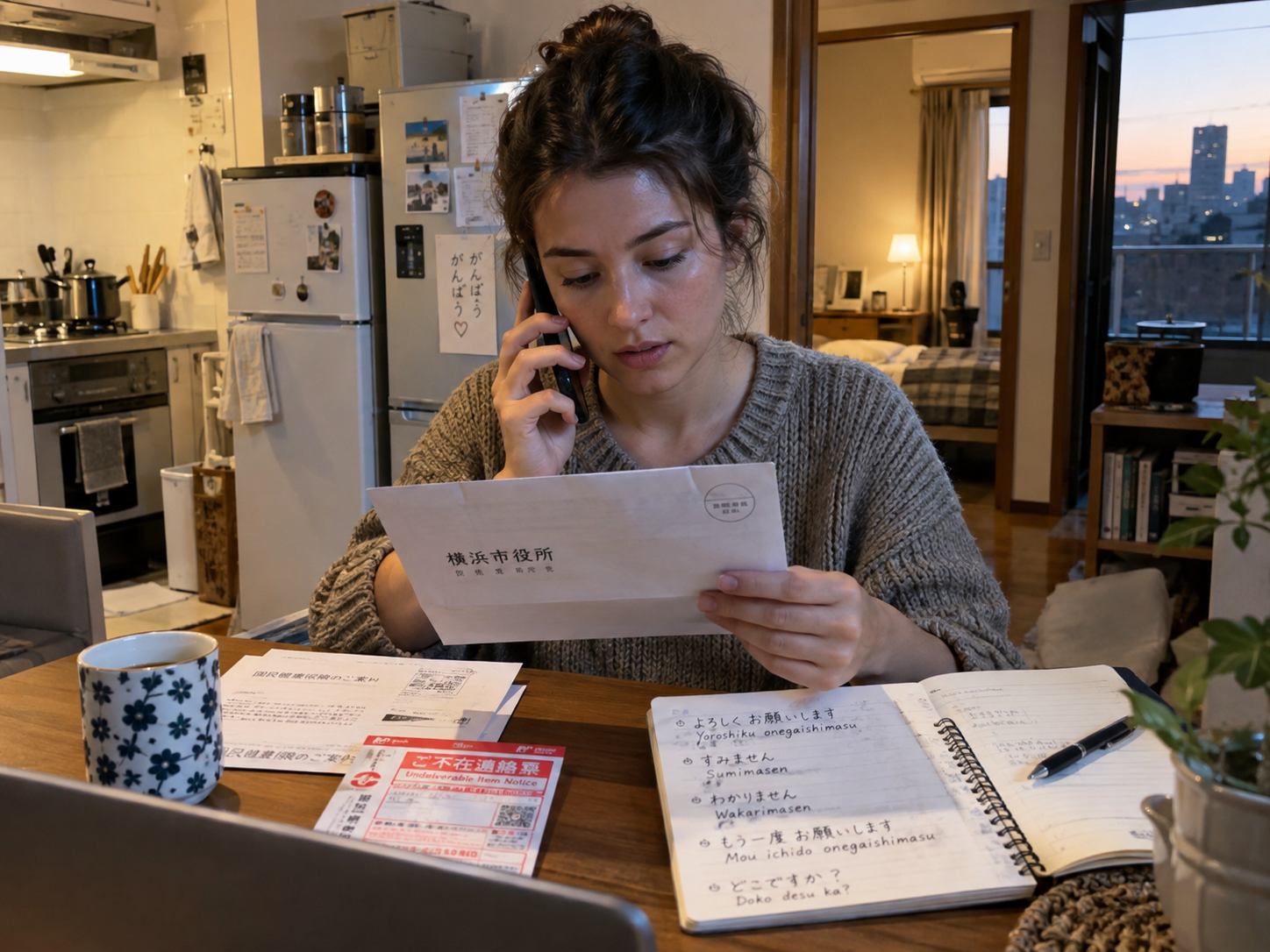
It is possible to live in Japan with very little Japanese. It is also possible to live in Japan for years with very little Japanese and discover that someone else is quietly doing a surprising amount of your life for you.
The gap appears in ordinary places: calling a clinic, reading a notice from city hall, asking a landlord about a repair, understanding why a delivery failed, speaking to a neighbor, or handling a work conversation that moves beyond the English-speaking team.
That is why “How much Japanese do I need to live in Japan?” has no single JLPT answer. The language level required to enter the country under a particular residence status, the level required by an employer, and the level that lets you live independently are three different questions.
There is no universal JLPT requirement for “living in Japan”
Japan has many residence statuses and employment arrangements. Some specific pathways include formal Japanese requirements. The Japan Foundation's JFT-Basic, for example, measures basic Japanese needed by foreign nationals who are about to reside in Japan mainly for work and is used in connection with the Specified Skilled Worker system and certain other statuses.
Other professional jobs may have no single government-wide JLPT rule attached to the residence status, while individual employers still expect strong Japanese. Universities and language schools can have their own admissions requirements.
So the useful question is not “Which certificate gets me into Japan?” without context. It is “What will I need Japanese to do once I am there, and what does my specific visa, school, or employer require?”
Always check current official requirements for your own route rather than relying on a general language-learning article.
N5 can help you begin; it will not make daily life effortless
The JLPT's easiest level, N5, represents some understanding of basic Japanese. At this stage, you may recognize common expressions, read hiragana and katakana, know basic kanji, and follow very simple spoken exchanges when they are slow.
That is valuable. It means the country is no longer linguistically blank.
But daily life does not arrive as an N5 listening exercise. A pharmacist does not necessarily slow down because you know 100 kanji. A landlord may leave a voicemail. A government envelope may contain vocabulary you have never studied. A colleague may shorten words, trail off, or assume you understand context that was never said aloud.
N5 is a beginning, not an independence threshold.
N4 is where basic survival becomes more comfortable
The official JLPT description says N4 users can understand basic Japanese, including familiar daily topics written with basic vocabulary and kanji, and can generally follow daily-life conversations when spoken slowly.
For someone preparing to move, this is a meaningful foundation. You can build routine interactions around shopping, transport, restaurants, introductions, schedules, and simple questions.
You will still rely on translation tools and English in unfamiliar situations. Phone calls may be difficult. Forms may be slow. Conversations among native speakers will often move too quickly.
If your move is several months away, reaching something around this level before arrival can make the first weeks much less disorienting.
N3 is a practical turning point for many residents
The JLPT describes N3 as the ability to understand Japanese used in everyday situations to a certain degree. That wording is modest, but the practical difference from elementary Japanese can be substantial.
At this stage, you are more capable of following coherent conversations at near-natural speed, reading everyday materials, understanding notices, and extracting the main point from text that is slightly beyond your comfort zone.
For daily life, this often feels like the point where Japanese begins helping you solve problems rather than merely completing predictable transactions.
You can still be lost in specialized vocabulary. A medical explanation, lease clause, bank document, or rapid workplace discussion can remain difficult. But your ability to ask follow-up questions and understand the response improves enormously.
N2 is a common professional milestone for a reason
Officially, N2 means understanding Japanese used in everyday situations and, to a certain degree, in a broader range of circumstances. Learners at this level can read clearer articles and commentary on varied topics and follow coherent conversations and news at nearly natural speed.
That makes N2 a useful benchmark for many jobs and academic settings. It does not mean that every employer requires it, or that every N2 holder is comfortable in a Japanese workplace.
JLPT does not directly test live speaking or workplace writing. Someone can have strong reading and listening scores while still struggling to interrupt politely in a meeting or write an email that has the appropriate level of formality.
Living ability is wider than exam ability.
The most important Japanese may be extremely unglamorous
People often prepare for life in Japan by studying restaurant phrases and travel vocabulary. Those are useful. Long-term residents also need language for the boring systems that tourists rarely touch.
You may need to explain that your air conditioner is leaking. You may need to understand garbage sorting rules, school notices, apartment maintenance, residence paperwork, utility contracts, delivery slips, or a medical intake form.
You need numbers, dates, addresses, counters, time expressions, and the ability to spell your name repeatedly in the expected format. You need to understand the difference between polite phrases you hear in shops and the more ordinary speech people use with coworkers and friends.
Phone Japanese deserves special attention because visual cues disappear. Many learners who function comfortably face to face suddenly feel like beginners when the phone rings.
Your city and social circle change the answer
A foreign professional in central Tokyo working for an international company can create an English-heavy life more easily than someone living in a smaller city or working in a Japanese-only environment. A partner who is fluent in Japanese can remove enormous amounts of friction, but that can also hide how dependent you have become.
English support has expanded in many services, and translation technology is genuinely useful. Neither eliminates the social effect of language.
Without Japanese, you may be able to complete a transaction while missing the conversation around it. You can live in the country and still remain outside much of the informal information through which neighborhoods, workplaces, and friendships operate.
What should you learn before moving?
If you are starting from zero, learn hiragana and katakana early. Build a core of high-frequency verbs and adjectives. Learn numbers, dates, time, counters, directions, and the sentence patterns used for requests and explanations.
Practice listening from the beginning. Do not wait until your grammar feels complete. Learn phrases for asking someone to repeat, slow down, rephrase, or write something down.
Then add the vocabulary connected to your actual life. A parent needs school and childcare language. A software engineer needs workplace and technical vocabulary. Someone managing a chronic medical condition needs health-care terms. A renter needs housing language.
That approach is more useful than trying to memorize “Japanese for living in Japan” as one giant category.
Polyglottist Language Academy offers live Japanese classes for adults in Berkeley and online. For learners planning a move, structured study can help build the general grammar and listening foundation first, while private or targeted practice can focus on the situations you know you will face.
You do not need perfect Japanese to move to Japan. You do need to decide how much dependence you are comfortable with. The more of your own appointments, paperwork, repairs, conversations, and workplace problems you want to handle yourself, the more Japanese stops being a travel accessory and becomes part of the infrastructure of your life.