
Russian Pronunciation for English Speakers: The 8 Sounds That Will Trip You Up
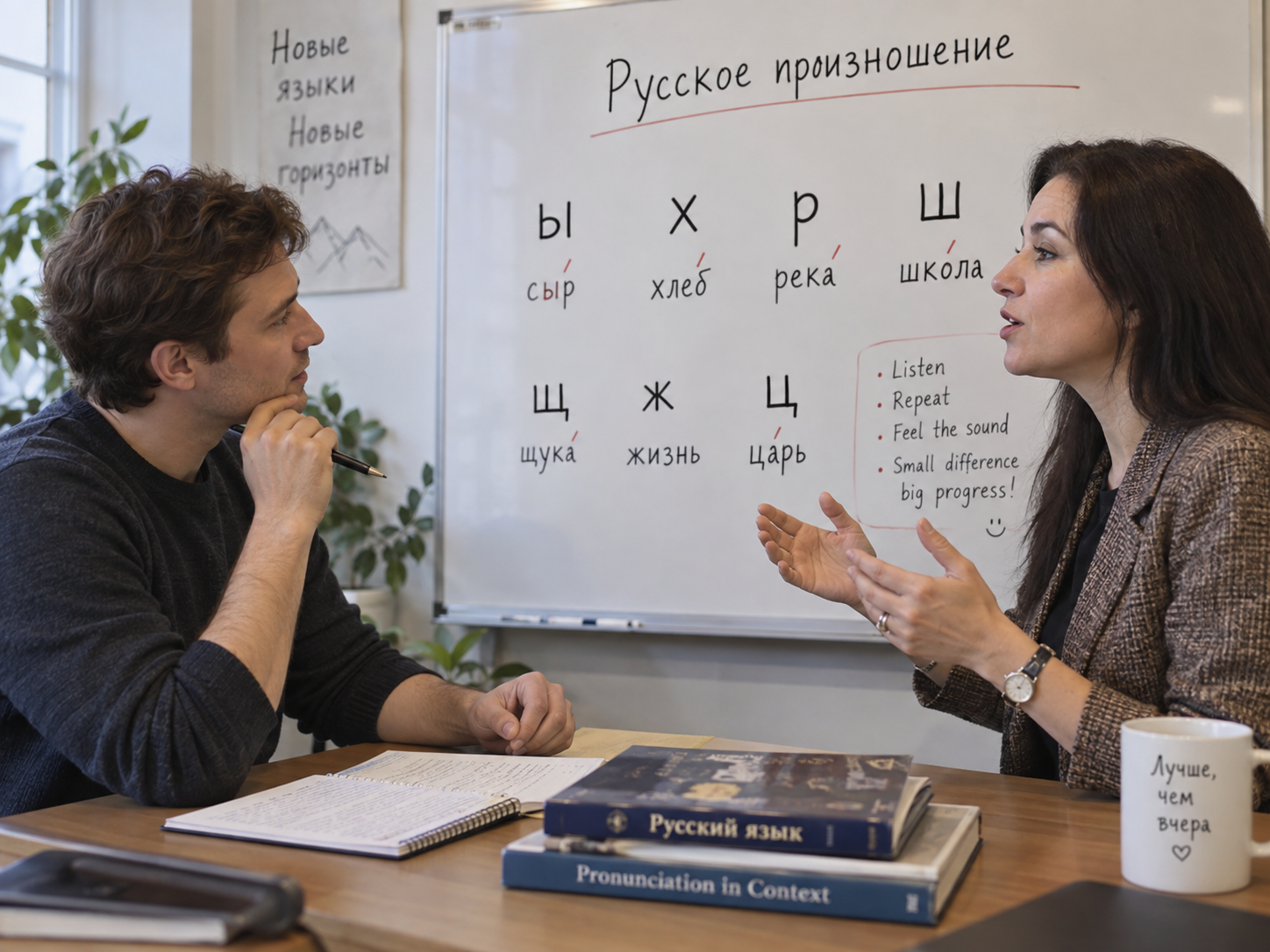
English-speaking beginners often expect Russian pronunciation to be difficult because of the alphabet. Then they learn Cyrillic, read a word correctly letter by letter, and discover that a native speaker still says it differently.
That is the real pronunciation problem. Russian spelling is more systematic than English spelling, but it does not simply tell you, “Say every letter exactly this way.” Stress changes vowels. Consonants come in hard and soft pairs. Some sounds are close to English sounds but not close enough to be interchangeable.
The eight problems below include individual sounds and larger sound patterns. They are the places where English habits most often interfere.
1. Ы: the vowel English does not give you for free
The Russian letter ы represents a vowel that does not have a neat standard-English equivalent. Beginners often replace it with English ee or ih.
Compare:
был — was
бил — hit / was hitting
The vowel difference helps distinguish the words. If you pronounce был like бил, context may rescue you, but you are no longer making the contrast Russian expects.
A useful way to approach ы is not to chase a perfect English comparison. Listen to a clear model and practice it after consonants in common words: мы, вы, был, сын. Keep the tongue relatively retracted compared with и and avoid adding a glide.
This sound improves with repetition. It rarely improves through increasingly elaborate English descriptions of where your tongue “should” be.
2. Х: stronger than English h
Russian х, as in хорошо, is produced with friction farther back in the mouth than ordinary English h. English speakers often weaken it until it nearly disappears.
хорошо — good / well
хлеб — bread
плохо — badly / not good
If you know the ch in Scottish loch or German Bach, the sound will feel familiar. If not, think of sustained friction rather than a breathy h.
You do not need to make it harsh. Overcompensating can sound theatrical. The goal is simply to keep audible friction.
3. Р: Russian r is not the American English r
Russian р is typically a tap or trill produced near the ridge behind the upper teeth. The American English r is formed very differently and is immediately noticeable when transferred into Russian.
рука — hand / arm
работа — work
три — three
Some adults can trill an r immediately; others need time. A perfect long trill is not required in every position, and Russian r is not always dramatically rolled. The bigger priority is moving away from the English r quality.
Practice short combinations such as ра, ро, ру, then words where the r sits between vowels. If the trill develops later, that is normal.
4. Hard and soft consonants: one of the most important Russian contrasts
Russian consonants often come in hard and soft, or palatalized, versions. English speakers hear the difference at first as if a tiny y sound has appeared, but softness is not simply adding y after the consonant.
Compare the feel of:
мат — profanity / mat in a specialized sense
мать — mother
угол — corner
уголь — coal
The soft sign ь does not have a sound of its own. It often signals that the preceding consonant is soft.
This contrast matters because softness can distinguish words and grammatical forms. It is not merely an accent detail. Beginners should train themselves to hear hard/soft pairs early rather than postponing the distinction until “advanced pronunciation.”
5. Ш and Щ: they are not the same sh
Russian ш and щ are often both approximated as English sh, but Russian distinguishes them.
ш is a harder, more retracted sound.
щ is longer and softer, with the tongue positioned differently.
школа — school
машина — car
ещё — still / more
щука — pike
For many learners, щ takes longer because English does not provide the same contrast. Do not force it into an exaggerated “shch” sequence every time. In modern standard Russian, щ is generally a long soft fricative rather than two fully separate consonants.
Listening to minimal or near-minimal contrasts is more useful than memorizing a spelling formula.
6. Ж: familiar in one English word, unfamiliar as a normal consonant
Russian ж resembles the sound in the middle of English measure or vision, but Russian uses it as an ordinary consonant in many positions.
журнал — magazine
жить — to live
уже — already
English speakers can usually make the sound; the challenge is making it confidently at the beginning of a word and keeping it distinct from ш.
Russian ж is normally hard. Beginners sometimes soften it because the following vowel looks as though it should pull the consonant forward. Listening to whole words helps prevent that.
7. Ц: keep it as one unit
Russian ц sounds roughly like the ts in English cats, but English speakers are used to that combination at the end of a word. Russian places it comfortably at the beginning and in the middle.
центр — center
цена — price
улица — street
The common beginner problem is inserting a tiny vowel before the consonant cluster or separating t and s too much. Practice ц as a single compact unit.
This sound becomes particularly useful because it appears in extremely common everyday words such as цена and улица.
8. Stress and vowel reduction: the rule that changes words you thought you knew
This is not one consonant or vowel, but it may be the most important Russian pronunciation habit of all.
Russian word stress is mobile and is usually not written in ordinary text. Unstressed vowels, especially о and а, can sound very different from their fully stressed versions.
хорошо is written with several о letters, but they are not all pronounced as a full, careful English-style oh. Москва also does not sound like a sequence of equally strong written vowels.
English speakers often read Russian too “spelling-perfectly,” giving every vowel equal weight. The result may be understandable but unnatural, and sometimes it makes familiar words harder for native speakers to recognize quickly.
Learn stress with the word. Do not memorize молоко as a sequence of letters and plan to add pronunciation later. Memorize where the stress falls and how the whole word sounds.
Stress can also distinguish words or grammatical forms, so it is more than decoration.
Which mistakes matter most?
Not every foreign accent needs to be eliminated. If your р is imperfect but clear, communication may be unaffected. If you fail to distinguish a hard and soft consonant in a word where the contrast carries meaning, the error can create real ambiguity. Incorrect stress can also make a common word unexpectedly difficult to recognize.
A useful order of priorities is therefore: meaning-changing contrasts first, intelligibility second, accent refinement third.
That keeps pronunciation practice from becoming a perfectionism project.
Practice sounds inside words and sentences
Isolated drills are useful for discovering how a sound works. They should not become the entire method.
Once you can produce х reasonably well, put it into хорошо, хлеб, and a sentence such as Это хорошо. Once ы is recognizable, practice мы, вы, был, and phrases where the vowel appears at normal speed.
Connected speech changes timing. It also forces you to coordinate pronunciation with grammar and meaning. That is the skill you eventually need in conversation.
Teachers often notice that adult learners improve faster when they record short phrases and compare them with a model rather than repeating a difficult consonant fifty times in isolation. The comparison gives you rhythm, stress, and consonants at once.
Polyglottist Language Academy's Russian classes for adults include pronunciation alongside grammar, vocabulary, and conversation. Live feedback can be particularly helpful with hard/soft consonants and stress because learners do not always hear the difference they are producing themselves.
Cyrillic may be the first visible obstacle in Russian, but pronunciation becomes much easier once you stop treating letters as English sounds wearing Russian shapes. The goal is to hear the contrasts Russian actually uses and then practice them in the words you want to say.