
Filipino Food and Language: What Dishes Like Adobo, Sinigang, and Halo-Halo Can Teach You About Culture
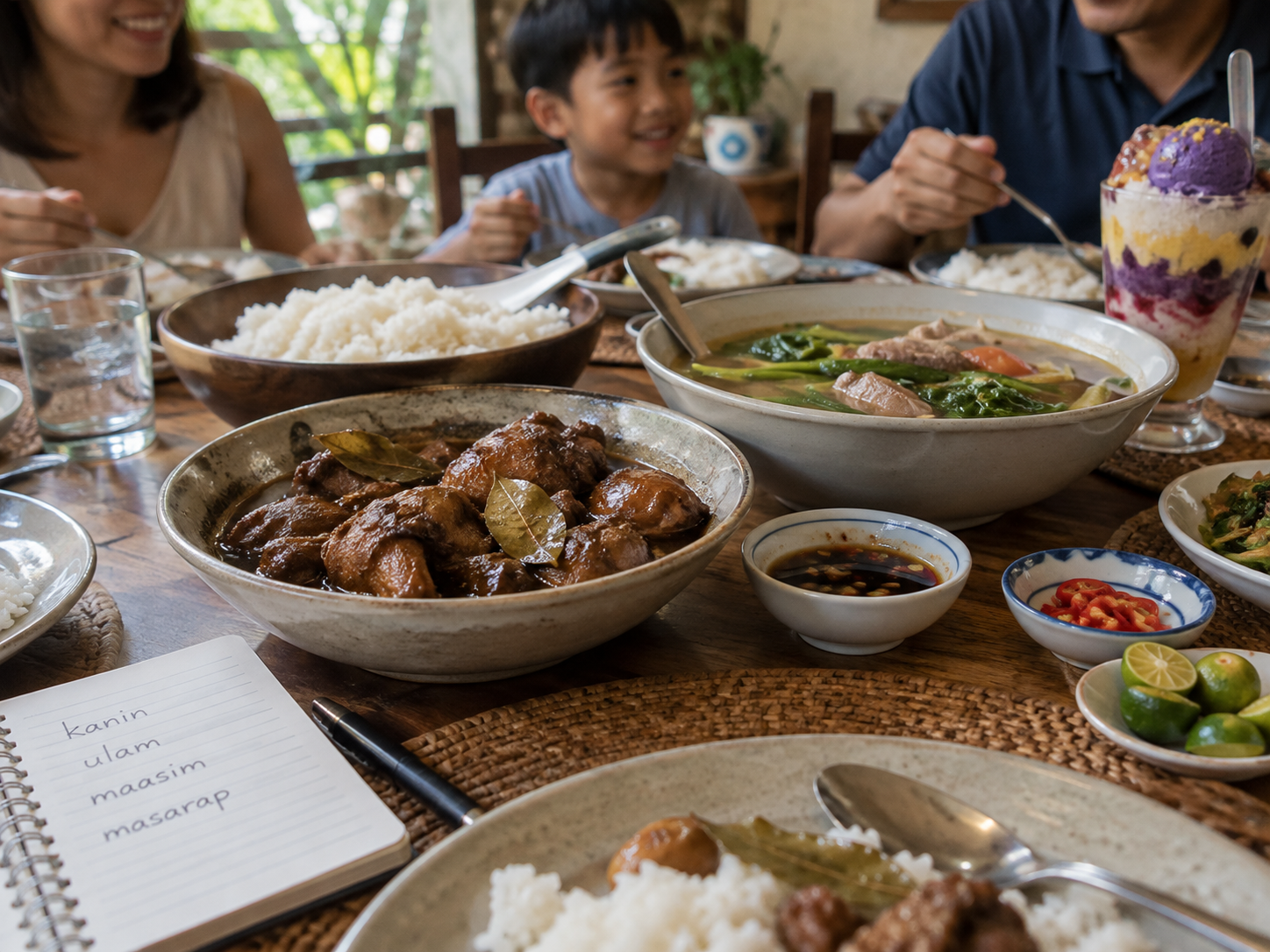
A beginner who opens a Filipino menu often recognizes fewer words than expected, even after learning some Tagalog. Adobo sounds Spanish. Pancit has Chinese roots. Halo-halo is Tagalog. Lechon arrived through Spanish. The menu itself is a small record of Philippine history: languages, ingredients, cooking techniques, and foreign influences were absorbed over centuries, then made distinctly local.
That is one reason food is such a useful doorway into Filipino language and culture. A dish name is rarely just a label. It may describe a technique, a flavor, a texture, an ingredient, or the act of combining things. Once learners notice those patterns, a restaurant menu begins to look less like a collection of mysterious proper nouns and more like ordinary language.
Adobo: a foreign word for a very Filipino idea
The word adobo comes from Spanish, but Philippine adobo is not simply a Spanish dish transplanted to Southeast Asia. In the Philippines, the term came to describe local preparations in which meat, seafood, or vegetables are cooked with ingredients such as vinegar, salt or soy sauce, garlic, peppercorns, and bay leaf. Recipes vary enormously by region and household.
For a language learner, the interesting point is not deciding which adobo is “authentic.” It is noticing how comfortably a Spanish-derived word sits inside Filipino speech. Philippine languages contain thousands of Spanish loanwords, especially in areas such as food, time, religion, household life, and administration. Yet those words were often reshaped in pronunciation, meaning, or use.
Food vocabulary makes this visible without a grammar lecture. A Filipino speaker can discuss adobo, kutsara (spoon), tinidor (fork), mantika (cooking oil), and kusina (kitchen) in an ordinary Tagalog conversation. The language does not feel less Filipino because some words entered through Spanish. Borrowing is part of its history.
Sinigang and the Filipino taste for sourness
Sinigang is a sour soup or stew, commonly made with tamarind but also with other souring agents depending on region and season. It is one of the best dishes for understanding a flavor category that matters in Filipino cooking: maasim, “sour.”
English-speaking learners often memorize food adjectives such as matamis (sweet), maalat (salty), maanghang (spicy), and masarap (delicious). Maasim deserves equal attention because sourness appears again and again in Filipino food: green mango with salt or shrimp paste, vinegar-based dipping sauces, tamarind soups, pickled vegetables, and citrusy marinades.
That preference also helps explain why sawsawan matters. A sawsawan is a dipping sauce, but the word points to more than one standardized condiment. At the table, people may combine vinegar, soy sauce, calamansi, chilies, fish sauce, onions, or garlic according to taste. One person may want more acid; another more heat. The meal can be shared while the final seasoning remains personal.
Halo-halo is also a language lesson
The name halo-halo comes from halo, “mix.” Repetition gives the sense of repeated or thorough mixing: literally, roughly, “mix-mix.” The dessert usually combines shaved ice, milk, sweetened fruits or beans, jellies, and other toppings, though the exact mixture varies.
Learners quickly discover that reduplication is not limited to dessert names. Tagalog uses repetition in many grammatical and lexical ways. You may encounter forms that indicate repeated action, plurality, intensity, or a particular aspect of a verb. Halo-halo is therefore memorable because the structure is doing something very Tagalog even before a beginner understands the grammar behind it.
There is a cultural parallel, too, though it should not be pushed too far. Philippine food history is layered. Indigenous ingredients coexist with Chinese noodles, Spanish names, American canned goods, regional Austronesian traditions, and later global influences. Filipino cooking does not simply preserve each influence in a separate compartment. It recombines them.
Pancit shows how borrowed food becomes local
Pancit refers broadly to noodle dishes and is associated with Chinese influence in the Philippines. Yet there is no single pancit. Pancit bihon, pancit canton, pancit palabok, pancit Malabon, and other versions differ in noodles, sauces, toppings, and regional history.
This is useful for learners because food terms often behave like category words. Knowing pancit does not mean you know what will arrive at the table. The modifier matters. The same is true of ulam, a word that beginners should learn early. Ulam is the dish eaten with rice; it is not neatly equivalent to English “entrée” or “side dish.” A piece of grilled fish, adobo, vegetables, or stew can all function as ulam.
The centrality of rice is built into ordinary vocabulary. Kanin means cooked rice. Bigas is uncooked rice. Palay refers to unhusked rice. English can describe all three with the single word rice plus an explanation; Filipino languages often lexicalize distinctions that matter in daily life.
The restaurant language is often bilingual
Another thing a learner notices quickly is that real Filipino conversation does not stay inside the clean boundaries of a textbook. Tagalog and English are frequently mixed, particularly in urban speech. A server may ask something partly in English and partly in Tagalog. A diner may answer the same way.
That does not mean learning Tagalog is unnecessary. It means the goal is not linguistic purity. A few natural phrases can change the tone of an interaction: Ano po ito? (“What is this?”), Masarap ba? (“Is it good?”), Isa po nito (“One of these, please”), or simply Salamat po (“Thank you,” with politeness).
Food gives beginners something concrete to talk about, which is why it works so well in class. Students who are hesitant to discuss abstract topics can usually describe what they like, what they ate, whether something is maanghang or matamis, and what they want to try. Vocabulary becomes conversation almost immediately.
For students who want to go beyond menu words, Polyglottist Language Academy’s Tagalog classes place food vocabulary inside ordinary speaking practice, so words such as kanin, ulam, and sawsawan become part of sentences rather than a memorized list.
A Filipino menu is therefore more than a collection of dishes. It shows how language records contact, adaptation, local taste, and everyday habits. Once you know what the words are doing, adobo, sinigang, and halo-halo begin to tell a much larger story.