
Where to Learn Vietnamese in the San Francisco Bay Area
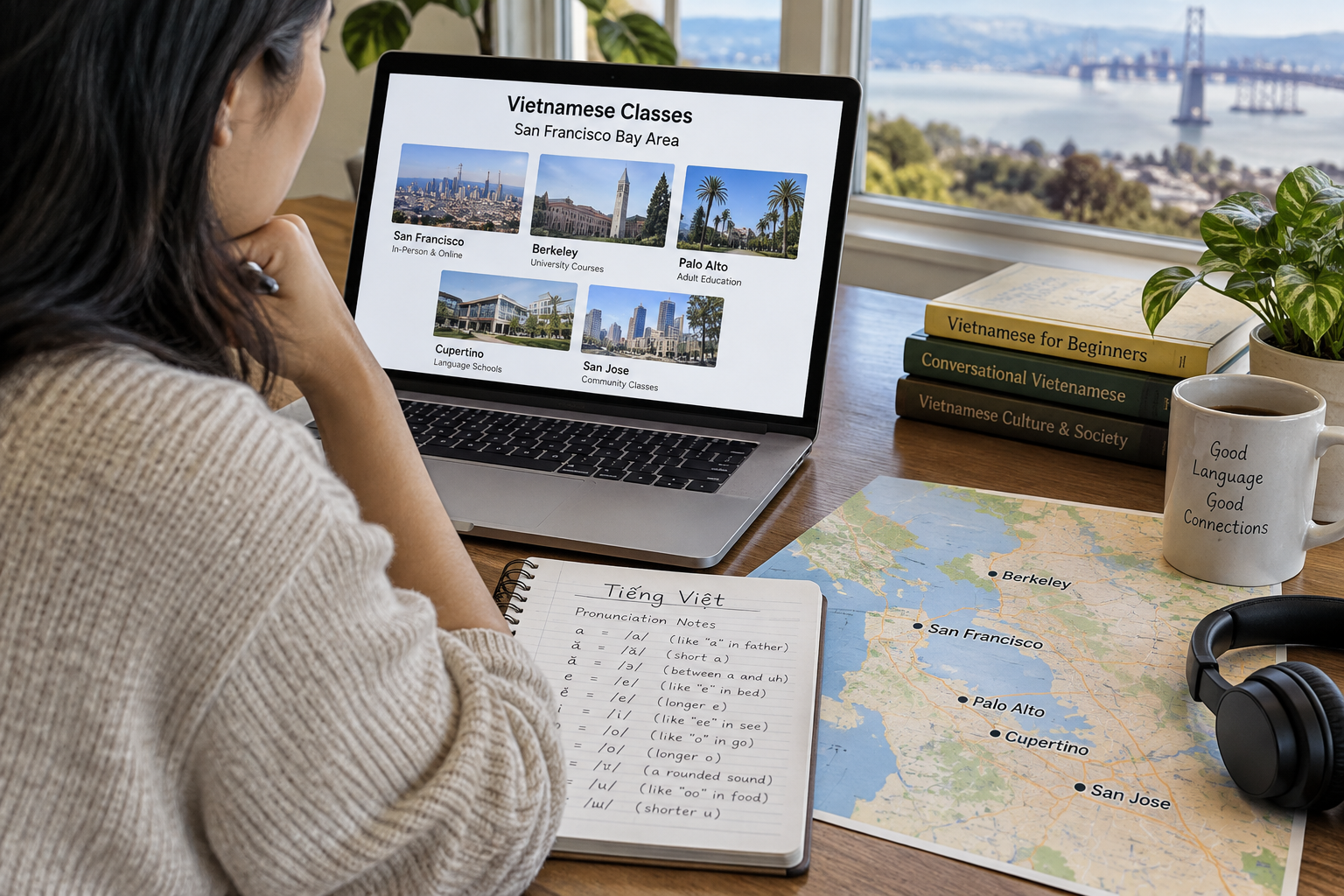
The Bay Area is one of the better places in the United States to study Vietnamese, but the options are scattered across very different kinds of institutions. A course at UC Berkeley, a Stanford language sequence, a community-college class in the South Bay, and a six-week live online adult group may all be called “Vietnamese classes,” yet they demand very different amounts of time and serve different learners.
Before choosing a school, decide what kind of commitment you actually want.
UC Berkeley: intensive academic Vietnamese in the East Bay
UC Berkeley’s South and Southeast Asian Studies department offers Vietnamese from introductory through advanced levels. In Fall 2026, its schedule includes Introductory Vietnamese 1A, Intermediate Vietnamese 100A, and Advanced Vietnamese 101A.
The beginning class is a five-unit university course with significant weekly contact. It emphasizes phonology, tonal distinctions, grammar, reading, writing, and everyday conversation.
That is excellent if you want serious academic progression and can participate through Berkeley’s enrollment system. It is less practical if you are a working adult looking for one evening per week. University listings should never be assumed to function like open-enrollment community language schools, so nonstudents should verify eligibility directly.
Stanford: a multi-year sequence with community engagement
Stanford’s Language Center currently offers first- and second-year Vietnamese sequences, and recent course descriptions include a service-learning component connecting students with the local Vietnamese-speaking community through visits and guest speakers.
That combination is appealing because language does not remain entirely inside a classroom. The sequence builds communication across reading, writing, listening, and speaking while explicitly connecting language and culture.
Again, this is an academic university program. The schedule is designed around Stanford quarters and student life, not the typical after-work adult learner. For eligible students, however, it is one of the Bay Area’s deepest structured options.
De Anza College: a practical South Bay community-college sequence
De Anza College lists three quarter-long Vietnamese courses—VIET 1, 2, and 3—designed to build reading, writing, listening, and speaking skills. The sequence begins with elementary Vietnamese and continues across the academic year.
Community colleges can be an excellent middle ground for adults because tuition and enrollment structures differ from private language schools and four-year universities. The tradeoff is that academic calendars, prerequisites, and daytime or fixed meeting times may still be inconvenient for full-time workers.
De Anza is especially relevant for learners in Cupertino, Sunnyvale, Santa Clara, and the western South Bay who want a credit-bearing sequence.
San José City College: another South Bay academic option
San José City College’s catalog includes Elementary Vietnamese 1 and 2 (VIET 001A and 001B). That makes it worth checking for current term availability if you are near central San Jose.
Course catalogs show what an institution can offer, not necessarily what is running every semester, so always confirm the actual schedule before planning around a class.
San Francisco learners may need to look beyond San Francisco itself
San Francisco State maintains Vietnamese learning resources through its Modern Languages Lab, including conversational Vietnamese and tone/sound practice materials, and university materials reference Vietnamese language coursework. But the broader Bay Area has stronger clearly documented multi-course sequences at Berkeley, Stanford, and South Bay colleges.
This illustrates a Bay Area reality: the best course for a San Francisco resident may not physically be in San Francisco.
That does not mean driving to Palo Alto or Berkeley after work is automatically sensible. Geography should be treated as part of course quality. A brilliant class you miss twice a month because crossing the Bay is exhausting is not, in practice, your best class.
Live online adult classes solve a different problem
Polyglottist Language Academy in Berkeley offers live online Vietnamese group and individual classes designed specifically for adults. Current group classes are small, with live instructor interaction rather than asynchronous video lessons.
For Vietnamese, live feedback matters because beginners can mishear or reproduce tones and vowels while believing they are correct. A teacher needs to hear you, not merely mark a written exercise.
Online instruction also makes teacher fit easier. You can choose a class for level, regional exposure, and teaching style without restricting yourself to whatever happens to run within a 20-minute drive.
Private tutoring is useful when your goal is unusually specific
Private instruction can make sense for a heritage learner with uneven skills, someone preparing to meet a partner’s family, a professional needing a specialized vocabulary, or a traveler working on pronunciation before a trip.
The risk is lack of structure. A private lesson can become an enjoyable weekly conversation that does not build systematically. Ask the teacher how progress is planned, what materials are used, and how pronunciation, grammar, and review will be integrated.
Complete beginners should prioritize pronunciation over prestige
A famous university name does not automatically make a course ideal for every beginner. Vietnamese pronunciation has enough unfamiliar vowel distinctions and tonal information that early feedback is critical.
Ask how much individual speaking time the class allows. Ask whether tones are corrected consistently. Ask which regional variety the instructor speaks and whether students will be exposed to others.
A learner who builds inaccurate sound categories for months can still correct them, but it requires far more work than learning carefully from the beginning.
Heritage learners should ask about placement before enrolling
A heritage learner may understand a grandmother from Huế, speak southern Vietnamese with family, and have almost no literacy. Another may read well after college study but freeze in conversation. They should not necessarily be placed together simply because both call themselves “intermediate.”
Good placement should consider listening, speaking, reading, and writing separately.
If a school does not have a formal heritage track, ask whether the instructor is comfortable adapting material for uneven ability. Relearning xin chào for several weeks is not a good use of time for someone who already understands normal family conversation.
Match the format to the life you actually lead
Choose UC Berkeley or Stanford if you want intensive academic study and have access to the university environment. Consider De Anza or San José City College if a community-college schedule and credit structure fit you. Use a live online small group when consistency, evening access, and conversation matter more than campus life. Choose private instruction when your needs are too specialized for a standard sequence.
And wherever you study, use the Bay Area itself. Oakland and San Jose both have substantial Vietnamese communities, cultural events, restaurants, organizations, and museums that can turn classroom vocabulary into something you actually recognize in the world.
The best Vietnamese course in the Bay Area is not necessarily the one closest to your home or attached to the most prestigious institution. It is the one you can attend consistently, where you receive enough correction to improve, and where the language you study begins becoming usable outside the lesson.