
Gairaigo: Japanese Words Borrowed from English (And Why They Sound So Different)
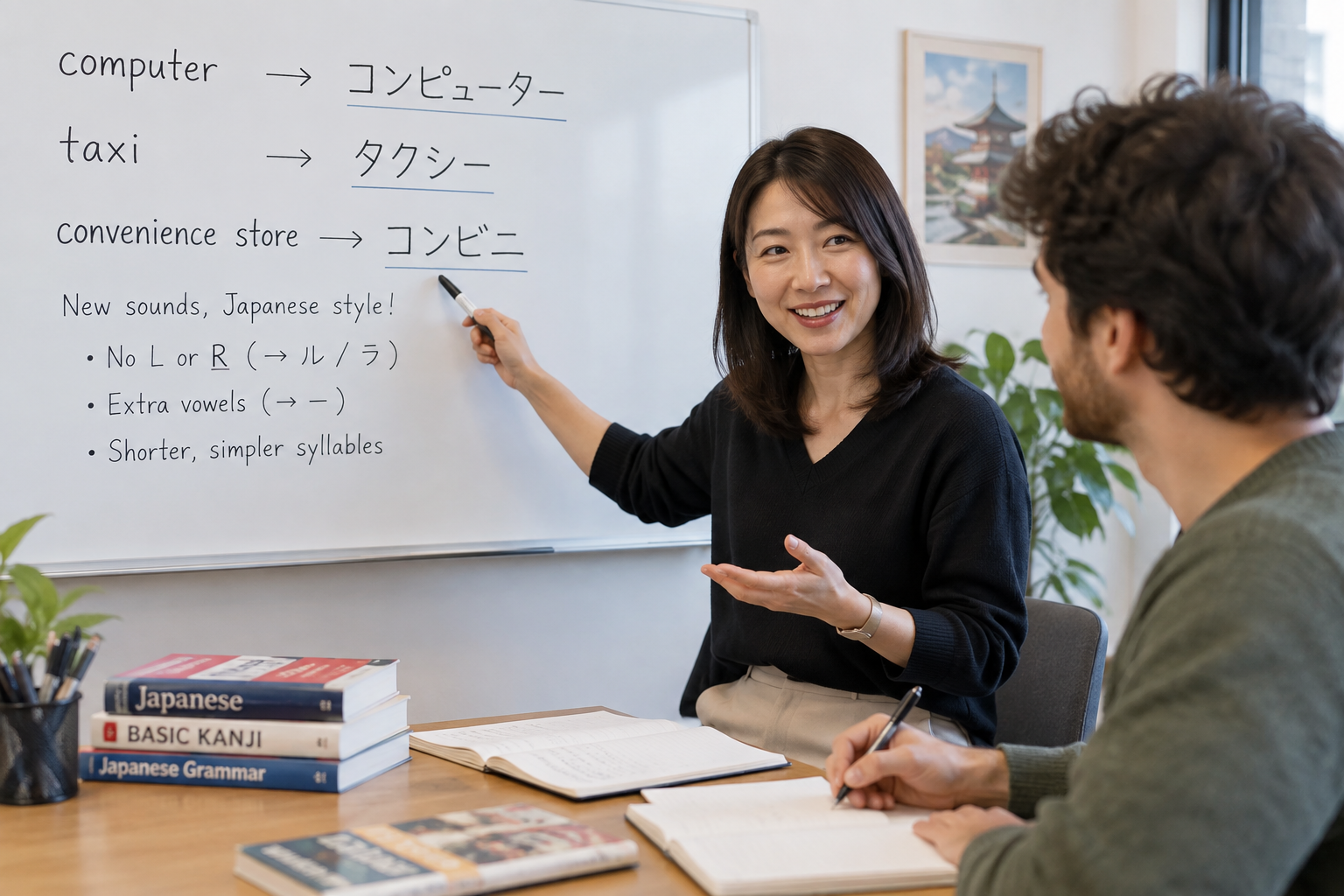
The first time an English speaker hears aisukurīmu, the meaning may not be obvious. Then someone writes アイスクリーム, says it again, and suddenly “ice cream” appears inside the Japanese sound pattern.
This is the strange advantage of English-speaking Japanese learners: thousands of borrowed words can become useful vocabulary, but only after you stop expecting them to sound like English.
These borrowed words are generally called gairaigo (外来語), literally “words from outside.” Many modern gairaigo come from English, though Japanese has also borrowed from Portuguese, Dutch, German, French, Italian, and other languages. Katakana is the writing system most strongly associated with them.
Japanese does not simply pronounce an English word with an accent
When a word enters Japanese, it has to fit Japanese phonology.
English allows complicated consonant clusters: strike, text, glass, desk. Japanese syllable structure is much more restricted. Most morae consist of a consonant followed by a vowel, with special exceptions such as ん and the small っ.
That means an English word often gains vowels so it can be pronounced using Japanese sound units.
“Strike” becomes ストライク (*sutoraiku*).
“Glass” becomes グラス (*gurasu*).
“Desk” becomes デスク (*desuku*).
Once you understand the mechanism, gairaigo stops looking random.
Why “hotel” becomes ホテル
English has consonants and vowel qualities that Japanese does not reproduce one-to-one. Japanese selects the closest available sound pattern.
“Hotel” becomes ホテル (*hoteru*). The final l cannot remain as an English-style final consonant, so the word ends in ル. English l and r are both commonly mapped into the Japanese R-series sound, which is neither a typical English R nor L.
This is why English learners who try to “hear the English” inside every katakana word sometimes get confused. The Japanese form has become a Japanese word with Japanese pronunciation.
Consonant clusters are usually broken apart
Consider “computer”: コンピューター (*konpyūtā*).
The Japanese word reorganizes the original sounds into pronounceable morae. It also contains a long vowel, marked by ー.
“Taxi” becomes タクシー (*takushī*).
“Christmas” becomes クリスマス (*kurisumasu*).
“Present” in the gift sense becomes プレゼント (*purezento*).
The added vowels are not filler that speakers can casually delete. They are part of the Japanese pronunciation.
Long vowels matter
Katakana loanwords are full of the long-vowel mark ー:
コーヒー — coffee
ケーキ — cake
タクシー — taxi
スーパー — supermarket
To an English speaker, shortening the vowel may feel like a minor accent difference. In Japanese, vowel length is structurally meaningful. It changes the rhythm and can distinguish words.
When teachers correct gairaigo pronunciation, long vowels are often one of the first things they hear learners flatten.
Doubled consonants matter too
The small ッ marks a short pause or consonant doubling:
ベッド — bed
バッグ — bag
サッカー — soccer
English speakers often see the small ッ but fail to produce it clearly. In natural Japanese rhythm, it occupies time.
Try saying サカー and サッカー slowly. The difference is not decorative spelling; the second word contains a distinct timing unit before the k.
English L and R usually meet the same Japanese sound
Japanese ラ, リ, ル, レ, ロ use a consonant often described as a tap or flap. English words containing L or R are usually adapted using this series.
“Radio” → ラジオ (*rajio*)
“Restaurant” → レストラン (*resutoran*)
This does not mean Japanese speakers cannot hear any difference between English L and R. It means traditional Japanese phonology does not organize them as two separate native consonant categories in the way English does.
For learners, the practical lesson is to pronounce the katakana form as Japanese rather than exaggerating an English R or L.
Newer katakana combinations stretch the sound system
Modern Japanese has developed combinations to represent foreign sounds more closely:
ファ — fa
フィ — fi
ティ — ti
ディ — di
チェ — che
You will see these often in names, technology, fashion, entertainment, and international terminology.
Even so, the adaptation remains Japanese. A word may approximate the source more closely than older loans, but it still follows Japanese timing and pronunciation habits.
Gairaigo can become shorter than the English source
Japanese loves abbreviation.
パーソナルコンピューター (*pāsonaru konpyūtā*, personal computer) becomes パソコン (*pasokon*).
コンビニエンスストア (*konbiniensu sutoa*, convenience store) becomes コンビニ (*konbini*).
リモートコントロール becomes リモコン (*rimokon*, remote control).
These shortened forms are ordinary Japanese vocabulary. Knowing the original English expression does not guarantee that you will guess the abbreviation.
Gairaigo and wasei-eigo are not the same thing
This distinction saves learners a lot of confusion.
Gairaigo are loanwords borrowed from other languages. Wasei-eigo (“Japanese-made English”) refers to expressions built in Japan from English-looking material but used in ways that may not exist in English.
For example, サラリーマン (*sararīman*) means a salaried company employee. ペーパードライバー (*pēpā doraibā*) means someone who has a driver’s license but rarely or never drives. An English speaker cannot reliably reconstruct those meanings from English alone.
This is why katakana vocabulary should be learned as Japanese vocabulary. Etymology can help memory, but current Japanese meaning is what matters.
Not every katakana loanword is from English
パン (“bread”) comes historically from Portuguese pão. アルバイト (“part-time job”) comes from German Arbeit. Other words have entered Japanese through Dutch, French, Italian, and additional languages.
Katakana tells you something about how a word functions or how it entered the language, but it does not label the source language.
How English speakers should study gairaigo
First, read the katakana before looking at the English. This forces you to process the Japanese sound sequence.
Second, mark long vowels and small ッ. Those are easy to overlook and disproportionately important for sounding accurate.
Third, learn shortened forms as separate vocabulary. コンビニ is not merely a pronunciation exercise; it is a high-frequency Japanese word.
Finally, listen to the word in Japanese sentences. Gairaigo becomes natural when its rhythm is embedded in Japanese, not when it is constantly compared with the English original.
In beginner Japanese classes at Polyglottist Language Academy, katakana and loanwords are useful precisely because they let learners begin reading recognizable vocabulary early. But the goal is not to collect funny transformations. It is to understand how Japanese reshapes borrowed material into its own sound system.
Once that happens, aisukurīmu no longer sounds like an unusually long way to say “ice cream.” It simply sounds like アイスクリーム.