
What's Actually Hard About Japanese (And What's Surprisingly Easy)
Japanese has a reputation for being one of the hardest languages an English speaker can learn, but that statement hides an important question: hard in what way?
A beginner can pronounce a Japanese sentence reasonably well after a short explanation, yet still be unable to read it. Another student may know hundreds of kanji and still miss ordinary speech because the grammar disappears into contractions and context. Japanese is not difficult in one uniform block. Some parts demand years of accumulation; others are kinder than English speakers expect.
The writing system really is the long project
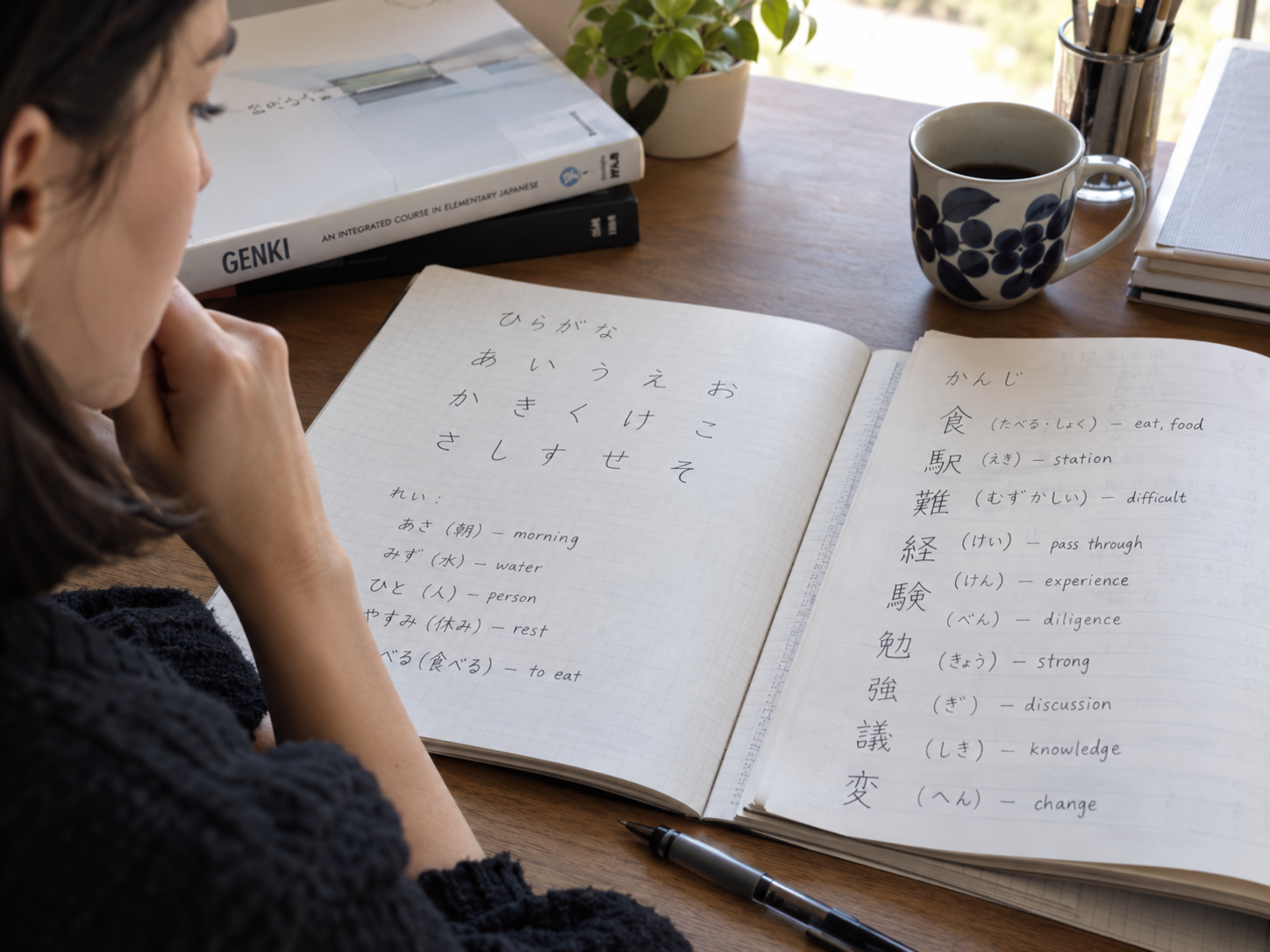
The obvious difficulty is literacy. Japanese normally combines hiragana, katakana, and kanji. Hiragana and katakana are finite syllabaries and can be learned relatively quickly. Kanji is different. A learner must gradually acquire a large inventory of characters, multiple readings, compounds, and conventions about which written form looks natural in which word.
The mistake beginners make is treating all three systems as if they were the same problem. They are not. Kana is an early milestone. Kanji is an ongoing reading practice that continues far beyond the beginner stage.
This can feel discouraging if your only measure of progress is “How much Japanese can I read?” Spoken ability may move much faster. A student can learn to introduce themselves, ask simple questions, order food, and understand classroom Japanese while their reading remains limited.
Word order takes adjustment, but it is more systematic than it first looks
English depends heavily on word order. “The dog bit the man” and “The man bit the dog” differ because position identifies the roles. Japanese uses particles such as は, が, を, に, and で to mark relationships between words, so the sentence can feel backwards to an English speaker because the verb often comes at the end.
A beginner sees 私はコーヒーを飲みます and has to resist the urge to translate word by word. A more useful mental model is: “As for me — coffee — drink.” Once the learner becomes comfortable waiting for the verb, the structure becomes less mysterious.
Particles remain difficult because their meanings overlap and depend on context. Knowing that に can mark time or destination does not automatically tell you when で is required instead. This is one area where repeated examples matter more than memorizing one English equivalent.
Japanese listening is harder than the textbook suggests
Slow classroom Japanese is usually segmented clearly. Real speech is not. Sounds shorten, particles may be dropped, predictable material disappears, and speakers rely heavily on shared context.
This creates a common intermediate frustration: the learner understands the sentence when reading it but cannot catch the same sentence in conversation. The problem is not necessarily vocabulary. It is processing speed plus reduced speech.
Teachers often find that students improve once they stop treating listening as a test of intelligence and start training it as a separate skill. Replaying a short clip, shadowing, and noticing where sounds disappear can be more productive than simply watching longer material with subtitles.
Politeness is not just a list of “formal forms”
Japanese politeness is another famous difficulty. Beginners first learn です and ます, which is manageable. Later they encounter honorific and humble forms, workplace conventions, and choices that depend on status and relationship.
The challenge is social rather than purely grammatical. A form can be grammatically correct but inappropriate for the situation. Learners have to understand not only what the sentence means but what stance it creates between speakers.
Fortunately, most beginners do not need to master the full honorific system immediately. Neutral-polite Japanese carries a learner through a large number of ordinary situations.
Pronunciation is surprisingly approachable
Compared with many languages, beginner Japanese pronunciation is relatively friendly to English speakers. The sound inventory is smaller than English, syllable structure is constrained, and spelling in kana maps to pronunciation much more consistently than English spelling does.
There are still important details: vowel length can change meaning, the Japanese r is not an English r, doubled consonants matter, and pitch accent affects naturalness. Yet a learner generally does not face the dense consonant clusters or wildly irregular spelling of English.
A sentence written in kana can usually be sounded out reliably once the system is known. That is a major advantage.
You do not have to learn grammatical gender or articles
English speakers who have studied French, Spanish, German, or Russian sometimes expect every noun to carry grammatical gender. Japanese does not. You do not need to memorize whether “table” is masculine or feminine, and adjectives do not agree with nouns by gender.
Japanese also lacks articles equivalent to a, an, and the. Context determines whether a noun is specific or general.
Plurality is often left unmarked as well. 本 can mean “book” or “books” depending on context. This does not make Japanese grammar simple, but it removes several categories that cause persistent errors in European languages.
Verb patterns are more regular than many learners expect
Japanese verbs look strange initially, but conjugation is comparatively systematic. There are irregular verbs, but far fewer than in English. Once a learner understands the major verb groups, forms such as past, negative, te-form, potential, and conditional are built through patterns rather than hundreds of unrelated forms.
The difficulty is not usually remembering dozens of irregular verbs. It is learning what the forms do in real sentences and how they combine.
Vocabulary distance is the quiet difficulty
For English speakers, one of the hardest parts of Japanese is simply that many common words offer no familiar clue. A Spanish learner sees importante and guesses “important.” Japanese daiji or taisetsu provides no such bridge.
Loanwords in katakana help—*ホテル* (hotel), コンピューター (computer), レストラン (restaurant)—but everyday Japanese still requires building a large new vocabulary from scratch.
That is why the language can feel easy during the first scripted lessons and much harder later. The grammar may be understandable, but comprehension depends on thousands of words and expressions accumulated over time.
For students who want structured practice, Polyglottist Language Academy’s Japanese classes combine grammar with speaking and listening, which helps prevent the common problem of knowing forms on paper but freezing when they appear in conversation.
Japanese is genuinely demanding, especially if your goal includes high-level reading. Yet several parts that beginners fear most are not the real obstacles. Kana is learnable. Pronunciation is manageable. Verb patterns are fairly regular. The long work lies in literacy, vocabulary, listening, and the social choices embedded in natural Japanese.